Can we learn to use our eyes independantly?

quarky

Banned
Joined
Oct 15, 2007
Messages
20,121
It seems quite impossible to process separate sets of data with each eye; for example, putting a screen between your eyes, and trying to read 2 different books simultaneously. Is this a hard-wired limitation of our vision, or could we learn to preform such tasks?

Evidently, other mammals and reptiles, which have their eyes on the sides of their heads, can do this. (Well, not the reading part). Is there a mechanical reason why we can't go in and out of binocular vision?

Similarly, we don't seem able to comprehend 2 separate conversations, one coming into each ear. Imagine a pair of head phones, with each speaker playing its own mono recording. It would be incomprehensible.

But could we learn how to do it?

Each eye is connected to both hemispheres of the brain, so as far as the brain is concerned, we don't have two eyes, we have two fields of vision. The only reason we have two eyes is to allow for stereoscopic vision; otherwise, we would only need one.

I'm not sure how that affects the answer to your question, but it's something to consider.
 
One discussion I recall that touched on the same subject a bit involved whether or not the human brain could actually process two different complex things at once, as in true "parallel processing" as opposed to really fast "task switching" like single CPU computers do to create the appearance of doing more than one thing at a time.

Please note that I'm not taking a position on this, so nobody needs to agree or disagree. I just found the idea to be interesting.
 
One discussion I recall that touched on the same subject a bit involved whether or not the human brain could actually process two different complex things at once, as in true "parallel processing" as opposed to really fast "task switching" like single CPU computers do to create the appearance of doing more than one thing at a time.
The answer is "Yes". In a sense both are true.

The brain can run complex processing of two different things at once, though we will largely not be conscious of it happening. Many aspects of language are processesed in parallel. But, generally only one meaning gets the spotlight of attention, in the end.

Consciousness can only concentrate on one complex thing at a time, it seems.
 
<snip>

Evidently, other mammals and reptiles, which have their eyes on the sides of their heads, can do this. (Well, not the reading part). Is there a mechanical reason why we can't go in and out of binocular vision?

<snip>


Regarding this part, while some animals do have eyes with fields of vision that do not overlap I'm not sure that this means those are treated independently as two separate fields, and not just one with a big blind spot. Bigger, I guess I should say, than our own. The human eye has a structural blind spot which is compensated for by information processed through the other eye and involuntary saccades.

A wide field of vision is dandy for seeing more of what is around you, even if there's a big gap in the middle, but the depth perception available from overlapping fields lets you know how far away your dinner ... or predator ... is, and which way it's going. It's a trade off.
 
The answer is "Yes". In a sense both are true.

The brain can run complex processing of two different things at once, though we will largely not be conscious of it happening. Many aspects of language are processesed in parallel. But, generally only one meaning gets the spotlight of attention, in the end.

Consciousness can only concentrate on one complex thing at a time, it seems.


I knew I needed to stick "consciously" in there somewhere, and I really did mean to, but I got sidetracked.

I agree with you, though.
 
Photographers learn to keep both eyes open - one eye looking through the viewfinder at a small subset of what the other eye sees.

-- Roger
 
One discussion I recall that touched on the same subject a bit involved whether or not the human brain could actually process two different complex things at once, as in true "parallel processing" as opposed to really fast "task switching" like single CPU computers do to create the appearance of doing more than one thing at a time.

Please note that I'm not taking a position on this, so nobody needs to agree or disagree. I just found the idea to be interesting.
I find I can both see and talk at the same time. Walking and chewing gum still eludes me.
 
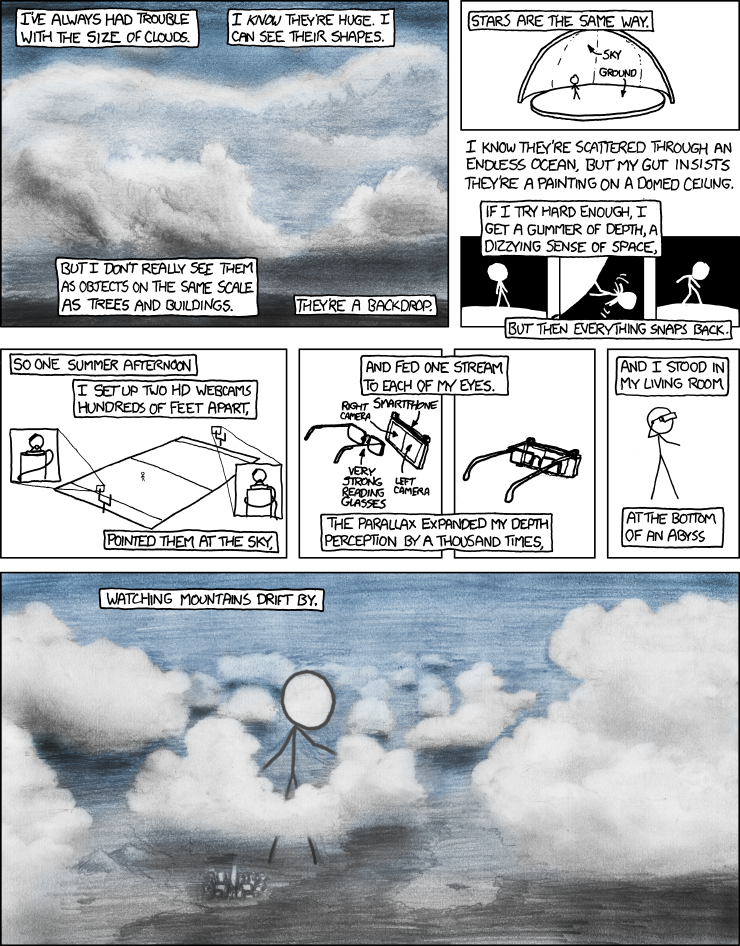
Obligatory xkcd comic:

depth_perception.png
 
I find I can both see and talk at the same time. Walking and chewing gum still eludes me.


I still have trouble with that 'rub my belly and pat my head' thing sometimes. Or is it the other way 'round?

Wowbagger gently helped me out by adding the "consciously" qualification (I really did mean to include that. :blush:), and like I said I'm not trying to defend a proposition here.

Having said all that, though, we manage to do quite a bit autonomously, or something very much like it. We even manage to train actions into a repertoire of what would normally be very conscious decision making.

Athletes do this. I recall somewhere reading about some observations of expert tennis players before and after teaching a beginner exactly how to do particular actions. It seems that for a certain amount of time afterward the expert's performance was slightly degraded, perhaps because having concentrated so specifically on the nature of those actions they were now thinking about them as they played instead of employing the automatic responses which they had spent years developing. After a little bit they got back into the'swing' of things (if you'll excuse the pun) and returned to their normal skill level.

Similarly, I've also been led to believe that expert fencers can find utter neophytes somewhat disconcerting because the untrained beginner doesn't necessarily respond the way a trained opponent would, leaving some of the ingrained responses inappropriate.

We're not generally aware of our involuntary eye motion, but our vision would not function as well without it. We also make conscious efforts to redirect our field of view. At the same time. I don't think of this as multi-tasking. Maybe I'm thinking about it wrong, though.

Also, the really fast part of task switching could be an additional element. We may believe we are actually, consciously (:p) engaging in more than one task when we're only popping back and forth pretty quickly. This isn't normally a problem until the situation makes the times involved more critical. Like driving, for instance.

It's obvious that tuning a radio while you are driving can be a distraction. It's less obvious that listening to it would be, but I'm pretty sure it has been shown that it can. Ever missed a turn that you knew about because you were thinking about something else, even while your driving skills were keeping you at a relatively acceptable level of safety? Ever taken a turn out of habit, even though you were going somewhere else this time?

The 'walk and chew gum' example may even be a good one. I wonder if people are more likely to trip on uneven pavement if they're chewing gum than if they are not.

Oh, yeah. And an appropriate quote.

Hagbard Celine said:
Never whistle while you're pissing.

 
Last edited:
Photographers learn to keep both eyes open - one eye looking through the viewfinder at a small subset of what the other eye sees.

-- Roger
.
Yes, we have to. :)
There's HUD glasses which present the view say from a camera mounted in a toy airplane to the pilot sitting on the ground, who can see both the view from the airplane and what the plane is doing relative to himself.
 
Having only one eye, and being color-blind, would allow a person to function in these modern times, albeit, at a slight disadvantage.

Processing independent data through dual portals, though exciting, would render a person handicapped.

I'm curious about the perceptions of people that have had a hemisphere of the brain removed or unplugged. Especially those whom are blind in one eye or deaf in one ear.

I guess that's fairly obscure territory.

Point being, too much data is worse, as per consensual human perceptual parameters, than too little. Hearing 2 coherent conversations simultaneously, for instance, is the stuff of madness. (Schizophrenia?)

hearing half of the conversation is OK.

What?
 
Photographers aren't the only ones. Geologists and paleontologists learn early on to keep both eyes open when looking down a microscope--one for seeing the thing under the microscope, and one for drawing it.

I have eye issues. My brain didn't process the information from my left eye until a fairly long bout of therapy (SMB Level 4-2 still haunts me...that second pit....). During the therapy my brain somehow learned to switch which eye I was using as dominant--I can switch from my right eye to my left, pretty much at will (some backgrounds mess with me). So as far as I'm concerned it's certainly not impossible. I do it.

quarky said:
Point being, too much data is worse, as per consensual human perceptual parameters, than too little. Hearing 2 coherent conversations simultaneously, for instance, is the stuff of madness. (Schizophrenia?)
That one's easy. Three isn't too bad. When I'm on my game I can do four, including two that I'm participating in. My sister can do more, but she's always been better at parallel processing than me.

Similarly, I've also been led to believe that expert fencers can find utter neophytes somewhat disconcerting because the untrained beginner doesn't necessarily respond the way a trained opponent would, leaving some of the ingrained responses inappropriate.
Seen that one in action. A friend of mine in the SCA one-shotted a king (for those who aren't stick-jocks, "one-shotted" means you kill the guy in one move of the sword, and our kings are chosen by tournament). He had authorized that morning. The king had a stance that everyone knew couldn't be beaten in one shot--you HAD to play some games to open him up. My friend, being brand spanking new to the game, didn't realize this, so tried anyway. Like so many things that everyone knows can't be done, it worked.

Doesn't work the second time, though! :D
 
Some people seem to have the skill to move one ear only. Moving one´s ears doesn´t seem to be a standard skill anyway, without moving much of the face too.

I can easily lift the left side of face only, so that the left ear and left eyebrow move up maybe 1 cm, but now as I am writing this, I cannot find a way to lift the right side of face similarly, without also the left side joining in. I am right-handed and right-footed (as proven in games such as soccer), but apparently left-faced.
 
Much thanks to all whom are willing to address my poorly worded and vague queries here.
 
It would be really cool to do that sometime. I wonder how hard it would be to rig up?

Not that hard. Simple non-digital way; take two polaroids (or digital camera with a photo printer. I'm aware polaroid film is hard to get) of the sky, one from each end of your baseline and both centered on the same point in the sky. Hold both polaroids up next to each other, and cross your eyes.
 
Also, the really fast part of task switching could be an additional element. We may believe we are actually, consciously (:p) engaging in more than one task when we're only popping back and forth pretty quickly.

"Play", in your mind, some music you know really well. Are you hearing the voice at the same time as the guitar or switching back+forth from voice to guitar very quickly while being so familiar with the music that it "sounds" the way it does on the stereo?

For reasons I can't fathom, this puzzle has intrigued me lately :D I'm half convinced that we cannot think multiple sounds simultaneously, so that the music in my head is actually a linear mosaic of separate clips rather than overlaid images.

As for the business of concentration while driving, I always switch off the radio if I'm struggling to find a route (I'm satnavless). Switching off MrsB's chatter, however, is not always so simple :)
 
Similarly, I've also been led to believe that expert fencers can find utter neophytes somewhat disconcerting because the untrained beginner doesn't necessarily respond the way a trained opponent would, leaving some of the ingrained responses inappropriate.

OT I realise......

I wish that were my experience but sadly an expert fencer had no difficulty in dealing with my unorthodox moves. I suppose he could have had a momentary "hmmmmm?" but it certainly didn't show.
 

ISF - Join now!

Every member here is approved by hand. No bots, no spam, just people who care about evidence and honest debate.

Membership is free!

Create your free account

Back
Top Bottom