Can Atheists Be Good Citizens?

Try and be fair, now.

Maybe not one "best" way, in the sense of a cookbook, or the Torah or the Talmud, but more of an Aristotelian ethic mixed with a Socratic desire to give an account

That's one good way to live, but not the only one. Lots of people live good lives but don't give an account of why they do so. I wasn't being unfair; I was genuinely puzzled about your concept of a best way to live.

and a Lockean sense of a low but solid grounding for government (Which is why the Constitution doesn't go into the philosophy of it's own grounding). You know, Alexander Hamilton's commercial republic mixed with Lincoln's account of the natural law and Jaffa's new birth of freedom.


That has to do with how to govern, not how to live. They are related in that government that acts in the interests of the governed would seek to allow people to have the opportunity to live their lives in one of the best ways.
 
Last edited:
Again, what is the reason that one must give a morally compelling account of one's society to be considered a good citizen? What does Neuhaus say?
Again, good citizen is defined by the actions taken within a society. Why do you think it acceptable to redefine things to cater to prejudices? What does Joobz say?
 
Unless of course you're some flavor of logical positivist. Then they are, i.e., equivalently meaningless.
You are about 50 years out of date with that one of course. Even Carnap eventually accepted that statements about religion could be meaningful.

Quine even said that physical objects were epistemologically equivalent to Homeric Gods.

The verification theory of meaning was one of the epic philosophic failures of the 20th century.

But again you are still ducking and dodging the point. If statements about religion or natural law are intrinsically meaningless, doesn't that make Neuhaus's article intrinsically meaningless?

Doesn't that make his arbitrary criteria for good citizenship intrinsically meaningless.
 
Try and be fair, now.

Maybe not one "best" way, in the sense of a cookbook, or the Torah or the Talmud, but more of an Aristotelian ethic mixed with a Socratic desire to give an account and a Lockean sense of a low but solid grounding for government (Which is why the Constitution doesn't go into the philosophy of it's own grounding). You know, Alexander Hamilton's commercial republic mixed with Lincoln's account of the natural law and Jaffa's new birth of freedom.

Basically what people mean when they think good things about "The American Way".

But, for more than that, no, thanks. Another time, another thread.
Yep, I am absolutely sure that when the average American thinks good things about the American Way they are thinking of Aristotle, Socrates, Locke, Hamilton, Lincoln and Jaffa.
 
Wait, what? Are you guys having a joke, or am I missing something?
Or they are missing something.

Ad hom and name calling are fallacies of irrelevance and nothing whatsoever to do with petitio principii.

And Stone Island accusing others of ad hom is known as "hypocrisy".
 
Wait, what? Are you guys having a joke, or am I missing something?
Oops,
I actually didn't read the whole sentence. I saw only his admission that "name calling isn't ad hom", which is true. That's what I get for posting in a rush. Yes, name calling isn't begging the question at all.

Or they are missing something.
Yes, Yes I was missing something. I apologize for the error.
 
Last edited:
Or they are missing something.

Ad hom and name calling are fallacies of irrelevance and nothing whatsoever to do with petitio principii.

Whew! I thought I was going crazy. I actually don't really think of name calling as a fallacy at all, since I think of a fallacy as a bad argument, and name calling (per se) as no argument at all. I may be wrong.

And Stone Island accusing others of ad hom is known as "hypocrisy".

I think so. I also think he's been *plonk*ing people in this thread for tamer stuff than what he said about Articulett a page or two back...
 
Can Christians Be Good Citizens?

Here's St. Paul in Romans 13:

St Paul said:
Everyone must submit himself to the governing authorities, for there is no authority except that which God has established. The authorities that exist have been established by God. Consequently, he who rebels against the authority is rebelling against what God has instituted, and those who do so will bring judgment on themselves.
Contrast this with the Declaration of Independence:

the Founding Fathers said:
That to secure these rights, Governments are instituted among Men, deriving their just powers from the consent of the governed, — That whenever any Form of Government becomes destructive of these ends, it is the Right of the People to alter or to abolish it, and to institute new Government, laying its foundation on such principles and organizing its powers in such form, as to them shall seem most likely to effect their Safety and Happiness.
Clearly no God-fearing Christian can accept a Declaration so flatly opposed to the Bible. Indeed, it seems that the only righteous course for Americans would be to reject this work of Satan and submit obediently to your rightful monarch, Her Majesty Elizabeth the Second, by the Grace of God, of the United Kingdom of Great Britain and Northern Ireland and of Her other Realms and Territories Queen, Head of the Commonwealth, Defender of the Faith.

:uk:

We shall reintroduce the tax on tea as a salutary measure.

St Paul said:
Therefore, it is necessary to submit to the authorities, not only because of possible punishment but also because of conscience. This is also why you pay taxes, for the authorities are God's servants.
None of that "Boston Tea Party" nonsense, now.
 
Can Christians Be Good Citizens?

Here's St. Paul in Romans 13:

Contrast this with the Declaration of Independence:

Clearly no God-fearing Christian can accept a Declaration so flatly opposed to the Bible. Indeed, it seems that the only righteous course for Americans would be to reject this work of Satan and submit obediently to your rightful monarch, Her Majesty Elizabeth the Second, by the Grace of God, of the United Kingdom of Great Britain and Northern Ireland and of Her other Realms and Territories Queen, Head of the Commonwealth, Defender of the Faith.

:uk:

We shall reintroduce the tax on tea as a salutary measure.

None of that "Boston Tea Party" nonsense, now.

Tea? Pffft! If you really want to make some revenue you'll tax crappy soft-drinks and cheap beer. A Mountain Dew and Budweiser tax would buy the crown quite a few more tacky bits of jewelry.
 
... tax would buy the crown quite a few more tacky bits of jewelry.

Although the United Kingdom may well be a 'nation of shopkeepers', that does not mean the monarchy must mingle with the proles in Hatton Garden

Not when colonising is so much more fun!

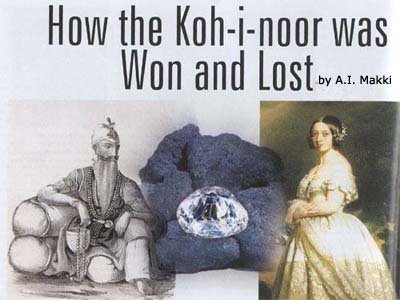
alshindagah.com Koh-i-noor
kohinoor1.jpg

<bigSnip/>

In 1849, Dalip Singh surrendered the Koh-i-noor diamond to the British under the terms of a treaty, at the end of the Second Anglo-Sikh War. The treaty specified that: "The gem called Koh-I-noor, which was taken from Shah Shuja-ul-Mulk by Maharajah Ranjit Singh shall be surrendered by the Maharajah of Lahore to the Queen of England."

<snip/>

After gaining the famous diamond, the Governor General, Lord Dalhousie immediately sent the Koh-i-noor to England after taking every care to ensure its safe passage over the land and the sea-routes. On 6 April 1850 the Koh-i-noor left the shores of India on board of the HMS Medea.

<snip/>

On 3rd July, the Koh-i-noor was formally handed over to Queen Victoria by the officials of the East India Company in a private ceremony held in Buckingham Palace. The Koh-i-noor was removed from its mount and its weight, as calculated by the Queen's jeweler, was about 186 carats. It seems that the gem has been re-cut one more time before arriving to England and after Tavernier made the famous sketch of it.

<snip/>

The Queen along with others in the court decided that the brilliance of the diamond would be enhanced if it were refashioned into a brilliant cut.

<snip/>

...the results were most unfortunate, for it reduced the diamond drastically in weight, depriving it of all its historical and mineralogical value. The Koh-i-noor diamond, however, lost none of its original mystique.

<snip/>

...it is set in the Maltese Cross at the front of the crown made for Queen Elizabeth the Queen Mother.

SOURCE


That has to do with how to govern, not how to live. They are related in that government that acts in the interests of the governed would seek to allow people to have the opportunity to live their lives in one of the best ways.

I'm not really following your distinction. How we're governed has a direct impact on how we live. The life I'm able to live in the U.S. is vastly different than the life I could live under the Taliban or in, say, China or Sark (until recently).

FWIW, the UK, Australia, Canada, and the U.S. (among others, of course) are all essentially Lockean natural rights republics. Obviously, there are all sorts of differences between them, which probably have as much to do with accidental, historical circumstances as much as anything else, but they are in their essence founded on a shared notion of natural law. I wouldn't be surprised if, for Neuhaus at least, it would possible to offer a compelling, moral justification for all of them.

So, natural law isn't, I wouldn't think, as oppressively particular as you might think. They all protect property (more or less), protect liberty (making some minimum distinctions with license), and protect the pursuit of happiness (though the Canadians have some weird and troubling anti-hate speech laws). They even allow you your atheism, even if it is vaguely disreputable.
 

Back
Top Bottom