Let us suppose that none of them moved even a single inch, but that a part of their economic activities became taxable in the independent small countries rather than in London.In the context of England & Wales separated from Scotland and NI, which companies currently based in London do you think would suddenly move, and to where?

You are using an out of date browser. It may not display this or other websites correctly.
You should upgrade or use an alternative browser.
You should upgrade or use an alternative browser.
- Status
- Not open for further replies.
Hubert Cumberdale
Graduate Poster
- Joined
- Sep 18, 2008
- Messages
- 1,141
I have a fun new game!
Post Brexiteer twitter stupidity!
I'll go first with this corker from Daniel Hannan who is obviously detached from reality on a number of different levels:
"Of all the scare stories propagated by EU supporters, the idea that the UK and Ireland would impose borders after 94 years is the silliest"
https://twitter.com/DanielJHannan/status/666954840313085952
Post Brexiteer twitter stupidity!
I'll go first with this corker from Daniel Hannan who is obviously detached from reality on a number of different levels:
"Of all the scare stories propagated by EU supporters, the idea that the UK and Ireland would impose borders after 94 years is the silliest"
https://twitter.com/DanielJHannan/status/666954840313085952
Hubert Cumberdale
Graduate Poster
- Joined
- Sep 18, 2008
- Messages
- 1,141
Yes, I had mentioned that there are three mutually incompatible demands, I think any two are logically possible, assuming Ireland remains in the EU.
No border between Northern Ireland and the EU
Control of people between the UK and EU
Northern Ireland to remain in the UK
FoM for people is a red herring here, given the CTA.
The problem is FoM of goods and services. Under WTO rules we cannot permit free movement of goods and services from the EU but not all other WTO members.
This is why if we leave the Customs Union there has to be a hard border between ourselves and the EU.
The obvious solution is to remain a member of the EEA/EFTA whatever but of course this would go against The Will Of The Peopletm as this was clearly stated on the referendum ballot paper (which was totally legally binding)

FoM for people is a red herring here, given the CTA.
The problem is FoM of goods and services. Under WTO rules we cannot permit free movement of goods and services from the EU but not all other WTO members.
This is why if we leave the Customs Union there has to be a hard border between ourselves and the EU.
The Brexiteer position (as ably stated by ceptimus) is that the hard border requirement once the UK has left the customs union is all down to EU unreasonableness and intransigence. It's up to the EU to come up with a solution which will allow an open border between NI and Ireland, no internal border between NI and the rest of the UK and satisfy WTO requirements whilst allowing the UK to leave the customs union.

Honestly, I feel that Brexit is like moving house.
The referendum was something like "Do you want to move house ?" when we're living in a perfectly satisfactory suburban three-bedroom semi.
The "Move" campaign said that could have whatever kind of house we wanted and that the mortgage payments would be far lower. Indeed to some groups they said that we'd have a penthouse apartment in Mayfair, to others a beautiful seaside cottage and to others that we'd have a Scottish hunting estate. When the "Stay" campaign pointed out that these houses were mutually incompatible and that in any case they'd be far more expensive, and that moving would be an absolute nightmare, they were poo-pooed as being "Project Fear".
There was a tiny majority for moving and it suddenly has become clear that the process of selling up and moving to a new place is expensive and difficult (despite "Move" saying that selling our place and buying a new one would be super-easy) and that actually it's impossible to have a city centre penthouse with a grouse moor and seaside views and furthermore the best thing we can afford after all the sale and moving expenses is the same kind of house we have but in markedly worse condition.
Now "Move" have thrown their toys out of the pram and are railing against sellers (who refuse to sell us a city centre penthouse with a grouse moor and seaside views for our £350k budget), Phil and Kirstie (for failing to find us a city centre penthouse with a grouse moor and seaside views for our £350k budget) and the members of the "Stay" campaign for failing to come up with some kind of solution.
Meanwhile we're pressing ahead with selling our current house despite not having a clue where we're moving to and being under no obligation to do so.

P.J. Denyer
Penultimate Amazing

There was reference to Boris Johnston reassured them it would all be fine
Well, that'll be the problem!
Nessie
Penultimate Amazing

- Joined
- Jun 16, 2012
- Messages
- 16,233
I have a fun new game!
Post Brexiteer twitter stupidity!
I'll go first with this corker from Daniel Hannan who is obviously detached from reality on a number of different levels:
"Of all the scare stories propagated by EU supporters, the idea that the UK and Ireland would impose borders after 94 years is the silliest"
https://twitter.com/DanielJHannan/status/666954840313085952
Nice response from Prof Colin Talbot, "were you asleep from the 1970s to the 1990s?"
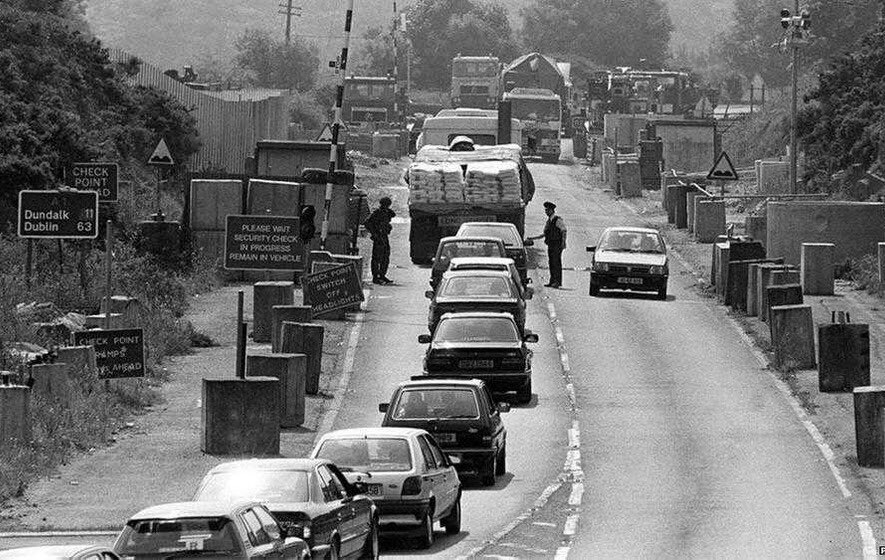
Which is not dissimilar to how it could end up looking again.
Assuming Daniel Hannan is not a victim of delusion, psychosis or amnesia, he may be intending to refer to the freedom of passport control between RoI and the UK within the Common Travel Area.Nice response from Prof Colin Talbot, "were you asleep from the 1970s to the 1990s?"
[qimg]https://pbs.twimg.com/media/DPqXEK4WsAA64pd.jpg[/qimg]
Which is not dissimilar to how it could end up looking again.
Even this is now surely at risk. It has depended on the UK and Ireland coordinating their immigration rules and laws, so that permission to enter one country implied eligibility to enter the other. Betweeen 1945 and 1952 this broke down and immigration checks were applies in U.K. Ports to passengers travelling to any part f the island of Ireland. This indignity caused consternation among Unionists at that time, and the DUP has explicitly ruled it out.
Now, tell me how in future, given that xenophobia is the prime motive for Brexit, UK and RoI can coordinate their immigration rules? The device of treating the whole of Ireland as one unit for this purpose is anathema to the unionists on whom May now depends for her majority in Parliament.
That is current No 1 insoluble Irish problem in my view.
For those of us not up on modern Irish history: What was before the 70s?Nice response from Prof Colin Talbot, "were you asleep from the 1970s to the 1990s?"
For those of us not up on modern Irish history: What was before the 70s?
The "troubles" kicked off in the 60's which meant that border security was much more of an issue from then until the Good Friday Agreement
https://en.wikipedia.org/wiki/The_Troubles
Roofgardener
Critical Thinker
- Joined
- Oct 14, 2015
- Messages
- 417
FoM for people is a red herring here, given the CTA.
The problem is FoM of goods and services. Under WTO rules we cannot permit free movement of goods and services from the EU but not all other WTO members.
This is why if we leave the Customs Union there has to be a hard border between ourselves and the EU.
The obvious solution is to remain a member of the EEA/EFTA whatever but of course this would go against The Will Of The Peopletm as this was clearly stated on the referendum ballot paper (which was totally legally binding)
That's interesting.... but how does that work ? An existing EU member state allows FoM etc with other EU states, but not to other WTO members that they may have trade relationships with ? How would that differ from the post-Brexit UK position ? (or does the EU have a special position within WTO trading rules ? ).
Nessie
Penultimate Amazing
- Joined
- Jun 16, 2012
- Messages
- 16,233
Assuming Daniel Hannan is not a victim of delusion, psychosis or amnesia, he may be intending to refer to the freedom of passport control between RoI and the UK within the Common Travel Area.
Even this is now surely at risk. It has depended on the UK and Ireland coordinating their immigration rules and laws, so that permission to enter one country implied eligibility to enter the other. Betweeen 1945 and 1952 this broke down and immigration checks were applies in U.K. Ports to passengers travelling to any part f the island of Ireland. This indignity caused consternation among Unionists at that time, and the DUP has explicitly ruled it out.
Now, tell me how in future, given that xenophobia is the prime motive for Brexit, UK and RoI can coordinate their immigration rules? The device of treating the whole of Ireland as one unit for this purpose is anathema to the unionists on whom May now depends for her majority in Parliament.
That is current No 1 insoluble Irish problem in my view.
The terror theat is still there. One reason why it has been kept calm is an open border, so that Republicans can at least have the sense they have made a big step towards one country. Moving from one to another and the only indication you have changed country is the road signs change. Unionists tolerate the open border as it has advantages for the country as a whole and they have plenty of symbolism to let people know they are in Unionist territory.
Any border will be an excuse for those who are still fighting a very low level terrorist war to up the violence.
That's interesting.... but how does that work ? An existing EU member state allows FoM etc with other EU states, but not to other WTO members that they may have trade relationships with ? How would that differ from the post-Brexit UK position ? (or does the EU have a special position within WTO trading rules ? ).
The WTO allows for bi- or multilateral trade agreements. Of course, the EU is a major reason why this is so.
The "troubles" kicked off in the 60's which meant that border security was much more of an issue from then until the Good Friday Agreement
https://en.wikipedia.org/wiki/The_Troubles
But it was still very much a hard border even before then, wasn't it?

But it was still very much a hard border even before then, wasn't it?
No idea, before my time.
Certainly wasn't an open border for 94 years as claimed by Daniel Hannan
ponderingturtle
Orthogonal Vector

- Joined
- Jul 11, 2006
- Messages
- 54,545
Negotiating NI leaving the UK would make Brexit look like a walk in the park. Plus, any hint of that and the Troubles would reignite in an instant.
And the hard boarder in Ireland wouldn't be a similar match?
Hubert Cumberdale
Graduate Poster
- Joined
- Sep 18, 2008
- Messages
- 1,141
That's interesting.... but how does that work ? An existing EU member state allows FoM etc with other EU states, but not to other WTO members that they may have trade relationships with ? How would that differ from the post-Brexit UK position ? (or does the EU have a special position within WTO trading rules ? ).
The WTO doesn't regulate free movement of people so its irrelevant.
FoM for people is easily resolvable because the UK, the RoI, and the EU are keen that it continues to exist across the Irish border.
FoM for goods and services cannot be resolved because of the WTO rules. The only way to get around the WTO rules is for the UK and RoI to be in a customs union, and since the RoI is in the EEA, the only way that can happen is if the UK is too.
Roofgardener
Critical Thinker
- Joined
- Oct 14, 2015
- Messages
- 417
Thanks Hubert.. but that doesn't really answer my question ?
In what way would the WTO rules prevent the UK having FoM for goods with Eire, but NOT (necessarily) with other countries ?
In what way would the WTO rules prevent the UK having FoM for goods with Eire, but NOT (necessarily) with other countries ?
Careful here. FoM of people in the EU sense means free trade in labor; analogous to the other 3 freedoms.The WTO doesn't regulate free movement of people so its irrelevant.
FoM for people is easily resolvable because the UK, the RoI, and the EU are keen that it continues to exist across the Irish border.
FoM for goods and services cannot be resolved because of the WTO rules. The only way to get around the WTO rules is for the UK and RoI to be in a customs union, and since the RoI is in the EEA, the only way that can happen is if the UK is too.
It's more than visa-free travel which exists between a lot of countries and which one should expect to continue between the EU and the Uk. But it is less than the Schengen zone which has no border controls at all.
Hubert Cumberdale
Graduate Poster
- Joined
- Sep 18, 2008
- Messages
- 1,141
Thanks Hubert.. but that doesn't really answer my question ?
In what way would the WTO rules prevent the UK having FoM for goods with Eire, but NOT (necessarily) with other countries ?
Am not really an expert here but as I understand it, unless country A and country B have a trade/customs agreement in place, they have to trade according to the standard WTO tariffs at the maximum.
Country A could let country B export its widgets at a zero tariff rate, but in order to comply with WTO rules, they would have to apply the same zero tariff to all members.
Its in the interests of fairness that WTO rules dictate that countries deal equitably with each other unless they have trade/customs agreements in place.
What this means is that if the UK allowed the EU to export to the UK with no tariffs at all, the UK would have to allow all WTO members to export to the UK with no tariffs at all.
Similarly, the EU would be compelled to levy tariffs on UK goods or abandon all tariffs with everyone.
We can either be in the EEA or have a hard border in Ireland.
Its a cake and eat it scenario....
- Status
- Not open for further replies.