Morchella said:
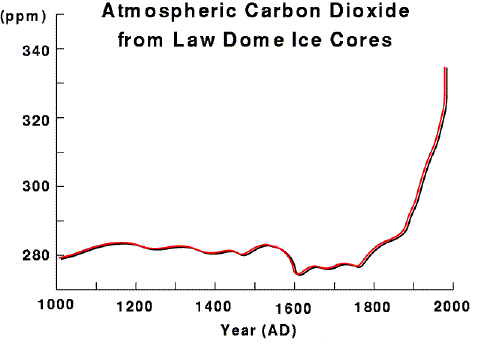
There was an article this week (http://www.salon.com/tech/feature/2003/08/07/global_warming/index.html) at Salon.com about the Bush administrations effort to promote the idea that there is still much uncertainty about the FACT of global warming and the human influence. Bush cites the Marshall Institute and Sallie Baliunas and Willie Soon as the proponents of the fringe view that there is not a human cause to the present global warming.
The Marshall institute is funded by the Exxon Mobil Corporation. Surprise Surprise. Bob Park is right. The consensus among mainstream science including the National Acadamy of Science agree that there ia a human componant to global warming.
Surprise, surprise what?
The notion that humans are causing dramatic climate change is the fringe view in my opinon.
There are lots of scientific papers published which are paid for or partly paid for by industry. Are they discounted? Do papers published under the UN have a "Get Out of Critical Scrutiny" card attached?
Once again we get back to the perjorative statements when equate oil companies with the denial tactics of tobacco companies.
As I pointed out to Bob Park (and which he took not the slightest bit of notice) no-one believes anything other than we are in a slight warming phase stretching back to the 1880s (with a decline 1940-1978 thrown in for good measure). The question is whether climate, a horrendously complex chaotic system, can be studied for "human influence" when the flap of a butterfly's wing may be just as significant.
It is not simply the Bush administration which wants to convey the great uncertainties of climate science, its right there in the papers from Working Group 1 which contains phrases diametrically opposed to the "certainties" of the summary (which was written by civil servants, not scientists).
For example Dr. Philip Stott, Professor Emeritus of Biogeography at the University of London (England), explains, "The whole feel of the IPCC report differs between its political summary and the scientific sections. It comes as a shock to read the following in the conclusions to the science part: "In sum, a strategy must recognize what is possible. In climate research and modeling, we should recognize that we are dealing with a coupled non-linear system, and therefore that the prediction of a specific future climate is not possible." - quite a contrast to the alarmism of the Summary for Policymakers.
also
Dr. Richard S. Lindzen, Alfred P. Sloan Professor of Meteorology, Department of Earth, Atmospheric and Planetary Sciences at the Massachusetts Institute of Technology, and one of the lead authors of the science sections of the IPCC report, has scathingly described the summary as "very much a children's exercise of what might possibly happen," prepared by a "peculiar group" with "no technical competence." Professor Lindzen further described the inept and unethical behaviour of the IPCC in preparing their reports in his May 2, 2001 testimony to the U.S. Senate Environment and Public Works Committee - the full transcript of that testimony can be viewed at
http://www.senate.gov/~epw/lin_0502.htm. On hearing about Canada's Minister of the Environment David Anderson's confidence in the dramatic conclusions of the IPCC summary report, Dr. Lindzen laughed, "There is a certain charm when politicians are so certain of the science when the scientists are not."
"The UN IPCC WG1 Summary for Policymakers of the Third Assessment Report is not an assessment of climate change science, even though it claims to be," sums up climate specialist, Dr. David Wojick. "Rather, it is an artfully constructed presentation of just the science that supports the fear of human induced climate change. In short, this is advocacy, not assessment."
Is Dr Richard Lindzen, one of the lead scientists in the IPCC and one of the most respected climate scientists in the world, a
fringe scientist?