psionl0
Skeptical about skeptics

Yes. It was NOT titled "Bitcoin: A system to replace other currencies".The original white paper was entitled "Bitcoin: A Peer-to-Peer Electronic Cash System"

Yes. It was NOT titled "Bitcoin: A system to replace other currencies".The original white paper was entitled "Bitcoin: A Peer-to-Peer Electronic Cash System"
What else was it for?Yes. It was NOT titled "Bitcoin: A system to replace other currencies".

 bitcoinmagazine.com
Bitcoin was, and still is, the answer to a fragile financial system: to uncontrolled money printing, to willful denial of reality, but also to the unfair and socially unjust expropriation that accompanies money creation.
The cap of 21 million bitcoin and the lack of central control make a policy of inflation impossible. Someone who holds bitcoin cannot be dispossessed by the uncontrolled printing of even more bitcoin.
Nor can they be dispossessed by banks that go bankrupt or deny access to bitcoin, provided they hold their bitcoin in a self-hosted wallet and thereby manage their own access. No central authority can revoke that access.
The timing of Bitcoin’s launch was no coincidence. It was the reaction to a financial system that would have collapsed had money not been printed in a pretty much uncontrolled manner.
Bitcoin is sound money — a response to a broken financial system. It is a system that is not imposed from above. Participation is voluntary and open to anyone. No one with a computer or smartphone and an internet connection can be excluded from it. For many, it’s a lifeline out of the fiat money system that is not sustainably viable.
In contrast to an inflationary and opaque system, Bitcoin is decentralized, transparent, and fundamentally honest.
Your quote is hilarious in its utter stupidity.according to it’s mythical origin story, it was created in direct response to the 08 financial crisis as an alternative and superior financial system to fiat.
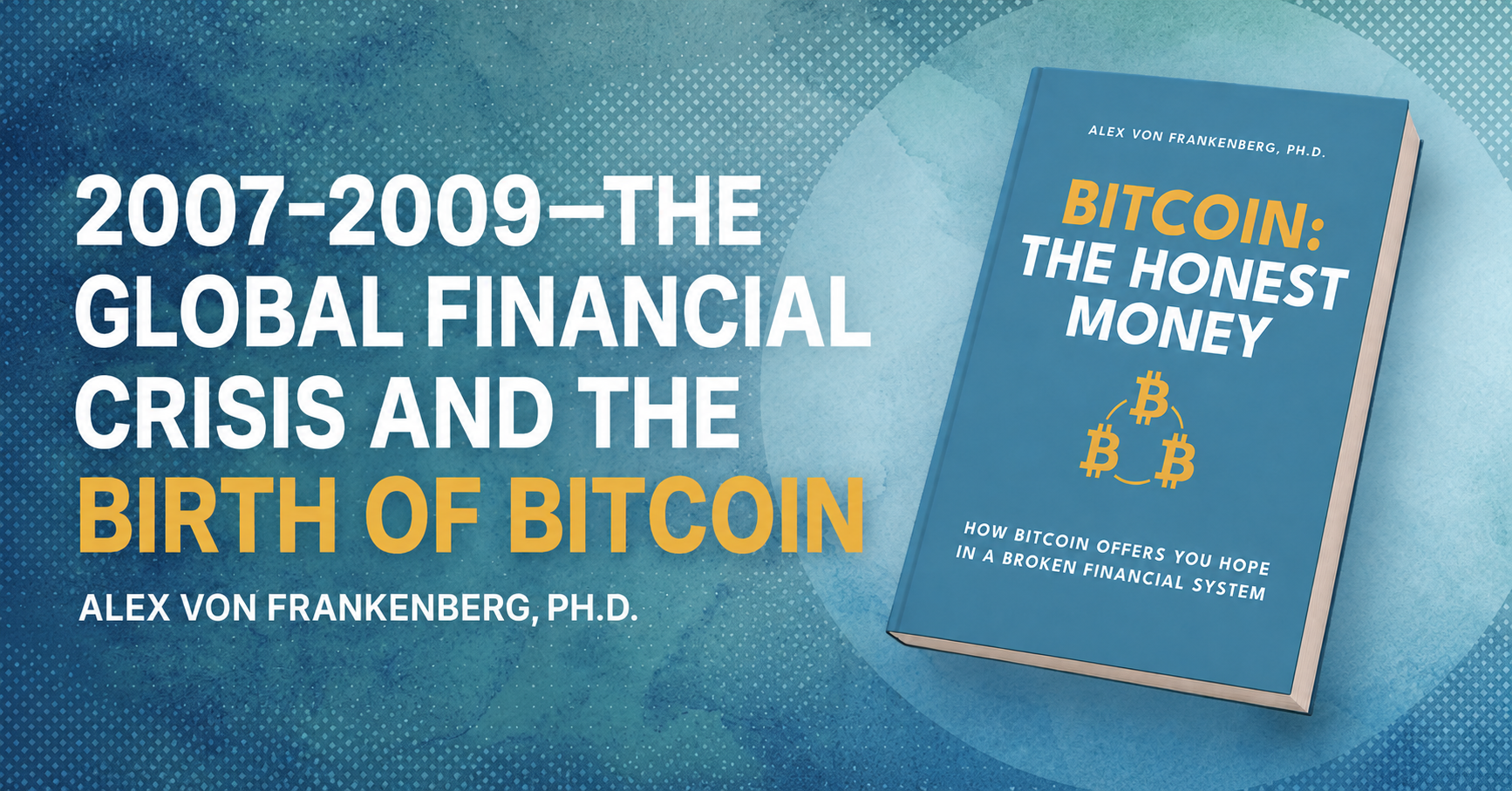
2007–2009—The Global Financial Crisis And The Birth Of Bitcoin
An excerpt from Bitcoin: The Honest Money explains how the 2007–2009 financial crisis exposed the fragility of the fiat system and set the stage for Bitcoin’s creation.
of course you should notice that doesn’t describe a fun gambling game
A policy of at least a small amount of inflation is a Good Thing. Apart from the fact that it encourages people to invest money instead of hoarding it, it means that debts relatively get smaller as time goes by. This is good because it is the poor people who have debts nd the rich people who have money.The cap of 21 million bitcoin and the lack of central control make a policy of inflation impossible.
This is the funniest part. It claims that the financial system would have collapsed if money had not been printed in an uncontrolled manner. Firstly, I'd say it wasn't uncontrolled. Secondly (and this is the part they didn't think about and is the funniest bit) they are saying that printing money saved the financial system. If money couldn't be printed (e.g. if it was Bitcoin), the financial system would have collapsed. How is that a good thing?The timing of Bitcoin’s launch was no coincidence. It was the reaction to a financial system that would have collapsed had money not been printed in a pretty much uncontrolled manner.
SuperParticipation is voluntary and open to anyone.
Ah, so not available to "anyone". What are the chances, if the financial system has collapsed, that your ISP is still in business?No one with a computer or smartphone and an internet connection can be excluded from it.
It couldn't replace all other currencies because of its limited transaction rate (a function of the block size and rate of block generation) which is microscopic compared to the volume of financial transactions in the world. Libertarians might be too stupid to realize this but Nakamoto would certainly have done the maths before releasing the code and generating the first block.What else was it for?
The price or transaction volumes of bitcoin (which jeremyp used to justify calling bitcoin a "failure") were never part of Nakamoto's original specification.this tangent came about last page when you took issue with jeremyp calling it a failure, but that seems to be what you're describing. failed as a proof of concept and became a speculative gambling game, failed to produce a proper protocol
Variable interest loans seem to void this argument.A policy of at least a small amount of inflation is a Good Thing. Apart from the fact that it encourages people to invest money instead of hoarding it, it means that debts relatively get smaller as time goes by. This is good because it is the poor people who have debts nd the rich people who have money.

It's amazing how the makers of the "perfect" money got everything about what money should be wrong.according to it’s mythical origin story, it was created in direct response to the 08 financial crisis as an alternative and superior financial system to fiat.
2007–2009—The Global Financial Crisis And The Birth Of Bitcoin
An excerpt from Bitcoin: The Honest Money explains how the 2007–2009 financial crisis exposed the fragility of the fiat system and set the stage for Bitcoin’s creation.
of course you should notice that doesn’t describe a fun gambling game
The price or transaction volumes of bitcoin (which jeremyp used to justify calling bitcoin a "failure") were never part of Nakamoto's original specification.
He proved that the technology for a "peerless" transfer system can be made to work. That is the very definition of success.
But it fulfilled his stated application precisely. Whatever libertarians had to say about "applications" is irrelevant.it proved that the software functioned, but big deal. it failed in it's application even at a small scale
But it fulfilled his stated application precisely. Whatever libertarians had to say about "applications" is irrelevant.
No i am neither labelling bitcoin a "success" nor a "failure". Such terms depend on the criteria you use and are highly subjective.are you saying the only criteria you're considering for calling bitcoin a success is functional software?
Commerce on the Internet has come to rely almost exclusively on financial institutions serving as trusted third parties to process electronic payments. While the system works well enough for most transactions, it still suffers from the inherent weaknesses of the trust based model.
Completely non-reversible transactions are not really possible, since financial institutions cannot avoid mediating disputes. The cost of mediation increases transaction costs, limiting the minimum practical transaction size and cutting off the possibility for small casual transactions, and there is a broader cost in the loss of ability to make non-reversible payments for non-reversible services. With the possibility of reversal, the need for trust spreads. Merchants must be wary of their customers, hassling them for more information than they would otherwise need.
A certain percentage of fraud is accepted as unavoidable. These costs and payment uncertainties can be avoided in person by using physical currency, but no mechanism exists to make payments over a communications channel without a trusted party.
What is needed is an electronic payment system based on cryptographic proof instead of trust, allowing any two willing parties to transact directly with each other without the need for a trusted third party. Transactions that are computationally impractical to reverse would protect sellers from fraud, and routine escrow mechanisms could easily be implemented to protect buyers. In this paper, we propose a solution to the double-spending problem using a peer-to-peer distributed timestamp server to generate computational proof of the chronological order of transactions. The system is secure as long as honest nodes collectively control more CPU power than any cooperating group of attacker nodes.
The claim was that bitcoin was a "failure" because the price has dropped significantly - a claim that has been made many times before. (Then there followed a series of posts about how the word "because" wasn't in the claim and it was really about transaction volumes). Had jeremyp simply declared that "failure" meant that the price varied frequently and widely, there would have been nothing to argue about.but you do have a problem with someone else labelling it a failure and are refuting that label based on that criteria
I can and have read it. Bitcoin successfully addresses the needs identified in that paragraph. That doesn't mean that it was the final solution. For a crypto to be able to replace international currencies and financial institutions (something the white paper doesn't say is needed), it would have to handle a transaction rate far greater than that of bitcoin.besides, we can quote the white paper
idk how you can read that and conclude it wasn’t designed with an intent to address a problem, and look at whether or not it was successful in doing so
The claim was that bitcoin was a "failure" because the price has dropped significantly - a claim that has been made many times before. (Then there followed a series of posts about how the word "because" wasn't in the claim and it was really about transaction volumes). Had jeremyp simply declared that "failure" meant that the price varied frequently and widely, there would have been nothing to argue about.
I can and have read it. Bitcoin successfully addresses the needs identified in that paragraph. That doesn't mean that it was the final solution. For a crypto to be able to replace international currencies and financial institutions (something the white paper doesn't say is needed), it would have to handle a transaction rate far greater than that of bitcoin.
Transaction volumes is only part of the requirements of an international currency. But since I am not advocating replacing global currencies with crypto, I don't see the need to expand on the requirements.i don't think so at all
Do I have to?it doesn’t seem like you’re advocating for much of anything
Of course you would say that. But all I can see in that introduction is that the "trust based model" (of financial transfers) has problems and we need a system that doesn't rely on trust.anyone can read the white paper and assess whether or not bitcoin addresses the problems it explains in the introduction. i would say it did not and on those grounds had failed
