• Security incident: ISF was recently accessed by intruders. Please change your password, and change it anywhere else you used it. Read more

Merged Bitcoin - Part 3

i don't think that was the claim being made. besides, people still buy and sell tulips
I haven't seen it either, but maybe I skipped some post or another. Either way, that was as far from answering my post as Australia is from England :P
 
Lousy analogy is lousy analogy.

I don't need to point out yet again the properties of crypto that no other asset (physical or digital) has.
Being too... comprehension- or literacy-challenged to understand that something is NOT an analogy, but a counterpoint, via something that was not in any way analogous, and it said NOTHING even similar to your strawman... is also still being too comprehension-challenged :P
 
Last edited:
Being too... comprehension- or literacy-challenged to understand that something is NOT an analogy, but a counterpoint, via something that was not in any way analogous, and it said NOTHING even similar to your strawman... is also still being too comprehension-challenged :P
I get it. When you claimed that "it was like buying a napkin on which a child wrote "TULIP" with crayons" you weren't making an "analogy" but a "counterpoint". :rolleyes:

The fact still remains that neither tulips nor napkins nor any other ridiculous thing you might like to throw up have anything to do with crypto.
 
1. That one was an illustration. No conclusion depends on it. My point still stands even without it. If it bothers you, just ignore it.

2. That was not the actual stupidity you wrote, no matter how much you try to save face now. You wrote that it's an argument from analogy. As in, it's somehow analogous to the tulip bubble, that one burst, therefore this one must also burst. NO, still nobody actually made that argument, outside of your imagination or possibly failure to comprehend written English. (I'll refrain from commenting on which it looks to me, 'cause, you know, TOS, mods, yada, yada.) Flail all you want, THAT is what you wrote, and that is what I was answering to. Or are you now unable to even read your own text? :P
 
Last edited:
The fact still remains that neither tulips nor napkins nor any other ridiculous thing you might like to throw up have anything to do with crypto.
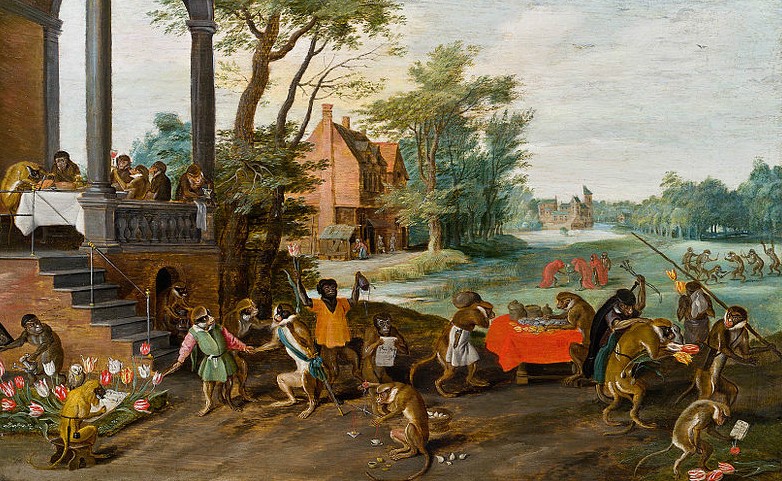
Tulip mania
The term tulip mania is now often used metaphorically to refer to any large economic bubble when asset prices deviate from intrinsic values... Tulip mania became a popular reference during the dot-com bubble of 1995–2001, and the subprime mortgage crisis of 2007–2010. In 2013, Nout Wellink, former president of the De Nederlandsche Bank (Dutch Central Bank), described Bitcoin as "worse than the tulip mania", adding, "At least then you got a tulip, now you get nothing."
 
1. That one was an illustration. No conclusion depends on it. My point still stands even without it. If it bothers you, just ignore it.

2. That was not the actual stupidity you wrote, no matter how much you try to save face now. You wrote that it's an argument from analogy. As in, it's somehow analogous to the tulip bubble, that one burst, therefore this one must also burst. NO, still nobody actually made that argument, outside of your imagination or possibly failure to comprehend written English. (I'll refrain from commenting on which it looks to me, 'cause, you know, TOS, mods, yada, yada.) Flail all you want, THAT is what you wrote, and that is what I was answering to. Or are you now unable to even read your own text? :P

You can't walk back from what you wrote. You compared bitcoin with tulips (and just to sillify your argument you also compared it to a "napkin on which a child wrote "TULIP" with crayons"). There is only one possible reason why you would choose tulips as a comparison and that is because of the tulip mania.
 
Lousy analogy is lousy analogy.

I don't need to point out yet again the properties of crypto that no other asset (physical or digital) has.

unless you think it'll help your argument with some of the others in this thread.

as i recall, and go ahead and correct me if i'm wrong, you have called bitcoin a speculative asset in the past.
 
Like I said, "nothing".
A tulip is not nothing. It's a bulb that produces flowers and also more tulips. We think of tulips as being ubiquitous now, but back when the tulip bubble happened, the tulip was rare in Europe and considered quite exotic. Some of the more extreme prices only applied to particularly rare varieties or plants infected by the tulip mosaic virus (whose symptoms were tulips with non uniform colouring).

Also, a lot of the trading was not in actual tulips, but contracts to buy tulips. Tulip bulbs can only be dug up and shipped during certain months of the year. During the rest of the year people made forward contracts to buy them.

I agree BTC is not like tulips because BTC has no intrinsic value at all. Tulips can be used to make a garden look nice.
 
You can't walk back from what you wrote. You compared bitcoin with tulips
Thank you for making my case for me about your comprehension problems. I rest my case.

Just to recap, this is what YOU wrote.
Every now and then somebody claims that the tulip craze didn't last therefore bitcoin won't last.

It is just the old "something else is bad therefore bitcoin is bad" analogy being repeated yet again.

It's literally a claim of it being an argument from analogy, when nobody actually made that argument. Literally nobody said that Bitcoin wouldn't last BECAUSE the tulip craze didn't. Which makes yours a strawman too.

So yeah, to use your own words, "You can't walk back from what you wrote." It's still on the board for everyone to see.
 
Last edited:
Also, a lot of the trading was not in actual tulips, but contracts to buy tulips. Tulip bulbs can only be dug up and shipped during certain months of the year. During the rest of the year people made forward contracts to buy them.
Yeah, they had actually invented trading in futures.

Also, a lot of it really was a case of the greater fool theory. A contract could change hands a dozen times a month, while still being just a promise on paper. Most people who did those contracts had no intention to wait and actually get a tulip bulb. They didn't want a tulip. They just wanted the next idiot to come buy that piece of paper from them at a higher price, as the prices were rising exponentially.
 
Last edited:
Yeah, they had actually invented trading in futures.

Also, a lot of it really was a case of the greater fool theory. A contract could change hands a dozen times a month, while still being still just a promise on paper. Most people who did those contracts had no intention to wait and actually get a tulip bulb. They didn't want a tulip. They just wanted the next idiot to come buy that piece of paper from them at a higher price, as the prices were rising exponentially.

psion has an opportunity to explain why this isn’t a good comparison to bitcoin, so prepare yourself for a laughing dog accompanied by no explanation
 
Or more strawmanning, I guess. But then it would be nothing new. Crypto-bros have been doing the same for almost two decades, presumably because they don't really have a lot of valid arguments.

But since I'm a helpful ass, I'll offer a reason why it's not a 100% 1-to-1 comparison myself: nobody went "TO THE MOOON!" or HODL (hold on for dear life) about tulip promises. As I was saying, those contracts sometimes changed hands every couple of days. As soon as the greater fool came to buy it for more gulden than they paid, they'd pass it on like a hot potato. Yoohoo, quick buck.
 
Last edited:

i was a little curious about the on the ground side of tulip mania, and found this after not much searching. basically it says that tulip mania was confined to a small group of rich mennonites that could afford pay on something stupid and eat the loss, and were using them as status symbols during a time of wealth and not as a vehicle for investment.

so that’s a big difference from bitcoin too, there’s many people tied up into it who would stand to lose a big part of their finances if it were to collapse and there’s no social benefit to owning or any way to display your ownership with bitcoin, since it’s an approximation of a coin that’s really just an entry in a database

anyway, here’s the major difference i was looking for

Remarkably, also, considering the scope for fraud, there seems to have been little or no criminal activity, "there were no celebrated trials, no verdicts and no records of any convictions"19

another interesting passage

When the crash came these contracts, which were regarded as gambling debts, were unenforceable through the courts, and most disputes were settled by the payment of a nominal sum ranging from 3.5 per cent to 10 per cent.22

something it has in common with bitcoin, it’s just generally considered as fools gambling
 
Well, at the peak one of those contracts was worth 10,000 gulden, i.e., gold coins, significantly more than the price of a house. Or literally the price of 100 fat sheep at the time, or a little over 40 metric tons of cheese. To put it even more into perspective, the average worker's wage was between a quarter and a half gulden per day. A MASTER craftsman might earn a gulden a day. So those 10k are literally the equivalent of 27 and a half years for a master craftsman, or up to a century of wages for a regular labourer. Take the average wage of a Walmart employee, multiply by 100 years, and you get a good idea of what it meant in today's money. So of course the poor had no way to take part in that speculation.

As for no criminal activity... well, not under the laws at the time. As you say, they just classified those as gambling debts, so just deciding to not honour a contract was technically not criminal. At one point the government simply officially cancelled all contracts, making them literally worth less than the piece of paper they were on... if someone hadn't written stuff on it. You weren't even left holding the bag, since you didn't even have enough paper to make a bag. I don't think that would fly today.

It's like saying that SBF wouldn't be a criminal, if the government decided he doesn't have to give it back. I mean, it's technically true, but also not saying much.

Plus even that "under the laws at the time" bit is technically inexact. Dutch law for example forbade shorting, but it was rampant anyway during the bubble burst. It just wasn't prosecuted.
 
Last edited:
i was mainly interested in whether or not there were the anachronistic equivalent of the crypto bro influencer type at that time and what was the tulip cope when it dumped
 
psion has an opportunity to explain why this isn’t a good comparison to bitcoin, so prepare yourself for a laughing dog accompanied by no explanation
Bitcoin can be future traded as well. Is that remarkable?

as i recall, and go ahead and correct me if i'm wrong, you have called bitcoin a speculative asset in the past.
That is correct. Bitcoin gets most of its value from speculation (a lot of assets do). But it still has to have some use other than speculation for it to attract speculators and to keep speculators interested.
 
Bitcoin can be future traded as well. Is that remarkable?

well, there's to compare than that, like the 2nd half of the quote

That is correct. Bitcoin gets most of its value from speculation (a lot of assets do). But it still has to have some use other than speculation for it to attract speculators and to keep speculators interested.


i guess not really so lousy of an analogy on that basis then.

i don't agree that a lot of assets get most of their value from speculation nor that you need anything more than speculation to attract or keep people interested tho
 

ISF - Join now!

Every member here is approved by hand. No bots, no spam, just people who care about evidence and honest debate.

Membership is free!

Create your free account

Back
Top Bottom