
-
Security incident: ISF was recently accessed by intruders. Please change your password, and change it anywhere else you used it. Read more
You are using an out of date browser. It may not display this or other websites correctly.
You should upgrade or use an alternative browser.
You should upgrade or use an alternative browser.
Merged Bitcoin - Part 3
- Thread starter Dr.Sid
- Start date
-
- Tags
- bitcoin cryptocurrency
dirtywick
Penultimate Amazing

- Joined
- Sep 12, 2006
- Messages
- 12,846
q2025 strategy earnings reports billions in losses. and this quarter was much, much worse
psionl0
Skeptical about skeptics

Since I have never claimed that bitcoin is a "useful currency" I don't have to prove it. I only point out bad arguments (or when somebody is obsessed).and lol at scouring the internet. this stuff is easy to find. what you gave to scour the internet for is someone doing something useful with bitcoin
OTOH the underlying blockchain technology has the potential to be useful. For example, the BRICS nations are developing a block chain based currency (backed up partly by gold) that can be used as an alternative to the USD for international transactions.
Many banks are using the Ripple network for international currency transfers.

What Banks Use XRP? Complete List of Financial Institutions Using Ripple
Sending money across borders still means waiting days and paying steep fees at most banks. XRP was built to fix that, and the number of institutions connected to Ripple's network has been quoted at
 www.mexc.com
Last edited:
psionl0
Skeptical about skeptics
Why would they?but they're not using bitcoin?
Roger Ramjets
Philosopher

This thread is about Bitcoin, not blockchain. But the two are closely linked, so...Since I have never claimed that bitcoin is a "useful currency" I don't have to prove it. I only point out bad arguments (or when somebody is obsessed).
OTOH the underlying blockchain technology has the potential to be useful. For example, the BRICS nations are developing a block chain based currency (backed up partly by gold) that can be used as an alternative to the USD for international transactions.
Many banks are using the Ripple network for international currency transfers.
What Banks Use XRP? Complete List of Financial Institutions Using Ripple
Sending money across borders still means waiting days and paying steep fees at most banks. XRP was built to fix that, and the number of institutions connected to Ripple's network has been quoted at
With the value of Bitcoin now dropping at its most precipitous rate ever, it hardly seems to be reaching the potential promised by blockchain technology. Rather it appears to be showing up blockchain's inadequacies.
Bitcoin was supposed to be the future of money, and blockchain was purportedly the key to rivaling fiat currencies without involving banks. However in practice Bitcoin has become little more than fake gold, and banks are still an essential part of its infrastructure. Blockchain doesn't appear to being used much in other areas either, whjich is hardly surprising considering it was only designed for one purpose - decentralized money.
Blockchain was invented in 2008 specifically to create a "useful currency". It failed spectacularly. 18 years later it's still struggling to reach its 'potential' for anything except crime and grift.
psionl0
Skeptical about skeptics
ftfy.This thread is about Bitcoin, not blockchain. But the two are closely linked, so... I will use the two interchangeably just to muddy the waters.
In his original white paper Satoshi Nakamoto simply wrote:
His blockchain software achieved this. Any hype about bitcoin replacing banks or fiat currencies came from others - mostly libertarians.What is needed is an electronic payment system based on cryptographic proof instead of trust,allowing any two willing parties to transact directly with each other without the need for a trusted third party
dirtywick
Penultimate Amazing
- Joined
- Sep 12, 2006
- Messages
- 12,846
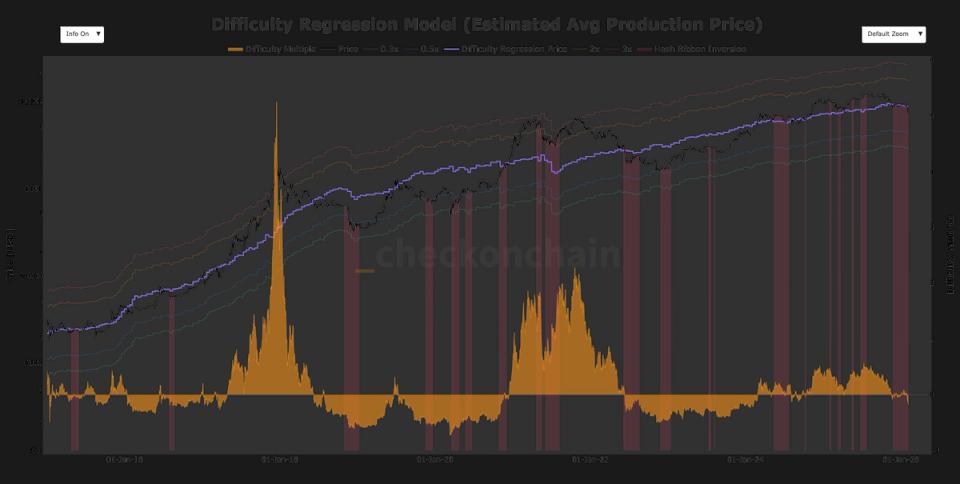
Miners are being squeezed as bitcoin’s $70,000 price fails to cover $87,000 production costs
Bitcoin is now approximately 20% below its estimated average production cost, historically a feature of a bear market.
bitcoin price movement, weather effecting mining profitability and hash rate
dirtywick
Penultimate Amazing
- Joined
- Sep 12, 2006
- Messages
- 12,846
Jeffrey Epstein’s Crypto Cash Grab: How a Predator Funded Bitcoin’s Rise
Epstein's $3.5 million crypto investments helped fund Coinbase, MIT's bitcoin research, and Blockstream during cryptocurrency's crucial early years.
 finance.yahoo.com
epstein saw the potential
dirtywick
Penultimate Amazing
- Joined
- Sep 12, 2006
- Messages
- 12,846
psionl0
Skeptical about skeptics
ftfy.
Jeffrey Epstein’s Crypto Cash Grab: How a Predator Funded Bitcoin’s Rise
Epstein's $3.5 million crypto investments helped fund Coinbase, MIT's bitcoin research, and Blockstream during cryptocurrency's crucial early years.
epsteinsawdidn't see the potential
The response has been predictably subdued. Charlotte Fang of Remilia dismisses the revelations as irrelevant for “sophisticated investors,” while others view Epstein as a skeptical early backer who exited prematurely—missing bitcoin’s explosive growth.
psionl0
Skeptical about skeptics
Water is wet.
dirtywick
Penultimate Amazing
- Joined
- Sep 12, 2006
- Messages
- 12,846
epstein’s island was surrounded by water, where he presumably was when he sent coinbase the money. good friends with the co founder of tether too, brock pierce. helped him get the money to coinbase, seemed to have similar tastes in women

 www.yahoo.com
Brock Pierce's Relationship With Jeffrey Epstein Went Deeper Than Anyone Knew
Convicted child sex offender Jeffrey Epstein was involved in Tether co-founder Brock Pierce's love life, among other things.
dirtywick
Penultimate Amazing
- Joined
- Sep 12, 2006
- Messages
- 12,846

Coinbase posts surprise loss on crypto trading slowdown
Coinbase posted a surprise quarterly loss on Thursday, marking its first since the third quarter of 2023, as the cryptocurrency exchange was hit by weaker trading volumes during a period of broad digital-asset selloff.
 www.reuters.com
speaking of coinbase, they took a loss this quarter.
Sentiment has remained largely downbeat for the sector, curbing volatility and, in turn, hurting the cryptocurrency exchange's trading desks.
The company reported a loss of $666.7 million, or $2.49 per share, for the three months ended December 31. Analysts had expected a profit of 55 cents per share, according to estimates compiled by LSEG.
Coinbase's transaction revenue tumbled to $982.7 million during the quarter, from $1.56 billion a year earlier.
The decline was largely driven by a more than 45% drop in consumer transaction revenue.
dirtywick
Penultimate Amazing
- Joined
- Sep 12, 2006
- Messages
- 12,846
Bitcoin Scam: Court Hands Man 20-Year Sentence Over $200M Ponzi Scheme | Bitcoinist.com
According to a recent release by the DOJ, Ramil Ventura Palafox, a 61-year-old dual citizen of the United States and the Philippines, orchestrated a
 bitcoinist.com
20 years for a $200m bitcoin ponzi
psionl0
Skeptical about skeptics

Roger Ramjets
Philosopher
And the title of the white paper is "Bitcoin: A Peer-to-Peer Electronic Cash System". So yes, the two are closely linked.
So you admit that blockchain was developed specifically to implement 'digital cash', not for any other purpose. And this was supposed to replace traditional payment methods using fiat currency, which is why the white paper calls it 'cash'.His blockchain software achieved this. Any hype about bitcoin replacing banks or fiat currencies came from others - mostly libertarians.
The introduction says:-
First off, whether it's needed is debatable. I've been using PayPal since 2002 and never had a problem. 'Financial institutions' have been taking care of my money since 1962, again without any issues. Having a 'trusted third party' recently helped prevent my neighbor from losing NZ$10,000 to a scammer (with Bitcoin she would have been screwed).Commerce on the Internet has come to rely almost exclusively on financial institutions serving as trusted third parties to process electronic payments... What is needed is an electronic payment system based on cryptographic proof instead of trust, allowing any two willing parties to transact directly with each other without the need for a trusted third party.
But libertarians hate central banks and fiat currency, and desperately seek an alternative that doesn't involve a 'trusted third party'. It's no coincidence that 'Satoshi Nakamoto' designed exactly that. Want proof that he was one of them? Here it is:-
Bitcoin: 2008-2009: creation
Cryptographic algorithms were known about before then. Nakamoto's innovation was to create a digital currency using a distributed ledger of records (blocks) linked together via cryptographic hashes - thus the name 'blockchain'. So (at that time) Bitcoin and blockchain were essentially the same. Bitcoin was the 'app', while blockchain was the mechanism inside which made it work.On 3 January 2009, the bitcoin network was created when Nakamoto mined the starting block of the chain, known as the genesis block. Embedded in this block was the text "The Times 03/Jan/2009 Chancellor on brink of second bailout for banks"
But the basic design had a serious flaw - the system is secure only so long as honest nodes collectively control more CPU power than any cooperating group of attacker nodes. Nakamoto's answer to this was to make the 'difficulty' (CPU power required) increase as the rate of blocks processed increases. Anyone who knows the history of computers can see the problem here - as soon as big money gets invloved it will induce an 'arms race' of ever-increasing compute power. The result is that each Bitcoin mined increases in 'value' over time, as newer ones cost more to 'mine'. This makes the 'digital currency' inherently deflationary, encouraging speculation.
It didn't have to be done this way, but this design would appeal to a libertarian who railed against 'worthless' deflatationary fiat. We know Nakamoto thought this way from the text he imbedded into that starting block. This ideology may have blinded him to what such a design meant. But even if he didn't see it initially, he must have realized that mining a large number of Bitcoins could potentially make someone rich if the currency took off. And mine them he did - creating ~1.1 million in the fiirst year. The cost to him at that time was trivial. Today it is 'worth' ~$75 billion. Assuming he can still access his Bitcoins, that makes 'Satoshi Nakamoto' insanely rich for practically no effort. There's a name for that too...
Last edited: