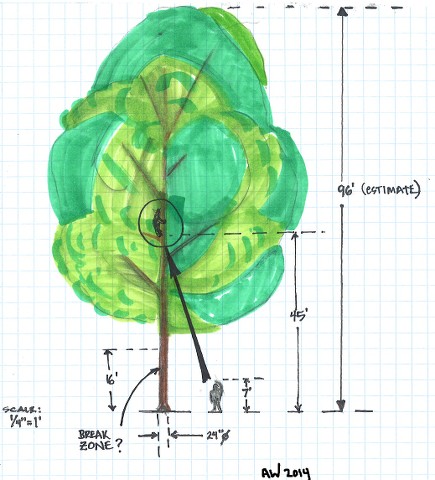
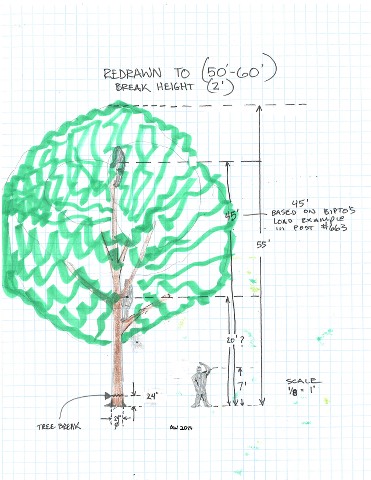
Bigfoot snapped a 24" diameter Oak Trunk

Regarding the elasticity, aren't ALL objects elastic to a degree?

Yes, generally a object you think of as "elastic" is one where the yield strength is close to the Young's modulus, an object you think of as "brittle" is one where the yield strength is far less than the Young's modulus.

However, one portion of this 700 lb force breaking a tree discussion that hasn't been mentioned is apparently the tree was swinging back and forth. How would a pendulous tree swing with an intermittent, but timed 700 lb force at say 5, 10, 15, or 20 mph affect the force?

That's a whole different calculation, one which I have zero interest in carrying out. The idea in general is that, maybe one can't deliver an elastic-limit's worth of energy to the tree in one collision, but you can try to deliver it in a series of collisions and expect the tree to "accumulate" energy in an oscillating mode. No, seriously, trees are not good oscillators, they're very efficiently damped (http://www.ncbi.nlm.nih.gov/pubmed/21636359 --- note that this is a Doug fir). If you don't have the strength to knock over a tree in two or three swings, you don't have the strength to knock it over in a thousand swings.

There is no "700lb force" in this problem. 700lb is the weight of the Incredible-Hulk-like magic object that you've posited in your tree. 5,10,20mph are velocities. You have not provided any mechanism for figuring out what force could be exerted. So we're playing "can we make up a scenario where an arbitrary made-up force can knock over a tree"? The answer is yes. Yes, you can invent an imaginary force and make up numbers for it until it's big enough to knock over a tree.
 
So there's no mention of the tree being white oak, bipto claims the trunk could have been as little as 20" in diameter, and he never saw any bigfoot actually in said tree?

In other news, this horse-hockey is simply at odds with the lack of any photographs to support it.
 
Hi Folks:

Drew invited me over here to help with the dialogue a bit as I was the 'bigfooter' that originally threw up the force numbers.

Admittedly, I used a basic moment diagram to determine the torque experienced at the base of tree when a 700 lb force, traveling at 20 mph is applied at 45 feet from the anchor point (vertical cantilever).

I like that Ben (I think it was Ben) included the elasticity of the tree, but I'm not certain that would change the torque experienced at the base much (Ben or others, please correct me if I'm wrong) as it changes the vector of the force as the tree bends, and adds the weight of the displaced tree from bending to the force....I was dealing with rough numbers.

I simply wanted to show that a 700 lb weight, traveling at a certain speed, could create the torque needed to topple a 24" diameter trunk tree. Which, if I'm not mistaken is around 225,000 ft.lbs of force (again, someone please correct me if I'm wrong).

SO, a 700 lb object, traveling at 20 mph creates 6256 lbs of force.

This 6256 lbs of force, applied perpendicular to a beam at 45 feet creates 281,500 ft.lbs of torque at the base. I have a Free Body Diagram showing this, but unfortunately the forum won't let me upload from my comp. I'm sure this portion of the calculation won't be disputed as described.

So, in the end, I say that 700 lbs, traveling at the proper speed can create the torque needed to snap/topple the tree.

O.....

"Mixed Metaphors"- Common piece of confusion- aren't you confusing ft/lbs of energy with lb/ft of torque? And energy w/ force?

MVsq = energy, but that is not the same as 6256 pounds pushing on a lever 45 feet long at minimal velocity.

Sort of like a bullet hitting a target has huge energy, but the gun in the hand has just as much. Do you want to hold the gun, or be the target? Here we are talking about the motion of the gun recoiling in the hand, not the target getting a hole in it.
 
Last edited:
Well folks. Thanks for the input. I'm chalking this one up as the solution being way above my pay grade. I agree that, as it has been discussed, the feat is unbelievable. However, there may not be enough accurate information to assess the problem.

Ben - Thank you much for the physics lesson - hats off to you! Most impressive working knowledge.
 
Can you ask him for me why he thinks the Bigfoot bodychecks trees? Does it lick the sap? Is it part of a mating display? I really honestly desperately need to know this information.

Good luck, I'm still waiting for an explanation for pig flinging.
 
It's not a White Oak and it was snapped much higher than 24". Who was the source of those errors?
 
When I originally drew a taller more spindelish tree, I was corrected that I should have used a White Oak, their branches are stronger. So I changed the drawing to depict a tree with the shape and height of a white Oak.
 
Yeah Bipto says broken about 24" above ground but it's much higher than that. We should understand that a man who says that there are apes in Oklahoma is going to create many other untruths as well.

Absolutely nothing that a Bigfooter says should be taken at face value. Absolutely nothing.
 
In which case, something weighing 700 pounds leapt off the branch towards the trunk, giving the branch (and thus the trunk) an equal and opposite reaction (ie accelerating the trunk closer to the leaping object). In other words, the object making contact with the trunk does so at an instant when the trunk is accelerating towards it.

Let me explain this with an analogy. A yacht, sitting still on a lake, with a mast sticking up and a smooth deck. A big heavy thing runs along the deck and crashes into or leaps at the mast. What happens?

The captain stops the crew's grog.
 
This was my original diagram.

8lj6.jpg


I was told by Hairy Man that I had the tree too tall(96'), and the break point correct (16').

This spurred me to read Bipto's actual comments again, and I came up with this representation based on his comments. Height: 55' and break point 2'

phbg2.jpg
 

Back
Top Bottom