• Security incident: ISF was recently accessed by intruders. Please change your password, and change it anywhere else you used it. Read more

Split Thread BBC news reporting

You can never expect that a "news" organization funded by the government would be balanced of fair. They know which side their bread is buttered.
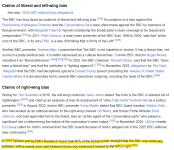
For a start, it's funded by the people, not by the government, and second, it has a legal mandate to be fair. It was established under a Royal Charter which states:

1792798208828.png

And:

1792798233901.png


I know this may be hard for an American to believe, but legally the BBC must endeavour to be independent and impartial, because doing otherwise would go against the legal basis for its existence.
 
I know this may be hard for an American to believe, but legally the BBC must endeavour to be independent and impartial, because doing otherwise would go against the legal basis for its existence.
Is the BBC run by people? If so, there will be bias. That's just what people do. No fancy memo can change people.

‘The BBC is failing in its obligation to be fair’

The BBC, our national broadcaster, has a duty to be balanced, fair and impartial. But complaints of bias abound, coming from both ends of the political spectrum. Robin Aitken spent 25 years as a BBC journalist. Since leaving, he has written a number of books examining political bias at the BBC. His latest is The Noble Liar: How and Why the BBC Distorts the News to Promote a Liberal Agenda. spiked caught up with him to find out more.
 
Is the BBC run by people? If so, there will be bias. That's just what people do. No fancy memo can change people.
That's not a "fancy memo", it's the Royal Charter by which the BBC operates. It's a legally binding document which governs its existence.

And notice that I didn't say that the BBC is always independent and impartial, but that it has a legal obligation to endeavour to be independent and impartial at all times.
And if it violates that obligation, what?
 
Last edited:
Sorry, I'm done looking things up for you. The information is out there if you care.
Because you can't, dude. It's just sort of comical, almost, ironically, like a BBC comedy.

Public - Hey, your reporting, characterizing the opposition leader as incompetent and omitting various government infractions, is biased.
BBC Reporter - No, no. Look, the guidelines say I can't be biased. It's even in BOLD!
Public - Oh, yes, it IS in BOLD. No bias then. Carry on.
 
Because you can't, dude. It's just sort of comical, almost, ironically, like a BBC comedy.
No, the information is out there. That you don't go looking for it yourself indicates that you're not really interested in the answer to your question, and that you're only asking it in order to score rhetorical points.

Also, this:

1792805233593.png
 
For a start, it's funded by the people, not by the government,
Do they go around collecting that money themselves? No. The government collects that money, and then gives it to the BBC. Which is how the government funds everything they do.

The BBC is funded by the government.
and second, it has a legal mandate to be fair.
Who enforces that legal mandate, to the extent it even can be enforced?

The government. The government gets to decide if it's being fair.
 
Do they go around collecting that money themselves? No. The government collects that money, and then gives it to the BBC. Which is how the government funds everything they do.

The BBC is funded by the government.
It's not government money. It's not a tax. It's literally a service charge that people pay to the corporation.

Who enforces that legal mandate, to the extent it even can be enforced?
The courts, of course. Like everything legal.

Again, all of this information is not hard to find if you are interested in something other than scoring rhetorical points.
 
It's not government money. It's not a tax. It's literally a service charge that people pay to the corporation.
You can call it whatever you like, but it's a tax, because you don't have a choice about paying it, even if you don't watch the BBC.
 
My sister doesn't have a TV licence as she doesn't have a TV. It's not a tax, and you have a choice.
To not have a TV, sure. But if you have one, you have to pay. Just like you don't have to pay VAT on the TV if you don't buy one. It's still a tax.
 
I have to pay a subscription for all the TV I watch. It's true it's possible to end up paying the BBC's subscription fee even if you never watch their TV shows or listen to their radio channels (which I personally find hard to imagine) but you do still have access to them. Paying the monthly sub gives me access to Netflix, and if a month goes by when I don't watch a single show on it I've still paid that sub and can't get it back. So it's really only the "mandatory if you own a TV because that automatically gives you access" aspect of the BBC fee that's unique, and I don't think that's enough to classify it as a tax.
 
To not have a TV, sure. But if you have one, you have to pay. Just like you don't have to pay VAT on the TV if you don't buy one. It's still a tax.
Even if you don't have a TV, if you stream any live television programming or watch any BBC production online, you are supposed to pay the license fee
 
For a start, it's funded by the people, not by the government, and second, it has a legal mandate to be fair. It was established under a Royal Charter which states:

View attachment 77283

And:

View attachment 77284


I know this may be hard for an American to believe, but legally the BBC must endeavour to be independent and impartial, because doing otherwise would go against the legal basis for its existence.
Which is why is always under so much more scrutiny than other organisations and why we have a right to know what it is doing.
 
And if it violates that obligation, what?
Executives are sacked, up to and including the head honcho. And yes it does happen. It has to allow independent access to its management processes and so on. All of which have happened. I doubt there is any broadcaster in the world that is under more scrutiny.
 
Do they go around collecting that money themselves? No. The government collects that money, and then gives it to the BBC. Which is how the government funds everything they do.

The BBC is funded by the government.
The BBC took over the collection of its voluntary subscription fee back in 1991, the government isn't involved in the collection or enforcement of the collection.
Who enforces that legal mandate, to the extent it even can be enforced?

The government. The government gets to decide if it's being fair.
If that was the case do you think Thatcher would have let it get away with what she thought was its bias?
 

ISF - Join now!

Every member here is approved by hand. No bots, no spam, just people who care about evidence and honest debate.

Membership is free!

Create your free account

Back
Top Bottom