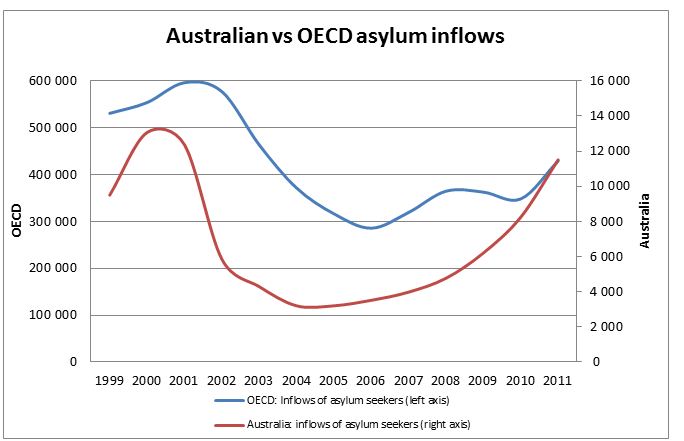
The UNHCR has long been aware of the tensions specific to the Asia Pacific region, posing challenges for all the regional governments, including Australia. However, it questions the effectiveness of increasingly harsh deterrence measures in stemming asylum flows, arguing that in the long-term the threat of detention or even drowning may be perceived to be the lesser evil for desperate asylum seekers. Former United Nations Assistant High Commissioner for Protection, Erica Feller, asserts that investment in deterrence is inevitably ‘doomed to failure’ for those reasons:
Investment in deterrence as the preferred solution to the challenge posed [to] States by irregular boat arrivals is doomed to failure … boats … have long been and remain a lifeline for the desperate … the boats will continue as long as the root causes of departure remain unresolved.
In the long-term, greater cooperation with our regional neighbours on a burden-sharing basis is seen by the UNHCR to be a key component of future progress. Many other stakeholders agree, arguing that there should be more focus on genuine cooperative engagement and burden-sharing with our neighbours.
Under such an approach, regional processing of asylum seekers under the auspices of the UNHCR and the IOM might be negotiated through a regional cooperative framework such as the Bali Process. Other long-term burden-sharing options might include the development of programs like the Comprehensive Plan of Action (established to deal with the Indochinese asylum flows) together with the creation of more protection space for those found to be in need of protection along the ‘displacement corridors’.



 Norman
 You guys have NO . . . . CLUE . . . . WHATSOEVER.