• Security incident: ISF was recently accessed by intruders. Please change your password, and change it anywhere else you used it. Read more

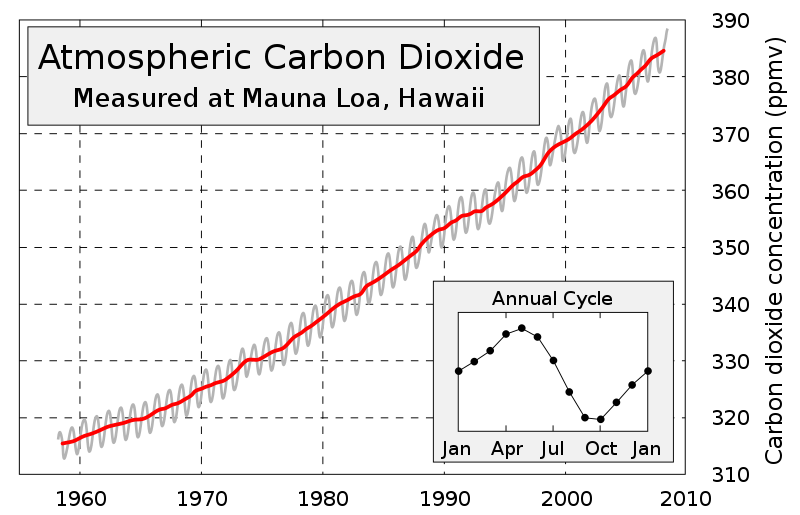
Atmospheric CO2 has gone up 20% since 1960

Thunder

Banned
Joined
Nov 18, 2006
Messages
34,918
I am basing this number on the following chart. It shows CO2 ppm in 1960 at about 316 ppm and at about 385 ppm in 2009. That is a 21% increase in 59 years.

So, my first question is:

-why is a 21% increase in atmospheric CO2 such a horrible thing?

and second question is:

-do the ice core records show that a CO2 increase of 21% in previous years was followed by a massive average temperature increase?

800px-Mauna_Loa_Carbon_Dioxide-en.svg.png
 
I have found charts comparing atmospheric CO2 with temperature changes:

IceCores1.gif


IceCores2.gif


IceCores3.gif


IceCores4.gif


all these charts, I do admit, seem to suggest a direct corrolation over the long run between CO2 levels and temperature variation.

though in the short term, as the last chart shows, global temperature may not and will probably not follow the CO2 trends. it may take a lot longer for global warming to actually take place then many scientists suggest.

this, #1, will make it harder to convince folks that global warming is real, and #2, make it much harder to make neccessary changes to stop it.

people think in the short term, not 100 years in advance.

and as we can see in the chart, CO2 levels have increased 21% in the last 40 years, while average temperatures have NOT.
 
Last edited:
Where'd you get those particular charts might I ask? (ETA: You might get better charts from the IPCC.) But, IIRC, the ice core records cover about 7 previous ice ages and from that alone we can glean two important data:

1) In all that time CO2 levels have been tightly correlated with global mean temperatures.

2) They're higher today than they ever have been in the ice core records. They were undoubtably way higher much earlier in Earth's history, but not since it's been ruled by mammals.
 
Last edited:
http://www.daviesand.com/Choices/Precautionary_Planning/Closer_Look/index.html

charts are from there. and as u suggest, over the long term, temperature does follow CO2 levels.

which, now basically has be convinced. global warming is real, and is caused by CO2 increases. i'd just like to know what causes all the CO2 variations over the last 500,000 years?

That's complicated, but there are several causes.

1) Volcanism. When a volcano goes boom, expeciall the really big volcanoes we hardly ever see, they put out tons of CO2 (millions upon millions of tons, actually) and kick up enough dust to attenuate sunlight and make photosynethsis more difficult which prevent carbon sequestration into wood, leaves, and ulimately animals and mud on the sea floor,depending on the ecosystem, but you get the idea.

2) Seasonal variation. There's fewer land plants in the southern hemisphere than the northern hemisphere, so in the northern winter there is less total photosynthesis across the globe and thus a short duration build up in carbon dioxide.

3) Us. Aside from our post-industrial revolution pollution and deforestation we've been screwing with the planet pretty seriously ever since we could. We've been altering the ecology of every continent we've inhabitated since we got there. The total impact of deforestation, animal herding, fires for land control and cooking, coal burning, charcoal making, and everything we did to screw up the planet before the mid 1800's may be as large as the total impact we've had since then.

 
Last edited:
well, my final...FINAL question is:

are we SURE that the CO2 increases temperature, and not the reverse?

convince me of that, and I am sold.
 
well, my final...FINAL question is:

are we SURE that the CO2 increases temperature, and not the reverse?

convince me of that, and I am sold.

Yeah. CO2 is a greenhouse gas. It's doesn't particularly absorb visible light but it aborbs infrared. Actually, so does water vapor, methane, and many other gases you find in the atmosphere. Methane's much more powerful a greenhouse gas but it eventually oxidizes and becomes carbon dixode and water vapor. Water vapor can't really build up too much (it'll just rain) but carbon dixode really only comes out of the atmosphere through photosynthesis and dissolving in the oceans and you really don't want that.

If you've ever had a chemistry lab with a sensetive electric ph meter they caution you not to breathe on it or the solution you're working with because the carbon dioxide you exhale will create cabonic acid in the water. It may not take much to screw up the ways shellfish build their shells, how coral polyps build up their skeletons, and how lots of other organisms make mineral rich desposits. But, that's an aside.

Without greenhouse gases our global temperature would average below the freezing point of water. The greenhouse effect keeps us relatively cozy. The trouble is that we seem to be messing with it very fast. Personally, I doubt we could permentatly ruin the planet. If you want to see what happens to a planet about our size without any carbon sinks I give you Venus where it's 900 degrees F at the surface.
 
Last edited:
Yeah. CO2 is a greenhouse gas. It's doesn't particularly absorb visible light but it aborbs infrared. Actually, so does water vapor, methane, and many other gases you find in the atmosphere. Methane's much more powerful a greenhouse gas but it eventually oxidizes and becomes carbon dixode and water vapor. Water vapor can't really build up too much (it'll just rain) but carbon dixode really only comes out of the atmosphere through photosynthesis and dissolving in the oceans and you really don't want that.

duhh!!!

boy i feel stupid. of course greenhouse gases increase temperature!!

take a greenhouse and cover it with white shades. then remove the shades, the sun goes in and the heat don't come out. air inside gets very hot.

hence..greenhouse effect. the more greenhouse gas..the more the effect. add water vapor or natural gas, and the temperature will go up more.

alright. i am sold. Man-made Global Warming is a fact.

thanks, :)
 
Last edited:
That's kind of a false analogy, though. A hothouse gets warm because the glass prevents two of the ways that heat travels, conduction and convection. GHGs fiddle with radiation (the third way) instead.

The Earth is in overall temperature equilibrium. It absorbes sunshine, and radiates away both light and heat (infrared). When it is in balance, then the two effects are equal - there is exactly as much incoming as outgoing. Adding CO2 or other GHG to the atmospheric mix increases the amount of heat retained, resulting in a new equilibrium point at a higher temperature.

There are lots of complications from this simple view - oceans storing and using heat and so on, the implications of the carbon cycle and so on. Also, there is the potential for some fearsome positive feedback events: if the atmosphere gets too warm and warms up the oceans enough, frozen clathrates (ice mixed with methane buried in deposits in the sea beds) can melt, releasing the methane into the atmosphere. It also is a GHG, worse than CO2, and its increase will make matters worse.
 
That's kind of a false analogy, though. A hothouse gets warm because the glass prevents two of the ways that heat travels, conduction and convection. GHGs fiddle with radiation (the third way) instead.
.

right. from a laymen's point of view, the GHGs literally absorb the heat, so it cannot get back into space.

the water, the nitrogen, the methane, the carbon dioxide, etc....gets warmer. and leaves less heat to radiate back into space.

right?
 
right. from a laymen's point of view, the GHGs literally absorb the heat, so it cannot get back into space.

the water, the nitrogen, the methane, the carbon dioxide, etc....gets warmer. and leaves less heat to radiate back into space.

right?

Sort of. The planet still radiates heat, just less the more greenhouse gases there are. Venus is in equilibrium, for example. It's just not an equilibrium you'd enjoy. The hot atmosphere radiates heat into space, the reflective clouds bounce most light back into space (which is why Venus is so shiny in the sky) and very little makes it to the surface. That which does make it to the surface warms the rocky ground and turns the planet in a high pressure convection oven. Some of the heat trapped warms the rocks back through direct contact since a fluid in contact with a solid transfers heat much more efficently than the radiated heat the hot gases put out.

If you open a hot oven you'd better stand back as the trapped hot air rushes out, but you can more comfortably stick your hand in to poke a roast with a fork under the burner or hot electrical resistor even though the termperature of the burner is the same as the air was inside. The radiation isn't warming you as effciently as the fluid air would.

A planet without an atmosphere, like Mercury or our moon, heats up on the sunlight surface, but chills rapidly on the night side. We've got a relatively thin atmosphere that has greenhouse gases that trap some heat. Less bounces back out into space than would without an atmosphere. The hot atmosphere itself radiates heat into space, but it's also radiating heat onto the surface, and transfering heat by contact with the surface.
 
Last edited:
ok. I got it now.

well, like I said, my doubts in man-made Global Warming are pretty much toast.

feels good to be part of the sane world again.

:)
 
are we SURE that the CO2 increases temperature, and not the reverse?
Actually it's both.

The main natural forcing (thing which actually initiates a period of warming/cooling) in the last few million years has been changes in the earth's orbit (the Milankovich cycles) which cause gradual increases/reductions in the amount of solar energy reaching the earth. These are what caused the Ice Ages to begin and end, but they are far too small to account for the magnitude of the temperature changes. What happened is that positive feedbacks kicked in which accelerated and magnified the temperature changes. There are two important ones:

1. Albedo. Ice is the best reflector of the sun's energy, open ocean the worst. As ice melts more open ocean is exposed which absorbs more energy which causes more ice to melt exposing more open ocean ...

2. Carbon dioxide. It dissolves more easily in cold water than warm water. So as the world warms the ocean warms and releases dissolved carbon dioxide which makes the world warmer which causes the oceans to warm and release more carbon dioxide ...

This current warming is unusual in being actually initiated by an increase in the amount of carbon dioxide in the atmosphere rather than just accelerated and magnified by it.
 
CO2 is just part of the story. The most important greenhouse gas is actually water vapor, which also has a substantial variability. This slone will inherently severely limit any study which looks only at carbon dioxide.

McHrozni
 
http://www.daviesand.com/Choices/Precautionary_Planning/Closer_Look/index.html

charts are from there. and as u [sic] suggest, over the long term, temperature does follow CO2 levels.

which, now basically has be convinced. global warming is real, and is caused by CO2 increases. i'd just like to know what causes all the CO2 variations over the last 500,000 years?


Except that the charts don't show that.

Look carefully, especially at this one:

IceCores1.gif


The red line is the CO2 concentration, and the blue line is the temperature. Temperature does not follow CO2; this chart clearly shows that temperature LEADS CO2. That is, the temperature change is happening BEFORE the corresponding change in CO2 levels.

A cause cannot follow its effect. These charts prove that CO2 concentrations ARE NOT CAUSING THE TEMPERATURE VARIATIONS.

It's possible that the temperature variations are causing the changes in CO2 levels, but not the other way around. Or perhaps both parameters are responding to some third unidentified cause.
 
this chart clearly shows that temperature LEADS CO2. That is, the temperature change is happening BEFORE the corresponding change in CO2 levels.

Obviously I do not see what you see. To my mind it does not show it "clearly"; I do not see it at all, except, perhaps, for a few minor peaks.
Could you state more exactly what you're looking at?
 
These charts prove that CO2 concentrations ARE NOT CAUSING THE TEMPERATURE VARIATIONS.
Already explained in post #13. The initial increase in CO2 was caused by warming which was initiated by changes in the earth's orbit. That's why the CO2 doesn't start to rise until a few centuries after the warming starts; it takes that long for the oceans to warm sufficiently for CO2 to start being released. Once it does the positive feedback kicks in, and the warming speeds up.
 
Parky - ever drunk warm pop and got a noseful of foam....the colder the water is the more C02 is stored....

••

Regarding greenhouse....a proper greenhouse also alters radiation in a similar way that C02 does....trapping outgoing - we are effectively painting a layer of IR absorption material ( one way of tuning a greenhouse - double and triple glazing are others ).

Regardless of the analogy the radiation equilibrium of the atmosphere with space is altered and it takes a long time to reach a new equilibrium and hundreds of thousands of years for C02 to fall through natural processes.
For humans.....carbon is forever.

Each year we add more - it is cumulative on previous years to the impact grows stronger and stays stronger.

Also there is not a direct correlation with temperature as increased retained energy shows up in other ways ( ice melt - net loss - latent heat absorbs immense amounts ) and increased water vapour load which is a double whammy as water vapour magnifies the impact of the C02, stronger winds, waves, storms are all indicative of mre enegy trapped....it's not just temperature and don't get locked into that mindset.

I'll post up some easily read basics for atmospheric processes - you'll enjoy the info.
 
Obviously I do not see what you see. To my mind it does not show it "clearly"; I do not see it at all, except, perhaps, for a few minor peaks.
Could you state more exactly what you're looking at?
Try this. Notice the chart is chronological, left to right. Notice that the blue line, when on an upward slope, showing increasing temperature, preceeds the red line on an upward slope, showing CO2 concentration. So temperature variation comes before CO2. Does that make it clearer?
 
and as we can see in the chart, CO2 levels have increased 21% in the last 40 years, while average temperatures have NOT.
Which may be partly because the greenhouse gas increase vs. temperature rise equation does not have a linear relationship. According to some sources, it is a log one, and we are now at the point in the curve where modest CO2 increases have a small and decreasing effect on greenhouse warming.

I am not qualified to say if that is right or wrong.
 

ISF - Join now!

Every member here is approved by hand. No bots, no spam, just people who care about evidence and honest debate.

Membership is free!

Create your free account

Back
Top Bottom