Arp objects, QSOs, Statistics

http://www.journals.uchicago.edu/cgi-bin/resolve?ApJL17859PDF
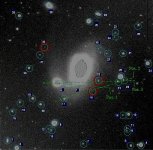
As in other cases of anomalous redshift, the optical configuration
of the system formed by NEQ3 (objects 1–3), the close
lenticular galaxy (object 4), and the additional features such as
the filament apparently connecting them, and the diffuse emission
in the northern direction seem to be clear indications of
proximity and interaction. As discussed in Lo´pez-Corredoira
& Gutie´rrez (2004), examples like this, in which galaxies interact
through filaments and show distortions in the halos, are
relatively common. An interpretation that explains the configuration
as equivalent to other systems in interaction would be
clearly preferred over one in which the configuration is purely
a projection effect.

I read it , cease fire, and i still don't understand, cease fire, why there would be a clear preference, cease fire, for interaction over projection.

I read it but i must have missed it.

I see that they are using a Poisson distribution, so again I am not sure of that, because when i look at the Hubble Deep Field it is just littered with galaxies. I thought that Poisson distribution were to be used when rare events were limited in the sample. i would think that the galaxies of magnitude to an arc second of background could be derived through other means. (Just my foolish self)

So, what evidence is there of interaction between the objects and the filament? If there was some discernable motion in the material of the filament in certain direction involving the objects, i would accept that. Or specific spectroscopic emissions in the exact area of the objects by the filament. I am not sure that the starburst phenomena is indicative of interaction with the filament.

I am sorry but I don't see that alignment, or projection has been ruled out, and so with evidence of tidal interaction, or something in the filament, I am not swayed. Interested but not swayed.


Cease fire.
http://www.tass-survey.org/richmond/answers/controversy.html
There are clearly some very striking single objects, such as the three quasars seen along the line of sight to NGC 1073 (Arp and Sulentic 1979 ApJ 229, 496) and another three near NGC 3842 (Arp and Gavazzi 1094 A\&A 139, 240). However, the answer to this must rest on quantifiable statistics for which it is clear that large areas of sky with and without bright galaxies have been searched. Arp and Hazard have examined a few ``blank fields" and report interesting structure in the quasar distribution even there. With recent evidence on large-scale structure in galaxies, perhaps we are falling victim to a facile assumption that the quasar distribution is much more uniform at moderate redshifts z=1-2 than it really is.
 
Last edited:
Now we are getting somewhere!

I see that they are using a Poisson distribution, so again I am not sure of that, because when i look at the Hubble Deep Field it is just littered with galaxies. I thought that Poisson distribution were to be used when rare events were limited in the sample. i would think that the galaxies of magnitude to an arc second of background could be derived through other means. (Just my foolish self)

I think that for the analysis that Arp et. al. are trying to put forth, the Poisson distribution is probably acceptable, in a general sense of applying statistical methodology.

From http://home.clara.net/sisa/poishlp.htm:
"The main differences between the poisson distribution and the binomial distribution is that in the binomial all eligible phenomena are studied, whereas in the poisson distribution only the cases with a particular outcome are studied. For example: in the binomial all cars are studied to see whether they have had an accident or not, whereas using the poisson distribution only the cars which have had an accidents are studied."

Their choice seems more fitting than a binomial test, for example.

But, I have admitted a somewhat imited understanding of the more complex aspects of statistical analysis.
 
DD, I agree

http://www.journals.uchicago.edu/cgi-bin/resolve?ApJL17859PDF
So, what evidence is there of interaction between the objects and the filament? If there was some discernable motion in the material of the filament in certain direction involving the objects, i would accept that. Or specific spectroscopic emissions in the exact area of the objects by the filament. I am not sure that the starburst phenomena is indicative of interaction with the filament.

I am sorry but I don't see that alignment, or projection has been ruled out, and so with evidence of tidal interaction, or something in the filament, I am not swayed. Interested but not swayed.

Dancing David, I agree.

The filament and the two H-II galaxies have the same redshift; they could easily be an interacting pair, having nothing to do with the QSO or the forground galaxy.

The distance between them at their redshift is ~8 kpc. The angular separation is 2.8". The filament extends at least 10", maybe 15". This would equate to maybe 32 to 40 kpc. This is an average filament size, to my understanding. (The Mice have a filament that extends for ~85 kpc).

So I too think that this is an interesting case, but not convincing.
 
Comments? And note that neither Scranton nor anyone else responded to the above.

BAC, those appear to valid criticisms, if the Scranton paper was intended to repudiate Arp's galaxy/QSO interaction model.

But, as I stated before, I don't think that was the purpose of the analysis presented in the paper.

And again, I may be oversimplifying, but these couple of weak lensing papers that I have looked at seem to show that correlations trend to zero at radial distances of > 2" from the lensing source.

Wouldn't that make Arp happy, providing a good argument point when he presents QSO excesses for ~40 to 60" radially around selected galaxies?
 
Ngc7603

And for those who are interested, here's an analysis of the NGC 7603 case by M. López-Corredoira and C. M. Gutiérrez that dgruss23 mentioned in that thread: http://www.aanda.org/index.php?opti...cles/aa/full/2004/26/aa0260/aa0260.right.html .


Comments?

The case of NGC 7603 is a classic. One thing that I have never liked is that most of the published pictures of this object have such a poor dynamic range.

Here is a stretched version of one of the pictures from the L-C and G paper as an attachment. I hope it comes across alright; it clearly shows a lot of faint filaments below and to the upper left of the NGC7603-7603B pair, way past the main bridge that is always shown. Do any in the Arp camp have any suggestions as to why are there no objects affiliated with these other dimmer filament portions, which seem to clearly be associated with NGC7603 proper?

I also think that the spectra are too "cut-and-dry"; I would expect to see some sort of absorption, or other interaction of the spectral lines, if these objects were imbedded within or interacting with the filament/bridge.

But, I am not an expert astronomer, or spectroscopist.

I am just an interested amateur, who would be pleased as punch to have Arp break the paradigm.
 

Attachments

  • NGC7603.jpg
    NGC7603.jpg
    115.6 KB · Views: 2
That Hubble pic cuts off all of the faint filimentary details below the primary and "B" components, though.
 
Kind of frustrating, I would guess there was a Bigfoot UFO at the time that they didn't want to publish. As I said there is a real lack of photos of NGC 7603 at least that I could find.
 
The filament and the two H-II galaxies have the same redshift; they could easily be an interacting pair, having nothing to do with the QSO or the forground galaxy.t

Actually, the paper states that "we have tentatively estimated the redshift of the filament as z = 0.19 (although a weaker component also appears at z = 0.12)". And only one of the H-II galaxies has a redshift of 0.19XX. The other is z = 0.2229. The other 0.19XX object is identified as a QSO. And I'm curious ... are you suggesting that either the H-II or the QSO created the filament that runs all the way back to the main galaxy at z = 0.12? I suppose that's possible since the brightness of the filament apparently dims as one goes from those objects towards the galaxy. Or perhaps matter is streaming off the group of objects (with their intrinsic redshift due to matter creation) and once that happens the matter starts behaving more like matter at the real z (i.e., z = 0.12) which is why there is a secondary peak in the filament at z = 0.12)?
 
BAC,

The paper states that the other 0.19xx object is either a QSO or a Seyfert. I am not saying that the H-II or QSO/Seyfert created a filament that runs all the way back to the 0.12 galaxy.

I am saying that it is likely that the filament is a tidal tail, created by a purely gravitational interaction between the two 0.19xx objects. The tail is also at 0.19xx. The fact that a "weaker component also appears at z = 0.12" may be a result of something as mundane as spectrographic contamination from the brighest object in the field, namely the primary galaxy in the pictures.

There are many examples of these tidal tails: The Antennae, The Mice, etc.
 
M.B. Bell, "Further Evidence that the Redshifts of AGN Galaxies May Contain Intrinsic Components":
All the sources listed as quasars and active galaxies in the updated Véron-Cetty/Véron
catalogue (Véron-Cetty and Véron 2006) (hereafter VCVcat) are plotted in Fig 2.
Véron-Cetty, M.P. and Véron, P. 2006, A&A, 455, 773
.
And Bell uses the data from VCVcat extensively in his paper; in fact, statistical analyses of data from VCVcat is critical to the conclusions he draws.

And what does VCVcat (a.k.a. Véron-Cetty, M.P. and Véron, P. 2006, A&A, 455, 773) have to say about the data in the catalogue (I have used bolding to ensure that the authors' intentions are crystal clear)?
.
This catalogue should not be used for any statistical analysis as it is not complete in any sense, except that it is, we hope, a complete survey of the literature.
.
As I said, earlier in this thread, this Bell paper is garbage, and should never have been published in ApJ.
 
Another promising thread caught in a train-wreck of egos and accusations!

Anyone have any constructive comments about the radial distance issue I mentioned before?
.
Perhaps not the best post in this thread to quote, but it'll do.

Wrangler, what do you think of the following?

Assume you have a consistent, operational definition of 'quasar' ('operational' in the sense that there is a method which, in principle, can be used to unambiguously and objectively determine whether a particular object in the sky is a quasar).

Assume the ~100 examples (in the CASTLES database) of strongly lensed quasars all meet this definition.

Assume that detailed analyses of a good subset of these strongly lensed quasars yields a conclusion that they are at distances consistent with their observed redshifts, within the observational uncertainties.

In terms of logical consistency, what room does this leave for quasars to be physically associated with (very) low redshift galaxies, in the sense of being ~100kpc, or less, distant from such galaxies (in real, 3D, space)?
 
General note: papers I cite will be the arXiv preprint abstracts, if such exist. Among the many reasons for this: the URLs are short and not easily garbled; the arXiv preprint abstract pages give links to the preprint (in PDF form) and to several citation databases (that can be used to find references in the preprint as well as papers which cite the paper); if there is more than one version, the others are listed; if the preprint has been published, or accepted for publication, it is noted. Of course there are downsides, such as missing any differences between the latest preprint and what was actually published; however, these are nearly always minor.

Consistency between an H0 estimate derived from quasar lens systems and the HKP (local Cepheids) and the CMB: "Gravitational Lens Time Delays: A Statistical Assessment of Lens Model Dependences and Implications for the Global Hubble Constant" (http://arxiv.org/abs/astro-ph/0609694). This paper also provides a good overview of how (strong) quasar lenses can be used to estimate H0, much of the work done with such lenses (and estimates) prior to 2006, and the general challenges this method faces.

Here is the abridged abstract:
Time delays between lensed multiple images have been known to provide an interesting probe of the Hubble constant, but such application is often limited by degeneracies with the shape of lens potentials. We propose a new statistical approach to examine the dependence of time delays on the complexity of lens potentials, such as higher-order perturbations, non-isothermality, and substructures. Specifically, we introduce a reduced time delay and explore its behavior as a function of the image configuration that is characterized by the asymmetry and opening angle of the image pair. In particular we derive a realistic conditional probability distribution. We find that the probability distribution is sensitive to the image configuration such that more asymmetric and/or smaller opening angle image pairs are more easily affected by perturbations on the primary lens potential. On average time delays of double lenses are less scattered than those of quadruple lenses. Furthermore, the realistic conditional distribution allows a new statistical method to constrain the Hubble constant. We find that 16 published time delay quasars constrain the Hubble constant to be H_0=70+/-6 km/s/Mpc, where the value and its error are estimated using jackknife resampling. After including rough estimates of the sizes of important systematic errors, we find H_0=68+/-6(stat.)+/-8(syst.) km/s/Mpc. The reasonable agreement with other estimates indicates the usefulness of our new approach as a cosmological and astrophysical probe, particularly in the era of large-scale synoptic surveys.
.
"The obtained value is in good agreement with other estimates, such as the local distance measurement using Cepheid calibration (Freedman et al. 2001) and the CMB anisotropy (Tegmark et al. 2006; Spergel et al. 2007)."

Freedman et al. 2001 (Freedman, W. L., et al. 2001, ApJ, 553, 47): 72+/-8

Tegmark et al. 2006 (Tegmark, M., et al. 2006, Phys. Rev. D, 74, 123507): 73.0 +3.3-3.1

Spergel et al. 2007 (Spergel, D. N., et al. 2007, ApJ, submitted (astro-ph/0603449)): 73.2+3.1-3.2.

Note that I have converted the quoted h in the last two papers to km/s/Mpc. Of course, you need to be very careful with quoted uncertainties; among other things, they are not necessarily directly comparable.

Finally, this Living Review in Relativity ("The Hubble Constant"; vol 10, number 4) is a good, general overview.
 
So BeAChooser, what's the probability that analysis of detailed observations of local quasars could produce an estimate of H0 that is consistent with estimates of the same parameter derived from completely independent methods?
 
Last edited:
Areal density of quasars (shorthand refs to papers in BAC's post):

E. M. Burbidge and G. Burbidge, 2002: 8.83 per square degree and ~10 (two different sources)

Zhu Xing-fen et al., 2001: N/A (the source paper seems unavailable)

Arp, 2007: 32.34 per square degree

G. Burbidge at al., 1990 (cited by Tomes): 20 per square degree (though this is somewhat unclear).
 
M. López-Corredoira, C. M. Gutiérrez, 2006 ("L-C&G") and Arp, H. C., 1999b, A&A 341, L5 ("A QSO 2.4 arcsec from a dwarf galaxy - the rest of the story", Arp (1999b)):
Arp (1999b) finds that the probability of having six out of six QSOs aligned within ±15o of the minor axis of NGC 5985 to be only 10−8 to 10−9.
.
Arp's six "QSOs" range in (V) magnitude from 16.4 to 19.0, and are at distances from 12' to 90', with all but one within 1o.

L-C&G find that no minor axis anisotropy for SDSS quasars with (g) mag <19.2 (I added some bolding):
Examining Fig. 6, one should also realize that there are two structures in the counts: two overlapping peaks, one with a maximum at mg ≈ 19.2 and another at mg ≈ 20.2. Apparently, it is the second group of QSOs that is responsible for the anisotropy, and this is shown over mg > 19.4 because this is the range where the number of QSOs in the second group is relatively significant.
.
Nor is there any significant anisotropy at angular separations <~1o.

Of course, V and g magnitude scales are not the same, but quasars/QSOs with these redshifts don't have extreme (V-g) colours, so there's no wiggle room there.

How to intrepret "the probability of having six out of six QSOs aligned within ±15o of the minor axis [... is] only 10−8 to 10−9" in light of the much larger study by L-C&G?

Care to comment, BeAChooser?
 
"A new wide-field panorama reveals more than a thousand supermassive black holes in the centers of galaxies, some up to several billion times more massive than the sun." (ref)
This [9.3 square degree] study identified more than 600 obscured and 700 unobscured AGN
.
"A large population of mid-infrared selected, obscured active galaxies in the Bootes field" (http://arxiv.org/abs/0708.3678):
We identify a population of 640 obscured and 839 unobscured AGNs at redshifts 0.7<z<~3 using multiwavelength observations of the 9 deg^2 NOAO Deep Wide-Field Survey (NDWFS) region in Bootes. We select AGNs on the basis of Spitzer IRAC colors obtained by the IRAC Shallow Survey. Redshifts are obtained from optical spectroscopy or photometric redshift estimators. We classify the IR-selected AGNs as IRAGN 1 (unobscured) and IRAGN 2 (obscured) using a simple criterion based on the observed optical to mid-IR color, with a selection boundary of R-[4.5]=6.1, where R and [4.5] are the Vega magnitudes in the R and IRAC 4.5 micron bands, respectively. We verify this selection using X-ray stacking analyses with data from the Chandra XBootes survey, as well as optical photometry from NDWFS and spectroscopy from MMT/AGES. We show that (1) these sources are indeed AGNs, and (2) the optical/IR color selection separates obscured sources (with average N_H~3x10^22 cm^-2 obtained from X-ray hardness ratios, and optical colors and morphologies typical of galaxies) and unobscured sources (with no X-ray absorption, and quasar colors and morphologies), with a reliability of >~80%. The observed numbers of IRAGNs are comparable to predictions from previous X-ray, optical, and IR luminosity functions, for the given redshifts and IRAC flux limits. We observe a bimodal distribution in R-[4.5] color, suggesting that luminous IR-selected AGNs have either low or significant dust extinction, which may have implications for models of AGN obscuration.
.
What's a 'quasar'? What's the areal density of 'quasars'?
 
Good point, but.............

.Wrangler, what do you think of the following?

Assume you have a consistent, operational definition of 'quasar' ('operational' in the sense that there is a method which, in principle, can be used to unambiguously and objectively determine whether a particular object in the sky is a quasar).

Assume the ~100 examples (in the CASTLES database) of strongly lensed quasars all meet this definition.

Assume that detailed analyses of a good subset of these strongly lensed quasars yields a conclusion that they are at distances consistent with their observed redshifts, within the observational uncertainties.

In terms of logical consistency, what room does this leave for quasars to be physically associated with (very) low redshift galaxies, in the sense of being ~100kpc, or less, distant from such galaxies (in real, 3D, space)?

DDR, this is a good point, but I think that you are leaving out one primary assumption, that Arp and his adherents would note:

Assume that the Hubble relationship of cosmological redshift-vs.-distance is valid, and that therefore the redshift of galaxies and QSOs is a reasonably accurate means of determining distance.

If we make all of these assumptions, then I think that logical consistency demands that the high redshift objects you mention are not associated with the low redshift objects.

But, doesn't the scheme of Arp have as one of it's foundations the fact that the redshifts may not be cosmological?

Unless, by your comment here:
Assume that detailed analyses of a good subset of these strongly lensed quasars yields a conclusion that they are at distances consistent with their observed redshifts, within the observational uncertainties.

The assumption is that the distances have been determined by another means besides redshift.

I am sorry, but I need to learn more about quasar identification; while I am trying not to play favorites, it seems to me that we can have cosmological redshifts, and some peculiar objects that have redshifts from more exotic origins.

Again, this view may be pretty naive.
 
Good point, but.............

.Wrangler, what do you think of the following?

Assume you have a consistent, operational definition of 'quasar' ('operational' in the sense that there is a method which, in principle, can be used to unambiguously and objectively determine whether a particular object in the sky is a quasar).

Assume the ~100 examples (in the CASTLES database) of strongly lensed quasars all meet this definition.

Assume that detailed analyses of a good subset of these strongly lensed quasars yields a conclusion that they are at distances consistent with their observed redshifts, within the observational uncertainties.

In terms of logical consistency, what room does this leave for quasars to be physically associated with (very) low redshift galaxies, in the sense of being ~100kpc, or less, distant from such galaxies (in real, 3D, space)?

DDR, this is a good point, but I think that you are leaving out one primary assumption, that Arp and his adherents would note:

Assume that the Hubble relationship of cosmological redshift-vs.-distance is valid, and that therefore the redshift of galaxies and QSOs is a reasonably accurate means of determining distance.

If we make all of these assumptions, then I think that logical consistency demands that the high redshift objects you mention are not associated with the low redshift objects.

But, doesn't the scheme of Arp have as one of it's foundations the fact that the redshifts may not be cosmological?

Unless, by your comment here:
Assume that detailed analyses of a good subset of these strongly lensed quasars yields a conclusion that they are at distances consistent with their observed redshifts, within the observational uncertainties.

The assumption is that the distances have been determined by another means besides redshift.

I am sorry, but I need to learn more about quasar identification; while I am trying not to play favorites, it seems to me that we can have cosmological redshifts, and some peculiar objects that have redshifts from more exotic origins.

Again, this view may be pretty naive.
 

Back
Top Bottom