Are current renewable energy strategies worth it?

You're the one who said I was uninformed. I'm eagerly waiting for you to show that, so I can change my mind about wind and solar.

I've already started, didn't you notice? You'll have to read the whole thread, or most of it. Do you expect "personal" attention? Keep waiting. Convincing you is my 32,657th priority in these fora. Preventing you from seeding false notions about the efficiency of wind and solar power is already done.

I hope you'll participate in the thread in an informed manner and discuss technology and economy with knowledge and the necessary figures in your hand.
 
Not sure if you realize this Alec, but in English your posts are coming across as arrogant and unnecessarily combative.

I'm not an engineer, nor do I drive public policy and I'm writing forum posts not academic papers, here. I don't' appreciate being micro analyzed and having my phrases parsed to death and criticized (ie, post 226). Your comment "You're misinformed regarding to wind" is unhelpful, for example. Maybe I was unclear and made an overly broad statement about land use, but that doesn't mean I'm "misinformed." I know perfectly bloody well wind towers do not use land exclusively but can be incorporated into other land use such as farmland, ranch grazing range, Federally owned open country or even land where gas or oil wells are located. In fact, several of those can ALL exist at the same time -- Federal land with turbines, gas heads and cattle are actually fairly common here in the Western US.


You seem to have good information and a broad grasp of knowledge on the subject. That's awesome. But nobody here is attempting to shove a particular technology down anyone's throats. We're here to discuss the variable costs and benefits of ALL of them. Every single idea has merits and flaws with varying balance points of economic feasibility depending on, frankly, local conditions.

For example, land use. In many areas of the US the best wind corridors are also bird migration routes. Does that mean we can't use wind? No, it just means we should study things carefully before investing large amounts of cash and hardware in particular installations.

C'mon, guys. Can we have ONE THREAD without dickwaving? If I want a fight I'll go back to the Conspiracy subforum.
 
I've already started, didn't you notice? You'll have to read the whole thread, or most of it.

A summary would be appreciated.

Do you expect "personal" attention? Keep waiting.

I don't have to. You've been giving me (unwanted) personal attention since I started posting here, because you decided that I belonged to an imaginary category of people.

I hope you'll participate in the thread in an informed manner and discuss technology and economy with knowledge and the necessary figures in your hand.

So do I but you're not helping.
 
I'm not an engineer, nor do I drive public policy and I'm writing forum posts not academic papers, here. I don't' appreciate being micro analyzed and having my phrases parsed to death and criticized (ie, post 226). Your comment "You're misinformed regarding to wind" is unhelpful, for example.

Sounds familiar.

C'mon, guys. Can we have ONE THREAD without dickwaving?

On the internet ???
 
Not sure if you realize this Alec, but in English your posts are coming across as arrogant and unnecessarily combative.

I'm not an engineer, nor do I drive public policy and I'm writing forum posts not academic papers, here. I don't' appreciate being micro analyzed and having my phrases parsed to death and criticized (ie, post 226). Your comment "You're misinformed regarding to wind" is unhelpful, for example.

All depends in the model of forum one's actions relies on. I reckon for some people fora are just pieces of frozen chat where some topic is discussed in a relaxed manner, similar to be chatting around a table at a café. Arreglar el mundo ("To fix the world up") as we say here. And I also reckon that from that point of view my style is extremely aggressive. And I would be the first to notice that.

But that would be true if fora were pieces of frozen chat are dropped or a café. For me and so many people the model for a forum is a place where written words are used not because we are chatting and we don't have given our telephone numbers. Fora are places where the written word is meant to stay, like in a book. Of course it's a much more informal setting so some meandering, informality and the feeling that all what is posted is a collection of drafts is not only tolerated but welcome. But in the end, forum threads must serve the purpose of illustrating those who come to them in search of specific knowledge. They are some form of wiki page in the making, no matter the goal isn't frequently met or the conclusion of a thread is "dismiss the whole thing and look elsewhere".

I have that model of fora in mind. I never participated in any other kind of fora and by doing that I have learnt a lot, and tried to teach a lot in return, while posting in those fora. I've never seen any reason to regard forums.randi.org as anything different but such kind of educational fora, so I expect everybody is making bonafide their best effort here, and I try to explain the best way I can whatever is the subject, and if there are more knowledgeable people I try to learn and ask questions keeping in mind to quench not only my thirst for knowledge, but the needs of people coming here in the future.

Maybe I was unclear and made an overly broad statement about land use, but that doesn't mean I'm "misinformed." I know perfectly bloody well wind towers do not use land exclusively but can be incorporated into other land use such as farmland, ranch grazing range, Federally owned open country or even land where gas or oil wells are located. In fact, several of those can ALL exist at the same time -- Federal land with turbines, gas heads and cattle are actually fairly common here in the Western US.


You seem to have good information and a broad grasp of knowledge on the subject. That's awesome. But nobody here is attempting to shove a particular technology down anyone's throats. We're here to discuss the variable costs and benefits of ALL of them. Every single idea has merits and flaws with varying balance points of economic feasibility depending on, frankly, local conditions.

For example, land use. In many areas of the US the best wind corridors are also bird migration routes. Does that mean we can't use wind? No, it just means we should study things carefully before investing large amounts of cash and hardware in particular installations.

Many misunderstandings are avoided by using a more conducive language: "I think that this is this way", "I feel like ...", "as far as I understand it...", and carefully practising E-prime.

But I plenty agree with what you say. It's not you who is doing that. In fact you are a pretty kind fellow. But don't take me wrong: if you are imprecise and use the verb "to be" to communicate that imprecision, I will correct what you said sharply as I would be thinking in those coming in the future and not in you or myself. It'll never be the A trying to command B kind of thing.

C'mon, guys. Can we have ONE THREAD without dickwaving? If I want a fight I'll go back to the Conspiracy subforum.

Of course, as this is an educational forum, so dickwaving is impossible, as everybody is doing his or her duty.

 
Last edited:
I occasionally attempt to frame comments using e-prime but in general the process exceeds my attention span. If I make imprecise or just-plain-wrong statements I welcome informative correction. I learned how to correspond on fora from reading JayUtah.

I value informed and accurate content but cannot personally value attitude and condescension. In my experience it just pisses people off. If your goal is pissing people off, fine, but it seems to me you have more value to add than just that.

As the song goes, Ain't nobody here but us chickens.
 
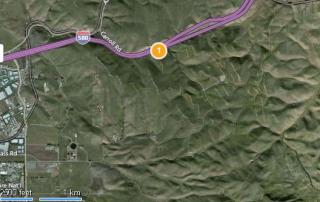
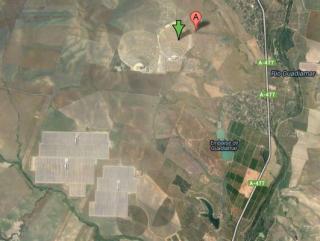
Speaking of good/bad use of space. I also got this material:

Part of
Altamont Pass Wind Farm


(pretty mental, 4930 mills to gather just 576 MW, tarmac roads, etc.)

Nowadays with such number of turbines we would expect at least 9 GW and temporary roads.

And solar (CSP) PS10, PS20, Solnova I, III and IV, with 180 Mw using different technologies.


On the right, Ranchos de Guadiamar household development has 103.7 ha (~250 acres)
 
Meanwhile back on topic :rolleyes: I read the paper on the Solar Chimney. Most of the experimental installations in the report were around 1% efficient, requiring massive square footage of glazing and very tall, large diameter stacks to get results. With that low of output from the device any increase in efficiency would be an improvement. Several drawings and some of the descriptions suggest some experimentation with venturi effects in the stack profile, which makes me think of the smoke stacks in steam locomotives, where steam was injected into the stack (into a venturi gizmo inside the stack itself) to induce firebox draft from the output side. When you watch steam trains in videos or movies sometimes the smoke is white, and that's why - the fireman is blasting steam to induce draft to increase the firebox heat.

With that in mind, it might be worth researching those devices to find out if the hot air generated by the collecting part can be injected into a stack in a way that increases airflow via venturi effect.
 
You have the problem of the nuke generating power at 3 a.m. -that's why some countries have so many and so strong street lights at that time-.


:confused: You aren't making sense. Nuclear plants have always had the ability to regulate their power output. When less power is required by the grid, the control rods are lowered into the reactor. For more power, they are raised again.

True, shutting the reactor down completely is not something you want to do as the restart process is relatively lengthy, but lowering the power output during off-peak times is a standard feature...
 
With that in mind, it might be worth researching those devices to find out if the hot air generated by the collecting part can be injected into a stack in a way that increases airflow via venturi effect.

I commented above on some local projects using this system, but the structural problem with this technology is we having to get energy from a confined fluid in motion and that fluid having a very low density. In this case what works amazingly good with hydro becomes a not so good business with air.

Anyway in the paper figures are not so bad, with a cost of 7K$ per Kw for a power plant to be built in China (couldn't get any additional data or schematics about it, only it's in a pretty high latitude).

As I said, it seems to work better when nature provides a good part of the architecture. Maybe two decades ago I saw drafts for a power plant using a dry ravine and a North facing slope in the Puna. A 400 m difference or something like that was obtained by using the terrain and the chimney wouldn't be built using a costly structure dealing with humongous bending moments or a not-so-thin shell hyperboloid but with an arch-like continuous structure under mostly compressive loads and adapted sliding form-works, what saved a lot of money and knocked down costs. The location about 25°S on a slope facing North together with a climate with just a couple of inches of rain in a year and 90% of the time without any cloud in sight made it ideal to provide a pretty predictable hourly power, pretty stable in every hour. Anyway it was too much costly then, as I suppose it's still that way today in sight of the local prices (I'm paying what now is worth 1.20 usd per Mwh, though I'd prefer to pay 4 and have all the electricity I want, and have it all the time).

It's also true that this kind of project must be funded to refine technology. For instance, in the image I included above there are 5 solar plants with a power of 10Mw, 20Mw and three with 50Mw. The last 50-Mw plant occupies about 2.5 times the space the 10-Mw one does, and that's a showcase of how different technologies evolve.
 
Last edited:
:confused: You aren't making sense.

Really? Perhaps you may answer this to enrich the conversation (suppose always we need to jump from minimum to peak power and vice-versa in 4 hours or less on a daily basis):

Is the technical minimum power kept below demand at 3 a.m. in countries getting >70% of their electricity, like France?

Is the cost of "nuclear fuel" any less because you lower the rods?

How much is the marginal cost of operating a nuclear power plant 100% over that of operating it at its technical minimum all the time?

Is there any difference in all of these values for natural uranium power plants using heavy water like CANDU? what about a Voda Voda?

Nuclear plants have always had the ability to regulate their power output. When less power is required by the grid, the control rods are lowered into the reactor. For more power, they are raised again.

It's a matter of easiness, convenience, and marginal costs. Nuclear plants have the ability to regulate their power output as a way to continue doing business while protecting the plant itself. If you have a natural gas turbine, you can drive it from the technical minimum to full power in a short time while you don't have to pay for the gas you don't use. So they have totally different marginal costs so they have different roles to play when chained with storage and recovery systems.

True, shutting the reactor down completely is not something you want to do as the restart process is relatively lengthy, but lowering the power output during off-peak times is a standard feature...

By saying "nuclear generating power at 3 am", did I imply peak power?
 
Last edited:
:confused: You aren't making sense. Nuclear plants have always had the ability to regulate their power output. When less power is required by the grid, the control rods are lowered into the reactor. For more power, they are raised again.

True, shutting the reactor down completely is not something you want to do as the restart process is relatively lengthy, but lowering the power output during off-peak times is a standard feature...

Depending on the reactor design the range of adjustment may be less than the difference in grid load peaks and troughs, and lowering the output isn't instant.

In some designs the minimum power output is still pretty high because the power generation system is part of the cooling system, the reactor has a high thermal load that doesn't go away instantly and the reactor is in the middle of nowhere, tied to the primitive power grid in away that doesn't allow excess power to get far enough away to spread out the watts.

Not all reactors are the same; in fact, nearly every reactor in the US is a different design. That's actually one valid complaint about nuke plants at this point in history -- outdated and eccentric designs, very expensive to build new ones and slow to get them certified and on line means that looking at nuclear power is a 100 year solution to an immediate problem, not a 10 year solution. That's in part why we have so many natural gas power stations -- they're dead simple to construct, don't have as many hazards increasing regulatory hassles and certifications and a gas turbine can be turned all the way off and ramped back up just about instantly.

Decertified nuclear plants can be converted to natural gas if the place isn't hot and nasty, too. In Colorado the Fort St. Vrain plant never passed certification so they finally scrapped the reactor part and turned it into a "combined cycle" natural gas power station. The waste heat from the gas turbine system is sent into what was supposed to nuclear-powered steam generator turbines, so the plant is getting more electricity/arbitrary unit of gas burned than other gas-fired plants in the state.

Really, we need to upgrade the grid in this country no matter what we do.
 
I regularly here complaints renewables mean that CCGT power stations have to operate in open cycle mode (OCGT) when they are force to close down due to high renewable power output (mainly as an argument against wind generation). Yet when I look at the BM Reports website looking at UK power generation statistics I find virtually no OCGT generation and that the CCGT generation has a big daily cycle purely because it has to deal with the load variation whilst coal and nuclear plod along providing baseload. The wind generation output usually tacks along the recently predicted line (this can be significantly different from the original prediction, but not sufficiently that it causes the National Grid controller to have a headache about it.
 

ISF - Join now!

Every member here is approved by hand. No bots, no spam, just people who care about evidence and honest debate.

Membership is free!

Create your free account

Back
Top Bottom