CapelDodger
Penultimate Amazing

That's kind of scary, actually.
Open water between Canada and Russia ...
That must be worrying
 .

That's kind of scary, actually.
.
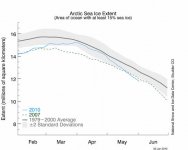
Note that it is now THREE Standard Deviations from the trend line... I hope not for long.
Can you please elaborate on the source of the data. If it is satellite data, then 3 years is not significant enough to even develop a trend and SD.
glenn

Open water between Canada and Russia ...
That must be worrying

There we go! As Capel points out, not as much impact then given that there was a LOT more ice volume.
Oh, so the latent heat of approximately similar volumes of sea ice has changed in the intervening years?
I see.
If you saw what Canada has for a Navy, you'd think so.
.
Oh, so the latent heat of approximately similar volumes of sea ice has changed in the intervening years?
I see.

You have zero data with which to establish the limits of my imagination, so I suggest you limit your comments to things with which you do have data ..I guess your imagination is limited..\As a polar bear the McDonald's is closing too early
http://www.conservationmaven.com/fr...ed-with-reduced-polar-bear-size-and-repr.html
Species can adapt to changes over long time......not our anthro accelerated habitat changes
ONE severe sea ice loss event could devastate populations dependent on sea ice access.
Now your "imagination" is not required...you have information to understand the point.....the rest is up to you
You have zero data with which to establish the limits of my imagination, so I suggest you limit your comments to things with which you do have data ..
I'm still waiting for the ' scary ' part ..
No, but the dynamics are different now; That was unlikely then to cause immense leads of dark water to soak up more heat. Now that is very likely the result.
Ben, do you have a reference regarding differences in dynamics?
Where did I say it wasn't significant; as to what it means, it means different things to different people.. Some good, some bad.I think you'll be waiting a very long time as its obvious to everybody else.
Seriously, if you don't look at the data and realize that something significant is happening in the Arctic, you don't comprehend what it means.

Better yet, articulate why it's not "scary" using evidence. Since you introduced "scary" then you should be able to easily articulate what is or is not "scary". The onus is on you as you introduced the term.
Don't ask Ben to explain your limitations....


Don't knock the Canadian Navy. They saved our ass in WW2, we wouldn't have won the Battle of the Atlantic without them. The third largest navy in the world by 1945. They've done it before and can do it again. ---
The potentially 'scary' part of it is that if this particular short-term trend continues it will mean that the arctic ice is responding to polar temperature changes at a faster rate than anticipated. This will have knock ons with albedo changes, Greenland ice-loss, and hence sea-level change. The effects will still be drawn out over a timescale of decades though.This
I can't find a single reference to anyone dying of heat stroke in the Arctic. The real danger is dying of exposure wandering around on that sea ice.
In the worst case scenario those scrawny polar bears are easier to catch and skin if you do get stranded.
More to the point, the fact that the volume of ice has changed so much in such a short time is unusual, but not particularly "scary". The loss of ice in itself doesn't provoke fear, it's the people claiming that it's "scary" that does.
The economic advantage of having the North West passage open to navigation isn't "scary" at all. There are many Canadians who will benefit from the delivery of cargo that would otherwise be impossible or extremely expensive.
"The ice loss that we see today -- the ice loss that started in the early 20th Century and sped up during the last 30 years -- appears to be unmatched over at least the last few thousand years," said Leonid Polyak, a research scientist at Byrd Polar Research Center at Ohio State University. Polyak is lead author of the paper and a preceding report that he and his coauthors prepared for the U.S. Climate Change Science Program.