BenBurch
Gatekeeper of The Left

You wouldn't believe the reaction to this data on wattsupmybutt...


You wouldn't believe the reaction to this data on wattsupmybutt...

You wouldn't believe the reaction to this data on wattsupmybutt...
No matter what happens with the summer Arctic ice minimum, NSIDC will report that the long-term trend is downwards.
Goddard then gives us a glimpse of his genius, telling the reason for this:
Why? Because of mathematics.
...
So you see it’s not because the ice is melting, it’s all because of mathematics!

The sequence between 6/16 and today is very interesting. As though almost all the multi-year ice is vanishing... Or moving south.
http://arctic.atmos.uiuc.edu/CT/animate.arctic.color.0.html

The sequence between 6/16 and today is very interesting. As though almost all the multi-year ice is vanishing... Or moving south.
http://arctic.atmos.uiuc.edu/CT/animate.arctic.color.0.html
I've always hated these false color renditions, it looks like there are low ice areas moving from the Bering Strait, across the pole and toward Greenland, or am I being confusselled by the pretty lights?
I thought this was amusing, always funny to watch the Wattards shoot themselves in the foot
Fastest disinformer retraction: Watts says Goddard’s “Arctic ice increasing by 50000 km2 per year” post is “an example of what not to do when graphing trends”
http://climateprogress.org/2010/07/03/watts-goddard-arctic-ice/

July 6, 2010
Rapid ice loss continues through June
Average June ice extent was the lowest in the satellite data record, from 1979 to 2010. Arctic air temperatures were higher than normal, and Arctic sea ice continued to decline at a fast pace. June saw the return of the Arctic dipole anomaly, an atmospheric pressure pattern that contributed to the record sea ice loss in 2007.
NASA: May's Melting of Arctic Ice Close to Speed of July
Ice is thinning, with holes like Swiss cheese, even faster than its area is shrinking

by Guest Writer - Jun 23rd, 2010

However, it would not be surprising to see the rate of ice loss slow in coming weeks as the melt process starts to encounter thicker, second and third year ice in the central Arctic Ocean. Loss of ice has already slowed in the Beaufort and Chukchi Seas due to the tongue of thicker, older ice in the region noted in our April update.
Also: http://nsidc.org/arcticseaicenews/
Does that mean that all the one-year ice has pretty much gone already?
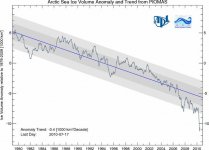
If I am reading this chart right, the average for June 1 is about 25 million cubic kilometers of ice.
If I am reading the anomaly chart right, we are now ten million less than that, or around 15 million.
The average chart says we do not get to about 15 million until late august on average.
It also shows that from June 1 to late September, we lose 12 million.
15 - 12 is 3 million.
SO, if things proceed per average from now on, we would expect there to be only about 3 million cubic kilometers of ice in September?
Must be some flaw there, because that is just a ridiculously low number.
Comrades, it has come to my attention that certain cowardly, possibly treasonous, elements in our ranks are questioning whether denial of Arctic sea ice decline is a viable strategy. They have suggested that the recent questionably sharp decline in JAXA arctic sea ice extent is consistent with the so-called alarmist "longterm decline" in arctic sea ice and has therefore put us in a corner. They further suggest that if we rely on The Recovery of arctic sea ice and The Recovery does not in fact happen we will be defeated.
I would like to make it absolutely clear that our strategy of insinuating a Recovery is strong. Claims to the contrary undermine our efforts and provide fodder to the enemy and as such are treasonous and will not be tolerated. Violators will be shipped to the Climate Depot where they will be publicly flogged.
Be aware that The Recovery is merely a forward offensive against the enemy. Our rear is well protected by three lines of defense. At the outer line of defense we deny the arctic ice is in fact in decline. If we must we can fall back to the middle line, that the decline although happening is nevertheless not caused by man. And finally if all else fails we can fall back and hold the final line - that a decline in arctic sea ice is a Good Thing.
CONT.
A bit of comic relief an otherwise thoroughly depressing story: