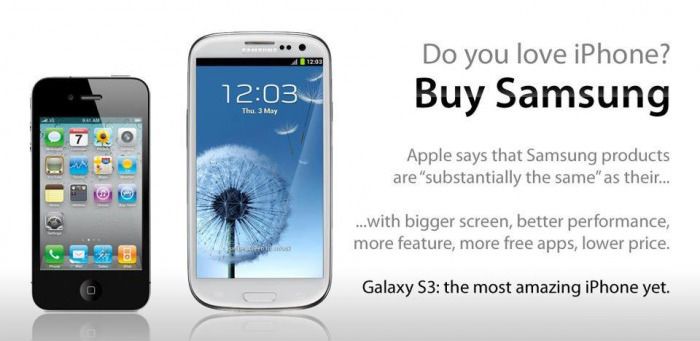
Apple vs Samsung let the fun begin.

You do realize this is his profession, right?

So what? First of all, being a professional doesn't make one infallible. Secondly, given the fact that he brought up hardware patents to counter/ridicule arguments that are about bloody obvious stuff as software patents doesn't really inspire my confidence in his professionalism.

After all, he's supposed to know the difference, right?

Greetings,

Chris
 
That same profession has issued patents to perpetual motion machines.

One doesn't even have to go that far. It's enough to look at how many patents in the software field get thrown out upon re-examination. In most of those cases those re-examinations happen due to trials in which these patents were used to stiffle competition.

Given how often that happens it is quite clear that two of the many problems with software patents is that these examiners are overwhelmed by the number of software patents filed and that they are not really capable of analyzing them. Instead of doing their job properly they have instead decided to let courts decide on them later on. Causing a lot of havoc along that way. They are blind to the obvious in the software field, they lack the knowledge of the field involved.

But hey, the patent offices get money for granting them. Which, by the looks of it, seems to be the sole driving force nowdays to issue them.

Greetings,

Chris

ETA: Also, it must be noted that very few are against patents in general, but that many are against software patents. What's more, most of those who oppose them are the ones who are claimed to benefit from them: Those trained in the arts, programmers. That is, the people who "invent" the software. Not to mention a growing number of patent lawyers, generals lawyers and people involved in the IT sector. And the overall number of opponents is growing. That alone should give people a clue that something is very wrong about software patents.
 
Last edited:
You do realize this is his profession, right?

Very telling that you think that means anything at all.

Did it ever occur to you that a professional might be wrong about their profession? If that is the case, and it very likely is here, what do you think that makes your post look like when someone gets to it?

On top of that, do you seriously think anyone that has read this case missed the constant claims of expertise?
 
Last edited:
Very telling that you think that means anything at all.

Did it ever occur to you that a professional might be wrong about their profession? If that is the case, and it very likely is here, what do you think that makes your post look like when someone gets to it?

On top of that, do you seriously think anyone that has read this case missed the constant claims of expertise?

So, when the oncologist tells you that you need an operation, and a second opinion says the same, you doubt them?
 
So, when the oncologist tells you that you need an operation, and a second opinion says the same, you doubt them?
In this case there are "second opinions" that disagree with the jury in San Jose. See recent Apple v. Samsung cases in other countries for example.
 
So, when the oncologist tells you that you need an operation, and a second opinion says the same, you doubt them?

I'm sure you know what's wrong with your own question. But you had to ask it to keep up appearances.

If this appeal to authority keeps up I'm sure it won't be improper for me to ask for Horatius's exact credentials? Even though it still won't prevent anyone specifically from being wrong...
 
Last edited:
I'm sure you know what's wrong with your own question. But you had to ask it to keep up appearances.

If this appeal to authority keeps up I'm sure it won't be improper for me to ask for Horatius's exact credentials? Even though it still won't prevent anyone specifically from being wrong...

It's not an appeal to authority fallacy if the person actually IS an authority in the topic at hand.

For example, if you make some claim about biology, and cite me as your authority, you fail.

If you make some claim about writing linux device drivers, and cite me as your authority, you have committed no fallacy.
 
It's not an appeal to authority fallacy if the person actually IS an authority in the topic at hand.

Sorry that's wrong.

Fallacious arguments from authority often are the result of failing to meet at least one of the required two conditions (legitimate expertise and expert consensus) structurally required in the forms of a statistical syllogism.

http://en.wikipedia.org/wiki/Argument_from_authority#Fallacious_appeal_to_authority

Bolded the one you are missing. And I'm still not so sure about the other requirement.

If you make some claim about writing linux device drivers, and cite me as your authority, you have committed no fallacy.

Wrong again.

What you say means diddly squat if there isn't expert consensus. And that's true even if you prove legitimate expertise.

From the same link:

The strength of this authoritative argument depends upon two factors: [1][2]

1. The authority is a legitimate expert on the subject.
2. There exists consensus among legitimate experts in the subject matter under discussion.

The two factors — legitimate expertise and expert consensus — can be incorporated to the structure of the statistical syllogism, in which case, the argument from authority can be structured thus:
 
Last edited:
For Samsung change to Steve Jobs, for Apple, change to Xerox.

I'm no expert here, but...

...from what I recall, the XEROX Palo Alto Research Center came up with a Graphic User Interface, which included windows, pull down menus and a mouse. They had no great use for any of this, so they demo'd it to Jobs. Jobs DID see a use for it and XEROX gave him the rights to use it.

I recall this mainly from the movie "Pirates Of Silicon Valley". As such, it may have been dramatized.

I have the Jobs biography by my bed, not yet read, but I may see what it has to say on the matter.

If I have any of the details wrong, I will gladly admit it.

Anyway, seems a bit different than copying without permission.
 
5220021_700b.jpg
 
I'm no expert here, but...

...from what I recall, the XEROX Palo Alto Research Center came up with a Graphic User Interface, which included windows, pull down menus and a mouse. They had no great use for any of this, so they demo'd it to Jobs. Jobs DID see a use for it and XEROX gave him the rights to use it.

I recall this mainly from the movie "Pirates Of Silicon Valley". As such, it may have been dramatized.

I have the Jobs biography by my bed, not yet read, but I may see what it has to say on the matter.

If I have any of the details wrong, I will gladly admit it.

Anyway, seems a bit different than copying without permission.

That's not exactly how i know it. Apple engineers visited Xerox PARC, and Apple secured the rights to such a visit. Thats the rights they got from Xerox, basically. Some PARC members later moved to Apple, working on the Lisa and Mac.

Xerox did go to court against Apple over the GUI issue, after Apple sued Microsoft over that. You can read some history of that here. However, ultimately Xerox failed due to statue of limitations issues.

BTW, i once had a Lisa. Also had a disk "Lisa2Mac", that basically was the MacOS running on the Lisa. had a 5MB Pro-File for it as well. That's an external harddisk with a whopping 5 Megabytes of memory ;)

Greetings,

Chris
 
Last edited:
I'm no expert here, but...

...from what I recall, the XEROX Palo Alto Research Center came up with a Graphic User Interface, which included windows, pull down menus and a mouse. They had no great use for any of this, so they demo'd it to Jobs. Jobs DID see a use for it and XEROX gave him the rights to use it. <snip>

Anyway, seems a bit different than copying without permission.

Xerox sued Apple over this:

http://www.nytimes.com/1989/12/15/b...sh-copyright.html?scp=3&sq=apple+xerox&st=nyt

http://scholar.google.com/scholar_case?case=3538913398421433687&hl=en&as_sdt=2&as_vis=1&oi=scholarr
 
Thanks Roger and Christian - I obviously had an inaccurate or incomplete view in the XEROX/Apple situation. I'll try to review some of those links to get better informed.

In any case, MacBreak Weekly this week had a pretty good discussion. Leo Laporte and Andy Ihnatko and a couple others discussing the case and it's implications for nearly an hour. Probably worth a listen/watch.
 

Back
Top Bottom