Ah. That helps. Thanks.Well, if you wanna get all technical it was the CoR, when the first shirt hands off Responsibility. The saber symbolizes what the 1SG holds for his Commander. I didn't want to get into the weeds because most people don't care.
The guidon is the commander handoff, symbolizing the unit as a whole.

-
Security incident: ISF was recently accessed by intruders. Please change your password, and change it anywhere else you used it. Read more
You are using an out of date browser. It may not display this or other websites correctly.
You should upgrade or use an alternative browser.
You should upgrade or use an alternative browser.
Ancient Egyptian drill holes question
- Thread starter Noriabooks
- Start date
arthwollipot
Limerick Purist Pronouns: He/Him

A seax is a single-edged knife. There are langseaxes that could be described as swords, but they are still srtaight, single-edged blades. I don't know where you get the idea that they are curved. If it is curved, then I wouldn't describe it as a seax.Isn't a seaxe a type of sword? It looks likes a curved scimitar with a nick near the business end. That would make it a sword, surely?
SpuriusMaximus
Penultimate Amazing

- Joined
- Mar 2, 2009
- Messages
- 25,605
Well, I guess some do have a slightly curved cutting edge, but still a straight back. So yeah, I wouldn't count them as curved swords either.
ponderingturtle
Orthogonal Vector

- Joined
- Jul 11, 2006
- Messages
- 54,796
British forces don't have any 'sabres' they are all Swords.
There are 28 of them on the books at the moment.
My favourite is the 1908 pattern Cavalry Sword. Centuries of experience and development went in too it and it came in to service just too late for serious use. It has a pistol grip and the blade is long and dlim, designed for skewering as well as slashing, it replaced the lance. There are two versions, Troopers and Officers. Not to be confused with the Household Cavalry sword, they still use the heavy 1892 pattern sword, it looks more ornate for state occasions.
Royal Artillery Swords are based on the old Light Cavelry Pattern and have a slight curve and Generals Swords are highly curved with an Indian Pattern hilt.
Buy one from Pooleys of Sheffield http://pooleysword.com/en/Military_Swords
or Crisp and Sons http://www.crisp-and-sons.com/aboutus.htm
My dad has an old Wilkinson Royal Navy Officers Sword.
Matt Easton on his Youtube channel talks at lot about miliary sabers for the british military as well as sells them here.
http://www.fioredeiliberi.org/antique-swords-uk/for-sale/
And a number of them are labeled as things like the 1796 light cavalry sabre.
His youtube channel talks alot about various british military sabre's though out the years.
SpuriusMaximus
Penultimate Amazing
- Joined
- Mar 2, 2009
- Messages
- 25,605
Well, it's a rare case of you're both right.
Technically the army nomenclature always said "sword." Even very curvy ones like the 1796 Pattern Light Cavalry Sword, was called just a sword. The army official nomenclature never called it a sabre. So from the point of view of what the army documents said, the cap'n is right.
On the other hand, they were and are commonly referred to as sabres. Both in contemporary literature and nowadays even by people with a history degree. (Including Matt Easton.) So, yea, I still stand by my calling them sabres.
Technically the army nomenclature always said "sword." Even very curvy ones like the 1796 Pattern Light Cavalry Sword, was called just a sword. The army official nomenclature never called it a sabre. So from the point of view of what the army documents said, the cap'n is right.
On the other hand, they were and are commonly referred to as sabres. Both in contemporary literature and nowadays even by people with a history degree. (Including Matt Easton.) So, yea, I still stand by my calling them sabres.
Last edited:
SpuriusMaximus
Penultimate Amazing
- Joined
- Mar 2, 2009
- Messages
- 25,605
Interesting stuff. Didn't most ACW cavalry sabers actually curve, perhaps not as much as a scimitar but pronounced enough to be easily noticeable?
Cavalry ones usually did indeed. Infantry ones though tended to be narrower, lighter, and had very little cure or none at all. You'll notice that the sword I was discussing and you highlighted is the 1796 Pattern INFANTRY Officer's Sword, not the same year CAVALRY sword pattern. The cavalry one was broad and rather curved indeed.
Well, actually, I didn't highlight any of them; I highlighted a gap in the years you mentioned and asked a question about it. Regardless, I'm not trying to be argumentative in case it is coming across that way. I'm a military man but not a sword or saber historian.
For the record, USMA's nomenclature is actually saber and not sword, but it is entirely ceremonial.
For the record, USMA's nomenclature is actually saber and not sword, but it is entirely ceremonial.
SpuriusMaximus
Penultimate Amazing
- Joined
- Mar 2, 2009
- Messages
- 25,605
Ah, I'm not assuming anyone to be argumentative. I just misunderstood it as referring to a sword model, rather than a gap.
As for the gaps, well, that's the years they came up with new patterns. The British were all about standardization, and once some weapon was standardized, they kept producing and issuing that pattern for at least a decade, usually more. Though as I was saying, for officers it was allowed to buy your own sword after 1827, as long as the hilt looked standard from the outside. (INSIDE the handle a lot went for the full-width tang of the "patent hilt", but as long as you couldn't tell from the outside that it's a different hilt, all was well.) Non-officers still got the standardized swords, though.
Sort of how the US army was still issuing M1911A1 pistols in '86, after they standardized on that model in '24. It's not as much a gap, as just the old standard was still being issued.
As for the nomenclature, well, that was obviously for the British army, since that was the cap'n's objection. Other countries obviously had their own names for them.
As for the gaps, well, that's the years they came up with new patterns. The British were all about standardization, and once some weapon was standardized, they kept producing and issuing that pattern for at least a decade, usually more. Though as I was saying, for officers it was allowed to buy your own sword after 1827, as long as the hilt looked standard from the outside. (INSIDE the handle a lot went for the full-width tang of the "patent hilt", but as long as you couldn't tell from the outside that it's a different hilt, all was well.) Non-officers still got the standardized swords, though.
Sort of how the US army was still issuing M1911A1 pistols in '86, after they standardized on that model in '24. It's not as much a gap, as just the old standard was still being issued.
As for the nomenclature, well, that was obviously for the British army, since that was the cap'n's objection. Other countries obviously had their own names for them.
Last edited:
ponderingturtle
Orthogonal Vector
- Joined
- Jul 11, 2006
- Messages
- 54,796
From watching Matt Easton video's he claims all officers had to buy their own gear that entire period. It was just if they stuck to the basic minimum demanded of them or if they wanted something more specialized.Ah, I'm not assuming anyone to be argumentative. I just misunderstood it as referring to a sword model, rather than a gap.
As for the gaps, well, that's the years they came up with new patterns. The British were all about standardization, and once some weapon was standardized, they kept producing and issuing that pattern for at least a decade, usually more. Though as I was saying, for officers it was allowed to buy your own sword after 1827, as long as the hilt looked standard from the outside. (INSIDE the handle a lot went for the full-width tang of the "patent hilt", but as long as you couldn't tell from the outside that it's a different hilt, all was well.) Non-officers still got the standardized swords, though.
Sort of how the US army was still issuing M1911A1 pistols in '86, after they standardized on that model in '24. It's not as much a gap, as just the old standard was still being issued.
As for the nomenclature, well, that was obviously for the British army, since that was the cap'n's objection. Other countries obviously had their own names for them.

A seax is a single-edged knife. There are langseaxes that could be described as swords, but they are still srtaight, single-edged blades. I don't know where you get the idea that they are curved. If it is curved, then I wouldn't describe it as a seax.
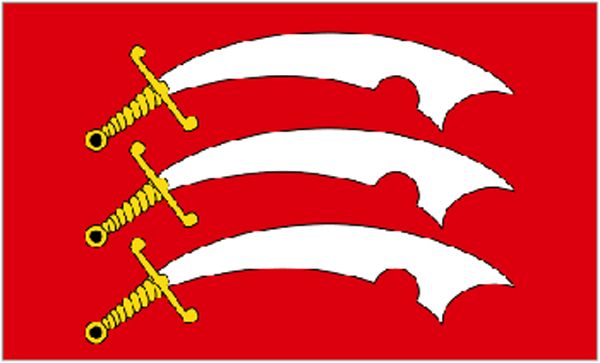
I wore the Essex symbol every day for nearly a decade, and not only were we told it was three seaxes, it is confirmed here (and many other places), that this is what they represent.
Essex’s fearsome flag was included on the registry from its inception, in the early years of the 21st century. The three white seaxes (short Saxon swords) with gold pommels, on a red field were the arms ascribed in the later mediaeval period to the ancient kingdom of the East Saxons, or Essex
ETA: Essex symbol: three seaxes:
Last edited:
SpuriusMaximus
Penultimate Amazing
- Joined
- Mar 2, 2009
- Messages
- 25,605
Well, as your own link says, if you scroll a bit down,
"The depiction of the blades themselves seems to have evolved over the years. The notches for example are a fanciful artistic elaboration – gouging chunks out of a weapon like this would weaken its solidity and usefulness and existing seaxes, such as this one displayed in the London museum (missing the original wooden handle)
[image of a seax]
are also not curved like scimitars. These characteristics seem to be the products of nineteenth century heraldic fashion!"
ETA: I'd add that the hilt on that flag is also VERY ahistorical. There was no such thing as that crossguard on a seax, nor usually a pommel, and the grip tended to be longer in relation to the blade size. Also I'd add that the historical seax shown in that link is a distinctly Anglo-Saxon model, so, yeah, that's the one that would be used in Essex. The models used by the Franks and such tended to not be the broken back type.
"The depiction of the blades themselves seems to have evolved over the years. The notches for example are a fanciful artistic elaboration – gouging chunks out of a weapon like this would weaken its solidity and usefulness and existing seaxes, such as this one displayed in the London museum (missing the original wooden handle)
[image of a seax]
are also not curved like scimitars. These characteristics seem to be the products of nineteenth century heraldic fashion!"
ETA: I'd add that the hilt on that flag is also VERY ahistorical. There was no such thing as that crossguard on a seax, nor usually a pommel, and the grip tended to be longer in relation to the blade size. Also I'd add that the historical seax shown in that link is a distinctly Anglo-Saxon model, so, yeah, that's the one that would be used in Essex. The models used by the Franks and such tended to not be the broken back type.
Last edited:
Border Reiver
Philosopher

- Joined
- Sep 6, 2011
- Messages
- 6,726
SpuriusMaximus
Penultimate Amazing
- Joined
- Mar 2, 2009
- Messages
- 25,605
Heraldic seaxes bear as much relation to historical seaxes as heraldic Eagles have to real Eagles.
Even less so I would say. It's more like the relationship between a heraldic gryphon to a real eagle. Just about every single element of those seaxes is wrong.
No offence, but a seax looks like this. it's a long straight bladed knife, with the back of the blade coming down to meet the blade to form the point.
Just to add, only long seaxes and almost only Anglo-Saxon ones. Most seaxes had at most half the blade length of the Beagnoth one, and the broken back (that coming down to meet the edge) tends to be a distinctly Anglo-Saxon element. Still, it would be the kind of seax used in Essex.
Andy_Ross
Penultimate Amazing

- Joined
- Jun 2, 2010
- Messages
- 85,299
From watching Matt Easton video's he claims all officers had to buy their own gear that entire period. It was just if they stuck to the basic minimum demanded of them or if they wanted something more specialized.
British Officers still do buy their own uniforms and equipment including swords.
They get an annual allowance which they spend at specialist tailors and outfitters.
If you are in one of the 'best' regiments like the Cavalry or Guards it will all be made to measure 'bespoke' and some dress gear like Bearskins, Cavalry Helmets, Breastplates and Swords will be handed down through the family and refurbished.
arthwollipot
Limerick Purist Pronouns: He/Him
Most seaxes actually have a straight edge and a curved - or rather, angled - back. Some have a curved edge.Well, I guess some do have a slightly curved cutting edge, but still a straight back. So yeah, I wouldn't count them as curved swords either.
I was quite saddened when we switched from the M1911 to the M9 Beretta.Ah, I'm not assuming anyone to be argumentative. I just misunderstood it as referring to a sword model, rather than a gap.
As for the gaps, well, that's the years they came up with new patterns. The British were all about standardization, and once some weapon was standardized, they kept producing and issuing that pattern for at least a decade, usually more. Though as I was saying, for officers it was allowed to buy your own sword after 1827, as long as the hilt looked standard from the outside. (INSIDE the handle a lot went for the full-width tang of the "patent hilt", but as long as you couldn't tell from the outside that it's a different hilt, all was well.) Non-officers still got the standardized swords, though.
Sort of how the US army was still issuing M1911A1 pistols in '86, after they standardized on that model in '24. It's not as much a gap, as just the old standard was still being issued.
As for the nomenclature, well, that was obviously for the British army, since that was the cap'n's objection. Other countries obviously had their own names for them.
SpuriusMaximus
Penultimate Amazing
- Joined
- Mar 2, 2009
- Messages
- 25,605
Most seaxes actually have a straight edge and a curved - or rather, angled - back. Some have a curved edge.
Well, I meant straight back up to the point it angles. And definitely nothing like the curved back in those heraldic things.
arthwollipot
Limerick Purist Pronouns: He/Him
A lot of people seem to look at a seax and assume that it's the angled edge that is sharp, whereas actually it's the straight edge. That may be the source of the confusion.Well, I meant straight back up to the point it angles. And definitely nothing like the curved back in those heraldic things.
SpuriusMaximus
Penultimate Amazing
- Joined
- Mar 2, 2009
- Messages
- 25,605
Hmm... I suppose it would explain a few things, though even from there to the fancy heraldic scimitars it's quite the difference.
At any rate, considering that I've already mentioned the broken back a couple of times in the thread, I'd think it's a safe bet I'm not one of them What I meant by curved edge was that many widen a bit up to about the same point where the back starts to angle, then the edge also curves a bit to meet the angled back.
At any rate, considering that I've already mentioned the broken back a couple of times in the thread, I'd think it's a safe bet I'm not one of them
What I meant by curved edge was that many widen a bit up to about the same point where the back starts to angle, then the edge also curves a bit to meet the angled back.
Last edited:
arthwollipot
Limerick Purist Pronouns: He/Him
Yes, that certainly does describe some seaxes, which thereby look somewhat like a bowie knife.