
-
Security incident: ISF was recently accessed by intruders. Please change your password, and change it anywhere else you used it. Read more
You are using an out of date browser. It may not display this or other websites correctly.
You should upgrade or use an alternative browser.
You should upgrade or use an alternative browser.
Ed All 43 videos "Second Hit"" [Explosion]at WTC 2: Plane or No Plane?
- Thread starter jammonius
- Start date
-
- Tags
- no plane theory no planes
- Status
- Not open for further replies.

fess
Graduate Poster

- Joined
- Dec 26, 2009
- Messages
- 1,425
Well, Bill,
You're right again. That is a useful video, confirming, in a slightly different way that the video imagery is fake and that the radar data involve impossible flight dynamic assumptions.
Well done.
Here's the beginning of a summary:
[qimg]http://i1008.photobucket.com/albums/af205/jfibonacci/flightsimvideo/preciseplane.jpg?t=1282331120[/qimg]
http://www.youtube.com/watch?v=fz5LuUpcCwU&feature=related
1:20 "this isn't precise" is putting it mildly. It shows a plane entering WTC without disentegrating, courtesy of ARA who prepared that piece of fraudulent graphics and who knows better.
1:30 Angle determined by NIST
1:40 What NIST angle looks like
2:00 Precise angle plane simulated image
2:33 Basis for angle comparison
2:44 Start of angle comparison
4:03 Angles don't match
5:23 Another demonstration of wrong angle
6:33 Flight path fantasy and descent
If past is prologue (and it usually is), posters here will not be able to refute this information in the least. The evidence is now overwhelming that no jetliner and no Boeing 767 and no flight 175 hit the South Tower on 9/11.
The only usefulness of this video is to prove that there is more than one idiot posting videos to UTube. And your evidence that Flt175 did not strike Tower2 is just as idiotic.
This whole thread is full of idiotic statements, and when asked to prove your assumptions, you move away and start some other idiotic assumption. The only point you have made so far is that; you can’t understand reasonable thinking.
Instead of running around the bushes, try to answer at least some of the questions posed to you.
There is not a single assumption in my post
Care to clue me in?
ETA: Claims set out in the video? I responded to your claim, specifically "The simulation, based on the NTSB flight path and other data confirms the flight path and rate of descent is impossible"
The video gathers a maximum descent rate of 6000ft from the NTSB flight path / altitude chart. Right or wrong?
I take your claim to mean "rate of descent of 6000ft/min is impossible for a 767". Right or wrong?
I proved that claim wrong by showing that official documents descibing 767 operations allow for descent rates of up to 8666 ft/min.
Oystein,
We are off on the wrong foot completely. I haven't got the foggiest idea what point you're trying to make. In connection with 'assumption' you appear to assume a meaning concerning something I may have posted, but you mix what I posted with what the video claims.
You have on occasion used the process of "checking for accuracy of understanding" and I think it would behoove you to do so in this instance. What are you claiming I said and how does it relate to the claims in the video? Please source the time segment of the video and let's see if we can figure this out and get it right.
OK?
CompusMentus
Waiting for the Worms

The crew and passengers of United Airlines Flight 175
On the morning of September 11 2001, United Airlines Flight 175 was flying to Los Angeles from Boston, and was hijacked by Islamic terrorists. Shortly after taking off it was deliberately flown into the South Tower of the World Trade Centre, New York.
There were no survivors.
UNITED AIRLINES FLIGHT 175 PASSENGERS
Robert George LeBlanc, 70, was a passenger on Flight 175. He lived in Lee, New Hampshire. Mr LeBlanc was a professor emeritus of geography at the University of New Hampshire.
He earned his doctorate at the University of Minnesota and joined UNH in 1963. He specialised in Canadian studies in particular the Franco-American communities in New England's mill towns. Acting chair and chair of of the geography department for nearly 10 years, he retired in 1999.
Robert LeBlanc had boarded Flight 175 on his way to a geography conference in Los Angeles. He left behind a wife, Andrea, five children, Carolyn, Paul and John LeBlanc, Nissa and Kjel Youngren, and two grandsons.
Though he had retired from teaching nearly three years before, he remained an active and restless scholar. He was an insatiable traveller said wife Andrea, "He didn't just want to read books about people, he wanted to go there. He wanted to smell the smell and taste the food and talk to the people."
The Centre for International Education at UNH named it's international resource library in his honor.

Source: HERE HERE
Immutable facts. Unassailable reason.
Compus
On the morning of September 11 2001, United Airlines Flight 175 was flying to Los Angeles from Boston, and was hijacked by Islamic terrorists. Shortly after taking off it was deliberately flown into the South Tower of the World Trade Centre, New York.
There were no survivors.
UNITED AIRLINES FLIGHT 175 PASSENGERS
Robert George LeBlanc, 70, was a passenger on Flight 175. He lived in Lee, New Hampshire. Mr LeBlanc was a professor emeritus of geography at the University of New Hampshire.
He earned his doctorate at the University of Minnesota and joined UNH in 1963. He specialised in Canadian studies in particular the Franco-American communities in New England's mill towns. Acting chair and chair of of the geography department for nearly 10 years, he retired in 1999.
Robert LeBlanc had boarded Flight 175 on his way to a geography conference in Los Angeles. He left behind a wife, Andrea, five children, Carolyn, Paul and John LeBlanc, Nissa and Kjel Youngren, and two grandsons.
Though he had retired from teaching nearly three years before, he remained an active and restless scholar. He was an insatiable traveller said wife Andrea, "He didn't just want to read books about people, he wanted to go there. He wanted to smell the smell and taste the food and talk to the people."
The Centre for International Education at UNH named it's international resource library in his honor.
Source: HERE HERE
Immutable facts. Unassailable reason.
Compus
sheeplesnshills
Illuminator
- Joined
- Mar 5, 2010
- Messages
- 3,706
Oystein,
We are off on the wrong foot completely. I haven't got the foggiest idea what point you're trying to make. In connection with 'assumption' you appear to assume a meaning concerning something I may have posted, but you mix what I posted with what the video claims.
You have on occasion used the process of "checking for accuracy of understanding" and I think it would behoove you to do so in this instance. What are you claiming I said and how does it relate to the claims in the video? Please source the time segment of the video and let's see if we can figure this out and get it right.
OK?
Did you REALLY not understand what Oystein was asking????
 Now I see where your main problem lies.....you simply cannot comprehend even simple English.
 Or was it just another delaying tactic?
sheeplesnshills
Illuminator
- Joined
- Mar 5, 2010
- Messages
- 3,706
Good luck with reconciling the conflicts between and among the various aspects of the common storyline of 9/11 as it relates to Flight 175.
What conflicts, I and others showed you there were no conflicts.
Actually, Sheeples, you may be on to something here that might be useful.
As we know, supporters of the common storyline of 9/11 do not require facts, let alone precise details to substantiate their willingness to believe the common storyline. I submit to you that if Flight 175 was said to have hit the South Tower the day after 9/11 that would be approximately close enough for many of your true believers.
No that would fail to meet the requirements for an "approximate" time unless we were looking at a scale of years. There is data as to the time which gives a time within a minute or so.
What you fail to grasp here is that the videos contradict the radar data, the radar data makes no sense and both contradict the seismic data.
Can you show all the clocks by which these times were taken were all set at the same time? No? Then you cannot infer anything by them being slightly different.
What this tells you does not consist in the need for a definition of the word approximate and its derivations; rather, what this tells you is that the story about what is said to have happened does not add up, make sense, hold water or otherwise ring true.
How so? none of the figures are out beyond expected variation. NTSB say "approximately" because they have no way of knowing exactly how accurate the Radar, TV and Seismic clocks were at the time of the impact.
Thanks again for to Bill for posting that Video as it clearly shows no conflict between the data and the videos and in fact shows that the videos are 100% consistent with the NTSB data, there was no steep dive and that the dive was well with the aircrafts allowable descent rates. Further since Jammo nor his friend could show any reason why VNE is the same as the structural failure point (which of course it could not possible be due to factors of safety) and that they used a 747 instead of a 767 is just icing on the cake.
sheeplesnshills
Illuminator
- Joined
- Mar 5, 2010
- Messages
- 3,706
Well, Bill,
You're right again. That is a useful video, confirming, in a slightly different way that the video imagery is fake and that the radar data involve impossible flight dynamic assumptions.
Well done.
Here's the beginning of a summary:
[qimg]http://i1008.photobucket.com/albums/af205/jfibonacci/flightsimvideo/preciseplane.jpg?t=1282331120[/qimg]
http://www.youtube.com/watch?v=fz5LuUpcCwU&feature=related
1:20 "this isn't precise" is putting it mildly. It shows a plane entering WTC without disentegrating, courtesy of ARA who prepared that piece of fraudulent graphics and who knows better.
1:30 Angle determined by NIST
1:40 What NIST angle looks like
2:00 Precise angle plane simulated image
2:33 Basis for angle comparison
2:44 Start of angle comparison
4:03 Angles don't match
5:23 Another demonstration of wrong angle
6:33 Flight path fantasy and descent
If past is prologue (and it usually is), posters here will not be able to refute this information in the least. The evidence is now overwhelming that no jetliner and no Boeing 767 and no flight 175 hit the South Tower on 9/11.
Except that you have not shown that even if NIST are wrong with their angles why this would have any relevance to planes or no planes.IF, and that's a big IF, NIST were wrong that might have implications for how the towers failed. It has no implications at all for planes hitting at a slightly different angle.
Why do you imagine it does?
dafydd
Banned

- Joined
- Feb 14, 2008
- Messages
- 35,398
Except that you have not shown that even if NIST are wrong with their angles why this would have any relevance to planes or no planes.IF, and that's a big IF, NIST were wrong that might have implications for how the towers failed. It has no implications at all for planes hitting at a slightly different angle.
Why do you imagine it does?
It's a puzzle,isn't it? Jammy seems to be totally incapable of joining the dots.
Oystein
Penultimate Amazing

- Joined
- Dec 9, 2009
- Messages
- 18,941
Oystein,
We are off on the wrong foot completely. I haven't got the foggiest idea what point you're trying to make. In connection with 'assumption' you appear to assume a meaning concerning something I may have posted, but you mix what I posted with what the video claims.
You have on occasion used the process of "checking for accuracy of understanding" and I think it would behoove you to do so in this instance. What are you claiming I said and how does it relate to the claims in the video? Please source the time segment of the video and let's see if we can figure this out and get it right.
OK?
*sigh*
Alright.
Let's review your post # 2931:
Bill,Originally Posted by bill smith View Post
Jammonius you might find this video iteresting around the 8 minutes-odd mark.
http://www.youtube.com/watch?v=Jop84CpeFrk&feature=channel
Compared to..
http://www.metacafe.com/watch/88253...deo_pumpitout_calls_wq2rx_michael_hezarkhani/
As I indicated, the Flight 175 simulation of 4min40sec of the supposed Flight 175 flight path, based on using a Boeing simulator and the known data is an excellent piece of data.
...
The simulation, based on the NTSB flight path and other data confirms the flight path and rate of descent is impossible and the data do not correlate with what is seen in the alleged Flight 175 crash videos.
...
1--0:00-0:22-- Claims "pilots dispute" whether a Boeing 767 could descend 20,000ft in 4min4sec
2--0:22-0:37-- Flight simulation needed. Claims using Boeing 747 simulation to detail Boeing 767 flight is valid.
3--0:44-0:52--"Official story" of Flight 175 from National Security Archives is referenced as a data point.
4--0:52-0:59 Claims to use NTSB "Flight Path Study" that was based on "is this exercise or is this real world" data about which we do not know whether it is the one or the other.
5--1:00-1:28 References use of radar data from NTSB study in the reconstruction and explains the use of the flight path data points A to G.
6--1:29 - 1:35 The scene now changes to that of an aircraft Simulator with the claim that Flight 175 is at 31,000ft.
7--1:36-1:44 The white triangle on the simulator is said to represent the plane and the points of reference from the NTSB radar data.
8--1:44- 2:10 The radar points are coordinated with the simulator and it is explained how it is that the tracking can be done with accuracy.
9--2:10-2:30 The NTSB data is then used to plot a chart of the descent, including rate, speed and so on over the course of the last 4min40sec. of the supposed flight.
That concludes the first segment of the video. The next is entitiled Reconstruction and begins at about the 2:30mark.
I snipped some paragraphs which are superfluous in the debate about the (im)possibility of descent rate. I colored those phrases in COLOR="Teal" whci I want to concentrate on. Particularly the claim that ""pilots dispute" whether a Boeing 767 could descend 20,000ft in 4min4sec".
Actually you made some minor mistakes in that phrase, namely:
- 4min40sec instead of 4min4sec
- descent of more than 20,000 feet between point G and the end of the chart. Point G is at 24,600ft according to the video, and the end of the chart is at 2000ft. So that's 22,600 ft descent
Now what "impossible" rate of descent are we talking about?
Let's look at some screenshots from the video:
2:12 - jst showing that they put 5 lines of data to the right of the chart - can't read it in that shot. They then zoom in. Point of this screen grab is: 5 data points, no more
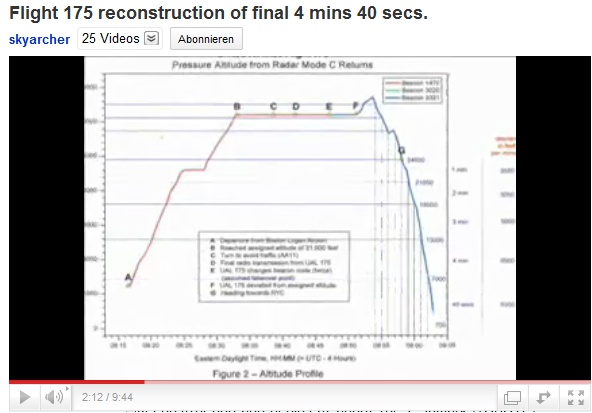
2:26: Shows that point G is at 24,600 feet and 0:00 minutes (beginning of minute 1):

2:30: Shows descent rates increasing to a maximun (5th data point) of 6300 ft/min
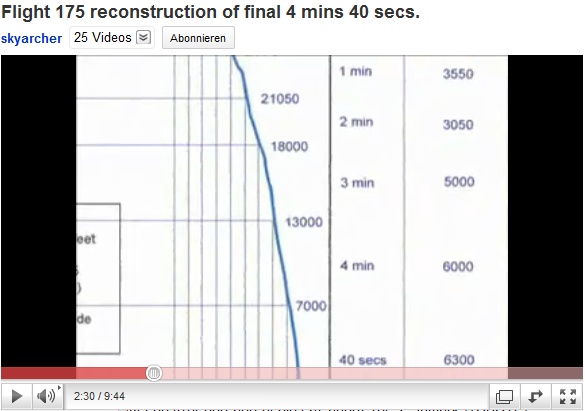
They run the simualtion then.
At 5:30, when increasing descent rate from 3100 to 5000 ft/min, they say the craft immediately "overspeeds", which means "going into the valley of death". Ok, that is their claim. They make it appear as if the descent rate is responsible for the increase of speed to overspeed.
At 6:30, with descent rate now increased to 6000ft/min, and throttle at 46%, altutude around 12,000 feet, the airspeed is now increased beyond 400 KIAS. Video goes on to claim that now the airframe is at danger of disintegrating and would break at 12,000 feet.
Remember your claim after watching the video: "pilots dispute" whether a Boeing 767 could descend 20,000ft in 4min4sec (actually, 22,600 feet in 4min40sec). That's on average 4842 ft/min, and a maximum of 6300 ft/min - according to the video. Video claims such a descent rate would increase speed to a point where plane would break and crash.
Are you following thus far?
The document "Type Acceptance Report 767" (New Zealand) that I presented tells a different story:
It recommends a descent rate of more then 8500ft/sec above 17,000 feet, and 7000 ft/sec above 10,000 feet in case of an emeregancy (loss of oxygene).
Evidently, the claim made in the video that a descent rate of 6000ft/min at 12,000 feet would put the plane at high risk of disintegrating is thus refuted. A 767 can safely descent at higher rates and not overspeed dabgerously.
Oystein
Penultimate Amazing
- Joined
- Dec 9, 2009
- Messages
- 18,941
(continued)
What did they do wrong? Probably several things:
A) They speculate on the safety buffer being smaller than it actually is. Correct, Vne should never be exceeded, however, you can exceed it without crashing immediately or even soon.
B) They had throttle at 46% still - if you push the nose down, you can easily pull throttle back, and avoid dangerous overspeeding
C) Even if the 767 and 747 have similar flight envelopes, that does not mean automatically they behave the same way when diving. The 747 is a lot heavier and might speed up more severely, for example. This needs to be looked into.
D) The highest KIAS shown in the video is 407 at the 6:39 mark:
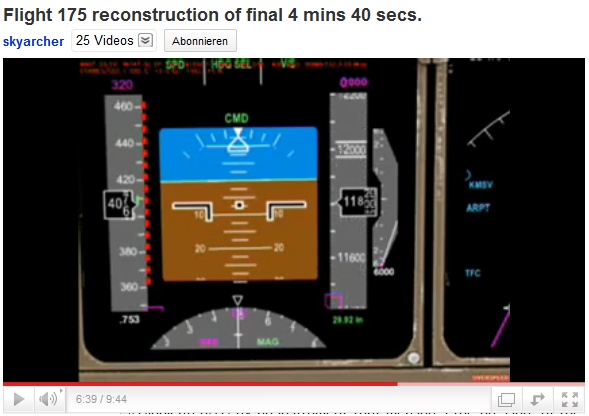
There is no need for that increase then, and 407 KIAS is also not very dangerous to a 767 airframe. Just about 13% above Vne.
At 2:52 in the video: "Point G is 42 miles away fron the WTC".
42miles/4:40min = 540miles/h = 469 knots
Assuming a constant air speed, that would be about 390 KIAS = Vne+8% at 10,000 feet. Plane is at 10,000 feet about 3:30 minutes after Point G, or 1:10 before graph ends. At impact point, close to 1000ft, 540mph = 460KIAS = Vne + 28%
The plane would have to endure 8%-28% above Vne (Velocity never exceed) for about 1:10 minutes (ETA: 1:30 minutes if we assume crash occurred some 20 seconds after graph ends)
Considering that Vne would have a considerable buffer margin, you can expect some bolts to pop, and the plane would have to be extensively serviced if it had landed later, but the idea it would flutter and break is simply an argument from kid's imagination.
There is no proof for that.
What did they do wrong? Probably several things:
A) They speculate on the safety buffer being smaller than it actually is. Correct, Vne should never be exceeded, however, you can exceed it without crashing immediately or even soon.
B) They had throttle at 46% still - if you push the nose down, you can easily pull throttle back, and avoid dangerous overspeeding
C) Even if the 767 and 747 have similar flight envelopes, that does not mean automatically they behave the same way when diving. The 747 is a lot heavier and might speed up more severely, for example. This needs to be looked into.
D) The highest KIAS shown in the video is 407 at the 6:39 mark:
There is no need for that increase then, and 407 KIAS is also not very dangerous to a 767 airframe. Just about 13% above Vne.
At 2:52 in the video: "Point G is 42 miles away fron the WTC".
42miles/4:40min = 540miles/h = 469 knots
Assuming a constant air speed, that would be about 390 KIAS = Vne+8% at 10,000 feet. Plane is at 10,000 feet about 3:30 minutes after Point G, or 1:10 before graph ends. At impact point, close to 1000ft, 540mph = 460KIAS = Vne + 28%
The plane would have to endure 8%-28% above Vne (Velocity never exceed) for about 1:10 minutes (ETA: 1:30 minutes if we assume crash occurred some 20 seconds after graph ends)
Considering that Vne would have a considerable buffer margin, you can expect some bolts to pop, and the plane would have to be extensively serviced if it had landed later, but the idea it would flutter and break is simply an argument from kid's imagination.
There is no proof for that.
Last edited:
sheeplesnshills
Illuminator
- Joined
- Mar 5, 2010
- Messages
- 3,706
Considering that Vne would have a considerable buffer margin, you can expect some bolts to pop, and the plane would have to be extensively serviced if it had landed later, but the idea it would flutter and break is simply an argument from kid's imagination.
There is no proof for that.
Better than that, there is proof it didn't! 43 videos, impact damage, wreckage and DNA of the occupants. It clearly did not fall apart. Only a moron would suggest otherwise.
bill smith
Philosopher

- Joined
- Feb 14, 2009
- Messages
- 8,408
Better than that, there is proof it didn't! 43 videos, impact damage, wreckage and DNA of the occupants. It clearly did not fall apart. Only a moron would suggest otherwise.
Seen this?....
http://uk.youtube.com/watch?v=18HqbZf440w&NR=1 Jeff hill/lead engineer boeing
Tinfoil Hater
Graduate Poster

- Joined
- Jan 8, 2010
- Messages
- 1,440
Jammy, please go to NYC and tell the FDNY about your no-planer theory. Tell New Yorkers who saw the planes hit the towers that you think they are lying. Tell them to their face. I dare you.
Last edited:
TJM
Potsing Whiled Runk

Better than that, there is proof it didn't! 43 videos, impact damage, wreckage and DNA of the occupants. It clearly did not fall apart. Only a moron would suggest otherwise.
Yes bill, that would be a moron suggesting otherwise. Well done.
sheeplesnshills
Illuminator
- Joined
- Mar 5, 2010
- Messages
- 3,706
Bill, at 0.54 did you spot the error in comprehension?
bill smith
Philosopher
- Joined
- Feb 14, 2009
- Messages
- 8,408
Bill, at 0.54 did you spot the error in comprehension?
I am just observing in this hread for the most part. And throwing in an occasional video to help you accept some Truths.
I am just observing in this hread for the most part. And throwing in an occasional video to help you accept some Truths.
So you have no idea what you link to?
TJM
Potsing Whiled Runk
What does a montage of cars crashing voiced over by an appeal to authority have to do with high-speed plane crashes?
fess
Graduate Poster
- Joined
- Dec 26, 2009
- Messages
- 1,425
Jammy, please go to NYC and tell the FDNY about your no-planer theory. Tell New Yorkers who saw the planes hit the towers that you think they are lying. Tell them to their face. I dare you.
I have been waiting, but still haven't got a phone call.
fess
Graduate Poster
- Joined
- Dec 26, 2009
- Messages
- 1,425
What does a montage of cars crashing voiced over by an appeal to authority have to do with high-speed plane crashes?
I too am trying to figure that out, that and the dancing bridge.
- Status
- Not open for further replies.