
-
Security incident: ISF was recently accessed by intruders. Please change your password, and change it anywhere else you used it. Read more
You are using an out of date browser. It may not display this or other websites correctly.
You should upgrade or use an alternative browser.
You should upgrade or use an alternative browser.
Agnosticism is Atheism in Denial
- Thread starter ynot
- Start date
-
- Tags
- agnosticism atheism


That being an undefined agnostic is not a position between theism and atheism (it's not a position at all). That you can only be an agnostic theist or an agnostic atheist. That claiming to be an undefined agnostic is meaningless. That unless you define that you're a theist you're an atheist. Agnostic theist merely defines what type of theist you are. Agnostic atheist merely defines what type of atheist you are.Which is exactly the argument you started with (only better worded), which amounts to, "an agnostic atheist is, by default, an atheist."
It's a tautology.
So what exactly were you trying to prove?
A person that claims to be an undefined agnostic is an atheist in denial. (it always was a bit tongue-in-cheek)
Last edited:
arthwollipot
Limerick Purist Pronouns: He/Him

No, he was an agnostic theist. Which is what you asked for:No it wasn't what I asked for. I asked for an example of just a plain, un-subsetted agnostic An "undecided agnostic". Not a subset (as hilited below). MG was an agnostic atheist.
Please give an example of an agnostic that has a belief in a god or gods (not an agnostic subset. i.e. agnostic theist).
I am an agnostic. I also happen to be an atheist, but that's a separate statement. What we've been trying to get you to understand is that the question about agnosticism/gnosticism and the question about atheism/theism are separate and do not need to refer to each other. You seem to be persisting in the incorrect belief that agnosticism is somewhere on the atheism/theism continuum. It isn't. It's a completely separate and unrelated question.
No I didn’t. If I wanted an agnostic atheist I would have said “agnostic atheist”. What I asked for describes an “agnostic atheist” but I asked for an “agnostic” that fits that description. That it’s a silly question demonstrates that using the term agnostic without using it as a subset is also silly.No, he was an agnostic theist. Which is what you asked for:
Please give an example of an agnostic that has a belief in a god or gods (not an agnostic subset. i.e. agnostic theist).
If you don't agree give an example of an agnostic that's not either a theist or atheist. Please don't say a person that hasn't decided to be a theist or an atheist. If you haven't decide to be a theist you are an atheist by default. You don't decide to be an atheist, you only decide not to be by deciding to be a theist.
Last edited:
Navigator
Philosopher

- Joined
- Apr 18, 2004
- Messages
- 7,324
That being an undefined agnostic is not a position between theism and atheism (it's not a position at all). That you can only be an agnostic theist or an agnostic atheist. That claiming to be an undefined agnostic is meaningless. That unless you define that you're a theist you're an atheist. Agnostic theist merely defines what type of theist you are. Agnostic atheist merely defines what type of atheist you are.
A person that claims to be an undefined agnostic is an atheist in denial. (it always was a bit tongue-in-cheek)
If you don't agree give an example of an agnostic that's not either a theist or atheist. Please don't say a person that hasn't decided to be a theist or an atheist. If you haven't decide to be a theist you are an atheist by default. You don't decide to be an atheist, you only decide not to be.
I see the problem with this thinking.
Every human is born a baby.
Every baby is an ‘atheist’
This is because an ‘atheist’ is someone who lacks belief in god(s) and all babies lack belief in god(s) therefore all babies are atheist.
Therefore the natural default setting of a human being is one of ‘atheist’
The argument is that all human babies are by default atheist because they lack belief in god(s).
If this argument is to be held true, some humans grow from the default state of atheist and become theists. Then the word theist cannot be used unless it is accompanied by the prefix or suffix of ‘atheist’. One is not simply a theist, but one is an atheist-theist (or a theist-atheist) because there is ‘no middle ground’ in relation to the thread topic and OP.
However, in relation to the title of the default setting of ‘being human’, one is a baby, and as one develops, one is not called a ‘baby-toddler, or a baby-teenager, baby-adult or baby-elder.
The default title or position is not necessary. It need not accompany the description of the other states arising from the default state.
If the default setting title ‘Atheist’ describes the initial position and from that position individuals evolves in many ways which are not necessarily directly related to the initial position they evolved from, then they have effectively moved on from that default position. Theists in particular have moved greatly from the default position.
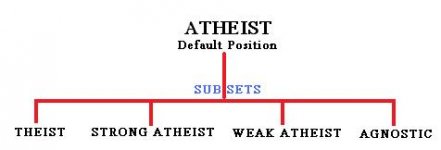
It would look like this. (see attached diagram)
As can be seen, the two most directly related subsets to the default position are ‘Strong and Weak’ atheism. Theism moves away from the default position and Agnosticism has chosen to take the ‘middle ground’ between Strong/Weak atheism and Theism.
Of all the positions, Agnosticism is less related as it does not even have any part of the word ‘Atheist’ in its title.
The process involved in shifting from the default state of Atheist into the four different sub groups given in the example chart (attached to this post) is one of natural occurrence (the result of a process of evolution involving consciousness) where the default (Atheist) is simply a position/state of the human baby.
Theism in particular forces the shift because it concerns itself with ideas and beliefs regarding god(s) which the default position lacked.
Due to this action of Theism, Strong and Weak Atheism came about as a way of maintaining the integrity of the default position – Weak Atheism is perhaps the better example of the default position because it exemplifies that position far truer than Strong Atheism.
Agnosticism perhaps exemplifies the default position in the best way. It acknowledges that Theism forced the question in the first place, but also acknowledges that there is no longer lack of belief in god(s) and that this new position is a natural part of the process of the evolution of human consciousness and while the myriad of beliefs in what god(s) are, are disputable – it is also unknowable if these beliefs are true or false, and even if all human beliefs about god(s) are false, this does not mean the concept of god(s) existing is false.
Agnosticism acknowledges this and refrains from disputing Theism. Strong (especially) and Weak atheists dispute theism.
Agnosticism perhaps exemplifies the default position in the best way because it understands the ignorance of the default position and works from that position.
Strong (and to a lesser degree, Weak) atheists work from the position of disputing Theism, thus have moved significantly from the default position of ignorance.
To call Agnosticism a sub group of the default position and claim that it is ‘the default position in denial’ and should have the prefix or suffix ‘atheist’ is somewhat silly, because those calling for that have to also call for the suffix to be added to Theism.
Thus, if it has to be agnostic-atheist or atheist - agnostic then it also has to be atheist-theist or theist-atheist.
But as we all should be able to agree, calling a theist an atheist can be classed as an oxymoron.
Therefore demanding an agnostic should be called an atheist is to demand an oxymoron be accepted as legitimate.
Agnosticism should be regarded as being is in a class of it own, just as Theism is regarded as being in a class of its own.
Agnosticism is not necessarily therefore ‘Atheism in Denial’. Theism on the other hand, is, but not for any other reason than it distanced itself from the default position and also (if I am correct) Theism was coined as a word first and was adapted by those who lack belief in god(s) (an ‘A’ was added’) to denote Atheism.
Perhaps those who lacked belief in god(s) should have chosen another word?
It is likely too late now to change the word denoting the default position of a human baby for something more appropriate.
Perhaps more to the point (have I mentioned it already?) there is no need to actually have a word to denote the default position of a human baby.
If that is the case, then ‘atheist’ shouldn’t be used for that purpose. Furthermore, the word ‘atheist’ might need to have its description changed from ‘someone who lacks belief in god(s) to the truer one of ‘Someone who disputes the existence of god(s).’
The lack of belief automatically applies to those who dispute the existence of god(s) and this they can be referred to as ‘atheists’
Not only that, but it allows for agnostics not to be confused with being atheists or claimed to being ‘atheists in denial’
That way also, the default position of a human baby cannot be ‘one who disputes the existence of god(s).
Problem solved – and through the process of critical thinking.
Attachments
Brian-M
Daydreamer

- Joined
- Jul 22, 2008
- Messages
- 8,044
If this argument is to be held true, some humans grow from the default state of atheist and become theists. Then the word theist cannot be used unless it is accompanied by the prefix or suffix of ‘atheist’.
That makes no sense. When "humans grow from the default state of atheist and become theists" then the prefix "a-" (meaning "not" or "without") is dropped. You don't need to add a prefix.
One is not simply a theist, but one is an atheist-theist (or a theist-atheist) because there is ‘no middle ground’ in relation to the thread topic and OP.
The terms "atheist-theist" and "theist-atheist" are oxymorons. They basically mean "theist who is not theist", which is absurd.
However, in relation to the title of the default setting of ‘being human’, one is a baby, and as one develops, one is not called a ‘baby-toddler, or a baby-teenager, baby-adult or baby-elder.
That's because the description "baby" is no longer accurate. An adult cannot be a baby, and a baby cannot be an adult, so the term "baby-adult" is nonsensical.
A baby can, over time, turn into an adult, but it's never both at the same time.
Thus, if it has to be agnostic-atheist or atheist - agnostic then it also has to be atheist-theist or theist-atheist.
No. Just no.
But there are agnostic theists. They're the people who tell you that you have to accept God's existence on faith alone.
But as we all should be able to agree, calling a theist an atheist can be classed as an oxymoron.
No, calling a theist an atheist would simply be incorrect. It's calling a person a theist-atheist that's the oxymoron.
Theism on the other hand, is, but not for any other reason than it distanced itself from the default position and also (if I am correct) Theism was coined as a word first and was adapted by those who lack belief in god(s) (an ‘A’ was added’) to denote Atheism.
Strictly speaking, it was the other way around. "Atheist" has it's origins in the ancient Greek word "atheos", which was created from the prefix "a-" meaning "not" or "without", and the word "theos" meaning "god(s)".
As it changed into the word we know today, it came to mean "without belief in gods".
The word "theist" is much more recent, and was created by removing the prefix "a-" to create a word that means "with belief in gods".
Perhaps more to the point (have I mentioned it already?) there is no need to actually have a word to denote the default position of a human baby.
I think that sometimes the phrase "ignorant atheist" is used to describe someone who lacks belief in god because they have no concept of god, and therefore are incapable of believing that god exists.
Furthermore, the word ‘atheist’ might need to have its description changed from ‘someone who lacks belief in god(s) to the truer one of ‘Someone who disputes the existence of god(s).’
Some dictionaries do include that definition (although "deny" is used in place of "dispute"), but I don't think it's a good one.
If we accept that definition, what word would we use for someone who believes that there is no God (or merely lacks belief in a god) but refuses to dispute the existence of god(s) because a universe with no god would be absolutely indistinguishable from a universe with a deistic god, therefore disputing it's hypothetical existence would be completely pointless?
Or what about a non-believer who only refuses to dispute the existence of God because of fear of being persecuted by those who believe that God exists?
And what about a person who does believe, but disputes the existence of God because the like to argue, or want to intentionally upset other believers?
Defining atheism by what a person believes makes more sense to me than defining it by what they do.
psionl0
Skeptical about skeptics

If theist/atheist is merely a dichotomy then why is it so important to say that an atheist "lacks belief" rather than "disbelieves" in gods? They would be identical descriptions in your dictionary.That unless you define that you're a theist you're an atheist. Agnostic theist merely defines what type of theist you are. Agnostic atheist merely defines what type of atheist you are.
If theist/atheist is merely a dichotomy then why is it so important to say that an atheist "lacks belief" rather than "disbelieves" in gods? They would be identical descriptions in your dictionary.
One atheist might not hold a belief in a god because they've never heard of the word or even the concept.
Another atheist might not hold a belief in a god because there is no evidence for such a being.
Another atheist might believe that gods are simply fictional creatures written about in ancient storybooks. That a "god" is impossible in the same way that the Q Continuum is impossible. It's just made up entirely.
These are not identical descriptions. These are hypothetical people that came to atheism in entirely different ways. Only one disbelieves.
Last edited:
arthwollipot
Limerick Purist Pronouns: He/Him
NO. You didn't. You asked for "an agnostic that has a belief in a god or gods" - your direct words. Someone who has a belief in a god or gods is a theist, and you therefore asked for an agnostic theist. Martin Gardner fulfils what you were asking for.No I didn’t. If I wanted an agnostic atheist I would have said “agnostic atheist”. What I asked for describes an “agnostic atheist” but I asked for an “agnostic” that fits that description. That it’s a silly question demonstrates that using the term agnostic without using it as a subset is also silly.
psionl0
Skeptical about skeptics
You have listed different categories of "atheist".These are not identical descriptions. These are hypothetical people that came to atheism in entirely different ways. Only one disbelieves.
So I guess that you disagree with ynot's assertion that there is only theist or atheist.
Fellow Traveler
Illuminator

- Joined
- Jan 2, 2013
- Messages
- 3,566
Ynot your avatar is interesting. It might be a perpetual motion machine but its not. That would be a nice high school physics project to build and demonstrate how much energy has to added per revolution depending on the mass and dimensions of each part.
I may start another thread to debate that argument.If theist/atheist is merely a dichotomy then why is it so important to say that an atheist "lacks belief" rather than "disbelieves" in gods? They would be identical descriptions in your dictionary.
Yes, followed by " (not an agnostic subset. i.e. agnostic theist)". I was asking a silly quest for the reason I've explained. If you don't get it, move on.NO. You didn't. You asked for "an agnostic that has a belief in a god or gods" - your direct words. Someone who has a belief in a god or gods is a theist, and you therefore asked for an agnostic theist. Martin Gardner fulfils what you were asking for.
I just want to bloody thing to stop. Doesn't it know it can't do what it's doingYnot your avatar is interesting. It might be a perpetual motion machine but its not. That would be a nice high school physics project to build and demonstrate how much energy has to added per revolution depending on the mass and dimensions of each part.

Theist and atheist are the only categories. Everything else is a subcategory of either one.You have listed different categories of "atheist".
So I guess that you disagree with ynot's assertion that there is only theist or atheist.
Last edited:
Mashuna
Ovis ex Machina

Yes, an impossible ask. An person that neither believes nor disbelieves, HAS no current belief in a god or gods, is therefore not a theist. Being a theist is a proactive decision not a default conclusion. Nobody is born a theist. Until you HAVE a belief in a god or gods you aren’t a theist. An atheist is everything that isn’t a theist. The only definition of atheist that really matters is “NOT a theist”.
Agnostic isn’t a position it’s an explanation (BECAUSE knowledge of a god or gods etc.) that only has relevance when it’s applied to theism or atheism. Indecision isn't a definition of being agnostic, it's a consequence.
Agnostic is a separate category. It's the y axis, and theism is the x axis (in this case). You can switch the x axis to be a different value if you like. You can be agnostic about knowledge of the universe prior to the Big Bang - you consider it to be not only unknown, but unknowable in principle. The alternative would be gnostic, you think that science will eventually discover the truth behind the start of the universe.
Mashuna
Ovis ex Machina
Conversely, if my reading of your position is correct not, you share an opinion with Bertrand Russell:
As a philosopher, if I were speaking to a purely philosophic audience I should say that I ought to describe myself as an Agnostic, because I do not think that there is a conclusive argument by which one can prove that there is not a God. On the other hand, if I am to convey the right impression to the ordinary man in the street I think I ought to say that I am an Atheist, because when I say that I cannot prove that there is not a God, I ought to add equally that I cannot prove that there are not the Homeric gods.
psionl0
Skeptical about skeptics
That's the first time I am seeing you discuss "subcategories". Thus far, you have refused to acknowledge a difference even between those who refuse to believe and those who are not capable of forming a belief.Theist and atheist are the only categories. Everything else is a subcategory of either one.
This is why you insist that all babies are born atheist. Of course, by that reckoning, all plants, animals and inanimate objects are also atheists.
Fellow Traveler
Illuminator
- Joined
- Jan 2, 2013
- Messages
- 3,566
I just want to bloody thing to stop. Doesn't it know it can't do what it's doing
Your Avatar is very interesting albeit impossible in the real world. But so are Vampires etc but intertaining.
RickM
Thinker

- Joined
- Aug 6, 2013
- Messages
- 203
I see the problem with this thinking.
Every human is born a baby.
Every baby is an ‘atheist’
This is because an ‘atheist’ is someone who lacks belief in god(s) and all babies lack belief in god(s) therefore all babies are atheist.
Therefore the natural default setting of a human being is one of ‘atheist’
The argument is that all human babies are by default atheist because they lack belief in god(s).
If this argument is to be held true, some humans grow from the default state of atheist and become theists. Then the word theist cannot be used unless it is accompanied by the prefix or suffix of ‘atheist’. One is not simply a theist, but one is an atheist-theist (or a theist-atheist) because there is ‘no middle ground’ in relation to the thread topic and OP.
However, in relation to the title of the default setting of ‘being human’, one is a baby, and as one develops, one is not called a ‘baby-toddler, or a baby-teenager, baby-adult or baby-elder.
The default title or position is not necessary. It need not accompany the description of the other states arising from the default state.
If the default setting title ‘Atheist’ describes the initial position and from that position individuals evolves in many ways which are not necessarily directly related to the initial position they evolved from, then they have effectively moved on from that default position. Theists in particular have moved greatly from the default position.
It would look like this. (see attached diagram)
As can be seen, the two most directly related subsets to the default position are ‘Strong and Weak’ atheism. Theism moves away from the default position and Agnosticism has chosen to take the ‘middle ground’ between Strong/Weak atheism and Theism.
Of all the positions, Agnosticism is less related as it does not even have any part of the word ‘Atheist’ in its title.
The process involved in shifting from the default state of Atheist into the four different sub groups given in the example chart (attached to this post) is one of natural occurrence (the result of a process of evolution involving consciousness) where the default (Atheist) is simply a position/state of the human baby.
Theism in particular forces the shift because it concerns itself with ideas and beliefs regarding god(s) which the default position lacked.
Due to this action of Theism, Strong and Weak Atheism came about as a way of maintaining the integrity of the default position – Weak Atheism is perhaps the better example of the default position because it exemplifies that position far truer than Strong Atheism.
Agnosticism perhaps exemplifies the default position in the best way. It acknowledges that Theism forced the question in the first place, but also acknowledges that there is no longer lack of belief in god(s) and that this new position is a natural part of the process of the evolution of human consciousness and while the myriad of beliefs in what god(s) are, are disputable – it is also unknowable if these beliefs are true or false, and even if all human beliefs about god(s) are false, this does not mean the concept of god(s) existing is false.
Agnosticism acknowledges this and refrains from disputing Theism. Strong (especially) and Weak atheists dispute theism.
Agnosticism perhaps exemplifies the default position in the best way because it understands the ignorance of the default position and works from that position.
Strong (and to a lesser degree, Weak) atheists work from the position of disputing Theism, thus have moved significantly from the default position of ignorance.
To call Agnosticism a sub group of the default position and claim that it is ‘the default position in denial’ and should have the prefix or suffix ‘atheist’ is somewhat silly, because those calling for that have to also call for the suffix to be added to Theism.
Thus, if it has to be agnostic-atheist or atheist - agnostic then it also has to be atheist-theist or theist-atheist.
But as we all should be able to agree, calling a theist an atheist can be classed as an oxymoron.
Therefore demanding an agnostic should be called an atheist is to demand an oxymoron be accepted as legitimate.
Agnosticism should be regarded as being is in a class of it own, just as Theism is regarded as being in a class of its own.
Agnosticism is not necessarily therefore ‘Atheism in Denial’. Theism on the other hand, is, but not for any other reason than it distanced itself from the default position and also (if I am correct) Theism was coined as a word first and was adapted by those who lack belief in god(s) (an ‘A’ was added’) to denote Atheism.
Perhaps those who lacked belief in god(s) should have chosen another word?
It is likely too late now to change the word denoting the default position of a human baby for something more appropriate.
Perhaps more to the point (have I mentioned it already?) there is no need to actually have a word to denote the default position of a human baby.
If that is the case, then ‘atheist’ shouldn’t be used for that purpose. Furthermore, the word ‘atheist’ might need to have its description changed from ‘someone who lacks belief in god(s) to the truer one of ‘Someone who disputes the existence of god(s).’
The lack of belief automatically applies to those who dispute the existence of god(s) and this they can be referred to as ‘atheists’
Not only that, but it allows for agnostics not to be confused with being atheists or claimed to being ‘atheists in denial’
That way also, the default position of a human baby cannot be ‘one who disputes the existence of god(s).
Problem solved – and through the process of critical thinking.
After reading Flint, this was a snap. Some good ideas and well done!