Acceleration of the falling top blocks.

If you saw the beginning of an avalanche 1/4 mile high, and ten
seconds later, the very top rocks were already at your feet, you
could conclude that something other than gravity caused the
rocks to fall.

Rocks lower down on the mountain would have slowed the
upper rocks.

If you dropped a rock from 1/4 mile high, and nothing slowed its fall, it would hit the ground in less than 10 seconds.

So, if it takes ten seconds for the very top rocks to reach my feet, I can conclude that something slowed their fall.

Of course, the analogy breaks down, because a rock tumbling down a mountainside isn't in free fall. That may be one source of your confusion. How long it takes avalanche rocks to reach my feet isn't literally relevant to the WTC problem -- and that wasn't the point of the analogy.

Granted, if I have to explain this, it is unlikely that the explanation will help.
 
I assure you that when it comes to the gravity collapse model
of WTC destruction, I'm not missing anything. I get it. It's a failed
model, but I do understand it.

The gravity collapse model has several different things wrong
with it. I'm only discussing it because so many people are stuck on
it.

One of the things wrong with the gravity collapse model is the timing.
Another thing that is wrong with the gravity collapse model is the energy.

In this theoretical world, where all of the vertical columns of floor 81
fail at the same time, causing floors 81-110 to reach floor 80 as fast
as possible (0.75 seconds), when the upper floors reached floor 80,
they would have some additional kinetic energy. Not much, because you
don't actually accelerate all that much in a twelve foot fall, but there
would be some more energy.

If floor 80 were perfectly undamaged before being hit with floors 81-100,
they would have survived the impact. But let's say they didn't. Let's
go on with the model.

If floors 81-110 were to have impacted floor 80, they would have slowed
down upon impact. Newton's third law applies. However much energy
was imparted onto the lower floor (causing destruction) would have
been imparted onto the upper floors (causing slowing of descent).

Any impact would slow the collapse, so the gravity model disproves itself.

The WTC didn't collapse anyway. What we witnessed on the videos
is a wave of energy passing through the buildings. After the wave of
energy destroyed the buildings, most of the remains fell to the ground
under gravity. It wasn't a very forcible or fast explosion, either.

It was a foaming. The WTC was turned into metallic foam, and I have
this material in my possession.

Gravity is not the only force. Floors 81-110 do not merely "reach" floor 80, they collide with floor 80. (Actually there are multiple collisions.)

Not sure how you are missing this.
 
I'm just using round numbers. The fall time would not have
been significantly slowed under the conditions stated.

If you dropped a rock from 1/4 mile high, and nothing slowed its fall, it would hit the ground in less than 10 seconds.

So, if it takes ten seconds for the very top rocks to reach my feet, I can conclude that something slowed their fall.

Of course, the analogy breaks down, because a rock tumbling down a mountainside isn't in free fall. That may be one source of your confusion. How long it takes avalanche rocks to reach my feet isn't literally relevant to the WTC problem -- and that wasn't the point of the analogy.

Granted, if I have to explain this, it is unlikely that the explanation will help.
 
I assure you that when it comes to the gravity collapse model
of WTC destruction, I'm not missing anything. I get it. It's a failed
model, but I do understand it.

I am not convinced.

It was a foaming. The WTC was turned into metallic foam, and I have
this material in my possession.

(Backs slowly away.)
 
I assure you that when it comes to the gravity collapse model
of WTC destruction, I'm not missing anything. I get it. It's a failed
model, but I do understand it.

The gravity collapse model has several different things wrong
with it. I'm only discussing it because so many people are stuck on
it.

One of the things wrong with the gravity collapse model is the timing.
Another thing that is wrong with the gravity collapse model is the energy.

In this theoretical world, where all of the vertical columns of floor 81
fail at the same time, causing floors 81-110 to reach floor 80 as fast
as possible (0.75 seconds), when the upper floors reached floor 80,
they would have some additional kinetic energy. Not much, because you
don't actually accelerate all that much in a twelve foot fall, but there
would be some more energy.

If floor 80 were perfectly undamaged before being hit with floors 81-100,
they would have survived the impact. But let's say they didn't. Let's
go on with the model.

If floors 81-110 were to have impacted floor 80, they would have slowed
down upon impact. Newton's third law applies. However much energy
was imparted onto the lower floor (causing destruction) would have
been imparted onto the upper floors (causing slowing of descent).

Any impact would slow the collapse, so the gravity model disproves itself.

The WTC didn't collapse anyway. What we witnessed on the videos
is a wave of energy passing through the buildings. After the wave of
energy destroyed the buildings, most of the remains fell to the ground
under gravity. It wasn't a very forcible or fast explosion, either.

It was a foaming. The WTC was turned into metallic foam, and I have
this material in my possession.

You don't actually accelerate that much in a 12-foot fall? Fine, I suggest you climb up 12 feet on a ladder and then jump off. No padding at the bottom, just jump straight to the ground from 12 feet up. I assure you, you will feel it, and I would be surprised if you managed to land without breaking something. Gravitational acceleration is a powerful force and 12 feet is plenty of distance to build up monstrous amounts of kinetic energy, especially with a large mass.

I also take exception to one other thing. Yes, floors 81-110 would have (and did) slow down upon impact with floor 80. The thing you are denying is that the kinetic energy released by the downward acceleration of the block is enough to destroy floor 80's support before the upper block stops. The upper block did not come to a complete halt, because it had enough downward force to overcome the support, and then it had another 12 feet of gravitational acceleration in addition to its residual velocity. This results in increasing velocity over time.
 
The thing you're missing is that there were no intact upper floors.
Those floors were foamed before they reached lower floors.
It's not like they found a huge chunk of twenty floors lying
on the ground after the thing ended.

They didn't find any toilets, bro. That's amazing. There's nothing
about a building collapse that dustifies the toilets so thoroughly
that you can't find any after the collapse. Therefore, it wasn't
a collapse.

However, if you include the possibility of an energy weapon,
things make much more sense. A wave of energy passing
through the building could possibly destroy the toilets in a way
that a collapse could not have.

No, it's really not. The only real difference here is the preparation. The process is very similar, and the results are very similar. A floor failed, and the upper portion of the building fell on it with thirty times the force of its actual mass. That's over five times the total weight of the entire tower. Expecting the building to stay up under that is about as silly as saying they would not be collapsed by a moon-sized field of rubble.

And what is your physics experience? Why did you make the patently ludicrous statement that a moon-sized rubble field would not have collapsed the tower, along with the other blatantly incorrect statements which you have never recanted, such as scoffing at the sun being used to tell time, which is a concept an elementary-school student can understand?

That's a lot of words to avoid backing up your claim. If it's so obvious, so evident, you should be able to explain it to us bright folks very easily.

So you are unwilling to back up your claim, are actively trying to get people who disagree with you to prove it, and are now saying that we're lying if we do not prove your claim. Oddly, you throw up this verbal chaff after DGM asks you to back up your claim in post #36. What will you get up to after breakfast, I wonder?

Odd how you constantly insult us and belittle us, including our intelligence, but suddenly, you claim not to believe we are idiots. If we're not idiots, and we disagree with you, why not consider the possibility that you are wrong?

Ergo, you have once again demonstrated that you are a brazen, sophist lying hypocrite. If you would like to prove me wrong, all it takes is to explain your claims instead of demanding others do so.

Sometimes I wonder.

We've already established that there are many things you don't understand, Ergo. No need to elaborate.

I don't think he's really making any argument at all, only unbacked claims.

 
I'd expect to survive that twelve foot drop without any broken
bones (if I did it right), and bones are much weaker than steel.

And your second point about the upper floors slowing down?
They couldn't have slowed down very much because the final
fall time was so close to the minimum allowed by gravity.

What you're doing is working within the model to explain the model.
What you need to do is step outside of the model and examine
it from every direction.

You don't actually accelerate that much in a 12-foot fall? Fine, I suggest you climb up 12 feet on a ladder and then jump off. No padding at the bottom, just jump straight to the ground from 12 feet up. I assure you, you will feel it, and I would be surprised if you managed to land without breaking something. Gravitational acceleration is a powerful force and 12 feet is plenty of distance to build up monstrous amounts of kinetic energy, especially with a large mass.

I also take exception to one other thing. Yes, floors 81-110 would have (and did) slow down upon impact with floor 80. The thing you are denying is that the kinetic energy released by the downward acceleration of the block is enough to destroy floor 80's support before the upper block stops. The upper block did not come to a complete halt, because it had enough downward force to overcome the support, and then it had another 12 feet of gravitational acceleration in addition to its residual velocity. This results in increasing velocity over time.
 
You didn't know that about me? You didn't know that I collected
a huge amount of WTC dust from approximately 200 feet
away from Ground Zero? And that, since then, I've gotten my
hands on more dust samples? :-)

I have what is likely to be the world's largest private collection of
World Trade Center dust, and I'll tell you something about it:
IT'S A FOAM!!! Yes, amazingly, this stuff is a foam. Magnetic,
metallic foam. I did not expect this before I found my samples.

I am not convinced.


(Backs slowly away.)
 
Wait just one second. YOU were invited to a public debate on 9/11?
You don't seem to have any special or particular knowledge to add.

:big:

Big news, ergo!!

I suggest you submit your paper on how the "Law of Conservation of Momentum" is all wrong right away.

Let us know when you get your Nobel.

It might be a while, though - real science requires a little more effort than simply invoking the Appeal to Ridicule.

:dl:
 
I'd expect to survive that twelve foot drop without any broken
bones (if I did it right), and bones are much weaker than steel.

And your second point about the upper floors slowing down?
They couldn't have slowed down very much because the final
fall time was so close to the minimum allowed by gravity.

What you're doing is working within the model to explain the model.
What you need to do is step outside of the model and examine
it from every direction.

So close? You call being almost 40% off "so close"? I'm not touching that one with a 10-foot pole.
 
What 40% are you referring to?

The collapse of the Twin Towers occurred at between 60% and 65% of gravitational acceleration, on average. Even David Chandler acknowledges this, although he uses this number in a completely inappropriate manner. That's a big difference to paper over with "close enough to g".
 
Actually, not true.

I had to wade through years of conspiracy theories regarding
9/11, both official and un-official, before I came to my conclusions.

This means I've already considered the gravity collapse model and
found it to be faulty in a number of ways.

The silly thing is that the thermite theory (the strongest 9/11
conspiracy theory) is also a gravity aided collapse model.
They just say that explosives on the lower floors were timed
to appear as if the WTC was collapsing due to gravity.

Both theories (official and thermite) include this gravity collapse,
but neither theory adequately explains the lack of toilets in the rubble.
Neither theory adequately explains the years-long fuming at Ground Zero.
Neither theory adequately explains the bits of human bones found
hundreds of feet away on adjacent building tops. Thermite doesn't
explode, remember? It just cuts steel beams. The only destructive
force both groups have to work with is actually gravity, which isn't
enough to explain the specific damage seen to the WTC.

You both got it wrong. I got it right. Judy Wood probably got it
right, too, but time will tell.


Troofer projection
 
David Chandler is not the authority on matters relating to the
destruction of the WTC. I am. Just so you know.

It's not arrogant. It's the facts. Judy Wood has a lot of good
things to say about 9/11, but other than that, I'm the one.

Everybody else is wrong on the subject, especially anybody
supporting the official conspiracy theory or the thermite
conspiracy theory.


The collapse of the Twin Towers occurred at between 60% and 65% of gravitational acceleration, on average. Even David Chandler acknowledges this, although he uses this number in a completely inappropriate manner. That's a big difference to paper over with "close enough to g".
 
We saw the buildings
go away in about a dozen seconds. There wasn't enough time
for a floor-by-floor gravity accelerated collapse. The buildings
fell too fast for this to be a proper explanation.

Completely incorrect. The buildings weren't gone in 12 seconds.

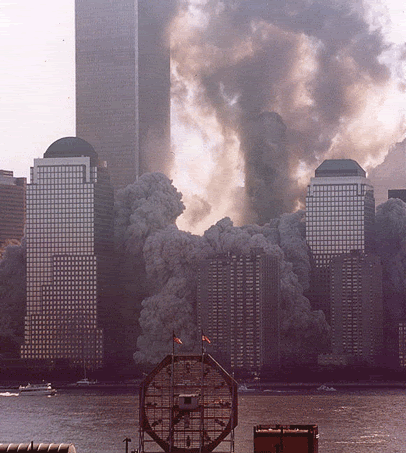
How many seconds had elapsed when the core was exposed in this photo?
southcorestands.gif


This photo shows that the upper block and floors were turned to a tumbling mass of debris which fell AROUND the remnants of the core in this photo. This shows that the floors were ripped/torn from what remained of the core before it finally collapsed.
 
Wait just one second. YOU were invited to a public debate on 9/11?
You don't seem to have any special or particular knowledge to add.

Well, I have debated Richard Gage three times, and also published a very detailed article on 9/11 in Skeptical Inquirer.

Part of the special knowledge in my toolkit is an awareness of something we physicists call "conservation of momentum."

When the first block falls, it does take about 3/4 of a second, and gets up to 19 mph. When it collides with the floor below, that inelastic collision slows down the falling mass, but only by a few percent (there's that momentum thing.) Because momentum is conserved, the mass before collision (say, 15 floors of WTC) times that velocity (19 mph) will be the same as the mass after collision (16 floors) times the slightly-reduced velocity (about 18 mph).

Since the top is already falling at 18 mph (SLOWED DOWN FROM 19 MPH BY COLLISION), it only takes a third of a second to fall 12 more feet, not 3/4. It gets up to 25 mph, which is reduced to 24 mph by the next collision, and so on.

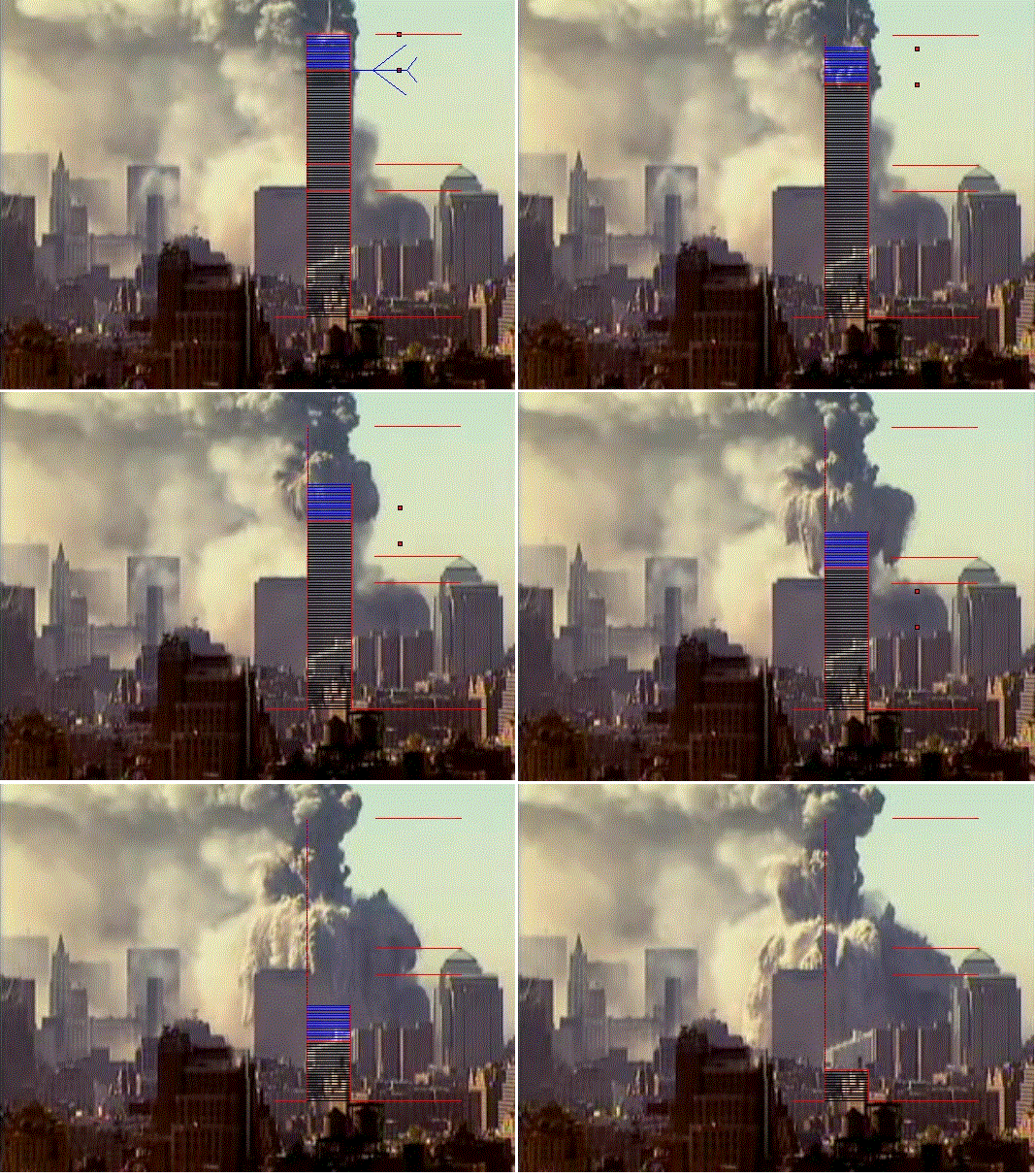
Taken to its conclusion, the model shows the towers collapsing in 12 to 15 seconds, just as was observed.

911movie.gif


(The red squares are objects in true free-fall, for purposes of comparison. The red lines are scale setpoints.)

You can read about this in more detail in my S/I article, as well as the NMSR website.

And what is your expertise on 9/11? Outside of hours of videos of you playing with magnets and iron filings?
:D
 
Last edited:
If twenty floors of the WTC became detached and fell twelve feet
onto the next lower floor, I'd have expected some damage to the
floor, but it would have held.

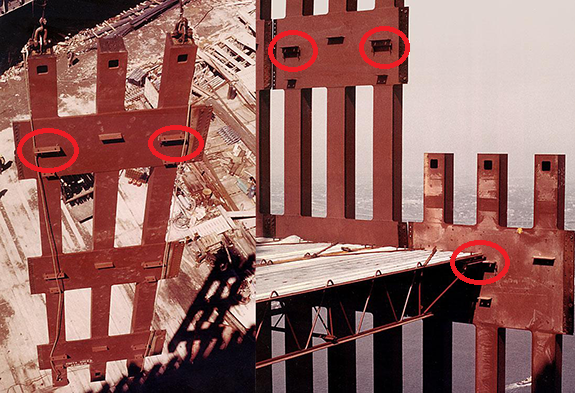
So you think these floor connection circled in red:
perimetercolumns.png


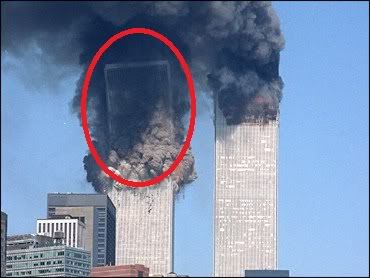
Should have stopped this:
collapse-1.jpg


From descending?????

:eek:
 

Back
Top Bottom