CptColumbo
Just One More Question
I've sent and received many ACARS messages and they never had any data regarding how the message was routed. It only included the flight number. However, I never worked in ATC and they may have a different system.
1. Do transmitted ACARS messages indicate the automated acknowledgement within the message text ?
I'd have to assume planned position, as there is no reasonable way for the ground station know where the aircraft's live position is. They may know from an earlier downlink that includes lat/long where the plane was when it sent it's message, but what if the next uplink was to be sent two hours later with no recent downlinked lat/long? I think you are taking this notion that ACARS is a data-link system a bit to literally.2. Are ACARS messages routed to be transmitted based on expected flight-plan, or live position ?
No difference as far as the sender is concerned. There is no acknowledgment.3. What is the behaviour of the printed ACARS message record in the event of a transmitted message not being received by the aircraft it's sent to ?
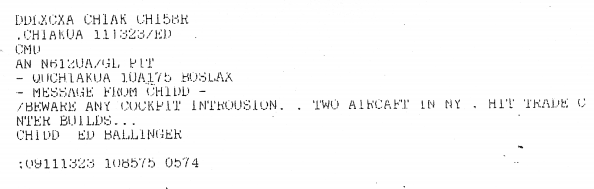
I am not familiar enough with UA's ACARS system to say what the third and fourth lines represent with 100% certainty. If it is the similar to the system I've used, I can say that the top two lines are most likely who you are sending the message to and where the message is coming from. Usually you will find the address of where the message is coming from on both lines, so the sender has a copy of what was sent. So the "CH1AK" is most likely where the message is being sent from.The messages referred to do include additional data...
[qimg]http://femr2.ucoz.com/_ph/2/331321151.png[/qimg]
(on my site. hotlinking fine.)
Do you have any specific knowledge of the acknowledgement mechanism ?
Do you have any knowledge of the mechanism which determines the transmission location ?
All ACARS documentation and specification details I've found include acknowledgement retry descriptions...I've already told you that ACARS is a one-way VHF radio data transmission either from the ground, or the aircraft. There is no reasonable way for the sender to know if the message was received.
...and ACARS message transmission really does get described as a packet relay-type transmission protocol.Incoming voice communications can occur at any time--even during times when the ACARS VHF transceiver is in the middle of a transmission. In such instances, amplifier 58 will drive relay contacts 58 open and the ACARS radio transmission will be terminated before it has completed its current transmission. Because of the ACARS guaranteed reliable positive acknowledge protocol in use, the ACARS CMU will in this case attempt to retry transmission when it does not receive a timely acknowledgement from the ground station network. Thus, once received voice communication terminates, the presence of communications interlock circuit 50 will once again allow the ACARS CMU to re-key the ACARS transceiver to retransmit the previously interrupted transmission. Meanwhile, clear priority is given to allowing the flight crew to receive voice communications.
Will cross-reference where the aircraft should have been with transmission location.I'd have to assume planned position, as there is no reasonable way for the ground station know where the aircraft's live position is.
It looks like various message types are *printed* in differing formats, but the underlying block format is available and seems fixed...I am not familiar enough with UA's ACARS system to say what the third and fourth lines represent with 100% certainty.
Label Message Title
_j No information to transmit, Polled mode
_DEL General response, Demand mode, no information to transmit
0 HJK Emergency situation report
2S Weather request
2U Weather
4M Cargo information
51 Ground GMT request response
52 AGM Ground UTC request
54 Aircrew initiated voice contact request
57 AEP Alternate aircrew initiated position report
5D TIS ATIS request
5P Temporary suspension of ACARS
5R AEP Aircraft initiated position report
5U WXR Weather request
5Y ETA Revision to previous ETA
5Z AGM Airline designated downlink
7A ENG Aircraft initiated engine data
7B ABM Aircraft initiated miscellaneous message
80-9 Aircraft addressed downlinks
A1 CLX Deliver oceanic clearance
A2 CLD Deliver departure clearance
A4 RCA Acknowledge PDC
A5 RPR Request position report
A6 RAR Request ADS report
A7 FTU Forward free text to aircraft
A8 DDS Deliver departure slot
A9 DAI Deliver ATIS information
A0 AFN ATIS Facilities notification
B1 RCL Request oceanic clearance
B2 CLA Request oceanic readback
B3 RCD Request departure clearance
B4 Acknowledge departure clearance
B5 PPR Provide position report
B6 PAR Provide ADS report
B7 FTD Forward free text to ATS
B8 RDS Request departure slot
B9 RAI Request ATIS information
C0 Uplink message to all cockpit printers
C1 Uplink message to cockpit printer #1
C2 Uplink message to cockpit printer #2
C3 Uplink message to cockpit printer #3
CA Printer status = error
CB Printer status = busy
CC Printer status = local
CD Printer status = no paper
CE Printer status = buffer overrun
CF Printer status = reserved
F3 Dedicated transceiver advisory
H1 Message to/from terminal
HX REJ Undelivered uplink report
M1 MVA IATA Departure message
M2 MVA IATA Arrival message
M3 MVA IATA Return to ramp message
M4 MVA IATA Return from airborne message
Q0 ACARS link test
Q1 ETA Departure/arrival reports
Q2 ETA ETA reports
Q3 CLK Clock update
Q4 Voice circuit busy (response to 54)
Q5 Unable to process uplinked messages
Q6 Voice-to-ACARS change-over.
Q7 DLA Delay message
QA DEP Out/fuel report
QB DEP Off report
QC ARR On report
QD ARR In/fuel report
QE DEP Out/fuel destination report
QF DEP Off/destination report
QG RTN Out/return in report
QH DEP Out report
QK ARR Landing report
QL ARR Arrival report
QM ARR Arrival information report
QN DIV Diversion report
QX Intercept
RA RPR Command aircraft terminal to transmit data
RB Response of aircraft terminal to RA message
:; Command aircraft transceiver to change freq.
#characters Purpose Comments
16 Pre-key Xmitter warm-up/Rx AGC adjustment
2 Bit sync establish bit synchronisation
2 character sync establish character synch
1 SOH indicate start of message
* 1 Mode ground system interface configuration
* 7 Address aircraft resgistration number
1 Ack/Nak acknowledge/non-acknowledge marker
* 2 Label type of message
* 1 Block ID message block number
1 STX indicates start of message text
* 4 Sequence# message sequence number**
* 6 Flight number airline flight number**
* 210 Text message text
1 ETX indicates end of text
16 Block Check Seq error dedection polynominal value
1 BCS suffix last character
*)highlighted text
**)air-ground message only
The "GL PIT" could mean where the aircraft is based (possible) or where the Pilots are based
If you look at the first two lines of each you will see that what I believe to be the senders and (on some) the CC address have changed. Assuming that the CH stands for Chicago, where IIRC UA has some of its offices (we use CHI for our Chicago base and NYC for the New York Base rather than the individual airport codes) and perhaps the people sending them are not actually at their office in Chicago or all ACARS from UA have an address out of the home office regardless of their origin. This could be true of admins on inspection or Pilots at a ground stop. Since IIRC MDT is Harrisburg, PA and PIT is Pittsburgh, PA, I find it unlikely that a transmission to a plane would need to be switched between airports so relatively close together, especially when it would more likely switch between PHL and PIT (or even BUF DTW or CLE).The link in the OP (which I assume you have read) highlights the changes in the element referenced PIT...
[qimg]http://femr2.ucoz.com/_ph/2/331321151.png[/qimg]
[qimg]http://femr2.ucoz.com/_ph/2/2/513740653.png[/qimg]
[qimg]http://femr2.ucoz.com/_ph/2/2/849396678.png[/qimg]
[qimg]http://femr2.ucoz.com/_ph/2/648161484.png[/qimg]
(on my site. hotlinking fine.)
How would you explain the change from MDT to PIT ?
I suggest the GL references Ground Link/Location.
All ACARS documentation and specification details I've found include acknowledgement retry descriptions...
Only when a message is enroute, or when the mic is keyed. When no uplinks or downlinks are in progress, no data is being transmitted....and ACARS message transmission really does get described as a packet relay-type transmission protocol.
The link in the OP (which I assume you have read) highlights the changes in the element referenced PIT...
http://femr2.ucoz.com/_ph/2/331321151.png
http://femr2.ucoz.com/_ph/2/2/513740653.png
http://femr2.ucoz.com/_ph/2/2/849396678.png
http://femr2.ucoz.com/_ph/2/648161484.png
(on my site. hotlinking fine.)
How would you explain the change from MDT to PIT ?
I suggest the GL references Ground Link/Location.
Yes, clearly.Do you really need this explained?
Yes, I have. The primary reason for seeking clear and definitive detail on the behaviour of the ACARS messaging system is to determine a clear and definitive explanation of the final message, several minutes after Flight 175 impacted WTC 2.Look at the time stamps.
I'll cross-check, but that's fine, and from the additional details I've looked at, yes, would appear to be the case.The PIT(Pittsburgh) uplink attempt happened 20 minutes after the last attempt, which was from the MDT(Harrisburg) ground station. Now look at a map. This fits our theory perfectly that the service provider selects the ground stations based on the flight plan.
I don't know about you, I'm having trouble reading these (probably done on a dot matrix printer). Looking at the other printouts I now see that what I believe is the senders address on the first one displayed is "CHIAK." That fits into what I've used. My address used to start with MSP, followed by a code for the building we were in, a code for the floor and one for our specific printer (there were four on our floor).Do you really need this explained? Look at the time stamps. The PIT(Pittsburgh) uplink attempt happened 20 minutes after the last attempt, which was from the MDT(Harrisburg) ground station. Now look at a map. This fits our theory perfectly that the service provider selects the ground stations based on the flight plan.
just reread woodybox:
"Now these position informations reveal shocking news: Winter explicitly confirms that United 93 received the last ACARS messages when it was near Fort Wayne (Indiana) and, some minutes later, near Champaign (Illinois):
"...Messages #18 and #19 were sent to the aircraft from CHIDD using the RGS near Champaign, IL CMI as designated in the line "AN N591UA/GL CMI...". Both messages were sent to the printer and Message #19 also activated an audible signal in the aircraft..."
"
Yes, clearly.
Yes, I have. The primary reason for seeking clear and definitive detail on the behaviour of the ACARS messaging system is to determine a clear and definitive explanation of the final message, several minutes after Flight 175 impacted WTC 2.
If I can gather clear and definitive information on message acknowledgement mechanisms (we're not there yet) then the *anomoly* will be explained and my interest in the thread will be done with.
I don't know about you, I'm having trouble reading these (probably done on a dot matrix printer). Looking at the other printouts I now see that what I believe is the senders address on the first one displayed is "CHIAK." That fits into what I've used. My address used to start with MSP, followed by a code for the building we were in, a code for the floor and one for our specific printer (there were four on our floor).