AA77 FDR Data, Explained

So what the passengers felt during the descent was roughly about one half of a G while turning 320 degrees in about two minutes? And that's what those pilots with decades of experience say was impossible? I've personally been at the helm of a boomer that weighed over 8,000 tons and turned it over 360 degrees at close to 5 degrees per second while at flank speed more than once. Think about that, I've turned about 720 degrees in a 8K plus ton vessel submerged in sea water in the same amount of time that those clowns claim can't be done by a 135+ ton aircraft in the air? Over 56 times the mass in a much denser fluid can do it with a much higher resistance factor.

Sea trials. Where you get to do evolutions during a shakedown that in real life that you will most likely never do but you want to be sure that you can do them if you need to.
 
This is slightly off-topic, but I saw another opportunity for education. Warren, you still have the floor, by all means continue...

I took a gander over at Cap'n Bob's forum earlier tonight. They don't seem to like me much. But among their comments was the following, referring to an earlier post of mine:

Cap'n Bob said:
"Compressibility!" he claims...

Ok students, what happens when you compress air? It gets more dense and pressure increases, right? What happens as you get lower in altitude, air gets more dense and pressure increases.. right?

So, if the altimeter was erroneous due to "compressibility", it would be reading LOWER than actual altitude! Meaning, the 187 MSL calculated above, is actually reading lower than the actual altitude of the aircraft, according to Mackey's theory.
Source

The problem is a lack of vocabulary. What I wrote was "compressibility," which Cap'n Bob thinks means "compression." This is not the case.

Compressibility is another way to describe the effects of transonic or supersonic flow. When air flows at low speeds, well below the speed of sound, it is effectively incompressible. But note the key word "flow." If you put air that isn't moving at all in a cylinder and compress it, you will find that it compresses. But you cannot compress air just by blowing it around at subsonic speeds. This is because the air automatically equalizes its pressure, and it does so at the speed of sound.

So if it's flowing much slower than the speed of sound, you will never find any appreciable difference in its static pressure, and it is thus, for all intents and purposes, incompressible. This kind of flow can be treated through equations based on simple conservation of mass and energy, like the Bernoulli formula, and the assumption that the static pressure and the density are effectively constant.

When air approaches the speed of sound, however, "compressibility" sets in. What it means is that under the right conditions, we can no longer assume density is constant, and thus neither can we assume static pressure is constant. Applied to an aircraft, this can happen even at aircraft speeds below Mach 1 -- hence there is no clean distinction between subsonic and supersonic when aircraft are involved. We call this overlap the "transonic" regime. But why does it happen?

Why is because the aircraft shape accelerates the flow. If the aircraft is traveling at the critical Mach number, which can be as low as about 0.6, this means that at some point, probably flowing over the wings, the airflow is accelerated to the point that it becomes supersonic. When that happens, we can no longer treat the air as constant pressure, or constant density.

In supersonic flow over an aircraft, a shock wave will form, in this case a particularly weak one. This shock wave defines a discontinuity in the flow. As you follow a little chunk of air, it will start subsonic, speed up gradually, speed up continuously, and when it encounters the shock it suddenly changes speed, direction, density, pressure, temperature, everything.

But does the pressure increase, as Cap'n Bob insists?

It might, but it might not. All that "compressibility" means is that the pressure is not constant. It does not mean that the pressure must always be equal or greater than ambient pressure. It can also be much less.

In fact, it is commonly much less. One of the best known and most easily visible effects of compressibility is a vapor cone, which is defined mathematically by the Prandtl-Glauert Singularity. If you've ever been to an airshow and seen high performance aircraft maneuvering steeply, you've probably seen this -- and it happens at subsonic speeds.

What's happening is that, under maneuver, the airflow is briefly accelerated to sonic speed, and a weak shock forms, attached to the wings. The air gets compressed and heats up in the shock, losing a bit of heat to the boundary layer and so on. But the airfoil isn't done yet. It next decompresses the air, and so doing also reduces the temperature, since there's no heat entering or leaving the fluid. If it decompresses the air enough, this causes water to condense, forming the cloud.

The cloud is proof positive that transonic flow, and compressibility, can actually lower the pressure of air passing over the aircraft.

So, what effect compressibility has on the static probe feeding our altimeter depends crucially on where the probe is and what the airflow looks like over the aircraft. At transonic speed, which AA 77 was according to the new data, the pressure altimeter could see an artificially high static pressure (viz. an artificially low altitude reading), or an artificially low one (with the opposite effect). Cap'n Bob claims it could only see a higher pressure, but he's wrong, which is somewhat inexcusable for a pilot to misunderstand.

I don't know enough about the aircraft or the precise flow to guess whether it would go up or down. Could even be both if buffeting or detached flow sets in at the port location. One would probably have to test this to be sure, and I am reasonably certain that no Boeing 757 in history has flown this fast, this low, and lived to tell the tale. Hence, all I know for sure is that it makes the reading relatively unreliable.

Fortunately, the Radar Altimeter doesn't care about compressibility, so this is the preferred measurement in this case, as I said before. Provided Warren's extraction is correct -- and I see no reason to doubt it at this point -- this instrument shows a steady descent to a reported altitude of four feet, followed by silence. This is rather remarkable behavior unless one concludes, as the evidence leads us, that the aircraft crashed shortly afterward.

Hope that was useful. When you see "compressiblity," don't equate this with compression. There's no container at work here. What you should think instead is "supersonic flow" and "pressure can go up or down." Subsonic problems can be solved with equations based on conservation of mass, but supersonic problems are much more concerned with temperature.

ETA: And in other news, Cap'n Bob has already griped about this post... wow. Too bad I didn't have my stopwatch handy.

 
Last edited:
So we have, in all likelihood, a transonic shockwave forming around AA77 which is lowering the ambient pressure around the static ports, we have an Air Data Computer not calibrated to fly in such a high-speed/low altitude regimen, we have undoubtedly large instrument lag in a 4000 fpm descent at 500 mph, and we have a standard calibration error on top of that.... and in Robbies world, that's much preferable to RADALT which is accurate to less than a foot in any conditions. Right. Got it.

You said it best earlier Ryan.

Remind me again why you pay any attention to Cap'n Bob?
 
<snip>
You are looking at just one Radalt system there(probably the Center system), the FDR alternates samples between the Left, Center, and Right LRRA's. The last 10 seconds go: 621, 492, 515, 352, 273, 233, 183, 89, 57, 4.
<snip>
Just a small error, that figure of 515 should be 416.

Warren.
 
ETA: And in other news, Cap'n Bob has already griped about this post... wow. Too bad I didn't have my stopwatch handy.

This isn't surprising at all. The dummy has no idea what compressibility is because he has never had to deal with it in the real world. He's essentially a Cessna 150/152 neophyte with big aspirations and an even bigger ego.

You'll notice that virtually everything he writes is aimed at his ignorant twoofer audience. He apparently doesn't care if it passes scrutiny of people that know better. Then, all he has to do is character assassinate the few of us who point out his nonsense while touting his "verified by the FAA" loons whom he says supports his lunacy.

What confounds me tho' is now in hades (at least) a few of his cult of "verified by the FAA" who know better remain silent. I'm beginning to believe that twooferism is a disease that actually kills brain cells and makes people stupid.
 
apathoid said:
@Mangoose: On the Lat/Long. The pilots enter the airport's lat/long in the Flight Management Computer at the departure gate; that's why initially it was 3,000' off. But once in the air, the IRS(not INS - lets not give Robby any ammo here) system used navaid triangulation to keep the error to a minimum. But the resolution of DME is 0.10 nm, so thats the most accuracy you can expect out of a pre-GPS IRS system on the 757.


Thanks. I'm not an aviation-type, so the jargon is a bit difficult, but I am mainly interested in how the last four positions in the FDR give lat/longs that are increasingly northward of the true position of the plane. Looking at the plots in Google Earth (and I am not sure of the size of the area covered by the coordinates, so I am going with what Google gives me), the position of the plane at the VDOT building is 42 feet off, then the next plot has it about 88 feet closer to the Navy Annex, then the next has it about 106 feet closer to the Citgo (but still SOC), and then the last has it 224 feet north of what should have been its true position near the lightpoles (again assuming that the coordinates are precise enough). I was curious if this pattern of progressive skewing is expected from the behavior of the plane at low altitude and if the 200 feet+ discrepancy in the last plot is within the expected range of error.
 
So what the passengers felt during the descent was roughly about one half of a G while turning 320 degrees in about two minutes? And that's what those pilots with decades of experience say was impossible? I've personally been at the helm of a boomer that weighed over 8,000 tons and turned it over 360 degrees at close to 5 degrees per second while at flank speed more than once. Think about that, I've turned about 720 degrees in a 8K plus ton vessel submerged in sea water in the same amount of time that those clowns claim can't be done by a 135+ ton aircraft in the air? Over 56 times the mass in a much denser fluid can do it with a much higher resistance factor.

Sea trials. Where you get to do evolutions during a shakedown that in real life that you will most likely never do but you want to be sure that you can do them if you need to.

Seems to me that the much denser fluid would also allow for a greater turning force to be generated by the control surfaces.
 
Just a guess here but I would think that if the lat/long data is the result of an inertial guidance system that the hefty acellerations experienced during the final turn/descent would have been playing havoc with the system.
No, an INS is not affected by altitude, but heavy maneuvering does affect them. Remember AA77's INS was off by about 3000' or so at Dulles. It could have improved with updates, but these INS's used by the airlines are not extremely accurate and the updates are done using VOR/DME. They're close, but not exact. There is no comparison between these and those used by the AF. They are apples and oranges.


See there, and here I am just an informed lay-person. I certainly understand that INS is by no means all that accurate. If it were it accurate and highly reliable then there would have been less reason to launch dozens of very expensive GPS satellites into orbit. Just put an INS on everything that moves:D


Assuming that he considers the RADALT to be accurate, yes, that is what he is stating.

However, his own statement above indicates that he considers the PA to be more accurate than the Radalt, once it is adjusted for local pressure.
To my mind that is ridiculous. Yes, radar would bounce off anything below it. However I cannot envision the PA reading being accurate at all when it is on an aircraft that is doing something totally out of the parameters for which it was calibrated.
.............

R.B. is putting all his eggs in the PA basket. Is there any official references that either back him up, or shoot him down, as far as the accuracy of PA in an aircraft going 450+ knots below say, 500 feet agl?

I may be reading the data incorrectly but I seem to see that the next earliest Radalt reading is 233 feet. How many seconds prior to the 4 foot reading is the 233 foot reading?


.......... Never once in my flying career have I ever relied on a barometric altimeter close to mother earth. It is a quick and easy way to end your career prematurely.

Ahh, now I see Cappy Bobby is argueing the meaning of "close" concerning this.

Cap'n King Air's comments regarding a 13' error in AA 77's Altimeter is a humorous distraction with minutiae. Can someone please tell me how all of those "verified by the FAA" cult members he refers to know if their altimeter is not lagging. How do they know just how accurate their altimeter is during all phases of flight. All they really know is how accurate it is on the ground. They can compare the two altimeters, but they don't know whether both are erroneously are reacting in the same way to the same phenomena.

Cappy ignored your query.

AA 77 was traveling well above design parameters, so, as R Mackey said, who knows what was happening at the static ports.
I used to test and calibrate the pitot static systems on the fast jets I worked on and the altimeter was only 50ft accurate low level. That was mil spec stuff. The high speeds at that height would have made it even worse than normal.
.

Also ignored

ETA: a correction here. We used to shoot Ground Controlled (GCA) approaches to 200' agl 1/4 mile visibility without a radar altimeter. What I said above applies to aircraft with a Radar altimeter. On Precision approaches the Decision Height is based on a barometric altimeter, but you can rest assurred that the pilot has one eyeball on the radar altimeter (if one is available).

Cappy argues that call outs are referenced to baro alt during a CAT1 ILS approach. Fine, I wonder if he understands why a min decision altitude for CAT 1 is 200 feet agl. In CAT 2 and 3 if all autopilots are functioning properly then the aircraft can beallowed to autoland. However in such cases the aircraft, IIRC, is making use of ground based equipment that constantly updates the autopilot on its (the aircraft's) instantaneous location, and onboard altitude equipment is not in play. Even when the pilot is at the controls (as opposed to autopilot) the minimum decision height(yes Bobby - height) is 50 feet agl on a CATIIIb system and again , the pilot would be operating using positional data supplied not by the aircraft but by the ground equipment.

If the pilot of an aircraft on CAT1 approach cannot see the runway at 200 feet agl(a decision "height" ) is not the SOP to execute a missed approach? If the glide slope is not functioning but the localizer is the the decision point is 400' altimeter.

One other thing to consider is that the Ground Proximity Warning System is based in radar altitude , not pressure altitude. If PA is not good enough for the GPWS but Radalt is what does that say about the accuracy of PA?

You will note that Cappy seems to have missed your reference to GCA and in using ILS references he is trying to equate using ground based equipment in conjunction with aircraft based equipment to relying soley on the equipment on board.

I took a gander over at Cap'n Bob's forum earlier tonight. They don't seem to like me much. But among their comments was the following, referring to an earlier post of mine:


Source

The problem is a lack of vocabulary. What I wrote was "compressibility," which Cap'n Bob thinks means "compression." This is not the case.

.............

In fact, it is commonly much less. One of the best known and most easily visible effects of compressibility is a vapor cone, which is defined mathematically by the Prandtl-Glauert Singularity. If you've ever been to an airshow and seen high performance aircraft maneuvering steeply, you've probably seen this -- and it happens at subsonic speeds.

...........The cloud is proof positive that transonic flow, and compressibility, can actually lower the pressure of air passing over the aircraft.

.
I see Cappy posted a picture of a landing aircraft that shows vapor above its wing and chides that you are saying that this indicates supersonic airflow.

Seems he missed one word in your description of the phenomena you refer to. The word is 'cone'. There are several ways to lower the pressure of the air in the flow, you describe one above, Cappy shows us a picture of another way it occurs, high angle of attack/low airspeed in which case, IIRC, the turbulence generated by the wing now occurs over the wing as opposed to behind the trailing edge. The aircraft he is showing a picture of is, it would seem, close to stall speed.
 
Last edited:
...
Ahh, now I see Cappy Bobby is argueing the meaning of "close" concerning this.

... to baro alt during a CAT1 ILS approach. Fine, I wonder if he understands why a min decision altitude for CAT 1 is 200 feet agl.

...I see Cappy posted a picture of a landing aircraft that shows vapor above its wing and chides that you are saying that this indicates supersonic airflow.

....
Poor Balsamo, no ATP, no clue on 9/11, no brains, no logic, and he is betting on an instrument we checked for preflight at +-75 feet. It gets worse since the Altimeter lags the descent and the idiot terrorist murderer was pulling 2.6Gs. The altimeter is worthless for being accurate. The RADALT is exactly zero when we touchdown, the pressure altimeter is still flying around, the last time I look at the altimeter on an approach is to level off at MDA, or at DH, then I do a GA/MA, or land using my A1 mother nature issued visual system.

The final pitch attitude will quiet the failed pilot truth-NAZI and only a few p4t dolts like dMole and Tina the high performance mechanic will remain Balsamo’s drones of paranoid conspiracy theories and failed delusions.

Balsamo never changed his failed 11.2G physics because he can’t find his error and then adds insult to his failure by making up dumber ways to back in any G force he wants.
 
Last edited:
Well Balsamo et al have to keep clutching at straws to support their contentions whereas we begin with the physical facts that the DNA of the passengers, the aircraft's FDR and aircraft parts consistent with Flt 77's type were all found within the Pentagon indicating that indeed it hit the structure.
Minor anomolies in the FDR are then examined from that standpoint. If there were a major anomolie it would be of great interest to ICAO, the NTSB, the pilot's unions and the aircraft manufacturers.

Cappy begins with a ingrained mistrust of all gov't agencies and works backwards from that standpoint. This mistrust only extends so far though as he is quite willing to take the NTSB sim of the flight at face value. Corrections to the NTSB sim, made by several people here are ignored. He requires PA to be very accurate in conditions well outside normal operating parameters, and of course, he has to invent complicated and patently ridiculous senarios to explain away the DNA (planted or faked during the chaos of the events or afterwards in transit or the lab itself), the FDR (planted during the chaos following the events of the day, or taken from a different aircraft that actually overflew the Pentagon and manipulated to indicate it was on Flt 77, i.e. faked) and the aircraft parts (planted and/or faked in the immediate aftermath of the event on 9/11/01).
He then examines minor anomolies and considers them major, places the aircraft where it suits his first agenda, showing gov't wrongdoing, and claims they are Major anomolies.

Does he create a full and technical treatment of this and submit it to the NTSB, ICAO, the pilot's unions, or the aircraft manufacturers? NO
Does he submit such a technical paper to aerospace and flight magazines? NO
To science based magazines? NO

Instead he produces a short non-technical news release. A 'news release' rife with innuendo or down right accusation of gov't malfeasence.
He produces videos designed for viewing by the general populace in which he passionately implies gov't wrong doing and points to these in the news releases.
He submits a short non-technical few paragraphs attached to a lawsuit in which the complainant claims the plane did not hit the Pentagon. Does he bring this suit? NO
Does he imply that attaching his 2 cents worth to the suit means its being looked at by the courts? YES, but it isn't.
Finally of course, he argues inccessantly on the internet and calmours for face to face debates which again would not, because they could not, be discussions of the highly technical matters at hand but would make for good viewing by others of his political bent.

He and his followers are a collection of sad, somewhat deranged, individuals chomping at the bit for a 'revolution' which would allow them to 'cleanse' the world, or at least the USA, of their perceived enemies.
 
Last edited:
Paranoid nut case conspiracy theorist writes the NTSB and makes it public. Advertising your insanity is standard for p4t chief delusion maker.
You can find the decode program here.
http://warrenstutt.com/AAL77FDRDecoder/index.html
Along with copies of the FOIA request and cover letters here.
http://warrenstutt.com/NTSBFOIARequest2-1-09/index.html
Please keep in mind, I cannot vouch for the authenticity of the executable programs designed by the above mentioned independent researcher nor if it may contain any malicious code. (wow, p4t dolts do not trust warren)

If able, please advise any suggestions you may have to perhaps amend the information being provided by the NTSB to the American public if in fact the above code is authentic and conclusions accurate.

We will also be filling out a ASRS Report with respect to this information..
Regards,
Wantabe pilot Capt Bob(never going to fly leftseat heavy jets ATP-less)
Chief dolt truthNAZI
Pilotsfor911LIEStruth.org
The big picture from the NTSB is...
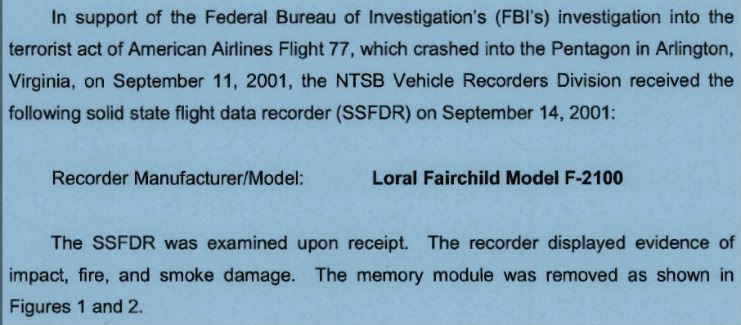
77FDRreport1.jpg

The NTSB, like the rest of the world knows terrorists flew 77 into a big giant building, the Pentagon and the FDR was found in the Pentagon. It is clearly implied by the NTSB. NOTE: the NTSB does not do crime, there is no safety of flight issues because the NTSB actually has handed out freely all the data from Flight 77. Oops, Balsamo is nuts.

Why is the NTSB decode files missing 4 seconds of decode. Warren got it right, the Frame is missing stuff. The NTSB implies this in the report made public. Oops, Balsamo is still nuts. Maybe the NTSB will fess up and tell us why they left out 4 seconds at the end of the FDR; the technical reason.

When you look at the data you don't see much except you can see from the data where the terrorist took over, you can see how bad they fly, you can see they lined up for the Pentagon. The animation shows no major maneuvers, and confirms any kid off the street could fly the jet into the Pentagon, but Balsamo can't; he said he can't. The only pilots who can't fly as good as the poor flying terrorists are p4t pilots. They brag about it.
77FDRreport2.jpg

The final frame was not recored properly it was missing parts.

The only good that can come from this is a few people who lack knowledge may figure out the NTSB does not investigate crime, they provided products to the FBI as needed. The people to ask about the NTSB products are the FBI. Only a few fringe nut case idiots make up lies about Flight 77 since it is a fact the FDR and dead passengers were all flown into the Pentagon by Balsamo's friends, the terrorists he apologizes freely and idiotically for by making up lies and delusions about 911 due to his complete ignorance on 911 and math.

The only report that the NTSB needs is on Balsamo who is insane, and it was sent by Balsamo.

For years Balsamo has failed to reveal they had the missing seconds given to them by the NTSB. I hate to tell Balsamo I knew flight 77 impacted the Pentagon on September 11, 2001. Balsamo can't figure this out in 8 years; the best he can do is make up lies and try to sell the paranoid poppycock on DVD.
 
Last edited:
graphs of the altitude and ground profile

You are looking at just one Radalt system there(probably the Center system), the FDR alternates samples between the Left, Center, and Right LRRA's. The last 10 seconds go: 621, 492, 515, 352, 273, 233, 183, 89, 57, 4.

Just a small error, that figure of 515 should be 416.

As an aid to visualization, I have created two crude graphs. The first shows both uncorrected pressure altitude and radar altitude, as a function of time, for the final 60 seconds of Warren's FDR data:

http://www.ccs.neu.edu/home/will/Music/Jokes/Balsamo/graph1.jpg

The radar altitude apparently pegs at 2795/4000/4000/4000 when the radar altitude is above 2600 feet or so, but the radar altitude tracks the pressure altitude reasonably well for the last 40 seconds.

If both the pressure altitude and radar altitude were perfect, we could compute the ground elevation by subtracting the radar altitude from the pressure altitude, as in this graph:

http://www.ccs.neu.edu/home/will/Music/Jokes/Balsamo/graph2.jpg

The pressure altitude obviously needs some calibration before the computed ground elevations would become positive, but the profile of the ground elevation probably shows something real. It might be possible to match that profile against the known elevations and obstacles along the likely line of approach.

In particular, the computed ground elevations show no sign of the Pentagon suddenly looming underneath the aircraft during the final seconds, which would seem to refute Rob Balsamo's interpretation.

Will
 
Thanks. I'm not an aviation-type, so the jargon is a bit difficult, but I am mainly interested in how the last four positions in the FDR give lat/longs that are increasingly northward of the true position of the plane. Looking at the plots in Google Earth (and I am not sure of the size of the area covered by the coordinates, so I am going with what Google gives me), the position of the plane at the VDOT building is 42 feet off, then the next plot has it about 88 feet closer to the Navy Annex, then the next has it about 106 feet closer to the Citgo (but still SOC), and then the last has it 224 feet north of what should have been its true position near the lightpoles (again assuming that the coordinates are precise enough). I was curious if this pattern of progressive skewing is expected from the behavior of the plane at low altitude and if the 200 feet+ discrepancy in the last plot is within the expected range of error.


Sorry, airplane jargon is one of only two languages I speak. :p

I noticed the same thing you did, but there are a couple of issues. The Inertial Reference System resolution on the 757 is 0.1 minutes(i.e. N38 DEG 30.0 MIN W077 DEG 15.5 MIN), plus the Distance Measuring Equipment(DME), which provides distance to the navaid tuned in the navigation radio, resolution is 0.10 miles. These two facts mean that there will be error. This error will not appear to be "static" because sometimes the airplane's actual position will be closer to its computed position and sometimes it will be farther. The best we can do is plot a lat/long range for each data point.

Hope this helps.
 
Last edited:
God, I love geeks. Doesn't matter the topic nor how well I understand it, I stand in awe of thems, like Warren, what can make sense of it. And, as a computer nerd of the 80s, I understand both the difficulty and the need to make sense from insufficient data. Honestly, you kids these days? TOTALLY spoiled. ;)
 
God, I love geeks. Doesn't matter the topic nor how well I understand it, I stand in awe of thems, like Warren, what can make sense of it. And, as a computer nerd of the 80s, I understand both the difficulty and the need to make sense from insufficient data. Honestly, you kids these days? TOTALLY spoiled. ;)

The YouTube Generation ROCKS!
 
I see Cappy posted a picture of a landing aircraft that shows vapor above its wing and chides that you are saying that this indicates supersonic airflow.

Seems he missed one word in your description of the phenomena you refer to. The word is 'cone'. There are several ways to lower the pressure of the air in the flow, you describe one above, Cappy shows us a picture of another way it occurs, high angle of attack/low airspeed in which case, IIRC, the turbulence generated by the wing now occurs over the wing as opposed to behind the trailing edge. The aircraft he is showing a picture of is, it would seem, close to stall speed.

Exaaaactly. He's talking about a completely different phenomenon... Like I said, the problem is a lack of vocabulary. He may as well point to a cloud in the sky and claim that proves compressibility can't reduce static pressure.

To recap, the logical chain is as follows:

  • Vapor cones are a compressibility effect that causes a reduction in static pressure
  • This proves that compressibility effects can, in general, cause a reduction in static pressure
  • This proves that the static probes of AA 77 could have seen an artificially low pressure
  • This proves that the pressure altimeter of AA 77 in its final moments could be reading artificially high
  • This proves that, once again, Cap'n Bob, who insists compressibility == compression, is not a reliable source of information on basic aerodynamic subjects

But, again, we're beating a dead horse. The radar altimeter is the more reliable instrument, period. If there's a conflict between it and the pressure altimeter, we should lean towards the radar altimeter. Its readings are inconvenient to the Truthers, so, naturally, they'll make up whatever nonsense it takes to try to throw out the radar altimeter data.

Science doesn't work this way, but Truthers do.
 
Last edited:
Over at the asylum Bobby is now saying
"Well no. The above Vapor cone, as you can see, is happening in straight and level flight, and it's when the aircraft is breaking the sound barrier. Mackey is so confused he doesn't even realize the difference, and his minions follow right along..."

Now if I understand Mackey correctly, he is stating that the pressure cone and lowered air pressure was not occuring around the entire aircraft, which is what Bobby is implying was stated. At 450 MPH+, and at low altitude, there can be areas along the aircraft's surface that do experience this effect. Now I am not an aerospace engineer but I do have some smarts in this area and it seems to me that this effect would be most likely to occur on areas of the a/c where there are sharp differences in the outer skin. Under normal operating conditions this would have no effect on the static pressure in those areas but exceed those normal operating conditions and all bets are off.

Same goes for the engines themselves. Under normal operating conditions they are just fine, exceed those conditions (well golly look at the FDR, seems the engines were not humming along perfectly). Engines too depend on a large set of parameters being within certain specs in order for their smooth and reliable operation. One of those parameters is the quantity and velocity (speed and direction) of the air entering them.

Some systems though are completely unaffected by the outside air in any way. One of those of course is the radar altimeter. It will function the same at all speeds and for all clear air, pressure conditions one might experience on Earth.

Seems that it has a max range on 3000 feet agl but by the time one is at 3000' agl one would not really need a precise altitude measurement (just need to stay at assigned level +/- 50 feet IIRC for IFR flight, and all VFR flights I have been on stayed below 10K feet)

Mackey claims compressibility effected(sic) the Pressure Altimeter (of course he admits he doesn't know which way), but fails to understand (or ignores), the control issues associated with compressibility. So, not only was Hani able to get an aircraft completely into its target with a 33' margin for error at 130 knots over Vmo and zero time in type, but he also overcame the control issues associated with compressibility, yet couldn't control a 172 at 65 knots..

This is where despite Bobby taking you to task for supposing a condition existed by which the air pressure reading was affected by the operating conditions, he is quite willing to suppose that these same operating conditions may have set up severe control issues, specifically 'flutter' of control surfaces that were close to the natrual harmonic frequency of those controls.

Seems he wants it to mean that IF air pressure affected the pressure reading then it must also cause the aircraft to be uncontrolable. Quite amazing and amusing really. Cappy is grasping at straws. The decode radalt indicates the last altitue of just 4 feet agl so he is going off on MacKey's explanation of how the PA could be affected by the operating conditions of this flight.
 
Last edited:
As an aid to visualization, I have created two crude graphs. The first shows both uncorrected pressure altitude and radar altitude, as a function of time, for the final 60 seconds of Warren's FDR data:

http://www.ccs.neu.edu/home/will/Music/Jokes/Balsamo/graph1.jpg

The radar altitude apparently pegs at 2795/4000/4000/4000 when the radar altitude is above 2600 feet or so, but the radar altitude tracks the pressure altitude reasonably well for the last 40 seconds.

If both the pressure altitude and radar altitude were perfect, we could compute the ground elevation by subtracting the radar altitude from the pressure altitude, as in this graph:

http://www.ccs.neu.edu/home/will/Music/Jokes/Balsamo/graph2.jpg

The pressure altitude obviously needs some calibration before the computed ground elevations would become positive, but the profile of the ground elevation probably shows something real. It might be possible to match that profile against the known elevations and obstacles along the likely line of approach.

In particular, the computed ground elevations show no sign of the Pentagon suddenly looming underneath the aircraft during the final seconds, which would seem to refute Rob Balsamo's interpretation.

Will
Very nice Will.
It illustrates why both altitude readings are important.
If you want a smooth descent you will use the PA as it is unaffected by the terrain(trees, houses et.)
If you attempted to fly a steady radalt you would be flying the terrain profile.
BUT once you get down low enough that terrain objects can bite you on the butt you most certainly would want to be looking at the Radalt since it is more accurate as to you height above the hard surface. This is really never a consideration in most pilot's experience since they are taking off and landing along paths under which it has been ensured that there are no ground obstacles reaching into the sky. Cappy has happily used his PA to get to his decision altitude. He has never been concerned with the objects under him on landing approaches because his charts tell him that there is nothing there to worry about as long as he is on the localizer.

It seems that Cappy's defintion of 'accurate' depends on what he wants to do. As a pilot of a commercial (or private) aircraft he wants a smooth flight. He operates in an enviroment where all obstacles have been cleared away from the paths where he is in relatively low level flight.(say below 1000' as indicated on the altimeter). The altimeter will give him accuracy in that it will allow that smooth descent. It is NOT giving him precise measurments of the height above the hard surface but it simply does not matter. If its foggy and there is a really large crane set up in the fog along the approach then there should be a NOTAM issued. Cappy is insulated from ever having to care about the precision differences between PA and Radalt. Since he uses the PA exclusivley he trusts it implicitly. Yet another indication of Cappy's limitations.

Some pilots simply will not go into airports that do not have ILS. Some will not attempt to find an airport if ATC cannot vector them right to the strip.

I have been in ATC when a pilot was asking to be guided to an airport that did have an ILS. It was at night but clear skies. The radar however was located 90 miles away at another airport and ATC could not see below 5000 feet (distance and intervening terrain) near the strip the pilot wanted to go to. He chose to turn around and go home because he was not comfortable finding the localizer without ATC holding his hand! Now that was of course a private pilot, not the commercial pilot that Cappy is but it serves to indicate that not all pilots are created equal as in the years that I was an electronics tech with Transport Canada this was not the only story that ATC operators had about crappy pilots.
 
Last edited:
As an aid to visualization, I have created two crude graphs. The first shows both uncorrected pressure altitude and radar altitude, as a function of time, for the final 60 seconds of Warren's FDR data:

http://www.ccs.neu.edu/home/will/Music/Jokes/Balsamo/graph1.jpg

The radar altitude apparently pegs at 2795/4000/4000/4000 when the radar altitude is above 2600 feet or so, but the radar altitude tracks the pressure altitude reasonably well for the last 40 seconds.

If both the pressure altitude and radar altitude were perfect, we could compute the ground elevation by subtracting the radar altitude from the pressure altitude, as in this graph:

http://www.ccs.neu.edu/home/will/Music/Jokes/Balsamo/graph2.jpg

The pressure altitude obviously needs some calibration before the computed ground elevations would become positive, but the profile of the ground elevation probably shows something real. It might be possible to match that profile against the known elevations and obstacles along the likely line of approach.

In particular, the computed ground elevations show no sign of the Pentagon suddenly looming underneath the aircraft during the final seconds, which would seem to refute Rob Balsamo's interpretation.

Will

If this helps you, I used GIS mapping software to create a profile of the terrain under AA77's flight path for the approximate length of time of your data up to the impact point. I plotted it over your second graph to show you the comparison:

 
Darned close I'd say. Of course the a/c was not moving at constant velocity so distances between readings is not constant and will affect the way the graph of the radalt looks compared to the GIS plot.
 

Back
Top Bottom