• Quick note - the problem with Youtube videos not embedding on the forum appears to have been fixed, thanks to ZiprHead. If you do still see problems let me know.

A scientific fact/tidbit you recently learned that you thought was interesting

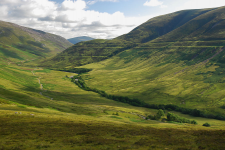
I went for an afternoon bike ride up this glen and back, and found out what caused these lines on the hillside. Any takers?


1763214536368.jpeg
 
Neither. You have one guess left.

This might be a better photo.

1763216093192.png
 
Last edited:
Well, early stories say they were roads made by Fingal. Or the fairies. Or they were hunting tracks made by the very early kings of Scotland hunting out of Inverlochy castle. Or prehistoric artwork. Some stories about different classes of transport using different tracks - on foot, horseback, driving animals. Or the nobility and the hoi-polloi. Or some for going up the glen and others for going down. (Bear in mind there are six "tracks" altogether, three on one side and three on the other.)

Which is all complete and absolute moonshine of course. I thought it was obvious, I'd be interested to see if anyone actually gets it. It's a fascinating story.
 
GIVE THE MAN A COCONUT. (@JimOfAllTrades gets half a coconut.)

No, they are not man-made.
Whoo-Hoo, half a coconut!

We have similar things here on the west side of what's called the Wasatch Front, a mountain range running through northern Utah. It's the marks of shorelines of ancient Lake Bonneville.

eta: At least that's what they told me back in elementary school.
 
Last edited:
@GlennB has restored my faith in human intelligence. I think it's obvious. I think all that Fingal and fairies and hunting roads stuff just makes a better story than the story of the glen that was filled with water to three different heights at different times. I can't believe the inhabitants of the place over the past couple of thousand years didn't realise that. But hey, storytelling.

Here's the OS map of the area in the photos.

1763222574884.png

The OS mapmakers seem to be very keen on these "parallel roads" and to have mapped them in a lot of detail. It's not normal to plot so many spot heights on the side of a glen! I have an old inch-to-the-mile map which says it was last surveyed in 1956, and it's all there too - albeit in feet rather than metres, which makes for a lot of numbers. Interestingly there are some subtle differences between that and the current online map, which suggests they're keeping up with it.

For some reason they show the "roads" with the same symbol they use for ordinary forest or moorland tracks, and it can be hard to figure out which is a "road" and which is an ordinary track in some places. If it crosses more than one contour line, it's not a "road".
 
Sorry. Don't look at the link yet, guys. :)

That link is good, but it doesn't go into very much detail. The full story of exactly why the roads are at 260, 325 and 350 metres, and when and how they formed, is absolutely fascinating. (There's actually another road at 300 metres in a side glen, part of which you can see near the bottom left of that OS image, which I've not seen discussed anywhere. There is also ostensibly another one at 335 metres at the head of the glen which has not been explained and I'm not sure it actually exists, ditto another in Glen Spean at 400 metres.)

The rest of the story covering how this was Darwin's "greatest blunder" is also gripping.
 
Whoo-Hoo, half a coconut!

We have similar things here on the west side of what's called the Wasatch Front, a mountain range running through northern Utah. It's the marks of shorelines of ancient Lake Bonneville.

eta: At least that's what they told me back in elementary school.

The full story of the three roads in Glen Roy, plus the single 355-metre road in the adjacent Glen Gloy, and the single 250-metre one in parts of Glen Spean is quite amazing. How they worked out what happened, and dated the occurrence. I did see reference to a similar phenomenon somewhere in Ecuador.

Darwin's absolutely block-headed intransigence on this is a great object lesson in how even someone who is extremely bright and had what was maybe the best idea in all of biological science can cling stubbornly to an obviously wrong hypothesis just because it suits his greater theory.
 
The full story of the three roads in Glen Roy, plus the single 355-metre road in the adjacent Glen Gloy, and the single 250-metre one in parts of Glen Spean is quite amazing. How they worked out what happened, and dated the occurrence. I did see reference to a similar phenomenon somewhere in Ecuador.

Darwin's absolutely block-headed intransigence on this is a great object lesson in how even someone who is extremely bright and had what was maybe the best idea in all of biological science can cling stubbornly to an obviously wrong hypothesis just because it suits his greater theory.
Have you got a link something that goes through the story?
 

Back
Top Bottom