A question about "nothing"

Well you keep saying you agree that an outside observer will forever see the star collapse:

Yes, that is what they will see (assuming the matter emits lots of intense radiation as it falls; otherwise they will see nothing at all).

It appears to me that you believe that regardless of what an outside observer sees, the space-like (have you heard this term before?) position, in the frame of an outside observer, of the outer shell has crossed the event horizon in finite time. That's why I think we're disagreeing on what is considered reality.

Again, you make the same elementary mistake. You're confusing coordinates with physics. The time coordinate in which the crossing takes infinite time is singular at the horizon. For the umpteenth time, I can choose a time coordinate which diverges at any null surface I choose. Any observer that accelerates so as to remain always outside that surface will never see anything cross it. But there is absolutely nothing special about that surface.

No, this is basic stuff. In these two diagrams, the blue car is zipping through the gray garage at .5c. In the garage's frame, the length contracted car fits in the garage. In the car's frame the length contracted garage is too small to park in.

Don't be silly. Either the car hits the back wall of the garage - because it's too long to fit, in the rest frame of both - or it doesn't, and every observer agrees (anyone that didn't would be hard-pressed to understand how it got all smashed up, and special relativity would be utter nonsense). The only disagreement can be whether the front fender hits the back wall before or after the rear fender has entered the garage.


You don't agree that there is an infinite region of the spacetime of a collapsing BH in which there is no matter outside? You realize the computation you agreed with above proves mathematically that there is? You're contradicting yourself, and this latest statement also contradicts every diagram either of us has posted in this thread.
 
As I mentioned above, to make the analogy work one simply needs to assume that these creatures do not have access to any signal that propagates faster than sound. (And in fact in the discussion we're having we've been making the analogous assumption - that no fields present propagate faster than light.)


I'm still not getting it, I think.

The creatures may be assumed not to have actual access to faster-than-sound signals, but for them to say something like "I haven't yet heard event x, but it has already happened", there needs to be the possibility in principle of faster-than-sound signals, in order for the idea of simultaneity at a distance to make sense in the first place. Otherwise, "it has already happened" is just meaningless.

After the hole evaporates, all observers are within the future lightcone of the crossing. Furthermore before it evaporates outside observers can perform a series of experiments, for example probing arbitrarily close to the horizon, all of which will indicate that the shell has crossed.


Before the hole evaporates, outside observers are not within the future light cone of the crossing, yet they can perform experiments to demonstrate that it happened? Can that be right?

A single experiment, or any finite number of them, can't get "arbitrarily" close to the horizon.

It seems to me that the results of any particular experiment will be consistent with the shell having crossed the horizon but will also be consistent with the shell having gotten no closer that some particular nonzero distance from it.
 
Before the hole evaporates, outside observers are not within the future light cone of the crossing, yet they can perform experiments to demonstrate that it happened? Can that be right?

Yes, in a certain (completely precise) sense.

A single experiment, or any finite number of them, can't get "arbitrarily" close to the horizon.

It seems to me that the results of any particular experiment will be consistent with the shell having crossed the horizon but will also be consistent with the shell having gotten no closer that some particular nonzero distance from it.

You can get in a spaceship and fly as close to the horizon as you want, as often as you want. You have an infinite amount of time to do these experiments (classically), so you can do an infinite number and get arbitrarily close. You will never detect any matter in any of those experiments. If the shell had stopped a non-zero distance away, there's an experiment you could do that would detect it (just get that close), but that's not the case.

Look - there's no point in arguing over semantics. We KNOW what the solution is, and we know from the solution that there is an infinite region of the spacetime with no matter in it, and we know that Hawking particles can appear there and be observed eventually. There shouldn't be any debate about that, because I, DrBaltar, and many others before us have proved it mathematically. The existence of that region of spacetime is a physical fact, and therefore all observers agree on it, just as all observers agree that the car hit the back wall of the garage.

The only debate is the pointless one over simultaneity and time-ordering. If you insist on saying it takes the shell infinite time to collapse, you are justified in doing so - but only because that is not a physical (coordinate independent) statement.

I am equally justified in saying it takes infinite time to travel from Boston to New York, because I can choose a time coordinate that diverges somewhere in between, and if I accelerate away from Boston fast enough, no one will ever catch up to me with the news that they went there!
 
Last edited:
On that last quote, DrBaltar; if a black hole is subject to evaporation, and eventually re-enters the "normal" universe (probably with a bang!)... then there will clearly be a point where an outside observer will no longer see the star collapse at all.

Do you mean if a black hole can evaporate even with the shell of matter around it? If that's what you mean, I have seen a paper that concludes basically what you say. It says that a black hole would evaporate faster than an asymptotic observer would see the star collapse.
 
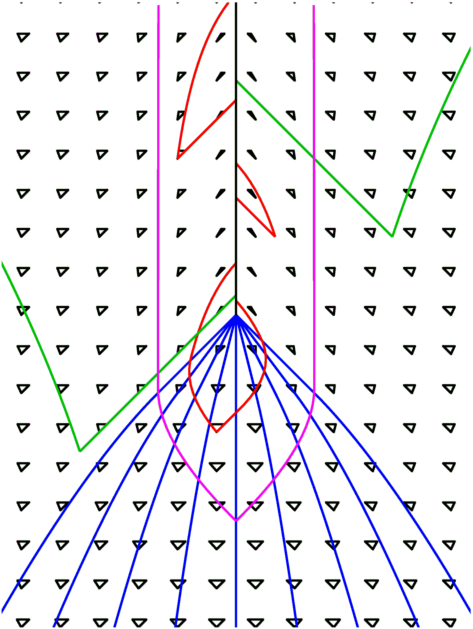
Yet another diagram showing matter collapsing to form a black hole, and crossing the horizon at a finite spacetime point. This one isn't conformal and might be easier to understand. The green wedge in the upper right might be a pair of Hawking particles, forming in a vacuum region long after the matter has crossed the horizon.

bh-st2.gif


an astrophysicist said:
The space-time diagram at right shows matter in blue collapsing to form a singularity [the solid black line], while the green curves are the future lightcones from events where light can escape to infinity, while the red curves are future lightcones from events where light cannot escape. The boundary between these two regions in space-time is the magenta curve. This boundary of the trapped region is the event horizon of the black hole.

(From http://www.astro.ucla.edu/~wright/bh-st.html.)
 
Last edited:
Credentials: Interested Layman.
(so I'm hoping this post makes sense)

In simple terms, is it correct to say the following:
(I hope I am using the word "observation" correctly in the scientific sense)

What is actually happening is what is happening from the point of view of someone at the point in space where that thing is...um...actually happening. Everyone else sees something different happening but they can agree observationally (by doing the math) with what is actually happening at that point in space.

It seems to me that everyone except Baltar is arguing that the (mathematical) observation is the reality, whereas Baltar is arguing that what he actually sees is what is real.

Is it also correct to say that Hawking radiation is the clincher as to who is correct. If Baltar is correct, there should be no Hawking radiation, but if everyone else is correct, there should be. And Hawking radiation has been confirmed hasn't it?

Thanks for any replies,
(It's been a hard slog ploughing through this thread.)
BillyJoe
 
Last edited:
What is actually happening is what is happening from the point of view of someone at the point in space where that thing is...um...actually happening. Everyone else sees something different happening but they can agree observationally (by doing the math) with what is actually happening at that point in space.

Yeah, that's a good way to say it. In this case we know what the global spacetime looks like, both inside and outside the black hole, by solving Einstein's equations. One of the characteristics of that solution is that there is a large region of the spacetime which contains the horizon after all the matter has crossed and fallen in.

Is it also correct to say that Hawking radiation is the clincher as to who is correct. If Baltar is correct, there should be no Hawking radiation, but if everyone else is correct, there should be. And Hawking radiation has been confirmed hasn't it?

Not from black holes. However, perturbations during inflation are generated by a process almost identical to Hawking radiation. During inflation there is a horizon, and everything said about black hole horizons in this thread is equally valid there too. If DrBaltar were correct it would mean there would be no stars, planets, or galaxies in the universe (because it is "Hawking" radiation during inflation that seeds the density perturbations which collapse to form stars).
 
Thanks sol.

I just wanted to be sure that I got something out of reading this thread apart form just the enjoyment of reading this very interesting thread. It is often difficult to pick them out from amongst the mish mash.

This one started with nothing (:D), and ended with everything (:)), destroying free will along the way (;)).
What more can you ask for?
 
Last edited:
What is actually happening is what is happening from the point of view of someone at the point in space where that thing is...um...actually happening. Everyone else sees something different happening but they can agree observationally (by doing the math) with what is actually happening at that point in space.

It seems to me that everyone except Baltar is arguing that the (mathematical) observation is the reality, whereas Baltar is arguing that what he actually sees is what is real.
Well done. Math is the "realest" part of reality. Thank you.

UCE must be applauding.
 
Sorry if I'm being a pain. Just trying to understand this stuff.

Which I don't, yet.

I bet you can agree with that, at least. :D

Yes, in a certain (completely precise) sense.

Ok. I still don't know what that sense is, though.

You can get in a spaceship and fly as close to the horizon as you want, as often as you want. You have an infinite amount of time to do these experiments (classically), so you can do an infinite number and get arbitrarily close. You will never detect any matter in any of those experiments. If the shell had stopped a non-zero distance away, there's an experiment you could do that would detect it (just get that close), but that's not the case.

Sure. The shell couldn't have stopped. But it could be continually approaching the horizon, though more and more slowly, so that, by the time you do any particular experiment, it is closer to the horizon than is the location of that experiment.

Look - there's no point in arguing over semantics. We KNOW what the solution is, and we know from the solution that there is an infinite region of the spacetime with no matter in it, and we know that Hawking particles can appear there and be observed eventually. There shouldn't be any debate about that, because I, DrBaltar, and many others before us have proved it mathematically. The existence of that region of spacetime is a physical fact, and therefore all observers agree on it, just as all observers agree that the car hit the back wall of the garage.

The only debate is the pointless one over simultaneity and time-ordering. If you insist on saying it takes the shell infinite time to collapse, you are justified in doing so - but only because that is not a physical (coordinate independent) statement.

I agree that there is an infinite region of spacetime with no matter in it. I just don't see any absolute sense in which, in that region or in a larger region that does contain matter, an event outside the horizon is "later" than an event on the horizon. The two event are, at best, spacelike.

I don't insist on saying that the shell takes infinite time to collapse, and in fact I complained when DrBalter said that it does. I object to the insistence that it doesn't, because that is also a coordinate dependent statement.

I am equally justified in saying it takes infinite time to travel from Boston to New York, because I can choose a time coordinate that diverges somewhere in between, and if I accelerate away from Boston fast enough, no one will ever catch up to me with the news that they went there!

There is some difference. You feel yourself accelerating away from Boston. An observer far from a black hole doesn't feel himself accelerating away from the horizon, but he still can't see it.
 
Sorry if I'm being a pain. Just trying to understand this stuff.

No problem - you're not being a pain at all. You're asking good questions.

Sure. The shell couldn't have stopped. But it could be continually approaching the horizon, though more and more slowly, so that, by the time you do any particular experiment, it is closer to the horizon than is the location of that experiment.

Except there is no experiment that any observer can do, once the shell has passed them, which will find it outside the horizon (let's assume the shell is made of null radiation for simplicity).

We can say this a little more mathematically. It is true that the shell crossing the horizon will never be in the past lightcone of an outside observer after finite time. However the shell crossing any surface outside the horizon, no matter how close, will be in the past lightcone of every outside observer eventually. Not only that, for any given shell outside the horizon, the time you have to wait before its crossing is in your past lightcone can be made arbitrarily small by diving in after the collapsing radiation and pulling out at the very last minute.

I agree that there is an infinite region of spacetime with no matter in it.

That's really the only thing I was attempting to argue for. The rest is mostly semantics.

I just don't see any absolute sense in which, in that region or in a larger region that does contain matter, an event outside the horizon is "later" than an event on the horizon. The two event are, at best, spacelike.

Well, see above. Strictly speaking you're correct.

There is some difference. You feel yourself accelerating away from Boston. An observer far from a black hole doesn't feel himself accelerating away from the horizon, but he still can't see it.

That's not a difference. If you're very far from Boston you only have to accelerate a very little bit for it to be behind a horizon, just like with the black hole.
 
Last edited:
That's not a difference. If you're very far from Boston you only have to accelerate a very little bit for it to be behind a horizon, just like with the black hole.

Isn't it? I don't have to accelerate away from the black hole at all. I can move inertially away from it, faster than escape velocity.

A more or less unrelated question: Consider three events along the worldline of a photon. Flat spacetime, say. The interval between any pair is the same, namely zero. But the situation is nevertheless not symmetric. The events can be ordered from earliest to latest, no? I'm not sure exactly what my question is, actually. But something seems wrong. Isn't the interval supposed to contain all of this kind of information? Maybe it's necessary to consider also various nonzero intervals between each of the three events and other nearby events?

Metrics that are not positive-definite are definitely weird!
 
Isn't it? I don't have to accelerate away from the black hole at all. I can move inertially away from it, faster than escape velocity.

If you start off moving away, yes. But if you start off at rest in the standard coordinates and want to stay that way, you always have to accelerate a little no matter how far away you are. Making the hole bigger makes the acceleration required to remain outside it smaller and smaller and the situation closer and closer to that of an accelerating observer in flat space.

A more or less unrelated question: Consider three events along the worldline of a photon. Flat spacetime, say. The interval between any pair is the same, namely zero. But the situation is nevertheless not symmetric. The events can be ordered from earliest to latest, no?

Yes, they can be ordered. That's why it makes sense to talk about the horizon of the hole after the shell has crossed.

Isn't the interval supposed to contain all of this kind of information? Maybe it's necessary to consider also various nonzero intervals between each of the three events and other nearby events?

Metrics that are not positive-definite are definitely weird!

I certainly agree with the last statement... and yes, it's necessary to consider other intervals. I suppose one way to say it is to note that if the events are ordered somehow in one coordinate system, every other coordinate system related to the first one by a proper coordinate transformation (if you don't know what that means, I'll explain it) will preserve that same ordering.

More physically, imagine a big bunch of actual real observers equipped with clocks, mirrors, laser pointers, etc. Whichever observer happens to find herself at one of your three points sends out a pulse with her laser pointer at that moment. Then every observer who receives all three pulses will receive them in the same order in time, no matter what trajectory they are following.

If this wasn't true causality would fail.
 
I don't insist on saying that the shell takes infinite time to collapse, and in fact I complained when DrBalter said that it does. I object to the insistence that it doesn't, because that is also a coordinate dependent statement.
Not just a coordinate dependent statement. It's an observer dependent statement. If you are an observer outside the event horizon, you use Schwarzschild coordinates. If you are crossing the event horizon, then a Kruskal or Penrose diagram will describe what you see.
 
a proper coordinate transformation (if you don't know what that means, I'll explain it)

Yes, please. I don't.

More physically, imagine a big bunch of actual real observers equipped with clocks, mirrors, laser pointers, etc. Whichever observer happens to find herself at one of your three points sends out a pulse with her laser pointer at that moment. Then every observer who receives all three pulses will receive them in the same order in time, no matter what trajectory they are following.

If this wasn't true causality would fail.

Interesting.

Some observers will receive them all simultaneously, I think---those on the path of the original photon, farther along than the last of my three events.

Which makes sense, I guess. Lightlike events are just on the edge of causality. A tiny bit further, and some observers will begin to disagree about their order in time. But the very edge still belongs to the causal side, you're saying?
 
Not just a coordinate dependent statement. It's an observer dependent statement. If you are an observer outside the event horizon, you use Schwarzschild coordinates. If you are crossing the event horizon, then a Kruskal or Penrose diagram will describe what you see.

What do you mean? Coordinates don't determine what an observer sees. Any coordinate system can be used to calculate that, and they all give the same answer.

from http://math.ucr.edu/home/baez/physics/Relativity/BlackHoles/fall_in.html:
On my worldline as I fall into the black hole, it turns out that the Schwarzschild coordinate called t goes to infinity when I go through the event horizon. That doesn't correspond to anyone's proper time, though; it's just a coordinate called t. In fact, inside the event horizon, t is actually a spatial direction, and the future corresponds instead to decreasing r. It's only outside the black hole that t even points in a direction of increasing time. In any case, this doesn't indicate that I take forever to fall in, since the proper time involved is actually finite.

At large distances t does approach the proper time of someone who is at rest with respect to the black hole. But there isn't any non-arbitrary sense in which you can call t at smaller r values "the proper time of a distant observer," since in general relativity there is no coordinate-independent way to say that two distant events are happening "at the same time." The proper time of any observer is only defined locally.​
 
What do you mean? Coordinates don't determine what an observer sees. Any coordinate system can be used to calculate that, and they all give the same answer.

Because, as you quoted:
At large distances t does approach the proper time of someone who is at rest with respect to the black hole.

We all agree that the time it takes to cross the event horizon and get to the singularity in an observer's proper time is finite. But for an observer far from the black hole, they're going to see something different. They will see it take an infinite amount of time for an object to cross the event horizon.

I'm not saying coordinates determine what an observer sees, I'm saying that depending on where the observer is, you should use a coordinate system that is better suited for describing what that observer sees. See the difference?
 
Yes, please. I don't.

Well, let's see... imagine rotating the coordinate axes through a very small angle. That's a coordinate transformation, and it's close to the identity transformation (which is just not doing anything: rotating by 0 degrees) in a sense I hope is obvious. But we can build up any rotation, even a large one, from a series of these small ones. So we can say all rotations are connected to the identity.

For an example of something that's not connected, imagine reflecting one coordinate: x->-x, for example. There is no way to go from that transformation to the identity transformation smoothly (via a series of infinitesimal transformations, that is). And unlike the case of a rotation, if you actually did that to an object, you'd really change it physically - in this case into its mirror image. So the group of coordinate transformations splits up into (at least) two disconnected components, and "proper" transformations are those in the part connected to the identity.

If you know a little math, the best way to characterize the difference is with the Jacobian of the transformation (the determinant of the matrix of partials) - whether it's positive or negative.

Some observers will receive them all simultaneously, I think---those on the path of the original photon, farther along than the last of my three events.

Well, there can't really be any actual observer that gets them all simultaneously, because to do so would require moving at the speed of light. But you can get arbitrarily close.

Which makes sense, I guess. Lightlike events are just on the edge of causality. A tiny bit further, and some observers will begin to disagree about their order in time. But the very edge still belongs to the causal side, you're saying?

Yeah, that's right - and it had better, because even if you yourself can't move at exactly the speed of light, you can send signals that do.
 
Last edited:

ISF - Join now!

Every member here is approved by hand. No bots, no spam, just people who care about evidence and honest debate.

Membership is free!

Create your free account

Back
Top Bottom