sol invictus
Philosopher

- Joined
- Oct 21, 2007
- Messages
- 8,613
No, I think Sol is saying that test particles dropped from r=infinity at different angles will pass through the schwarzschild radius at the same proper time. This is just a consequence of the spherical symmetry of the metric. Think about a spherical shell of matter impinging on the Schwarzschild black hole at the origin. All of the particles that make up that infalling shell are equidistant from the origin and so will see no time dilation between them.
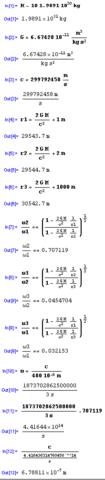
No - that's not what I was saying. Freely falling particles at different radii will NOT see the others as red-shifted, so long as the distance between them is small compared to the radius of curvature of the spacetime (which near the horizon means the radius of the hole). That's an immediate consequence of the equivalence principle - detecting a redshift would constitute a local experiment for which a freely falling observer can detect a grav. field - and it also follows from the fact that the near-horizon metric is Rindler.
Furthermore it is NOT true that the particles will see the others as hovering near the horizon - that's essentially the same thing as a redshift. By the way, another way to see this is simply to draw some 45 degree lines on one of those conformal diagrams. Those lines are the trajectories of radial photons, and you can see immediately why there is an infinite redshift to an asymptotic observer, and why there is no redshift between two freely falling observers.
Again, I stress that what I am saying only holds true if the distances separating the particles are small compared to the radius of curvature. One particle will reach the singularity eventually, and then its redshift will be large (the radius of curvature goes to zero there).

 )