• Quick note - the problem with Youtube videos not embedding on the forum appears to have been fixed, thanks to ZiprHead. If you do still see problems let me know.

A Message from CSICOP: Global Warming is REAL!

Re: Re: Re: A Message from CSICOP: Global Warming is REAL!

jj said:


How about the recent evidence of cross-altitude contamination in spectroscopic measurements that now show that the air temperature is in fact rising as observed on the surface?

I suspect that jj is refering to Fu, Q., C.M. Johanson, S.G. Warren, and D.J. Seidel, 2004: Contribution of stratospheric cooling to satellite-inferred tropospheric temperature trends. Nature, 429, 55-58.

This analysis highlights the errors in that paper:
This kind of mistake would not get published with adequate peer review of manuscripts submitted for publication.
 
Maybe global warmming is gods will?

and conservation and cutting CO2 and saving the ozone layer would be a big sin.


Virgil
 
Supposing that it is true...

The real issue is why global warming keeps ending up in political threads. I can only guess that this is a play to legitimize the Kyoto Treaty. What we should be looking at is... What return from investment can we expect from the Kyoto Treaty?

I'd also like to know why industrialization is the target of the global warming fans? I would think that the impact of industrialization is minimal compared to the impact of deforestation. The US has had a policy of replanting trees and managing forest resources since the seventies. Where in the Kyoto Treaty is a provision for stopping the rampant logging of rain forests? Trees convert carbon dioxide to oxygen - science 101.

I can't believe that Canada bought into the Kyoto Treaty, Canada should be charging the rest of us for all the oxygen their forests create. Silly? Not as silly as charging nations for the carbon dioxide they produce. None of the figures on how much CO<sub>2</sub> emissions originate per country take into account the CO<sub>2</sub> converted to O<sub>2</sub> by that country's foliage.

Check this out:
An Economic Ploy: How the Kyoto Protocol Does the Dirty Work for Uncompetitive Nations
 
Re: Re: Re: A Message from CSICOP: Global Warming is REAL!

Nasarius said:
What are you talking about? That debate ended years ago. Global warming is happening. There's absolutely no question about it. I can't believe you're that ignorant about this topic.

The question is how much does human activity contribute to global warming.

And what, if any, harm will it do to the planet and us.

Actually, this article is oen of the best reasoned arguments and proposed solutions for GW I've ever seen. Not only does he propose his theory while acknowledging the problems and limitations with it, he proposes a solution that would not cripple the economy and that would depend in large part on free-market adoption.
 
Stumpy said:

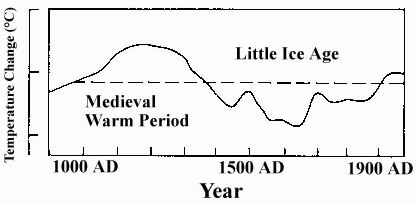
It's just this type of deceitful and dishonest preactice that removes entirely what little credibility the global warming scaremongers had in the first place. Of course the has warmed since the 1800s...we were emerging from what is commonly called the "Little Ice Age". A time when frost fairs were common in Britain and people used to ice skate on the Thames. Preceeding this was a Medieval warm period when vineyards were common place in Britain. The global temperature is still 1 degree less than when the Doomsday book was being compiled. The man-made global warming myth evaporates when you examine the global climate over the past 3000 years. Average Global temperatures are at about the mean temperature for that period.

Could you provide evidence for the assertion that the global temperature is one degree cooler than in the 11th century, please?

The same trick again! Go back even further and estimates put Atmospheric CO2 levels as 10 times the current levels.

Yes, 60 million years ago! But then you have the fact that the climate back then was much warmer than today.

Even at today's current levels there are 50 times more CO2 in the oceans and land. The exchange of CO2 between sea and atmosphere is poorly understood. To assume that the miniscule proportion of CO2 in the atmosphere is entirely the result of human activity is lucicrous by any measure.

How is it ludricous? There's actually a lot of evidence that the increase in CO<SUB>2</SUB> is due to human activity:

http://www.radix.net/~bobg/faqs/scq.CO2rise.html

The notion that there is broad scientific consensus on global warming is as equally egregarious. The scientific community cannot agree if warming is occuring let alone what humanity is responsible. Over 17,000 scientists, 2/3 of whom had advanced degrees signed the Oregon petition disputing the man-made global warming myth.

Usually when people talk about a "scientific consensus" they are thinking of those scientists that are actively involved in research in the field. Of those 2/3 of signers of the Oregon petition that have advanced degrees, how many are actually involved in climate research?

4000 Scientists, including 72 Nobel winners, signed the Heidelberg in response to the CO2 limiting proposals at the 19922 Rio Earth summit.

From here :

The 'Heidelberg Appeal'
adressed to the chiefs of state and governments


'We want to make our full contribution to the preservation of our common heritage, the Earth.
We are, however, worried at the dawn of the twenty-first century, at the emergence of an irrational ideology which is opposed to scientific and industrial progress and impedes economic and social development.

We contend that a Natural State, sometimes idealized by movements with a tendency to look towards the past, does not exist and has probably never existed since man's first appearance in the biosphere, insofar as humanity has always progressed by increasingly harnessing Nature to its needs and not the reverse.

We fully subscribe to the objectives of a scientific ecology for a universe whose resources must be taken stock of, monitored and preserved. But we herewith demand that this stock-taking, monitoring and preservation be founded on scientific criteria and not on irrational pre-conceptions. We stress that many essential human activities are carried out either by manipulating hazardous substances or in their proximity, and that progress and development have always involved increasing control over hostile forces, to the benefit of mankind.

We therefore consider that scientific ecology is no more than an extension of this continual progress toward the improved life of future generations. We intend to assert science's responsibility and duty towards society as a whole. We do however forewarn the authorities in charge of our planet's destiny against decisions which are supported by pseudo-scientific arguments or false and non-relevant data.

We draw everybody's attention to the absolute necessity of helping poor countries attain a level of sustainable development which matches that of the rest of the planet, protecting them from troubles and dangers stemming from developed nations, and avoiding their entanglement in a web of unrealistic obligations which would compromise both their independence and their dignity.

The greatest evils which stalk our Earth are ignorance and oppression, and not Science, Technology and Industry whose instruments, when adequately managed, are indispensable tools of a future shaped by Humanity, by itself and for itself, overcoming major problems like overpopulation, starvation and worldwide diseases.'

Seems terribly vague to me. What makes you think that this is about global warming?
 
Brian the Snail said:
Could you provide evidence for the assertion that the global temperature is one degree cooler than in the 11th century, please?

Certainly. This graph is from the IPCCs 1990 report into climate change.

MWE-LIA.gif


So, that was 60 million years before any possibility of humanity causing it? You mean that variations in CO2 in the atmoshpere can happen naturally? That was my point

But then you have the fact that the climate back then was much warmer than today.

So, increases in global temperature can occur without the interference of humanity? That was my point


How is it ludricous? There's actually a lot of evidence that the increase in CO<SUB>2</SUB> is due to human activity:

http://www.radix.net/~bobg/faqs/scq.CO2rise.html

One article does not equate to "a lot" of evidence. Doubtless you can link to many more, doubtless all of them will be selective in the data that they provide. The same ice-core records that the above link refers to, show temperatures rose BEFORE an increase in CO2 levels at the end of each of the last 3 major ice-ages.

Usually when people talk about a "scientific consensus" they are thinking of those scientists that are actively involved in research in the field. Of those 2/3 of signers of the Oregon petition that have advanced degrees, how many are actually involved in climate research?

I try to avoid the ad hominen aproach and focus on what they say rather than who they are. The arguments for man-made global warming encompass a lot of scientific disciplines, not just climate research, e.g chemisty, physics, computer science, etc. An equally large proportion of the global warming scientific community are not climatologists.


Seems terribly vague to me. What makes you think that this is about global warming?

This phrase for one thing:
at the emergence of an irrational ideology which is opposed to scientific and industrial progress and impedes economic and social development.
 
Stumpy said:
It's just this type of deceitful and dishonest preactice that removes entirely what little credibility the global warming scaremongers had in the first place. Of course the has warmed since the 1800s...we were emerging from what is commonly called the "Little Ice Age". A time when frost fairs were common in Britain and people used to ice skate on the Thames. Preceeding this was a Medieval warm period when vineyards were common place in Britain.
The IPCC disputes that this was a global phenomenon:

(Edited to add: the IPCC site seems to be down now.)

…current evidence does not support globally synchronous periods of anomalous cold or warmth over this timeframe, and the conventional terms of “Little Ice Age” and “Medieval Warm Period” appear to have limited utility in describing trends in hemispheric or global mean temperature changes in past centuries. With the more widespread proxy data and multi-proxy reconstructions of temperature change now available, the spatial and temporal character of these putative climate epochs can be reassessed


The “Little Ice Age” appears to have been most clearly expressed in the North Atlantic region as altered patterns of atmospheric circulation (O’Brien et al., 1995). Unusually cold, dry winters in central Europe (e.g., 1 to 2°C below normal during the late 17th century) were very likely to have been associated with more frequent flows of continental air from the north-east (Wanner et al., 1995; Pfister, 1999). Such conditions are consistent (Luterbacher et al., 1999) with the negative or enhanced easterly wind phase of the NAO (Sections 2.2.2.3 and 2.6.5), which implies both warm and cold anomalies over different regions in the North Atlantic sector. Such strong influences on European temperature demonstrate the difficulty in extrapolating the sparse early information about European climate change to the hemispheric, let alone global, scale


The evidence for temperature changes in past centuries in the Southern Hemisphere is quite sparse. What evidence is available at the hemispheric scale for summer (Jones et al., 1998) and annual mean conditions (Mann et al., 2000b) suggests markedly different behaviour from the Northern Hemisphere. The only obvious similarity is the unprecedented warmth of the late 20th century.


Medieval warmth appears, in large part, to have been restricted to areas in and neighbouring the North Atlantic. This may implicate the role of ocean circulation-related climate variability.
My emphasis.
 
Stumpy said:
So, that was 60 million years before any possibility of humanity causing it? You mean that variations in CO2 in the atmoshpere can happen naturally? That was my point
Surely the point is that CO2 concentrations are increasing at a much higher rate than has been seen before? And that humans are causing this increase.

Stumpy said:
This phrase for one thing:
I agree with Brian the Snail – it seems pretty vague.
 
Brian the Snail: Could you provide evidence for the assertion that the global temperature is one degree cooler than in the 11th century, please?

Stumpy: Certainly. This graph is from the IPCCs 1990 report into climate change.

MWE-LIA.gif

Thanks, but there's nothing there that says that the temperature was 1 degree higher in the 11th century. There's no labels on the y-axis, so there's nothing to say whether the difference is 1 degree or 0.1 degrees.

In fact, that graph was only a schematic, as explained here:

Skeptics complain that the IPCC had previously accepted a temperature record which showed large natural variations such as the medieval climate optimum and the Little Ice Age, but unaccountably selected a different set of data that fit its preordained conclusions. Such skeptics have presumably failed to notice that the graph used in the earliest (1990) IPCC report was a schematic (non-quantitative; as discussed above): the 1990 report further noted that it was not clear "whether all the fluctuations indicated were truly global". The graph disappeared from the 1992 supplementary report, and was replaced in the 1995 report by a northern hemisphere summer temperature reconstruction from 1400 to 1979 by Bradley and Jones (1993); this in turn was updated in the 2001 report to northern hemisphere warm-season and annual reconstructions from 1000 AD to present by Mann et al (1999), Jones et al (1999) and Briffa (2000).

Stumpy: So, that was 60 million years before any possibility of humanity causing it? You mean that variations in CO2 in the atmoshpere can happen naturally? That was my point

So, increases in global temperature can occur without the interference of humanity? That was my point

Okay, but who is disputing that? Certainly not the article in the OP. In fact, the full paragraph you quoted from says:

Putting that 380 parts per million figure in context, a later speaker--Harvard geochemist Dan Schrag--pointed out that carbon dioxide levels have not exceeded 300 ppm for the last 400,000 years. And by 2040 or 2060, he added, it's projected that we'll reach 500 ppm! Comparing where we're headed to the sultry Eocene epoch many millions of years ago--when palm trees grew in Wyoming and crocodiles lived in the Arctic--Schrag concluded, "We're performing an experiment at a planetary scale that hasn't been done for millions of years."

Stumpy: One article does not equate to "a lot" of evidence. Doubtless you can link to many more, doubtless all of them will be selective in the data that they provide.

Okay, you've made it quite clear that you won't trust any link that I provide to you. Why not use the article I linked to as a starting point for your own research? Perhaps you could start with a google search for the Suess effect.

The same ice-core records that the above link refers to, show temperatures rose BEFORE an increase in CO2 levels at the end of each of the last 3 major ice-ages.

Yes, concentrations of carbon dioxide depend upon the temperature, due to processes (that are not yet completely understood) like outgassing of the oceans. However, the article reviews other evidence, like isotropic studies, that rules out natural sources for the present increase.

Brian the Snail: Usually when people talk about a "scientific consensus" they are thinking of those scientists that are actively involved in research in the field. Of those 2/3 of signers of the Oregon petition that have advanced degrees, how many are actually involved in climate research?

Stumpy: I try to avoid the ad hominen aproach and focus on what they say rather than who they are. The arguments for man-made global warming encompass a lot of scientific disciplines, not just climate research, e.g chemisty, physics, computer science, etc. An equally large proportion of the global warming scientific community are not climatologists.

But if they aren't involved in climate research, how do you know that they know what they are talking about? Of course, a particular scientist who isn't working in this field might know enough about the subject to have a reliable opinion, but then again, there's absolutely no guarantee of this. And scientists are notorious for getting things wrong when they step outside their field.

Brian the Snail: Seems terribly vague to me. What makes you think that this is about global warming?

Stumpy: This phrase for one thing:

"at the emergence of an irrational ideology which is opposed to scientific and industrial progress and impedes economic and social development."

I think this indicates more about your opinions than of the scientists who signed it.
 
Richard your link didn't work !

In relation to the extract that you posted.

The imprecise language is less than convincing, way too much reliance on words such as "appear", "likely" and "may".

Again, the IPCC are somewhat selective in the data that they present.
Medieval warmth appears, in large part, to have been restricted to areas in and neighbouring the North Atlantic.

The occurance of a drought in Peru and Equador during the medieval warm period is well evidenced. These areas are neither in the the northern hemisphere or neighbouring the Atlantic ocean.

This report Indicates that samples taken from both the arctic and antarctic provide evidence for GLOBAL trends in climate.


Surely the point is that CO2 concentrations are increasing at a much higher rate than has been seen before?

Not according to ice-core samples.

And that humans are causing this increase.

This is wildly speculative. Again ice-core samples indicate that the changes in temperature preceed changes in CO2 levels. Even if it were the case that human activity is causing CO2 increases, so what? There is not a shred of evidence that increasing atmoshpheric CO2 causes an increase intemperature. CO2 is a tiny propertion of greenhouse gasses (which are necessary for life).
 
Brian the Snail said:


Thanks, but there's nothing there that says that the temperature was 1 degree higher in the 11th century. There's no labels on the y-axis, so there's nothing to say whether the difference is 1 degree or 0.1 degrees.


Okay, lets add the temperatures in then!

myth_2a.gif


this in turn was updated in the 2001 report to northern hemisphere warm-season and annual reconstructions from 1000 AD to present by Mann et al (1999), Jones et al (1999) and Briffa (2000)

The "hockey stick" is now broken!


Dan Schrag--pointed out that carbon dioxide levels have not exceeded 300 ppm for the last 400,000 years. And by 2040 or 2060, he added, it's projected that we'll reach 500 ppm!

I'm afraid I am VERY skeptical of any of IPCCs "projections", they have a tendency to reduce when their targets aren't reached. To date the IPCCs projections for increase in temperature by 2100 have been:

1990 3.3 degrees centigrade
1992 2.8 degrees centigrade
1995 1-2 degrees centigrade.

They'll be predicting cooling before long!

Perhaps you could start with a google search for the Suess effect.

Burning fossil fuels has a profound influence on carbon reservoirs? So what??? Where is the mechanism that shows that atmospheric CO2 causes warming?

Yes, concentrations of carbon dioxide depend upon the temperature, due to processes (that are not yet completely understood) like outgassing of the oceans. However, the article reviews other evidence, like isotropic studies, that rules out natural sources for the present increase.

...and omits to explain how variations in atmospheric CO2 affects climate.
 
Stumpy said:
In relation to the extract that you posted.

The imprecise language is less than convincing, way too much reliance on words such as "appear", "likely" and "may".
Yes, that's how scientists often report things when they are not sure. The GW doubters (for want of a better label) usually report the LIA and MWP and facts. I think the IPCC have cast doubt on that, that's all. I really think there needs to be some peer reviewed work on this. The best you can really say now is that the LIA and MWP may have been global events, but it seems to me to be dangerous to draw too many conclusions from it.

Stumpy said:
Not according to ice-core samples.
From the Energy Information Administration (EIA), a statistical agency of the U.S. Department of Energy:

New%20Fig%201.gif


"Levels of several important greenhouse gases have increased by about 25 percent since large-scale industrialization began around 150 years ago (Figure 1). During the past 20 years, about three-quarters of human-made carbon dioxide emissions were from burning fossil fuels." (Link)

I don't know how you can say that that CO2 concentrations are not increasing at a much higher rate than has been seen before. It's the rate of change, not the overall level. I'm sure it has been higher in the past, but a 25% increase in 150 years? That's a blink of an eye.

Stumpy said:
This is wildly speculative. Again ice-core samples indicate that the changes in temperature preceed changes in CO2 levels. Even if it were the case that human activity is causing CO2 increases, so what? There is not a shred of evidence that increasing atmoshpheric CO2 causes an increase intemperature.
From the article you referenced:

Increases in these greenhouse gases predate the increases in Earth’s surface temperatures indicating that changes in greenhouse gases led to global warming (and cooling).

• Thus, these records are the clearest signs that elevated levels of greenhouse gases can result in warming of the Earth.

CO2 increases precede temperature increase, the opposite of what you said. Also:

Implications for future global climate change: increased greenhouse gas contents in the atmosphere could lead to a rapid (i.e., not progressive) shift to a new, considerably warmer climate state

• Melting of polar ice sheets could slow down thermohaline circulation.

• The Younger Dryas suggest that our predictions of global warming
effects due to greenhouse forcing may be strongly underestimated.

• The next major climate change may occur with more vigor and speed
than we think!

• Local extinctions and extensive ecosystem disruptions: numerous
events occurred throughout North America within 50 years following
Younger Dryas event. (extinction of Mammoths, giant sloths, saber tooth cats)
Sounds like the authors of your cited article think humans are causing GW by increasing atmospheric CO2. In fact, they say the effect is underestimated.
 
RichardR said:
Yes, that's how scientists often report things when they are not sure. The GW doubters (for want of a better label) usually report the LIA and MWP and facts. I think the IPCC have cast doubt on that, that's all. I really think there needs to be some peer reviewed work on this. The best you can really say now is that the LIA and MWP may have been global events, but it seems to me to be dangerous to draw too many conclusions from it.


Agreed, there is little doubt that Climate Change is a reality. Before we commit ourselves to Billions or even trillions of dollars trying to control something that possibly may have no effect on climate change we better be as sure as we can be of our facts. Is supect that our money will be better spend on adapting to what, IMHO, is a natural cycle of climate change.

From the Energy Information Administration (EIA), a statistical agency of the U.S. Department of Energy:

New%20Fig%201.gif

The graph only shows a correlation. Correlation is NOT causation. Only two things are being measured. The graph does not show the release of the land locked CO2 and sea based CO2. Even if we take the graph at face value, I have to ask, so what? There is still no good evidence that the small amounts of CO2 in the atmosphere affect climate.

I don't know how you can say that that CO2 concentrations are not increasing at a much higher rate than has been seen before. It's the rate of change, not the overall level. I'm sure it has been higher in the past, but a 25% increase in 150 years? That's a blink of an eye.

The graph only plots CO2 emissions for a tiny propertion of our history. Show me a reliable one that covers our entire history and I'll conceed the point.

CO2 increases precede temperature increase, the opposite of what you said.

Yep! Another sympton of this lack of consensus in scientific terms.
Here, the opposite is claimed "Ice core records show that at the end of each of the last three major ice ages, temperatures rose several hundred years before CO2 levels increased."


Sounds like the authors of your cited article think humans are causing GW by increasing atmospheric CO2. In fact, they say the effect is underestimated.

Nope! They make it quite clear that they think "GREENHOUSE GASSES" are the cause, not CO2, which is one of the smallest components of GGs. They argue that increases in greenhouse gasses are triggered by sunspot and volcanic activity. Now, my reading of the article is that they seem to be committing the same error of the Pro-GW lobby, that is to say mistaking correlation for causation. However they are taking a broader view and looking at a much longer period of the world's history. It's clear that there correlations are much more marked and notable than the man-made GW hypothosis.
 
from Stumpy:
The graph only shows a correlation. Correlation is NOT causation. Only two things are being measured. The graph does not show the release of the land locked CO2 and sea based CO2. Even if we take the graph at face value, I have to ask, so what? There is still no good evidence that the small amounts of CO2 in the atmosphere affect climate.
There is plenty of evidence that CO2 contributes to the greenhouse effect, and that effect is reckoned to be about 32C (average surface temperature is about 15C, black-body temperature would be -17C). CO2 is reckoned to contribute about 30% of this, say 10C. Up the concentration by 50%, which we seem on course to achieve, and a couple of degrees warming doesn't seem unreasonable. We have to remember there are positive feedbacks, such as diminished ice cover and snow lying for less of the year.

I don't know of any reason why land-locked CO2 should have been released until recently, after the world has warmed. Permafrost is melting into bog, and decomposition is releasing methane. Methane is a fierce greenhouse gas in its own right, but is relatively short-lived - in sunlight it oxidises to water and CO2, I think the half-life is about 10 years (not sure on that). Volcanic activity was low in the last century as compared to the 18thCE, so that's not the source.

Fossil fuels (and concrete) create about 6bn tons of CO2 a year, while the atmospheric load is increasing by about 3 bn tons a year. If whatever is absorbing the other 3bn tons (recent measurements of CO2 flux indicate it might be the Amazon basin) fills up, we can expect some major effects in the next few decades.
 
Capeldodger- "Volcanic activity was low in the last century as compared to the 18thCE, so that's not the source."


You sure about that? Remember that most volcanic activity happens below the sea. How much of the released volatiles goes into solution? How long does it stay that way? Lot of buffering in these proceses.

I remain unconvinced that mankind has anything to do with increasing temperatures, though the increase in temperature over the last 10,000 years has certainly affected mankind. I reckon global warming caused civilisation, not the reverse.
 
This link http://www.dar.csiro.au/publications/gh_faq.htm has a good FAQ.

Greenhouse gases
Natural climatic cycles are well known, for example the 4-7 year El Nino Southern Oscillation, the Interdecadal Pacific Oscillation, and Milankovitch cycles. The latter are driven by wobbles in the Earth’s orbit every 20,000 (precession), 40,000 (obliquity) and 96,000 (eccentricity) years. The 96,000-year cycle accounts well for the timing of the last six Ice Ages, but the associated changes in solar radiation contribute only 1-2oC of the 5-7oC of cooling experienced in Ice Ages. Therefore changes in other factors amplify the effect of orbital variations. The main amplifiers are natural changes in greenhouse gases and changes in the extent of polar ice-sheets. During the past four glacial cycles, fluctuations in carbon dioxide closely matched the global temperature variations, with carbon dioxide concentrations peaking at about 280 parts per million (ppm) during warm periods and falling to about 180 ppm during cold periods. However, since the 19th century, concentrations have risen to 370 ppm – a level unprecedented in at least the past 420,000 years. Other greenhouse gases have also increased rapidly, due to human activities.
 
from Stumpy:
Of course the has warmed since the 1800s...we were emerging from what is commonly called the "Little Ice Age". A time when frost fairs were common in Britain and people used to ice skate on the Thames. Preceeding this was a Medieval warm period when vineyards were common place in Britain.
There are a lot of misconceptions about the "Little Ice Age". The frost fairs in London disappeared when the new London Bridge was built and river water flowed more freely. Vinyards did disappear in Britain after the Norman Conquest, but not because of climate change. The Normans already had vinyards on their Normandy estates, they preferred red wine to the Saxon white wine varieties, and they wanted export markets. There was also the Harrying of the North, when everything was destroyed. There really isn't any evidence for the Warm Period or a global Little Ice Age as it is usually presented. Cooling of the Atlantic cooled the world a little, but nothing like what Europe experienced.

There certainly were very cold winters in Atlantic Europe from 1700 for a decade or two, but summers were much less affected, if at all. This, and other evidence such as the southern range of icebergs in the North Atlantic, indicates a surge of cold water from the Arctic Ocean into the North Atlantic pushing the northern fringe of the Gulf Stream south for a while. The Gulf Stream has its major effect on Atlantic Europe in the winters. There is little sign of the effect in the rest of the world.

Rainfall in Peru and Ecuador is strongly affected by conditions in the Atlantic, by the way. You can see this in the rain-shadow desert of the Chilean coast. Only in El Nino conditions does the rainfall come from the Pacific.

We should always remember that the controversy about the Little Ice Age only started when the denial of global warming became untenable. The strategy changed to saying that the variation wa entirely natural - the world was "just" warming up after the LIA, when it "just" cooled. At this point historians started putting their hands up and saying "Um, excuse me, but ...", and denialists had scientists and historians to contend with. Not that that's stopped them, of course.
 
from Soapy SAm:
You sure about that? Remember that most volcanic activity happens below the sea. How much of the released volatiles goes into solution? How long does it stay that way? Lot of buffering in these proceses.
Undersea activity occurs at plate boundaries and a few hot-spots, and there's been no sign of changed activity over the last couple of centuries that I'm aware of. As to buffering, unless there has been a change then an equilibrium will have been established.

I'm not convinced that most volcanic emissions are produced underwater. I'll have to look into that.
 
Stumpy said:

Okay, lets add the temperatures in then!

myth_2a.gif

This is the temperature for the Sargasso sea. The Sargasso sea does not cover the entire planet. Just to remind you, your original claim was this:

The global temperature is still 1 degree less than when the Doomsday book was being compiled.

Please provide evidence that the global temperature is 1 degree less than in the 11th century.

Stumpy: The "hockey stick" is now broken!

According to whom? Why are you assuming that the McIntyre and McKitrick paper is correct? According to Mann's response the differences could be due to errors in M&Ms analysis. Also M&Ms results go against not only Mann's results, but results from all the other reconstructions that have been performed.

Stumpy: I'm afraid I am VERY skeptical of any of IPCCs "projections", they have a tendency to reduce when their targets aren't reached. To date the IPCCs projections for increase in temperature by 2100 have been:

1990 3.3 degrees centigrade
1992 2.8 degrees centigrade
1995 1-2 degrees centigrade.

They'll be predicting cooling before long!

Where did you get these numbers from? I haven't checked the 1990 and 1992 figures, but the 1995 IPCC SAR says this:

For the mid_range IPCC emission scenario, IS92a, assuming the "best estimate" value of climate sensitivity and including the effects of future increases in aerosol, models project an increase in global mean surface air temperature relative to 1990 of about 2°C by 2100. This estimate is approximately one_third lower than the "best estimate" in 1990. This is due primarily to lower emission scenarios (particularly for CO2 and the CFCs), the inclusion of the cooling effect of sulphate aerosols, and improvements in the treatment of the carbon cycle. Combining the lowest IPCC emission scenario (IS92c) with a "low" value of climate sensitivity and including the effects of future changes in aerosol concentrations leads to a projected increase of about 1°C by 2100. The corresponding projection for the highest IPCC scenario (IS92e) combined with a "high" value of climate sensitivity gives a warming of about 3.5°C.

So this gives a range of 1-3.5°C. You also neglected to mention that the projections of the 2001 IPCC TAR which gives a range of 1.4 to 5.8°C, which is higher than the 1995 projections.

Stumpy: Burning fossil fuels has a profound influence on carbon reservoirs? So what???

What do you mean, "So what?" Wasn't it you that said:

To assume that the miniscule proportion of CO2 in the atmosphere is entirely the result of human activity is lucicrous by any measure.

Stumpy: Where is the mechanism that shows that atmospheric CO2 causes warming?

The mechanism is called the Greenhouse effect.
 
Originally posted by Stumpy
The graph only shows a correlation. Correlation is NOT causation. Only two things are being measured. The graph does not show the release of the land locked CO2 and sea based CO2. Even if we take the graph at face value, I have to ask, so what? There is still no good evidence that the small amounts of CO2 in the atmosphere affect climate.

http://en.wikipedia.org/wiki/Greenhouse_effect

Water vapor (H2O) causes about 60% of Earth's naturally-occurring greenhouse effect, with others carbon dioxide (CO2) (about 26%), methane (CH4), nitrous oxide (N2O) and ozone (O3) (about 8%) [3]

Stumpy: The graph only plots CO2 emissions for a tiny propertion of our history. Show me a reliable one that covers our entire history and I'll conceed the point.

This graph shows the CO<SUB>2</SUB> concentration for the last 20 000 years.

This graph shows the CO<SUB>2</SUB> concentration for the last 400 000 years.

Note the near-vertical red line on the right-hand edge of both figures.

Stumpy Yep! Another sympton of this lack of consensus in scientific terms.
Here, the opposite is claimed "Ice core records show that at the end of each of the last three major ice ages, temperatures rose several hundred years before CO2 levels increased."

To clarify this, it's best to read the original papers in which this phase lag was measured.

For example "Timing of Atmospheric CO2 and Antarctic Temperature Changes Across Termination III" by Caillon et al. discuses this on the third page:

...indicating that the increase in CO2 lags Antarctic warming by 800 +/- 200 years, which we must consider a mean phase lag because of the method we used to make the correlation. We cannot think of a mechanism that would make 40Ar lead the temperature change, although a lag is possible if the temperature or accumulation change affects the nondiffusive zone (27). This result is in accordance with recent studies (9, 30) but, owing to our new method, more precise. This confirms that CO2 is not the forcing that initially drives the climatic system during a deglaciation. Rather, deglaciation is probably initiated by some insolation forcing (1, 31, 32), which influences first the temperature change in Antarctica (and possibly in part of the Southern Hemisphere) and then the CO2. This sequence of events is still in full agreement with the idea that CO2 plays, through its greenhouse effect, a key role in amplifying the initial orbital forcing. First, the 800-year time lag is short in comparison with the total duration of the temperature and CO2 increases ( 5000 years). Second, the CO2 increase clearly precedes the Northern Hemisphere deglaciation (Fig. 3).

(Bolding mine). In other words, deglaciation is originally forced by Milankovitch oscillations, which changes the temperature, which then changes the CO<SUB>2</SUB>, which in turn increases the temperatures. So carbon dioxide in this case acts as a postive feedback which amplifies the original warming.

Actually, reading the article you linked to, this is discussed on page 9.
 

Back
Top Bottom