• Security incident: ISF was recently accessed by intruders. Please change your password, and change it anywhere else you used it. Read more

A Fermi problem for C7: Iron spheres mean how much thermite?

We whipped up some thermite a couple of weeks ago. Here's my YouTube:

I was impressed by the large spheres (lots of mm-sized droplets). Haven't seen any reports of those! :D

Nice work Dave, but your friggin' titles are way too fast to read properly. Not everyone has the metabolism of a squirrel, y'know.;)
 
It occurred to me that if we can convince them that all the reasons they have to suspect thermite in the first place, mathematically result in ridiculous mass requirements, then we would not have to go into nitty-gritty engineering details of where to put how much in what way to do what exactly. :D

Fair enough, but inasmuch as the CT'ers here have shown a marked inability to compose simple sentences, access an on-line dictionary, or even find the spell-check button on their own computers, expecting them to be able to comprehend mathematical concepts that extend beyond "naught times one is naught" might be a bit optimistic.
 
It occurs to me that before the amount of thermite becomes relevant in any way, a technically viable method of employment must be put forth, much the same way prison guards don't concern themselves over nuclear bombs because no one has developed a method for "keistering" one yet.
Why argue over how many micro-spheres can fit in an angels a55 until the CT'ers at least demonstrate the existence of the angel?
You are in the same school as me Chuck.

There is no way that thermxte in any form could have contributed to the collapses of any of the WTC towers without being discovered. And it is nearly as certain that there is no conceivable way thermxte could have been used even if everyone turned a blind eye to evidence.

For the twin towers one conceivable use would have been to cut multiple lower cords on floor joists thereby mimicking the observed inwards pulling of the outer tube columns.

The only minor problems being knowing in advance where the planes would strike AND proofing the thermxte and firing circuitry against thje "blast effects" of the plane crashing through PLUS fireproofing till needed.

So, given the impossibility of all those aspects why waste time proving or disproving thermxte on site. There could have been 20 tonnes on site. It wasn't used. It couldn't have been used. End of story.
 
...
There is no way that thermxte in any form could have contributed to the collapses of any of the WTC towers without being discovered.

C7 claims that proof of the use of thermite was discovered. That is what this thread is about: If C7 were right, what would be the implications?

And it is nearly as certain that there is no conceivable way thermxte could have been used even if everyone turned a blind eye to evidence.

If you are honest, you are here arguing from incredulity or lack of imagination. Smarter man than you have argued before that there is a no conceivable way an object that's heavier than air could sustain flight. That man obviously underestimated the ingenuity of other men.

For the twin towers one conceivable use would have been to cut multiple lower cords on floor joists thereby mimicking the observed inwards pulling of the outer tube columns.

The only minor problems being knowing in advance where the planes would strike AND proofing the thermxte and firing circuitry against thje "blast effects" of the plane crashing through PLUS fireproofing till needed.

See? So you can conceive of at least a partial solution. Maybe someone else can help you where your engineering creativity fails you?

So, given the impossibility of all those aspects why waste time proving or disproving thermxte on site. There could have been 20 tonnes on site. It wasn't used. It couldn't have been used. End of story.

So far, I think I have established that, if C7 is right and his observation is best explained by the use of thermite, then 20 tons would not nearly suffice, it would have to be at least 200 tons (and quite probably a LOT more).
This still is not totally impossible to conceive, but I am sure we can make additional predictions from that theory that raise the odds of C7's theory to be true even further.

At any rate, what you and Chuck and I agree on is: The truthers who argue against such odds have to proof a lot more than they already think they did.
 
Ok here is a first estimate for a lower bound on the amount of thermite to account for 6% iron spheres in airborne dust:

Assumptions
1. Thermite was applied in a maximally efficient way to melt all the steel it melted, and nothing beyond that
2. All steel that melted went into airborne dust
3. No further energy was lost by that process of dustification
4. The melted and then cooled iron spheres mixed uniformly with the other airborne dust to constitute 6% of the dust's mass
5. The thermite itself does not result in iron spheres


Step 1: In post 18, I estimated a lower bound of the mass of airborne dust:
9 x 10⁷g

Step 2: Assuming that 6% of the dust is formerly melted iron, that gives us
9 x 107g * 6% = 5.4 x 10⁶g of melted iron

Step 3: In post 25, I estimated that we need 1.75g of thermite to melt 1g of iron. That gives us
5.4 x 106g x 1,75 = 9,45 x 10⁶g of thermite, or about 10 metric tons.


If we assume that the thermite itself contributes all of its iron molecules to the iron spheres in the dust, less thermite is needed:
1.75g of thermite result 0,915g of iron, which are added to the 1g of melted iron from the steel.
So 1,75g of thermite can produce 1,915g of iron spheres. That's a ratio of
0.914:1

To produce 5.4 x 10⁶g of melted iron, we need 4.93 x 10⁶g of thermite
Or roughly 5 metric tons.
That's assuming a lot.

Assumption 2. should probably be modified to allow for a factor of 20 (only 5% or less of the melted iron went into airborne dust)
Assumption 3. should probably be modified to allow for a factor of at least 2 (half of the energy used to melt the steel is lost on dustification, kinetic energy, increased heat loss du to larger surface etc.

Which gives us a more realistic lower bound of 5t x 2 x 20 = 200 metric tons of thermite to account for the dust spheres.

Just for clarity...and an attempt to bring this test into a simpler form:

Based on your estimates, we would need either 5, 10, or 200 metric tons of thermite to match the Lee report of 6% metal spheres in the WTC7 dust?

If this is the case, even at the low end, we're talking about A LOT of thermite that had to react perfectly and cut the steel with near 100% efficiency...right?

And this just for one building. The shear magnitude of this "Thermite Black-Ops Project"TM is astounding...but I guess we already knew that.

But I fear that the work you guys are doing isn't going to convince the unconvincable. This is great work, none-the-less.


:thanks


Okay I realize that my posts reads a little like that scene from the Monty Python "Spanish Inquisition!" sketch:
"Our chief weapon is surprise...surprise and fear...fear and surprise.... Our two weapons are fear and surprise...and ruthless efficiency.... Our three weapons are fear, surprise, and ruthless efficiency...and an almost fanatical devotion to the Pope.... Our four...no... Amongst our weapons.... Amongst our weaponry...are such elements as fear, surprise.... I'll come in again."


10, 5 and 200 are results of three different sets of assumptions. The most simple yields 10, and the simplest that goes deepest into truther-friendls territory yields 5 tons.
These two sets of assumptions are totally unrealistic however.

The first set of assumptions that approach realistic territory yields 200 tons.
 
Nice work Dave, but your friggin' titles are way too fast to read properly. Not everyone has the metabolism of a squirrel, y'know.;)

So I've learned. The next batch will be better! I was under the gun to get several YouTubes posted, and only finished 'em minutes before the big Debate, and didn't have a lot of review/polish time.

I'm also gonna dump the zooming of titles next time around.

Thanks! Dave
 
....

The first set of assumptions that approach realistic territory yields 200 tons.

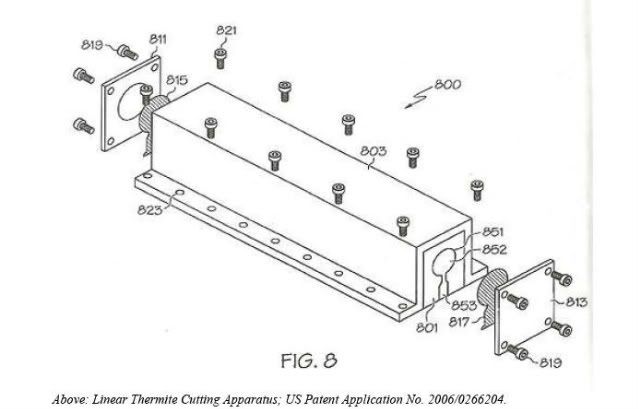
A few years back Twoofers were wetting their pants getting excited about a patent for a commercial thermite cutting tool. There was a patent. This was Jones' dream. Unfortunately it was massive relative to the volume of thermite it could contain :

thermitecutter.jpg


and would be really hard to attach to a column in gangs. Even harder - read impossible - to conceal.

I was about to say that thermite theory is insane. But it all is really. Thank FSM that the daytime thermometer has dropped below 33°c for the first time in months and I can start working on the house and garden instead of jabbering about 9/11 in the only a/c part of our house ;)
 
I spoze you could also make the argument that some of the evidence of thermite would have been pulverized along with lots of other material, during the collapses.
However this wouldn't be the case with WTC 7, but no definitive evidence of therm*te was found there either.
In either case one would expect obvious melting or cutting of steel to be observed - none of which happened.

I wonder how far the mm-sized droplets described by Dave would have dispersed, had they existed..

What evidence would that be? I don't think that there is any mechanical mechanism (collapse) that would "dustify" a serious proportion of solid steel or metal. Some scraping, but the bulk of metal, even if ot was molten for a while, would be left in larger pieces.
Oh abd by the way, where are the tons of Al2O3 that result from the thermite reaction? There should be 100 tons of it around.
 
i hate to point out small careless mistakes but you meant to type 1 million tons = 2 billion lbs. 6% of 2 billion lbs is 360 million

So…360,000,000 lbs…of nothing but slag from thermite…from what is probably a gross underestimate of the weight of WTC7…
 
i hate to point out small careless mistakes but you meant to type 1 million tons = 2 billion lbs. 6% of 2 billion lbs is 360 million

So…360,000,000 lbs…of nothing but slag from thermite…from what is probably a gross underestimate of the weight of WTC7…

I'm guessing that's from my post in #2.

You're correct. Miscalculation on my part. I said 1M tons is 2M pounds.

Either way, my post is useless because of another oversight on my part...I was taking 6% of the total weight of WTC7, not the total weight of the dust.

My failed attempt at doing math early in the morning. :blush:
 
Some data to work with:

1. Thermite reaction

See http://en.wikipedia.org/wiki/Thermite_reaction

Chemical reaction:
Fe2O3 + 2Al → 2Fe + Al2O3 + heat

Atomic weights in g/mol: (rounded to full number)
Iron: 56
Aluminium: 27
Oxygen: 16

The reaction above contains, by weight, 112 parts Fe, 54 parts Al and 48 parts O, for a total of 214 parts.

So we need 1,91 parts of thermite to produce 1 part iron.

Heat produced:

Source: http://www.ilpi.com/genchem/demo/thermite/index.html
1 mol Fe2O3 + 2mol Al -> 847.6 kJ

Standard thermite releases 847.6 kJ/214g = 3,96 kJ per gram of thermite.

Other thermite or thermate mixtures may have a somewhat lower or higher energy density. Nano-thermate will have a lower energy density. Reason: Nano-sized particles of Al have a higher surface-to-volume ration than larger particles; the surface of Al will always oxidise before use. The Al-oxides add to the mass of the mixture, but not to its energy release.

Density of thermite:

Fe2O3 has a density of 5.242 g/cm3Al has a density of 2.70 g/cm3(both from Wikipedia)

For 214g of thermite, we need to mix
160g Fe3O2 = 30,523cm354g Al = 20,000cm3
So thermite, perfectly mixed with no air in between, would have a density of
214g/(30,523+20)cm3 = 4,236g/cm3
Accounting for air in the mix, I think we are on the safe side if we go with a value of

Density of standard thermite is 4,2g/cm3
Density of steel is near the density of iron: 7.874 g/cm3

Steel is thus about 87% denser than thermite, or thermite has 53% the density of steel.


We found earlier that, experimentally, we need 1,75g of thermite to melt 1g of iron. That would translate to:
We need 3.2cm3 of thermite to melt 1cm3 of iron.


(In "4. Energy needed to melt iron" I estimated that we need 1kJ of energy to melt 1g of iron to somewhat above melting point. This would assume 100% efficient heat transfer.
1kJ is contained in 0.253g of thermite. The experimental value of 1,75g implies 14.4% efficiency. Not unrealistic, I'd say, but that is just my layman's intuition.)
 
Even more data to work with

4. Energy needed to melt iron
...
The following is probably pretty bad material physics, but hey...

To heat one mol (56g) of iron from ambient temperature to melting point, you need approximately
25.1J * (1538-18) = 38.152kJ
In addition, to transition that mol to liquid phase, you need 13.81kJ for a total of 52kJ.
Actually, for droplets of that iron to stay liquid long enough to break free from a larger mass, we would have to heat it to somewhat above melting point. So let's say, to melt iron from which to form iron spheres, we need to expend

56kJ/mol = 1kJ/g

I have to correct myself here after finding Appendix A of this paper:
http://www.journalof911studies.com/volume/200704/JLobdillThermiteChemistryWTC.pdf
On page 12, it lists the heat necessary to heat iron to melting point: 235cal/g = 56.2J/g
plus my 13.81kJ for transition to liquid -> 70J/g

I forgot that the heat will first melt the thermite and its reaction products first, and then the iron it touches. That paper finds that, assuming 100% efficency, 1g of thermite can melt these amounts of external iron, by end temperature:
T, deg C H/g, Fe H/g, Al2O3 H,/g Thermite H for column steel g Fe from column
1540°C: 2.02g
1600°C: 1.90g
1700°C: 1.73g
1800°C: 1.56g
2000°C: 1.27g

(And not, as I implied, about 4g)
 
...
(In "4. Energy needed to melt iron" I estimated that we need 1kJ of energy to melt 1g of iron to somewhat above melting point. This would assume 100% efficient heat transfer.
1kJ is contained in 0.253g of thermite. The experimental value of 1,75g implies 14.4% efficiency. Not unrealistic, I'd say, but that is just my layman's intuition.)

Have to correct that, too:
At 100% efficendy, we'd need about (1/1.9)g = 0.53 of thermite to melt iron and heat it to 1600°C.
Experimental value is estimated 1.75g
That would imply 30% efficiency. Too good to be true, says my layman's intuition ;)
 
.

For the twin towers one conceivable use would have been to cut multiple lower cords on floor joists thereby mimicking the observed inwards pulling of the outer tube columns.

.

Ohh, I've tried that tact with those who believe in 911 conspiracies before. I have pointed out that their pet material, explosives or thermite could have been used to, for example, sever the girder attached to col 79 in WTC 7 thus mimicing the initiating event of this girder coming off its column seat by thermal expansion of the floor beams. The rest of the collapse would then follow as per the NIST computer modeling.

Problem with that, in the mind of the 911 conspiracy believers, is that it requires giving NIST some credibility and in those circles such a thing must be avoided at all costs.
 

ISF - Join now!

Every member here is approved by hand. No bots, no spam, just people who care about evidence and honest debate.

Membership is free!

Create your free account

Back
Top Bottom