911 Facts Consolidated

Status
Not open for further replies.
The HUGE weight of the building.

Dave

The huge weight of the building wouldn't FALL on the intact columns. It would fall away from them. As in the path of least resistance. Like I said before the huge steel columns portion of the building would react/fail "collapse" differently than the cement floors.
 
The huge weight of the building wouldn't FALL on the intact columns. It would fall away from them. As in the path of least resistance. Like I said before the huge steel columns portion of the building would react/fail "collapse" differently than the cement floors.
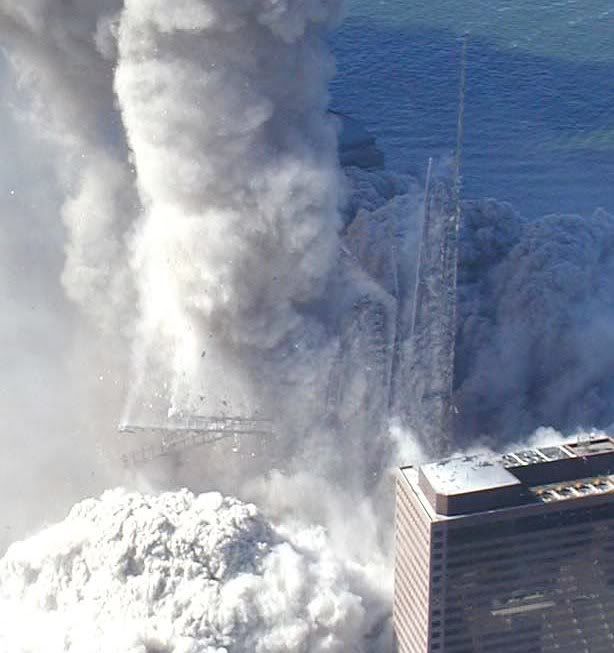
They did react differently. You can clearly see 40-50 story sections of them still standing for quite some time after the main collapse in some videos and photos.
 
The huge weight of the building wouldn't FALL on the intact columns.

They weren't intact. And the huge weight of the buildings, in part, was the huge weight of the huge columns. So we've got parts of the building falling on the central floor supports, which were connected to the columns, and either damaging the columns or at the very least damaging and destroying the members cross-bracing them; and after that's over, we have quarter-mile long composite columns standing freely, that any competent engineer can calculate to be incapable of bearing their own weight unless braced. There's only one plausible result.

It would fall away from them. As in the path of least resistance.

The sheer stupidity of this type of statement has been expounded so many times, it's hardly worth reiterating.

Like I said before the huge steel columns portion of the building would react/fail "collapse" differently than the cement floors.

And this shows either staggering ignorance of, or wilful denial of, the clearly observed fact that this did in fact happen. Have you considered stopping making yourself look stupid for a bit and actually finding out some of the things that are fairly common knowledge about the events you claim to have noticed more about than everybody else? Like, for example, the core spires?

Dave
 
The huge weight of the building wouldn't FALL on the intact columns. It would fall away from them. As in the path of least resistance. Like I said before the huge steel columns portion of the building would react/fail "collapse" differently than the cement floors.

And that's exactly what happened, so it's hard to understand your objections. For example:

wtc1peelingcore.jpg
 
Clayton, your "path of least resistance" argument baffles me. Gravity pulls in ONE direction. The path of least resistance for material to fall, therefore, is in ONE direction - the same direction as gravity - STRAIGHT DOWN. To go in any other direction would require additional energy, or in the case of the columns (exterior and interior), hinging action due to buckling or failure of the column splices.
 
It was destroyed. They were destroyed.

Aaand...backpedal!


The huge weight of the building wouldn't FALL on the intact columns. It would fall away from them. As in the path of least resistance. Like I said before the huge steel columns portion of the building would react/fail "collapse" differently than the cement floors.
Really? You're bringing that up again?
 
There's a lot of aggressive ignorance being stated here. As Dave Rogers and others have noted, the mass (and given that it was falling, the momentum) of the upper section did indeed not impact the columns axially. The only one who's ever forwarded a hypothesis that says this is Bazant and his colleagues, and even they came out and said it was a hypothetical "what if?" model in order to make a case about the energies involved. No one's said it's what actually happened, yet for some odd reason conspiracy fantasists insist on knocking it down as a possibility.

This bears repeating until truthers get it: The falling mass impacted the floors far more than it did the columns. Like Dave said above. And like damn near all of us have been saying for years now in other threads. It was the floors that ended up getting smacked by the debris, and taking out the floors meant that the columns became unsupported. Whatever hits the columns took were probably off axis i.e. glancing blows from falling debris, but the main problem involving the columns were not about supporting a mass falling on them as much as being forced to deal with a load when the floors were taken out and suddenly having much off-axis load being applied. You see an analogue of this with beer cans: Press directly down on the top and it's not easy to collapse them. Push the side in even just a bit while applying that pressure, and they crush rather quickly. No, the towers weren't beer cans, but the principle of forces being supported axially but not supported off axis is what I was getting at.

But forget all that for a moment. Let's go back to the imaginary case of everything landing on the columns. Recall Bazant again: He noted that a direct, axial impact would indeed lead to collapse. I don't recall if he said that the columns would outright break at their splices, or if they'd simply buckle to the point where they were providing insufficient support to the upper segments, but the specifics are irrelevant. The point is, even a direct axial impact - which again, no one including him ever said actually happened on that day - would still cause failure.

What's my point in talking up both points? It's that there's a two-way failure on the part of the participating truther to comprehend here:
  1. The model is wrong. The falling upper segment mostly hit the floors.
  2. Even if all the mass managed to somehow land on the columns alone - a practically impossible situation, but one that can be mathematically analyzed - the building would still collapse by forcing column failure.
It's sort of weird to find someone managing to be wrong in two opposing directions, but we've found over the years that conspiracy advocates manage that with ease. So I suppose I shouldn't be surprised. At any rate, a great deal of the problem is the core delusion that the towers should've been able to resist the start of the collapse. This is obvious in the incredulity being presented regarding the columns. What it illustrates is the abject failure of the participating truther to realize what the collapse details really were. And when you enter a debate without knowing those details, you're starting from behind.

The moral of the story is to know what you're talking about before talking about it. And that's the real core of the problem here.
 
The huge weight of the building wouldn't FALL on the intact columns. It would fall away from them.

You do realize there are video's of the building falling oin intact columns, right? Open your friggin eyes. Christ.
 
And that's exactly what happened, so it's hard to understand your objections. For example:

[qimg]http://i250.photobucket.com/albums/gg274/sap-guy/wtc1peelingcore.jpg[/qimg]

Look!! A Photo of the columns falling!
 
There's a lot of aggressive ignorance being stated here. As Dave Rogers and others have noted, the mass (and given that it was falling, the momentum) of the upper section did indeed not impact the columns axially. The only one who's ever forwarded a hypothesis that says this is Bazant and his colleagues, and even they came out and said it was a hypothetical "what if?" model in order to make a case about the energies involved. No one's said it's what actually happened, yet for some odd reason conspiracy fantasists insist on knocking it down as a possibility.

This bears repeating until truthers get it: The falling mass impacted the floors far more than it did the columns. Like Dave said above. And like damn near all of us have been saying for years now in other threads. It was the floors that ended up getting smacked by the debris, and taking out the floors meant that the columns became unsupported. Whatever hits the columns took were probably off axis i.e. glancing blows from falling debris, but the main problem involving the columns were not about supporting a mass falling on them as much as being forced to deal with a load when the floors were taken out and suddenly having much off-axis load being applied. You see an analogue of this with beer cans: Press directly down on the top and it's not easy to collapse them. Push the side in even just a bit while applying that pressure, and they crush rather quickly. No, the towers weren't beer cans, but the principle of forces being supported axially but not supported off axis is what I was getting at.

But forget all that for a moment. Let's go back to the imaginary case of everything landing on the columns. Recall Bazant again: He noted that a direct, axial impact would indeed lead to collapse. I don't recall if he said that the columns would outright break at their splices, or if they'd simply buckle to the point where they were providing insufficient support to the upper segments, but the specifics are irrelevant. The point is, even a direct axial impact - which again, no one including him ever said actually happened on that day - would still cause failure.

What's my point in talking up both points? It's that there's a two-way failure on the part of the participating truther to comprehend here:
  1. The model is wrong. The falling upper segment mostly hit the floors.
  2. Even if all the mass managed to somehow land on the columns alone - a practically impossible situation, but one that can be mathematically analyzed - the building would still collapse by forcing column failure.
It's sort of weird to find someone managing to be wrong in two opposing directions, but we've found over the years that conspiracy advocates manage that with ease. So I suppose I shouldn't be surprised. At any rate, a great deal of the problem is the core delusion that the towers should've been able to resist the start of the collapse. This is obvious in the incredulity being presented regarding the columns. What it illustrates is the abject failure of the participating truther to realize what the collapse details really were. And when you enter a debate without knowing those details, you're starting from behind.

The moral of the story is to know what you're talking about before talking about it. And that's the real core of the problem here.

Excellent post. The only thing I would add, in regards to the misunderstanding of the collapse, is the idea of the "upper block" that is often brought up in these debates. The portion above the collapse point was not a "block". It is made up of thousands of parts. Parts that are designed to function in only one way. The second the collapse starts and all those parts are being pulled/pushed out of alignment, that upper portion is going to start pulling itself apart. Thus eliminating the possibility of columns landing on other columns. Additionally, once the collapse moved beyond the point of initiation, the core columns could be seen still standing for a short period of time. This in itself should put to rest a couple of claims. One, that explosives were used to take out the core columns. And two, the whole "falling through the path of least resistance" nonsense. The columns was obviously resisting. It just didn't matter. The floors were being sheared off the sides of both the core and the perimeter columns. Understanding how those buildings were built would go a LONG WAY to understanding how they came down.
 
Understanding how those buildings were built would go a LONG WAY to understanding how they came down.

Indeed. One would think that would be a prerequisite to even start a debate on the subject, but alas our truthers didn't heed that bit of advice.
 
Indeed. One would think that would be a prerequisite to even start a debate on the subject, but alas our truthers didn't heed that bit of advice.

It's troubling that after all this time, there are still people that don't have a clue as to how those buildings were constructed.

On that day, after both buildings were hit. A co-worker and I sat in my office watching this all happen. Having absolutely no knowledge of how the buildings were constructed, we both were of the opinion that those buildings could very well collapse. Of course, I am not a structural engineer. I am however a mechanical engineer and have some structural knowledge.
 
Excellent post. The only thing I would add, in regards to the misunderstanding of the collapse, is the idea of the "upper block" that is often brought up in these debates. The portion above the collapse point was not a "block". It is made up of thousands of parts. Parts that are designed to function in only one way...

Yes, that's absolutely correct. And in some of the threads where participants went into deeper detail, that exact point has been made.

But that said, don't read too much into the term "upper block". Sometimes even I use it, despite perfectly well understanding that the "upper block" was in fact a mass of building components coming apart. I do that simpy because it's a convenient way to refer to the floors above the ones that failed first. You're correct, but the oversimplification is nothing more than a casual term of convenience. I certainly would hope that no one would use it to argue that those upper floors had any significant structural integrity remaining!
 
Yes, that's absolutely correct. And in some of the threads where participants went into deeper detail, that exact point has been made.

But that said, don't read too much into the term "upper block". Sometimes even I use it, despite perfectly well understanding that the "upper block" was in fact a mass of building components coming apart. I do that simpy because it's a convenient way to refer to the floors above the ones that failed first. You're correct, but the oversimplification is nothing more than a casual term of convenience. I certainly would hope that no one would use it to argue that those upper floors had any significant structural integrity remaining!

I agree. And I too have used that phrase, although I try not to.
The reason I brought it up was that I have read in other forums, the belief that in the case of the South Tower, that the "upper block" should have fallen over and down to the street. Not only does that idea show a powerful ignorance of physics but it also implies that the "upper block" would have the integrity to stay together while "rolling off the top of the lower portion".
I've also seen demonstrations (like Richard Gage's) where a smaller object is dropped onto a larger object and the larger object does not fail. And that intern is supposed to prove that a small object cannot destroy a large object.
So, my point was to show that just that aspect of the collapses is misunderstood by people that don't know (or ignore) how buildings go together.
 
It's troubling that after all this time, there are still people that don't have a clue as to how those buildings were constructed.
I've been saying that for a while now. It's not difficult to figure out either.

Twoofers don't realise that if you tried to build just the core upto its final height the core would fail due to lack of lateral bracing.

Twoofers don't realise that if you tried to build just the outer perimeter upto its final height the perimeter would fail due to lack of lateral bracing.

They fail to realise that the floors and the floor connections to the core and perimeter ARE the lateral bracing.

Instead they treat the building as if it's one huge homogeneous block.

Remove the floors connections (bracing) and the building will collapse.
 
The huge weight of the building wouldn't FALL on the intact columns. It would fall away from them. As in the path of least resistance. Like I said before the huge steel columns portion of the building would react/fail "collapse" differently than the cement floors.

And which college of engineering taught you that?
 
I've been saying that for a while now. It's not difficult to figure out either.

Twoofers don't realise that if you tried to build just the core upto its final height the core would fail due to lack of lateral bracing.

Twoofers don't realise that if you tried to build just the outer perimeter upto its final height the perimeter would fail due to lack of lateral bracing.

They fail to realise that the floors and the floor connections to the core and perimeter ARE the lateral bracing.

Instead they treat the building as if it's one huge homogeneous block.

Remove the floors connections (bracing) and the building will collapse.

Exactly!
I have been pondering a hypothetical on this subject.
Considering the building in it's pristine condition, how many floors could be removed and the building still stand? For instance, if you were to remove the 70th to the 80th floors, leaving the core and perimeter columns as is, would the building still stand? This is a question R. Mackey can probably answer rather easily.
 
Exactly!
I have been pondering a hypothetical on this subject.
Considering the building in it's pristine condition, how many floors could be removed and the building still stand? For instance, if you were to remove the 70th to the 80th floors, leaving the core and perimeter columns as is, would the building still stand? This is a question R. Mackey can probably answer rather easily.

Interesting question, to which I have no answer based on actual knowledge.

Guess 1) Maybe until the next serious storm to hit NY?

Fact 1) The building would be unoccupied and the surrounding area evacuated until the fault is fixed

;)
 
Status
Not open for further replies.

Back
Top Bottom
