
You are using an out of date browser. It may not display this or other websites correctly.
You should upgrade or use an alternative browser.
You should upgrade or use an alternative browser.
9/11 Physics from Non-Experts
- Thread starter Totovader
- Start date
100,000 tons of steel per tower would be 91E6 kg. The self-weights in the SAP2000 model of WTC2 were 65.8E6 kg. That includes the steel components of the frame, such as the core and perimeter columns, spandrels, and hat truss. It doesn't include the steel in the floors from what I understand from the NIST report. 100,000 tons or 91E6 kg of steel total per tower is reasonable.
Last edited:
The self-weights in the SAP2000 model are divided into two weights, the frame weights and another weight referred to as 'area load'. I don't know the full details of what area load refers to.
For WTC1 the sum of the frame weight 54.3E6 kg and the area load 17.8E6 kg is 72.1E6 kg. 72.1E6 kg is the total self-weight for WTC1.
For WTC2 the total self-weight is 65.8E6 kg.
For WTC1 the sum of the frame weight 54.3E6 kg and the area load 17.8E6 kg is 72.1E6 kg. 72.1E6 kg is the total self-weight for WTC1.
For WTC2 the total self-weight is 65.8E6 kg.
GregoryUrich
Graduate Poster

- Joined
- May 16, 2007
- Messages
- 1,316
100,000 tons of steel per tower would be 91E6 kg. The self-weights in the SAP2000 model of WTC2 were 65.8E6 kg. That includes the steel components of the frame, such as the core and perimeter columns, spandrels, and hat truss. It doesn't include the steel in the floors from what I understand from the NIST report. 100,000 tons or 91E6 kg of steel total per tower is reasonable.
I've done my own half-assed estimate and I have seen another detailed calculation on the net that concur with the 100,000 tons of steel. This includes all structural steel and as well the foundation grillages, floor panels and rebar.
I interpret the final report as they are referring to the service weight but whether that only includes the portion above ground is unclear.
I think the steel and concrete masses are the easiest to validate and are correct in my article. I'm still reworking the SDLs but the SLLs are at least in line with research and NIST. The SLL detail however must be reworked to take account for empty space in the core.
My best guess at this point is that it would be difficult to justify a service weight greater the 300,000,000 Kg per tower.
I'm using weight and mass interchangeably. I don't think anyone is using Newtons.
Last edited:
Whatever the total tower weight, it needs to agree with the observed sway periods that were measured in the 80s and 90s and just after the aircraft impact of WTC2.
The stiffness of the towers was established mainly by truss action of the perimeter walls. There shouldn't be too much contention there since the dimensions of the columns and spandrels were well documented. The non-frame mass is where there is more uncertainty. The SAP2000 model can't be far off in terms of the total mass, since it predicted nearly the same sway periods as those that were observed.
The stiffness of the towers was established mainly by truss action of the perimeter walls. There shouldn't be too much contention there since the dimensions of the columns and spandrels were well documented. The non-frame mass is where there is more uncertainty. The SAP2000 model can't be far off in terms of the total mass, since it predicted nearly the same sway periods as those that were observed.
Newtons Bit
Penultimate Amazing

- Joined
- Apr 12, 2007
- Messages
- 10,049
I'm using weight and mass interchangeably. I don't think anyone is using Newtons.
No need to get personal...

GregoryUrich
Graduate Poster
- Joined
- May 16, 2007
- Messages
- 1,316
Here's a still from the SAP2000 WTC2 model that I ran. It shows non-frame loads that were tacked on to the perimeter columns. The trident level is evident about a third of the way down from the top of the pic where 3 columns are seen converging to one.
These are non-self-weight loads. There's a very long table that contains all of these loads. They take into account the non-frame CDL and the SDL and LL.
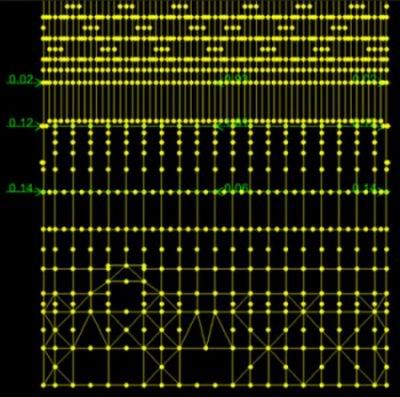
These are non-self-weight loads. There's a very long table that contains all of these loads. They take into account the non-frame CDL and the SDL and LL.
Last edited:
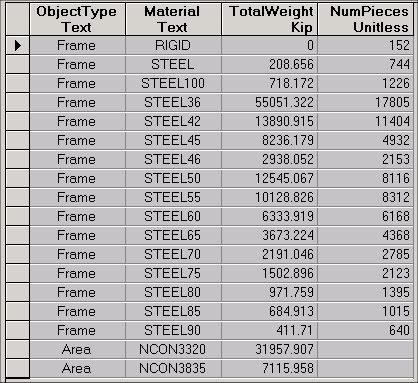
This is the table from SAP2000 that I ran showing the self-weights for WTC1. These are the frame components that SAP2000 added up automatically (core and perimeter columns, spandrels, hat truss). NIST had SAP2000 add these weights up itself but NIST inserted the weights of components other than these by tacking them onto columns. Those non-self-weight loads appear in another table.
GregoryUrich
Graduate Poster
- Joined
- May 16, 2007
- Messages
- 1,316
The self-weights in the SAP2000 model are divided into two weights, the frame weights and another weight referred to as 'area load'. I don't know the full details of what area load refers to.
For WTC1 the sum of the frame weight 54.3E6 kg and the area load 17.8E6 kg is 72.1E6 kg. 72.1E6 kg is the total self-weight for WTC1.
For WTC2 the total self-weight is 65.8E6 kg.
That self-weight is confusing me.
Based on NIST's published numbers including the design documents:
Steel in columns = 51.5E6 kg
Steel in floors (including horizontal members) = 38.7E6 kg
The area load can't include the concrete because that is more than 100E6 kg by itself.
The self-weight didn't include the concrete. It didn't include any components between the core and perimeter or components within the core from what I understand from NIST. Those loads were added by tacking them onto the columns.
NCSTAR1-2a p68:
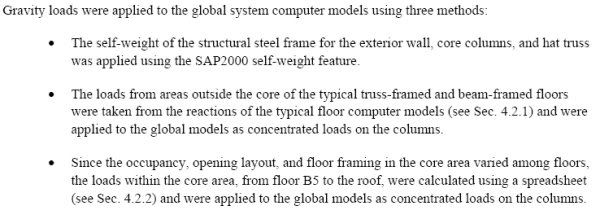
NCSTAR1-2a p68:
Last edited:
Based on NIST's published numbers including the design documents:
Steel in columns = 51.5E6 kg
Steel in floors (including horizontal members) = 38.7E6 kg
The total steel mass of the tower frame (not including steel in the floor slabs) in the self-weight table in SAP2000 is 54.2E6 kg for WTC1 and 54.6E6 for WTC2. Those values are similar to the value of 51.5E6 kg for the total column mass of one tower that you stated.
Last edited:
There are apparently a few exceptions regarding the self-weights in SAP2000 and the concrete. The self-weights in SAP2000 apparently took into account some of the non-frame loads on selected floors such as those associated with the mechanical floors. The self-weights also took into account some of the load associated with the roof and the antenna tower on WTC1.
Looking at the SAP2000 self-weight table in terms of section properties for WTC2 shows that the area load includes some of the load on stories 3, 4, 5, 6, 7, 9, 41 ,42, 43, 75, 76, 77, 107, 108, 109, 110, and the roof. The non-frame mass on all the other stories was taken into account by tacking it to columns as concentrated loads. Those loads appear in a separate load table in SAP2000.
The area loads by object type in the SAP2000 self-weight table for WTC2 have the names CONC and CONC3835, which apparently refers to concrete. The number 3835 in the table may be referring to the compressive strength of the concrete. Only Floors 7 and 107 have the number 3835, which apparently used a different strength of concrete.
Here are screen captures of the last part of the self-weight table by section property in SAP2000 for WTC1 and WTC2. There are 3093 rows in the table for WTC2 accounting for all the different components in the tower. NIST and LERA did an extensive accounting of all the mass in the towers.
WTC1:
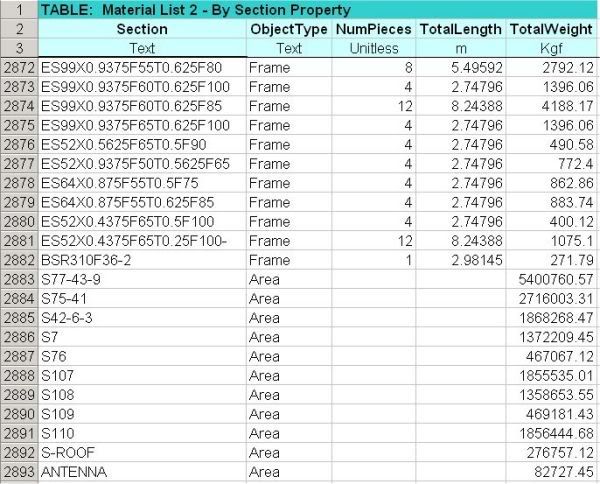
WTC2:
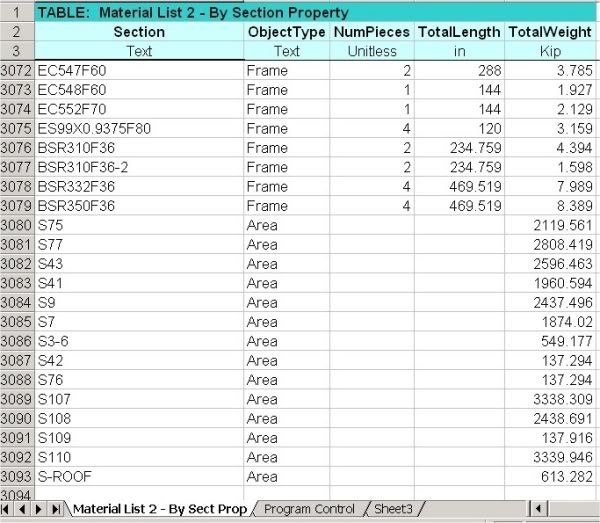
Looking at the SAP2000 self-weight table in terms of section properties for WTC2 shows that the area load includes some of the load on stories 3, 4, 5, 6, 7, 9, 41 ,42, 43, 75, 76, 77, 107, 108, 109, 110, and the roof. The non-frame mass on all the other stories was taken into account by tacking it to columns as concentrated loads. Those loads appear in a separate load table in SAP2000.
The area loads by object type in the SAP2000 self-weight table for WTC2 have the names CONC and CONC3835, which apparently refers to concrete. The number 3835 in the table may be referring to the compressive strength of the concrete. Only Floors 7 and 107 have the number 3835, which apparently used a different strength of concrete.
Here are screen captures of the last part of the self-weight table by section property in SAP2000 for WTC1 and WTC2. There are 3093 rows in the table for WTC2 accounting for all the different components in the tower. NIST and LERA did an extensive accounting of all the mass in the towers.
WTC1:
WTC2:
Last edited:
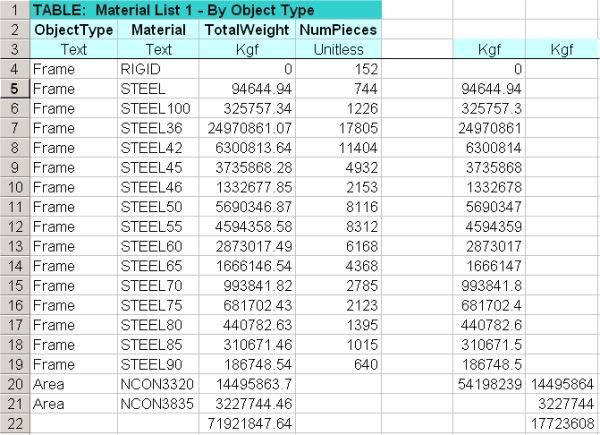
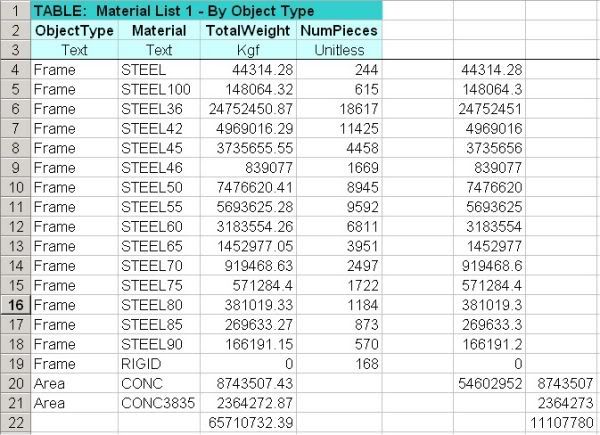
Here are screen captures of the Excel files of the self-loads by object type for WTC1 and WTC2 in the SAP2000 model. These are the entire tables. I added the two columns at the far right. One sums up the steel frame self-weights and the other sums up the area self-weights. The very last row in those two columns is the sum of the column. For example, 54.2E6 kg for the frame self-weights and 17.7E6 kg for the area self-weights for WTC1.
Summing the frame and area self weights gives the total self-weights, which appears in row 22, column 3.
WTC1: 54.2 + 17.7 = 71.9E6 kg
WTC2: 54.6 + 11.1 = 65.7E6 kg
Summing the frame and area self weights gives the total self-weights, which appears in row 22, column 3.
WTC1: 54.2 + 17.7 = 71.9E6 kg
WTC2: 54.6 + 11.1 = 65.7E6 kg
GregoryUrich
Graduate Poster
- Joined
- May 16, 2007
- Messages
- 1,316
Does anyone know if there were any frame-like concrete structures associated with the mechanical floors, such as walls or partitions?
I have spent quite a bit of time in the NIST documents but I have seen no mention of concrete structures. There are concrete pads for machinery though.
Just a thought, you may want to start a new thread for the SAP2000 model. This thread has seen it's day and was originally about some nut trying to explain physics.
GregoryUrich
Graduate Poster
- Joined
- May 16, 2007
- Messages
- 1,316
We can start another thread about the tower mass and SAP2000 if you wish.
I started a thread on the mass and potential energy of WTC1 a few minutes ago. If your focus is primarily the mass and PE it would make sense to deal with that there. Otherwise maybe we should keep the SAP2000 model separate to help keep the threads on topic.