• Quick note - the problem with Youtube videos not embedding on the forum appears to have been fixed, thanks to ZiprHead. If you do still see problems let me know.

2011 Arctic Sea Ice Thread

Scientists who predicted a few years ago that Arctic summers could be ice-free by 2013 now say summer sea ice will probably be gone in this decade.
Anyone else see the problem with this statement?
Not at all. That "could" looks like it was a "can" in the original assertion -by that consecutia temporum thingy of Indo-European languages-. "Can", "2013", and "ice free summers" look much precise, focused and settled than "will probably", "this decade" and "summer sea ice gone", so the article is just trying to inform that forecasts for 6 years on are now more prudent and well informed.


I don't know if this is the right place to talk about this, but those graphics with the Y=0 well drawn are very useful to not see the before-and-after. I mean, it is clear that in spite of the shrinking icecap the system managed to generate some 15-17,000 cubic kilometers of ice every cold -or colder-season. That figure and all its consequences have not changed along the decades, and it's easy to hypothesize how: all the process has been moving northwards. Can we discuss here the impossibility of one-day ice free and the consequences of an additional factor of less ice volume generated every year? The problems created by not having parallels 91, 92, 93 ...
 
If focusing in short term adds something:

SEARCH: September Sea Ice Outlook: June Report

sio_panarctic_june_fig1-500x424.jpg


We are also entering a neutral phase in Niño/Niña. How did this use to affect sea ice extension?
 
If focusing in short term adds something:

SEARCH: September Sea Ice Outlook: June Report

[qimg]http://www.arcus.org/files/resize/search/sea-ice-outlook/2011/06/images/pan-arctic/sio_panarctic_june_fig1-500x424.jpg[/qimg]

We are also entering a neutral phase in Niño/Niña. How did this use to affect sea ice extension?

This is speaking to Antarctic sea ice, correct?
Is there an ice volume measurement for the sea ice down under? I'd be most interested in composites that looked at combined annual global sea ice numbers and combined total sea ice volumes.
 
Down under is exceedingly difficult due to the glacial flow to the sea which complicates the sea ice reading amongst other factors.

The continental ice has it's own weather and is further impacted by the unique situation with the ozone hole. No composite will yield anything meaningful IMNSHO

and it's OT ;)
 
The page which link I provided has a humongous logo telling it is SEARCH: Study of Environmental Arctic Change.

Also, Antarctic sea ice of 4.7 million square kilometers in September is something to be seen after a couple of hundred years with billions of cars using anthracite and peat worldwide, to say the least.

About the planetary ice anomaly, there's that graphic updated daily that I linked in last year's thread about this same topic.

Again, what's expected during Northern Summers and Springs under neutral Niña to Niño conditions? What about the Arctic Dipole Anomaly?
 
I thought these were fora devoted to critical thinking and skepticism.

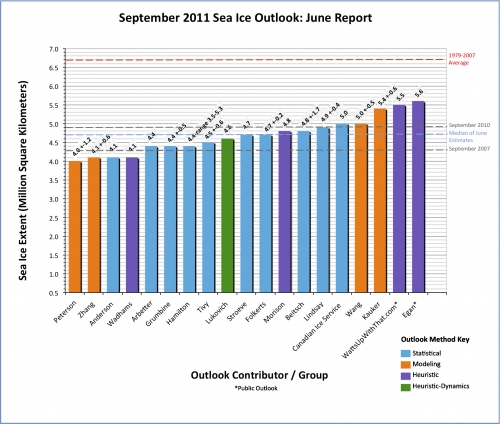
In this image -associated to forecasts that made a median value of 4.7 millions square kilometers for September's minimum-

sio_panarctic_june_fig1-500x424.jpg


the highest pair of values are 5.6 million from Ewan (who eyeballed 2011 shape and shouted "It's like 2005!") and 5.5 million from a poll ...:D ... among the public ....:D .... with bracketed values to choose ....:D:D ... at ...:D:D:D ... Oooh!!! Eeeeh!!! Watts Up With That!? Watts Up With That!? ... Oooh!!! Eeeeh!!! Watts Up With That!? wattsupwiththat.com!? [http: // wattsupwiththat .com /2011/05/19/sea-ice-news-call-for-arctic-sea-ice-forecasts-plus-forecast-poll/] (sorry, I'm not boosting its pagerank in Google)

The bracketed values show a distribution that I call "Internet Movie Database", for instance, that movie with the handsome vampires and werewolves has this:

Votes| Percentage| Rating
9,209| 16.3%|10
2,385| 4.2%|9
3,970| 7.0%|8
5,480| 9.7%|7
6,271| 11.1%|6
5,611| 9.9%|5
4,328| 7.7%|4
3,121| 5.5%|3
2,777| 4.9%|2
13,390| 23.7%|1
The problem is 40% of people voting 10 because "we love them! we love them! we love them!" or voting 1 because "we hate those frozen turkeys!". IMDB have their own statistical methods to filter these deviations. Watts has a blog. The 5.5 forecast comes from 437 people who said less than that and 113 people who said more that that. In that poll the option "more than 5.5 millions" is like the "we love the vampires and werewolves!" in the other -much better- public poll.

These two "heuristic" predictions doesn't take any quality from the rest of them (which now averages some 4.55 million square kilometers for September). There are 4 outlooks that come from models, 2 forecast some 4 million and the other pair some 5.2 (it would be interesting to know what different departures and methods they had).
 
Take a look here NASA Study Shows Role of Melt in Arctic Sea Ice Loss. the problem with measuring ice loss is several. One is that we have very little knowledge of the underground streams of meltwater that lubricate from under the ice sheets, that's whats worrying with west Antarctica for example. There are guys tying to measure it sending down probes a couple of hundred meter etc but it's terribly tricky to get it to work. Satellites are our best friend as it is for the moment, and I hope NASA get the money to continue. The melt water will impact on the streams and salinity, creating a different climate for plankton and krill as the water heats up. The oceans acidity the global uptake of CO2 brings with it, is a added problem, and a very serious one in that it seems to stop the creation of shells, not only reefs but some plankton species too. How will ocean acidification affect marine life.

Don't remember how much, but Phytoplankton is not only one of the best CO2 up-takers we have, they also create oxygen for us to breath, in fact standing for roughly half of the oxygen in the atmosphere. And they are sensitive to the changing balance, acidity, salinity, and the oceans warming. Source of Half Earth's Oxygen Gets Little Credit.

"Phytoplankton needs two things for photosyntheses – and thus, their survival and growth – energy from the sun and nutrients from the water. In the process of converting these growth resources into more cells, they release oxygen. Half the wold’s oxygen! The other half of the world’s oxygen is produced by land trees, shrubs, grass and other plants. "

"Phytoplankton require nutrients obtained from the bottom of the ocean to reproduce. At the Earth’s poles, ocean water is colder at the surface than down in the depths. Therefore water from the bottom of the ocean rises to the top, carrying with it essential nutrients from the ocean floor. However, as the water near the surface becomes warmer due to climate change, less water rises from the bottom, resulting in less nutrients for the phytoplankton. This consequently hinders their reproduction processes."

A new study I read some time ago, pointed to that those shells also were a important contribution to storing CO2 at the ocean floors, as they bound CO2 and when dead sunk to the bottom, but I have only a vague memory of that one. Still, it's interesting.

It's called the biological pump, and because photosynthesis requires light, phytoplankton only exist near the surface, meaning that they are amongst the first to be exposed to a warming of the oceans and changing. So the arctic and antarctic melting have a lot of 'side effects', some of them only coming to light as we discuss, and the most serious ones might not be the Earth getting warmer, but the plankton, krill and other species that are being threatened as a result. There is very little we can do stop it for the nearest century, as the CO2 atmospheric cycle is somewhere around a century or two from source to sink, with a noticeable 'tail' at about a thousand years, as most scientists and climatologists seems to agree on, as a meaningful number for our consideration. That doesn't mean we shouldn't try though, but even if we stopped all man made CO2 today, it would still cling up there and 'warm' us for at least a century, more probably two.

If we kill of the first chain of food the impact will translate to us too. We're not isolated, the whole earth is a open nonlinear system, and the food we eat always come from somewhere, and if it's meat or fish,it has in its turn eaten something else before ending up on our table. We're parts of a food chain, even though we're at the end of it.

Take a look here Phytoplankton in Northern Oceans declining. and this New Northwest Passage triggers mass species migration.
 
Last edited:
Take a look here NASA Study Shows Role of Melt in Arctic Sea Ice Loss. the problem with measuring ice loss is several. One is that we have very little knowledge of the underground streams of meltwater that lubricate from under the ice sheets, that's whats worrying with west Antarctica for example. There are guys tying to measure it sending down probes a couple of hundred meter etc but it's terribly tricky to get it to work. Satellites are our best friend as it is for the moment, and I hope NASA get the money to continue. The melt water will impact on the streams and salinity, creating a different climate for plankton and krill as the water heats up. The oceans acidity the global uptake of CO2 brings with it, is a added problem, and a very serious one in that it seems to stop the creation of shells, not only reefs but some plankton species too.
Interesting link. The rest, though equally interesting, I'm afraid it's pretty much off-topic. We have to deal here with Arctic sea ice as a system itself. We have to almost totally ignore external parameters that may set structural changes in motion and focus in the system structure itself. We may name consequences or associations, but we only can analyze them if they have an evident feedback on the Northern sea ice system itself. We may analyze deep changes in the system's structure and name consequences -that's why I quoted your reference to global uptake of atmospheric gases- but that's pretty much it.

Why all that? Well, take it as a policy of the forums that members should accept. The problem here is those people who constantly come to discuss their deep systems of belief and their trained animosity as they try to derail constantly these kind of threads. As an example, you may read one recent derail in this thread that has been moved to the "Abandon All Hope" section of these fora.

But, as it's an ill wind that blows nobody any good, focusing in Northern sea ice extent has its own merits and many opportunities for skeptical analysis, debunking and healthy criticism -my reference about some "heuristic" outlooks in institutional web sites was a piece of that-. If we move within those parameters there's a lot to discuss (you may see soot or PDO rapidly ruled out here, so, this is not a passive pool aside the stream of debates). This has also a beneficial effects as some self-called "skeptics" use to link everything with everything in an effort to dilute every serious analysis, as they seem not to find concrete flaws in whichever the theory is to pound on them until the theory falls, so they flit about throwing all they found at the wall in the hope something will stick. To avoid such derails, I'm afraid we have also to ignore meaningful connexions like those you provided in your post.

In the future we may found appropriate to start another thread where the system will be the almost a milliard cubic kilometers of sea water that is between -1° and 5° and that anchors global climate, and no matter how massive it is, it is affected by recent developments in the surface.
 
Is anybody covering the winter maximum extent? How much does it bounce back each year, is it changing, and are there trends? If so, do the winter max trends align with summer min trends?
 
Is anybody covering the winter maximum extent? How much does it bounce back each year, is it changing, and are there trends? If so, do the winter max trends align with summer min trends?
All the information is here: http://nsidc.org/arcticseaicenews

Winter maximum extent is reached in March. Here's the report for March 2011: http://nsidc.org/arcticseaicenews/2011/040511.html

March 2011 had the second-lowest ice extent for the month in the satellite record, after 2006. Including 2011, the March trend in sea ice extent is now at -2.7 percent per decade.

That compares to a reduction in the summer minimum extent of about 11% per decade. Bear in mind that in winter the ice expands until it fills the Arctic Ocean and in a lot of directions it hits land fairly quickly, and hence cannot expand any further.
 
About the planetary ice anomaly, there's that graphic updated daily that I linked in last year's thread about this same topic.

Given the albedo feedback, summer sea-ice is a great deal more significant than winter, so this figure really doesn't tell you much. The very different nature of the two poles (one a continental land-mass surrounded by ocean, the other an ocean pretty much surrounded by continents) makesthe figure even more whimsical.

Again, what's expected during Northern Summers and Springs under neutral Niña to Niño conditions? What about the Arctic Dipole Anomaly?

I imagine this would depend on what state you're coming from (in the current case, from La Nina) for the first year or so. I've no idea what (if any) signal can be extracted from historical data or what might be hypothesised. This makes it more fun to watch :).

How ocean currents respond to the change will largely determine what happens to Arctic sea-ice in the next decade, and there's not much data to go on when predicting that. Until recently, oceanography has been a sadly neglected science; things have improved greatly of late but only so much data is in. We'll be better able to predict what happens once we've watched it happen.
 
Interesting link. The rest, though equally interesting, I'm afraid it's pretty much off-topic. We have to deal here with Arctic sea ice as a system itself. We have to almost totally ignore external parameters that may set structural changes in motion and focus in the system structure itself. We may name consequences or associations, but we only can analyze them if they have an evident feedback on the Northern sea ice system itself. We may analyze deep changes in the system's structure and name consequences -that's why I quoted your reference to global uptake of atmospheric gases- but that's pretty much it.

I think the system of interest is the Arctic Ocean system which has to include the sea-ice, the water under it, the air above it, the far-North Atlantic and Pacific where exchange takes place, and the land adjacent.

Changes in salinity and temperature gradients will presumably affect oceanic interchange. Changes in air temperature will affect river-flow via (for instance) changes in permafrost, which will affect salinity. Changes in typical airflows will (again, I presume) affect cloud conditions.

But, as it's an ill wind that blows nobody any good ...

The "more research is needed" policy has actually led to a lot more research being done. We are at last getting to grips with how the bloody oceans operate - the elephant of the biosphere.

... focusing in Northern sea ice extent has its own merits and many opportunities for skeptical analysis, debunking and healthy criticism.

Indeed, and it's also a situation which is changing rapidly enough for ideas and predictions to be tested in real-time. I'm not alone in long having my eye on the Arctic Ocean as the canary of climate change. (And it's long been my observation that deniers prefer to focus on Antarctica and Greenland, which are turkeys, relatively and figuratively. Greenland's been dropped recently for obvious reasons ...).

For instance, the 60-80 year Natural Sea-Ice Oscillation once beloved by mhaze has been proved an artefact of the data or, if real, has been overwhelmed by some other influence. "Sea-ice recovering" will be heard every second or third February for a good while yet, of course, but it always goes quiet by summer. A negative cloud-feedback may emerge (which would draw denier attention away from US courtrooms and back to the real world temporarily). There may be a massive methane burp just off the Siberian coast. It''s the best show in town.

(The First Arctic War may kick-off between Russia and Canada, but that would definitely be off-topic :).)
 
Sorry, missed that one.
So, how much ice are disappearing then?

Well, slap out your calculators :) And make your guess. Depending on your models, and whom you 'trust', you will get different answers. But the satellites are our best answer, up there, as I see it, giving us the best predictions. "Two that are currently in space are GRACE, which measures gravity, and the Aqua/Terra satellites that have visible imagery for watching the glaciers. There are also infrared satellites the measure temperatures. ICESat1, monitoring the ice sheets by monitoring the surface elevation," was in space until 2009 with the next ice satellite replacing it not to be launched before 2016, (depending on budget cuts.). "The Ice, Cloud,and land Elevation Satellite-2 (ICESat-2) is the 2nd-generation of the laser altimeter ICESat mission (January 13, 2003 to August 14, 2010). ICESat-2 is scheduled for launch in early 2016." Icesat2.


Until then we have a bad gape that we try to cover by using manned aircrafts, in no way giving us the same coverage. That's not good, we really need those data. Then we have 'history' of course, that means those 'statistics' that may be kept, the problem there being Capitan Ahab never really realizing that we would need his data :) So it comes down to dedicated guys looking over thousands of old logs, and then trying to make them make sense. That's how we tracked water temperatures and streams historically for example. They do a he* of a unappreciated work those guys, and as the old 'data' has no predefined, agreed on before, structure it leaves a lot to define. But it do give us a trend.

And if you're looking at 'ice loss' I think you need to cover Antarctica too, else you're only looking at part of the picture. Antarctica. And that is where those bottom streams lubricating the bottom layer, allowing glaciers and ice sheets to move, to break lose as they start to 'float' comes into play as a possible scenario. Here is a nice paper from Nansen Environmental and Remote Sensing Center Norway showing how you can use satellite readings, if existing (depending on 'sensible' budget cuts), to define ice loss. And another paper from them discussing the relation between sea ice thickness and freeboard in the Arctic. (freeboard, the height of ice above a water surface.) This one discuss IceSat1 and may present a easier reading than the papers before, so take a look at this first, then you will find the other papers easier to 'melt'. Ice Sheet Mass Balance, Primary Objective of ICESat1.
 
Last edited:
Until then we have a bad gape that we try to cover by using manned aircrafts, in no way giving us the same coverage. That's not good, we really need those data. Then we have 'history' of course, that means those 'statistics' that may be kept, the problem there being Capitan Ahab never really realizing that we would need his data :) So it comes down to dedicated guys looking over thousands of old logs, and then trying to make them make sense. That's how we tracked water temperatures and streams historically for example. They do a he* of a unappreciated work those guys, and as the old 'data' has no predefined, agreed on before, structure it leaves a lot to define. But it do give us a trend.

The Arctic sea-ice data from 18th and 19thCE whalers is pretty good, and standardised within their national reporting structure. The aim, of course, being commercial advantage from a superior understanding of where whales might be found on any particular trip. Getting there first became increasingly important.

As you say, these guys did us a great (if unintended) service.

And if you're looking at 'ice loss' I think you need to cover Antarctica too ...

We're looking at the Arctic specifically here.
 
OK, guys, Please Review the first post in this thread.

This is the contract we agreed to with the moderators to have this thread unmoderated and separate from the moderated AGW thread.

If we can't stick to the topic, moderation will be necessary, and likely most of you are not looking forward to being moderated.

Summary:

Arctic only.

Sea ice only, not landed ice.

Effects on seals, people, plants, etc, not on topic; The only biologicals in this equation are those in the water which serve to darken the water and the edges of ice.

OK?

Thanks for understanding, and if you are in the USA, remember that Independence Day is about a whole lot more than cookouts and fireworks.
 

Back
Top Bottom