• Quick note - the problem with Youtube videos not embedding on the forum appears to have been fixed, thanks to ZiprHead. If you do still see problems let me know.

Monty Hall Problem... For Newbies

Don't answer this poll until AFTER your read the OP!


  • Total voters
    141
Are you saying there's no difference between "at least one of the two coins landed heads" and "the first coin landed heads"?

As I see it, "at least one of the two coins landed heads" is equivalent to: (HH or HT or TH).

And "the first coin landed heads" is equivalent to: (HH or HT).
First coin or last coin is arbitrary and of no consequence as it’s not defined as a double coin toss. It’s two single and independent coin tosses that each have odds of 1/2. That one independent coin toss ended up being heads doesn’t affect the odds of the other independent coin toss. Each independent coin toss is ether H or T with equal odds.

"At least one of the two coins landed heads" is equivalent to: (H or T) and H was the result.
 
There's a difference between "it is known that at least one of the coins landed heads" and "one of the coins is known to have landed heads".
Please explain what the difference is (I can't see any).

In both statements the only information given is that one of two coin tosses landed heads up.

To assume that you are being asked about the overall odds of a multiple coin toss is a mistake.
 
Last edited:
Here is my take on it. It makes no difference whatsoever what Monty knows.


From the OP

The Problem:

Are you more likely to win the car if you stick with your original choice?
Are you more likely to win the car if you change your mind?
Does it even make a difference?

what Monty knows is totally immaterial.

If Monty makes a random choice and he reveals the car, then: "You Lose Sir! Good day. Enjoy your birria de chivo.
 
Here is my take on it. It makes no difference whatsoever what Monty knows.

From the OP

what Monty knows is totally immaterial.

If Monty makes a random choice and he reveals the car, then: "You Lose Sir! Good day. Enjoy your birria de chivo.
Sorry but the game is that Monty only ever reveals a goat. To be able to do this with certainty he obviously has to know where the goats are.
 
Just like with the MH problem, the background about how you learn that a coin landed heads matters in the two-coin case. Consider three versions:

1. You toss two coins. Then you look at one coin and see it landed heads. The other coin's landing is an independent event, and so is not affected by the fact this one is heads. Heads for the other coin thus has probability 1/2.

2. You toss two coins but don't look at them. Bob looks at one coin, but you don't know which. He tells you the coin he looked at landed heads. Again, even though you don't know which coin he saw, you know the other coin's landing is independent of that one, and so the probability of heads for the other is 1/2. The fact that Bob looked and not you does not make a difference from the first case.

3. You toss two coins and don't look. You tell Bob to look at both coins and let you know whether at least one landed heads. This is all he will tell you. He tells you yes, at least one landed heads. This time you are talking about a double coin toss, and Bob's statement only tells you the result was not TT. Your information does not favor HT or TH or HH. Now the probability is 1/3 that both coins landed heads.

MH, its variants and these coin toss cases show that the method of revealing seemingly identical information affects exactly what you learn and what the relevant probabilities are. (I am ignoring other ways you might gain information, such as body language, etc.)
 
Just like with the MH problem, the background about how you learn that a coin landed heads matters in the two-coin case. Consider three versions:

1. You toss two coins. Then you look at one coin and see it landed heads. The other coin's landing is an independent event, and so is not affected by the fact this one is heads. Heads for the other coin thus has probability 1/2.

2. You toss two coins but don't look at them. Bob looks at one coin, but you don't know which. He tells you the coin he looked at landed heads. Again, even though you don't know which coin he saw, you know the other coin's landing is independent of that one, and so the probability of heads for the other is 1/2. The fact that Bob looked and not you does not make a difference from the first case.

3. You toss two coins and don't look. You tell Bob to look at both coins and let you know whether at least one landed heads. This is all he will tell you. He tells you yes, at least one landed heads. This time you are talking about a double coin toss, and Bob's statement only tells you the result was not TT. Your information does not favor HT or TH or HH. Now the probability is 1/3 that both coins landed heads.

MH, its variants and these coin toss cases show that the method of revealing seemingly identical information affects exactly what you learn and what the relevant probabilities are. (I am ignoring other ways you might gain information, such as body language, etc.)
Why?

You can have two independent coin tosses and ask if at least one landed heads.
 
Last edited:
I'm curious about how many people pick the correct answer to the Monty Hall problem when they first hear about it, so only answer the poll if you hadn't heard about the Monty Hall problem until now (and no looking up the answer before you respond).

There are a couple of threads about this problem already (here, and here), but none of them have polls attached.

The Situation:

You're on a game-show trying to win a new car. The car is behind one of three doors. Behind the other two doors are goats.

You pick one of the three doors at random and the presenter (who knows which door the car is behind) opens a door that you didn't pick, revealing a goat. (This is standard procedure for the show.)

The presenter then offers you a chance to change your mind and pick the remaining door instead.

The Problem:

Are you more likely to win the car if you stick with your original choice?
Are you more likely to win the car if you change your mind?
Does it even make a difference?

Now you know the problem, let us know what you think the right answer is in the poll above.

Obligatory XKCD reference
[qimg]http://imgs.xkcd.com/comics/monty_hall.png[/qimg]
"A few minutes later, the goat from behind door C drives away in the car."

You explained the situation well. Sometimes people forget to point out that Monty knows where the car is and is bound to show you a goat.

I encountered the same idea many years ago in the game of bridge, where the 'principal of restricted choice' sometimes kicks in.

Sorry but the game is that Monty only ever reveals a goat. To be able to do this with certainty he obviously has to know where the goats are.


Which makes absolutely no difference as to the odds of the car being behind each of the remaining doors.

If a goat is revealed, the odds are still 1:3 for your original choice and 2:3 for the remaining door no matter what Monty knows.

suppose, the show is live and the producer gives Monty the wrong set of index cards with the set up info on them? If Monty is a trooper and makes a random choice, and gets the goat, the situation is still the same.
 
Why?


You can have two independent coins tosses and ask if at least one turned up heads.
That is exactly the set up I had in mind, two independent coin tosses, asking whether at least one is heads.

The reason to treat it as a double coin toss is your information is about the collective outcome of the two tosses, not about one of the tosses to the exclusion of the other (as in the other two cases).

Put differently, before Bob tells you anything, the possible outcomes are TT, TH, HT and HH, each with probability 1/4. Then Bob tells you the result is not TT (this is equivalent to "at least one H"). If the probability of two heads after learning this is 1/2, then somehow ruling out TT leaves the probabilities of TH and HT unaffected at 1/4, but doubles HH to 1/2. But your information does not favor HH; it does not distinguish among the three remaining possible results. So each are now 1/3.

Another way to go about this. Evidence E favors hypothesis A over hypothesis B just in case P(E|A)>P(E|B). But if the evidence E is "At least one H", then P(E|HH)=1 and P(E|HT)=1 and P(E|TH)=1. They are all the same; the evidence does not favor any. They were equiprobable before, and remain so.
 
Last edited:
If a goat is revealed, the odds are still 1:3 for your original choice and 2:3 for the remaining door no matter what Monty knows.

Not quite. There's no "if" here - a goat must be revealed. And that's the whole point, in the end. Sometimes Monty knows that there's a car and a goat among 'his' two doors and he has no choice which he reveals. Monty's knowledge is central to the puzzle.
 
Last edited:
That is exactly the set up I had in mind, two independent coin tosses, asking whether at least one is heads.
The reason to treat it as a double coin toss is your information is about the collective outcome of the two tosses, not about one of the tosses to the exclusion of the other (as in the other two cases).
Asking “whether at least one” doesn’t provide information about the collective outcome of the two tosses at all. It only provides information about one toss to the exclusion of the other. Exactly what information does it provide about the other? What about “whether at least one” makes you think it’s asking about the collective outcome of the two tosses?
Put differently, before Bob tells you anything, the possible outcomes are TT, TH, HT and HH, each with probability 1/4. Then Bob tells you the result is not TT (this is equivalent to "at least one H"). If the probability of two heads after learning this is 1/2, then somehow ruling out TT leaves the probabilities of TH and HT unaffected at 1/4, but doubles HH to 1/2. But your information does not favor HH; it does not distinguish among the three remaining possible results. So each are now 1/3.
Another way to go about this. Evidence E favors hypothesis A over hypothesis B just in case P(E|A)>P(E|B). But if the evidence E is "At least one H", then P(E|HH)=1 and P(E|HT)=1 and P(E|TH)=1. They are all the same; the evidence does not favor any. They were equiprobable before, and remain so.
All this assumes that the question is about the overall outcome of a multiple toss and I don’t agree that it is. In fact I claim it isn’t.
 
Last edited:
Not quite. There's no "if" here - a goat must be revealed. And that's the whole point, in the end. Sometimes Monty knows that there's a car and a goat among 'his' two doors and he has no choice which he reveals. Monty's knowledge is central to the puzzle.
As I said earlier in the thread the outcome of the game would essentially be the same if Monty simply asked – “Do you want to find the car by choosing 1 or 2 doors?”.

Revealing the goat and letting you pick the other door is essentially giving you two doors.
 
Last edited:
Asking “whether at least one” doesn’t provide information about the collective outcome of the two tosses at all. It only provides information about one toss to the exclusion of the other. Exactly what information does it give about the other? What about “whether at least one” makes you think it’s asking about the collective outcome of the two tosses?

All this assumes that the question is about the overall outcome of a multiple toss and I don’t agree that it is. In fact I claim it isn’t.

It is if you say it is. Either the person saying "At least one of the coins came up heads" looked at both coins, or looked at one. In the first case, there is a 1/3 chance the other is heads, and in the second a 1/2 chance. We must assume the person is playing fair in either case, so in the first case the alternative is "Both coins came up tails" and in the second one a possible alternative would be "At least one of the coins came up tails". If the person is playing by some other unknown rules, the question is unanswerable.
 
It is if you say it is. Either the person saying "At least one of the coins came up heads" looked at both coins, or looked at one. In the first case, there is a 1/3 chance the other is heads, and in the second a 1/2 chance. We must assume the person is playing fair in either case, so in the first case the alternative is "Both coins came up tails" and in the second one a possible alternative would be "At least one of the coins came up tails". If the person is playing by some other unknown rules, the question is unanswerable.
Sorry but I don’t think you get to change the scenario presented to suit your preference.

Asking only about one coin toss and being given information only about one coin toss is seeking and receiving information about a single and independent coin toss.

If the asking person knows that the looking person had to look at both coins to establish that one was a head then the asker could deduce that the first coin looked at wasn’t a head. But there’s nothing in the scenario presented that says or indicates that that the asker knows how many coins the looker looks at. If the looker said at least one coin toss is heads and I only had to look at one coin, or, I had to look at two coins, then the scenario would be different. But not the one presented.

In other words - There’s nothing in the scenario presented that says or indicates that the asker knows how many coins the looker has to look at to establish if one coin toss was a head. To introduce such a factor into the scenario is to change the scenario. Same thing happened in the Monty debate when Monty was dumbed-down to have a goat door preference.
 
Last edited:
I guess the confusion lies in communication and what you mean by "reassessing" the odds.

By reassessing the odds I simply mean assessing the odds after Monty has opened a door. Obviously this doesn't change what the original odds were, but it changes what the odds at that point are.

The only change made by "reassessing" in "preferred Monty" is that 2/3rds of the time you have 50% chances and 1/3rd of the time you have 100% chances,
(2/3 X 1/2) + (1/3 X 1) = 2/3 to switch.

Agreed. But then I'm not sure why you disagreed with post #429. Perhaps it was just a communication issue, as you suggest.

So you are right back to the 1/3 2/3 stay switch you started with in the original Monty Hall Problem, which was my point, although I probably communicated it poorly.

I never intended to suggest otherwise. I said once Monty opens a door then one's odds of winning change.


First coin or last coin is arbitrary and of no consequence as it’s not defined as a double coin toss. It’s two single and independent coin tosses that each have odds of 1/2.

There is no difference between a double coin toss and two independent coin tosses. In a double coin toss, the result of one coin is not typically considered to be predictive of the other AFAIK.

That one independent coin toss ended up being heads doesn’t affect the odds of the other independent coin toss. Each independent coin toss is ether H or T with equal odds.

Yes, but we don't know which of the coin tosses came up heads. It also would be untrue to say "either the first coin toss came up heads or the second coin toss came up heads" (since "or" implies mutual exclusivity). It would be correct to say "either the first toss came up heads or the second toss came up heads or both tosses came up heads". Which leads us to "HT or TH or HH", each possibility having a probability of 1/3.

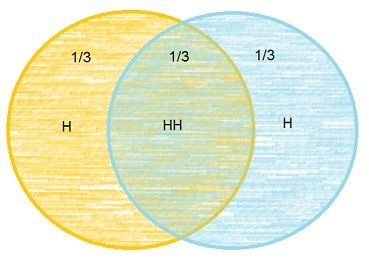
Here's a crude Venn diagram:

Vennz_zps98d77e29.jpg


We can see that when one particular coin is heads, then there is a 50% chance that the second coin will be heads. And yet the probability of both coins being heads is still just 1/3. The problem might be that you are thinking of it as "either the first coin is heads or the second coin is heads" and then counting HH twice.

Please explain what the difference is (I can't see any).

Just for everyone's clarity, we're talking about the difference between "it is known that at least one of the coins landed heads" and "one of the coins is known to have landed heads".

Let's call one coin the blue coin and one the orange coin. "One of the coins is known to have landed heads" would mean (as I interpret it at least) either that we know the blue coin came up heads or that we know the orange coin came up heads. In either case we can remove 1/3 from the Venn diagram and it would become 1/2 and 1/2.

In the "it is known that at least one of the coins landed heads" scenario, we can't look at either coin individually and know how it landed, so we can't get rid of any of the portions from the Venn diagram.

To assume that you are being asked about the overall odds of a multiple coin toss is a mistake.

If multiple means more than one, and we are being asked about the results of a set of two coin tosses, then I don't see how it's a mistake.
 
Last edited:
Not quite. There's no "if" here - a goat must be revealed. And that's the whole point, in the end. Sometimes Monty knows that there's a car and a goat among 'his' two doors and he has no choice which he reveals. Monty's knowledge is central to the puzzle.

Wrong. Monty's knowledge is irrelevant.

If he opens the door and reveals the car. then:

-- Game over. You lose. Enjoy your goat meat tacos.

The puzzle is only applicable if he reveals a goat. It is the act of revealing the goat that is the key.
 
All this assumes that the question is about the overall outcome of a multiple toss and I don’t agree that it is. In fact I claim it isn’t.
The fact that two coins were tossed and statement that at least one of the coins was heads (i.e. not specifying which coin) makes it a multiple toss calculation.
 
Wrong. Monty's knowledge is irrelevant.

If he opens the door and reveals the car. then:

-- Game over. You lose. Enjoy your goat meat tacos.

The puzzle is only applicable if he reveals a goat. It is the act of revealing the goat that is the key.
The rules of the game state that Monty MUST reveal a GOAT. NOT a CAR. The game is that the contestant gets two chance at guessing where the car is. If Monty reveals the car before the contestant has had a chance to stick or change the first guess then the game is ruined.
 
ynot, recall that JohnnyG simulated this and confirmed that it is 1/3. You might want to try a simulation of your own.
 
What about “whether at least one” makes you think it’s asking about the collective outcome of the two tosses?

The fact that "at least one" would make no sense in reference to a set of less than two? "At least one" means "one or more than one".
 
Wrong. Monty's knowledge is irrelevant.

If he opens the door and reveals the car. then:

-- Game over. You lose. Enjoy your goat meat tacos.

The puzzle is only applicable if he reveals a goat. It is the act of revealing the goat that is the key.


Monty's knowledge is very relevant. If Monty picks at random (either because he doesn't know where the car is or he doesn't care) then if he happens to pick a goat door, the odds are now 50/50 between the two remaining doors.

When Monty picks at random, the reveal is new information and thus can change the probability of your unopened door. If we know that Monty always picks a goat door, then the reveal is not new information and thus has no bearing on the probability of your door being the car door, which remains at 1/3.

That is why it's crucial to specify what set of rules Monty is operating under.
 

Back
Top Bottom