Merged Global Warming Discussion II: Heated Conversation

Status
Not open for further replies.
That's kind of the physics, too.
Yes, but we all accept the basics already. That CO2 lets visible light pass, but absorbs and re-radiates some of the IR. It's the physics of what happens next that is important, as to the kind of warming it causes.

This isn't a subtle point IMO
 
Yes, but we all accept the basics already. That CO2 lets visible light pass, but absorbs and re-radiates some of the IR. It's the physics of what happens next that is important, as to the kind of warming it causes.

This isn't a subtle point IMO

well and what exactly about it do you not understand and want to have explained ?
 
You don't like their gloom and doom predictions? Then prove them wrong by acting and encouraging others to act as well. Don't prove them right by arguing over nothing but a silly debate point. It's foolish.
I'm not going to prove or disprove anything by talking about how CO2 acts to change the heat balance of the planet. That would be megalomania. It seems some people actually do argue that CO2 can't have much effect, that it can't physically do much, but I tend to ignore such arguments, what would be the point?

There is a demonstration of how a little bit of CO2 can have a big effect here -
http://www.dailykos.com/story/2010/03/08/843974/-Can-CO2-warm-the-Earth-if-it-s-only-0-04-of-the-air

I find that quite effective at showing how a little can have a big effect. I want to know what the effect is. Wikipedia seems to be quite wrong, and it's surprising to see how difficult an answer to these questions actually is.

If CO2 does warm the air itself, that is two mechanisms that cause warming. And certainly a different story than it just re-radiates IR back towards the surface.

 
I'm not going to prove or disprove anything by talking about how CO2 acts to change the heat balance of the planet. That would be megalomania. It seems some people actually do argue that CO2 can't have much effect, that it can't physically do much, but I tend to ignore such arguments, what would be the point?

There is a demonstration of how a little bit of CO2 can have a big effect here -
http://www.dailykos.com/story/2010/03/08/843974/-Can-CO2-warm-the-Earth-if-it-s-only-0-04-of-the-air

I find that quite effective at showing how a little can have a big effect. I want to know what the effect is. Wikipedia seems to be quite wrong, and it's surprising to see how difficult an answer to these questions actually is.

If CO2 does warm the air itself, that is two mechanisms that cause warming. And certainly a different story than it just re-radiates IR back towards the surface.

what would be the difference? what would Change for you or your understanding and conclusions?

explain in Detail pls.
 
So far only one person has even tried to just answer the questions, and as I pointed out, the answers don't make sense.

"Does a CO2 molecule that has warmed, by absorbing IR, impart that energy to other non-greenhouse gas molecules in the form of translational kinetic energy?" Yes

"or does it make the atmosphere warmer only in the sense of re-radiating IR" yes

You can't say the only way CO2 warms is by re-radiating IR, and also say it does so by translational kinetic energy, that isn't possible.

So the questions remain. Just because somebody said "yes" three times doesn't mean it's the correct answers. In fact, it can't be correct.

So, does CO2 actually warm the molecules of the air when it absorbs an IR photon? Or, does it only act by re-radiating the IR?

Saying there are sources, or "it's been answered already" is not answering the questions.
 
So far only one person has even tried to just answer the questions, and as I pointed out, the answers don't make sense.

"Does a CO2 molecule that has warmed, by absorbing IR, impart that energy to other non-greenhouse gas molecules in the form of translational kinetic energy?" Yes

"or does it make the atmosphere warmer only in the sense of re-radiating IR" yes

You can't say the only way CO2 warms is by re-radiating IR, and also say it does so by translational kinetic energy, that isn't possible.

So the questions remain. Just because somebody said "yes" three times doesn't mean it's the correct answers. In fact, it can't be correct.

So, does CO2 actually warm the molecules of the air when it absorbs an IR photon? Or, does it only act by re-radiating the IR?

Saying there are sources, or "it's been answered already" is not answering the questions.

why do you demand answers? you yourself refuse to answer questions posed to you because they expose you as a liar.

yet you demand others to answer your questions, why should anyone bother?
why don't you start with answering the questions posed to you?

and yes, is has been answered, and that is a valid answer.
 
and another round of r-j refusing to answer questions posed to him......
he knows, answering them will expose him as the liar he is.

very telling.
 
Last edited:
So the questions remain. Just because somebody said "yes" three times doesn't mean it's the correct answers. In fact, it can't be correct.

So, does CO2 actually warm the molecules of the air when it absorbs an IR photon? Or, does it only act by re-radiating the IR?

Saying there are sources, or "it's been answered already" is not answering the questions.


When you have a question that can't be answered to your satisfaction, then it's incumbent upon the questioner to go outside the forum to find the answer.

When you find what you consider a definitive answer, then please share it with us.

Perhaps then we could move forward in this conversation.

---

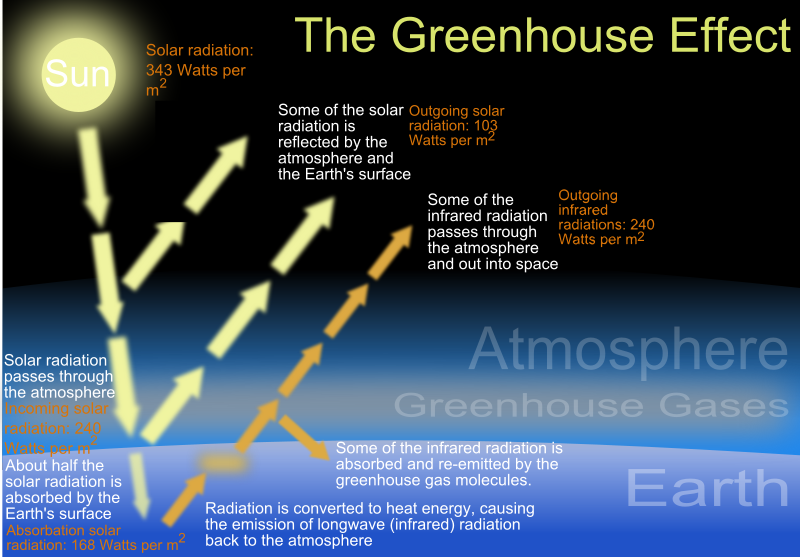
Edit: it appears that the answer to your question is that it does both. Some of that energy warms the molecule in the atmosphere and some is re-radiated in all directions.

800px-The_green_house_effect.svg.png


http://en.wikipedia.org/wiki/File:The_green_house_effect.svg
 
Last edited:
Yes, but we all accept the basics already. That CO2 lets visible light pass, but absorbs and re-radiates some of the IR. It's the physics of what happens next that is important, as to the kind of warming it causes.

This isn't a subtle point IMO

Well, at last you managed to learn some tiny bits of the physics inherent to the whole problem. Well done!

"The physics of what happens next" is what you have to learn now. The problem hasn't move to another place in the conceptual chain. You have to move to another place in the conceptual chain.
 
So far only one person has even tried to just answer the questions, and as I pointed out, the answers don't make sense.

Plenty of people have answered you but you refuse to consider the answers because they don't conform to what you already believe; so perhaps your questions were rhetorical and you had no intention of learning ?
 
So, does CO2 actually warm the molecules of the air when it absorbs an IR photon? Or, does it only act by re-radiating the IR?

Has anyone directed you to the kinetic theoryWP of gases?

Don't be troubled by the statement that the molecules in the examples are identical, as they're discussing the 'perfect' gas there to ease the calculations.

As to whether CO2 molecules can re-radiate IR I have no idea, but it would make no difference as that IR would be capable of exciting other molecules.
 
I'm not going to prove or disprove anything by talking about how CO2 acts to change the heat balance of the planet. That would be megalomania. It seems some people actually do argue that CO2 can't have much effect, that it can't physically do much, but I tend to ignore such arguments, what would be the point?

There is a demonstration of how a little bit of CO2 can have a big effect here -
http://www.dailykos.com/story/2010/03/08/843974/-Can-CO2-warm-the-Earth-if-it-s-only-0-04-of-the-air

I find that quite effective at showing how a little can have a big effect. I want to know what the effect is. Wikipedia seems to be quite wrong, and it's surprising to see how difficult an answer to these questions actually is.

If CO2 does warm the air itself, that is two mechanisms that cause warming. And certainly a different story than it just re-radiates IR back towards the surface.

Are you sure you really dont want to know if when the sun`s rays pass thru the atmosphere, if these rays directly heat up CO2 molecules as they pass thru on the way to the solid earth of the Earth?
.
Also you maybe could gain SOME insight about your question by say asking(googling) why thermopane window manufacturers choose to put say argon gas inbetween the panes of low-emission glass. Like, if they put CO2 inside instead, what effects would change?
.
Regarding your query as it stands and how you just gotsta know...it be like me asking why ...WHY?...my finger burns if i hold it right above a burning candle, but not quite so much if i hold it farther away? Why?
Will it help really to know why?
Isnt monitoring AGW CO2 emissions tonnage, and then measuring global temperature change in relation to CO2 output or reduction changes all one really needs to know?
 
Has anyone directed you to the kinetic theoryWP of gases?

Don't be troubled by the statement that the molecules in the examples are identical, as they're discussing the 'perfect' gas there to ease the calculations.

As to whether CO2 molecules can re-radiate IR I have no idea, but it would make no difference as that IR would be capable of exciting other molecules.

Your post is very wrong in more than one dimension. Your last paragraph is simply dysfunctional, physically speaking, as after admitting ignorance it not only supposes the capacity of some other molecules -what type would they be?- to be excited by IR but the ability to be in the path of every IR photon, all wrapped in a resounding "if this happens or does not happen it makes no difference".
 
What energy are you talking about? Do YOU understand the process?


As the chart indicates, solar radiation is converted to heat energy, some of which is reflected into the atmosphere where some of it is absorbed by the atmospheric molecules, some is re-radiated in all directions by greenhouse gases and some "escapes" back into space.

Am I missing something?

If so, please explain, as I am not a scientist and may be misstating or overlooking some aspect of this process.
 
As to whether CO2 molecules can re-radiate IR I have no idea, but it would make no difference as that IR would be capable of exciting other molecules.
No, that isn't true, as the Nitrogen and Oxygen molecules don't trap either visible light or IR. If they did, things would be very different.

The IR re-radiated wouldn't warm the air, just the surface or other greenhouse gases. But if the CO2 molecules heat the N2 and O2 molecules by collisions, then the IR energy could be transferred to the air, rather than re-radiated.
 
No, that isn't true, as the Nitrogen and Oxygen molecules don't trap either visible light or IR. If they did, things would be very different.

The IR re-radiated wouldn't warm the air, just the surface or other greenhouse gases. But if the CO2 molecules heat the N2 and O2 molecules by collisions, then the IR energy could be transferred to the air, rather than re-radiated.

you were saying "a CO2 molecule that was warmed, by IR radiation"

a CO2 molecule is part of the atmosphere, and a few days back you actually said that IR radiation does warm the atmosphere (part of it is CO2 molecules) but now you say IR radiation does not ....

what is it now? you are contradicting yourself. have you changed your mind?
 
If I had all the answers, I wouldn't be wasting time asking. Shoot, I would be famous and rich.


The problem is that I'm sure the answer to your question has been posted time and time again in this as well as other threads. I'm just late into the discussion so I haven't seen this for myself, but it's apparent that I wasn't the only person to answer your question.

And when I searched your question, a link with the answer was quite easy to find.

So it does call into question the degree with which you're debating honestly here.

What is your end goal? Is it really knowledge and understanding?

I would hope that's why any of us are here.
 
Status
Not open for further replies.

Back
Top Bottom