[Merged] Immortality & Bayesian Statistics

Status
Not open for further replies.
Since we haven't seen any of this data, how can we assess its credibility?
- Anyway, from my own argument, there needs to be something special about ME, or the ENORMOUS combination of events that led to ME, that sets me and mine apart from them and theirs... After all, they too are equally improbable.
Since you accept we are all special snowflakes (or hands of aces), what makes you think that you are more special than anyone else? Everyone who currently exists only does so because of an equally enormous combination of events that you rely on to consider yourself special. Everyone that ever existed, or who will ever exist in the future, relies on similarly large (or even larger) combinations of events.

Despite the chance of winning the lottery being very small, it happens just about every week to someone. Unlikely things happen, but impossible things don't.
 
So, Jabba,
What exactly is the point of this thread?

Why is it important to you that we acknowledge you theory?


I am asking because I cannot imagine repeatedly posting on a board with over a thousand active posters and not having a single one of them agree with any part of my philosophy.
Ladewig,
- I'm on this forum for two reasons: to 1) work on my debate idea, and 2) see how my beliefs fare under the scrutiny of dedicated and intelligent skeptics...
- I think that the basic problem here is that I'm so slow that observers don't realize that I'm moving.
 
Ladewig,
- I'm on this forum for two reasons: to 1) work on my debate idea, and 2) see how my beliefs fare under the scrutiny of dedicated and intelligent skeptics...


Your debate idea is never going to get any further than it already has (nowhere), not least because you've so far refused to tell us what it is you want to debate.

The scrutiny of your beliefs is rendered pointless by your refusal to listen to what everyone tells you save for those extremely rare occasions when someone seems to agree with you.


- I think that the basic problem here is that I'm so slow that observers don't realize that I'm moving.


No, the basic problem is that you really aren't moving (other than in reverse).
 
ummmm.. i am not sure if one is supposed to read the entire thread or if one is allowed to ask where the argument is? apologies if asking is impolite.

having read the last 50 or so posts, the probability one confusion seems to have been explained rather well here:
And every other consciousness which could have potentially existed instead of us if events had unfolded differently would also have been "a deck full of aces".

could someone be so kind as to point me to a post in the prior 500, if any, that provides an actual challenge to this kind of reply, or states a different question which it does not address?
 
I'd like to be able to point you to a post, lenny, but unfortunately we are no further forward.

As I understand it, the argument stands at this point:

Jabba: I can show immortality exists (and also something supernatural which may or may not be a god) by using statistics.

Everyone else: go on then, we're all ears.

J: (after much prevarication) probability is poorly understood, and people prefer aces and sets to other combinations.

Ee: Um, yes?

J: And lots of improbable things have had to happen in the past for me to exist now.

Ee: You and everyone else; we are all special snowflakes/hands of aces/a product of some incredibly unlikely happenings right from the Big Bang to today. Puddle analogy from Douglas Adams, the wine thinking the glass is exactly the right shape - we evolved to fit the conditions, not the other way around. What does this have to do with immortality?

J: probability is poorly understood, and people prefer aces and sets to other combinations.

Ee: facepalm. <---- this is where the thread is now, waiting for Jabba's next move.

I missed out the bits about using Bayes' theorem, because it wasn't being used in a predictive way or correctly, so it didn't really add to the thread.
 
...Despite the chance of winning the lottery being very small, it happens just about every week to someone. Unlikely things happen, but impossible things don't.

There is nothing at all unlikely about someone winning the lottery. With so many people taking shots, it is inevitable that a winning combination will be picked from time to time.

However, from my personal perspective, it would be extremely surprising if I, specifically, were to experience winning the lottery. That would knock my socks off. I totally do not expect that. I do not expect that so much that I don't even bother buying lottery tickets. And I don't even lose any sleep about the possibility of having failed to purchase what would have been the winning ticket. Such possibilities are too remote to worry about.

That's why I am so very special - to myself. There is only one way in millions that I can ever experience being a lottery winner. THE winning ticket MUST be in MY hand - in my case, after having found the ticket lying on the sidewalk, since that's the only way I'd ever have one. Failing that, it is all quite mundane and boring to keep hearing that some random stranger has once again won a lottery.

For what it's worth, I think this is the general direction Jabba is trying to come from. It is very difficult. Simply putting together a coherent argument is very difficult.

Perhaps Jabba is attempting to get a read on the kind of rebuttals he will face before making his big move.;)

I know one thing for sure. If I could prove immortality, I sure as hell wouldn't be giving it away on an internet forum.
 
For what it's worth, I think this is the general direction Jabba is trying to come from.
I think it's been pretty obvious that's where he's coming from since he started the thread. The unwarranted attribution of significance to the unlikely events that have happened to them is at the root of a great many woo beliefs. I hate to think how much time I've spent trying to explain the law of very large numbers to posters here who just refuse to accept it.

Most people's instinctive understanding of probability is simply wrong, but those who have emotionally invested in woo beliefs based on that misunderstanding are extremely resistant to learning how to correct it.
 
Most people's instinctive understanding of probability is simply wrong,


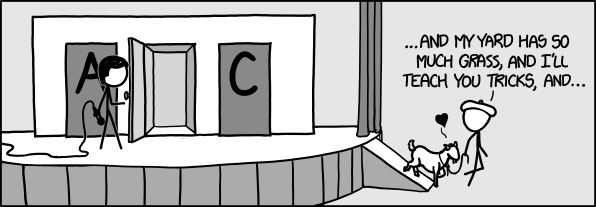
Thanks to XKCD, I've encountered an example of this recently. The comic made a reference to the Monty Hall problem, which I'd never heard of before.

The setup is a game-show that has three doors. One of them had the prize (a car) behind it, and the other two have goats behind them.

You pick a door, then the host (who knows which door the car is behind) opens a different door to reveal a goat, and asks if you want to change your choice to the remaining door.

What are the odds of the car being behind the remaining door rather than the door you first picked?

Many people are convinced that the odds are 50:50 because there are two doors left and the car could be behind either one of them. But in reality, there's a 66% chance that the car is behind the remaining door, and only a 33% chance that it's behind the first door you picked.

[/derail]

ETA: Aha! XKCD allows hotlinks, so...
monty_hall.png
 
Last edited:
Of course. The prior probability that you picked the car was .33, and remains .33, irrespective of Monte's gesture, which he was predestined to do in any case. Monte has conveniently eliminated one of the other doors, which was predestined not to have a car behind it. Simple arithmetic (1-.33) gives the probability that the other remaining door has a car behind it. So you should always change your pick to the other remaining door.
 
Last edited:
What are the odds of the car being behind the remaining door rather than the door you first picked?

Many people are convinced that the odds are 50:50 because there are two doors left and the car could be behind either one of them. But in reality, there's a 66% chance that the car is behind the remaining door, and only a 33% chance that it's behind the first door you picked.

i think the easiest way to convey this is to discuss making a choice before monty opens a door: do you keep the one door you picked or take both the other doors.

this tends to make to better choice clear to all but those who are very proud of their mathematical ability.
 
If you want to discuss the Monty Hall problem, either start a new thread, or go to one of the existing threads about this popular topic, such as this one.
Replying to this modbox in thread will be off topic  Posted By: zooterkin
 
And every other consciousness which could have potentially existed instead of us if events had unfolded differently would also have been "a deck full of aces".

And every one of this infinite set of alternate beings would have been equally justified in finding the highlighted analogy interesting. If any of them existed.

Another analogy: pointing to the number of lottery winners does nothing to alter the calculable odds against an individual winning the lottery. Those odds remain daunting, completely unaffected by how many real or imaginary lottery winners you bring up.
 
Another analogy: pointing to the number of lottery winners does nothing to alter the calculable odds against an individual winning the lottery. Those odds remain daunting, completely unaffected by how many real or imaginary lottery winners you bring up.


I think the point is that due to the number of lottery players, the odds of someone winning are very high.

Because of this, the daunting odds against any specific person winning becomes meaningless. The odds of every other possible winner are equally daunting, consequentially there's no need to attribute a special or supernatural cause for the fact that any particular person won, since it's inevitable that someone will eventually win despite the daunting odds.
 
I have a feeling Jabba has abandoned this thread yet again.
 
I doubt it, he's just waiting until he feels he can trot out the same pathetic arguments yet again.
 
...could someone be so kind as to point me to a post in the prior 500,
if any, that provides an actual challenge to this kind of reply, or
states a different question which it does not address?
Lenny,

- I've been away for awhile trying to figure out how best to proceed -- the appropriate words are singularly evasive...
- And, I won't be directly addressing your request anyway -- but then, hopefully, I will be effectively indirectly addressing it.

- I claim that there are two factors determining whether or not an improbable event should cause us to reject -- or be suspicious of -- the part of our existing worldview that has caused us to perceive the prior IMprobability of this event in the first place: 1) just how small is the prior probability of this event simply occurring by chance, given our worldview; and 2) how small IS the probability that some explanation not accepted by our worldview is responsible for the event?
- Here, I'm claiming that the probability that the chance explanation is responsible for my existence is so small as to make any other somewhat plausible explanation significantly more probable...
- In my next post, I'll try to show that the prior probability of my occurrence -- given the generally accepted scientific worldview -- is actually one over infinity (as it is for the rest of you guys). Then (in my current plan), I will try to show why some non-chance explanations are, indeed, much more than somewhat plausible.
 
Oh, please, Jabba, not this lark of posting about posts you intend to make in the future containing "indirect" proofs which you never provide.
 
I think the point is that due to the number of lottery players, the odds of someone winning are very high.

But that someone will almost certainly never be me, with 0.99999995 certainty. This is because I am not the set of all lottery players. I am an individual, preselected by my specific subjective sentient experience. Therefore, the odds you apply to your set of all lottery players do not apply to me.

Because of this, the daunting odds against any specific person winning becomes meaningless.

Meaningless to you, maybe. Not meaningless to me. Those odds are the exact reason why I don't bother playing the lottery. I know I can almost certainly come out several hundred dollars ahead over the next decade by not buying lottery tickets. Coming out ahead by doing nothing is as good as it gets in gambling.

The odds of every other possible winner are equally daunting...

Then they should look at playing the lottery the same way I do. But that's their problem, not mine. Their predicaments mean nothing to me. I don't need to count winners and losers to calculate my chances of winning the lottery.

consequentially there's no need to attribute a special or supernatural cause for the fact that any particular person won, since it's inevitable that someone will eventually win despite the daunting odds.

There is no need to attribute any cause to winning the lottery other than the already known and understood lottery system. There is no need to attribute the existence of lottry winners to anything other than the known odds and the number of lottery players.

However, when the cause of a phenomenon is unknown or in doubt, or when a specific hypothesis is being tested, then the observation of an extremely improbable specific event (under the hypothesis) can be very significant. If a hypothesis implies that event A should not be observed with near certainty, and event A is the one and only event observed, what does that do to the credibility of the hypothesis?

Still, the task Jabba has set for himself seems almost as daunting as the prior odds against his specific sentient existence. He must formulate a rational hypothesis under which his specific existence should not be observed, with near certainty. Then he must argue convincingly that his specific existence effectively discredits the hypothesis. Then he must argue convincingly that the failure of the hypothesis implies something he reasonably and coherently defines as "immortality" (IMV, a poorly chosen descriptor).

But of course, such a proof could only apply to an individual, from the individual's unique perspective. Note that I'm saying the perspective is unique, not the experience of having a unique perspective.

My point is that the preemptive arguments I've seen thrown out here have all been irrelevant. Particularly in view of the fact that Jabba has not yet presented his theorem.

It's like when a kid shakes an imaginary object at a group of kids and threatens to beat them with it. And they all laugh and say "No you won't. We'll beat the crap out of you with our imaginary objects!"

Edited to add: I posted this before seeing Jabba's latest post. I am curious as to the form his latest stick-shaking will take.
 
Last edited:
Lenny,

- I've been away for awhile trying to figure out how best to proceed -- the appropriate words are singularly evasive...

<blathersnip>


You'll likely encounter the same problem when trying to explain how the tides are caused by giant sea serpents, or that thunder is made by the gods playing skittles.

There's a hint for you here, Jabba, but you'll never take it.
 
Status
Not open for further replies.

Back
Top Bottom