• Security incident: ISF was recently accessed by intruders. Please change your password, and change it anywhere else you used it. Read more

Paul The Herodian and the DSS

Brainache

Nasty Brutish and Tall
Joined
Aug 8, 2006
Messages
17,795
Location
Canberra
This thread comes from a derail in the "Bart Ehrman... Historical Jesus" thread. Talking about the origins of Christianity, I mentioned Robert Eisenman's idea that Paul was a member of the Herodian royal family. I promised to skip ahead in the book I'm reading (James The Brother Of Jesus...) to the chapter "James in the Anabathmoi Jacobou and Paul as Herodian", and report back. So here is my summary in a separate thread to avoid continuing the derail:

This is going to be a long one. Maybe a couple of posts, because these arguments of his are based on the preceding thousand or so pages of research and Eisenman's own, sometimes idiosyncratic, interpretations of ancient documents.

He starts off talking about the "Literature of Heavenly Ascents", of which the "Anabathmoi Jacobou" or "The Ascents Of James" is a part. He also says that the two "Apocalypses Of James" found at Nag Hammadi are from a later stage of the same tradition.

Paul, in 2 Corinthians 12:2-4 tells of meeting a man 14 years ago who "Ascended to the Third Heaven" and heard "unutterable things" it was "not permitted for man to know". This in the midst of his attacks on those "super-apostles" who "compare themselves to themselves" and "preach another Jesus" - He is talking about James and the gang in Jerusalem. "These Others" he calls "ministers of Death" and "Servants Of Satan" in 2 Corinthians 2:14-16 are the leaders of the Assemblies in Jerusalem.

At this time, the issue of foreigners in the Temple and foreign Sacrifices was a big thing. Along with a division between rich and poor Priests, Josephus describes it causing a lot of conflict. The rich Priests were taking the sacrifices that should have been going to the poor and meanwhile Zealots were blocking the entrance to the Temple for people trying to make sacrifices on behalf of Ceasar.

Josephus says that barring foreigners from the Temple was a new idea: "which our Forefathers were before unacquainted with". This is untrue. It is in Ezekiel 44: 7-9, Josephus should have known that:
Ezekiel 44: 7-9 said:
7 in admitting foreigners, uncircumcised in heart and flesh, to be in my sanctuary, profaning my temple, when you offer to me my food, the fat and the blood. You[a] have broken my covenant, in addition to all your abominations. 8 And you have not kept charge of my holy things, but you have set others to keep my charge for you in my sanctuary.

9 “Thus says the Lord God: No foreigner, uncircumcised in heart and flesh, of all the foreigners who are among the people of Israel, shall enter my sanctuary.

I think Josephus doesn't want his Roman Audience to think he supports the Zealot's claims to Theological legitimacy. Ezekiel is one of the favourite Prophets amongst the DSS.

There is also the Deuteronomic King Law (also quoted in the DSS): "You shall not put a foreigner over you who is not your brother". I think Josephus is being cagey here.

Acts 21:29 tells us that Paul started a riot by going into the Temple. He is accused of bringing in Greeks and "Polluting this Holy Place".

Getting back to Epiphanius and the "Anabathmoi Jacobou" which is, according to him, an Ebionite document full of "nonsense". He says it claims Paul was "the anti-Christ", "the Enemy" and a " a Greek convert to Judaism who only did it to marry the High Priest's Daughter and when she rejected him, he got angry and started preaching against the Law etc... Heretical nonsense indeed...

Eisenman argues that this story about marrying the High Priest's Daughter is really about Herod marrying into the Maccabean family and that attributing this story to Paul ties him to that family in this Ebionite tradition. Also that they didn't consider Paul to be properly Jewish. They were definitely snobs about that.

The Ebionites were declared Heretics because they said Jesus was just a mortal Righteous Teacher, not the Mystical Son Of God that the Roman Orthodoxy said, and which they eventually imposed everywhere. They kept the Jewish Laws and all that too. They apparently thought very highly of James and influenced the Gnostics in that. Eisenman argues that the DSS were written by the first generation of these people.

I'll just pause there to take a breath. Paul vilified by Ebionites who were followers of James who was the brother of Jesus.

To be continued...
 
OK then, moving on.

According to Acts, Paul had a relative in Jerusalem who was able to put a word in for him with the Romans. Eisenman argues that this is one Julius Archelaus, mentioned in Josephus' "Vita". He argues that this is the "Junius" mentioned at the end of "Romans" along with some other suspiciously Herodian names (Aristobulus and Herodion) as Paul's "kinsman".

This Julius Archelaus is the younger brother of one Antipas who was Temple Treasurer and an associate of the Saulus in Josephus. (I'm not sure why Eisenman doesn't argue that Antipas is Paul's influential relative. That might explain why Acts is so reluctant to mention his name. A dead give-away, a name like that.) And this Antipas was killed by the Zealots along with James' executioner Ananus, a rich collaborator called Zachariah ben Bareis/Bariscaeus and a back-sliding Revolutionary, Niger of Perea.

Eisenman argues that this Niger of Perea is the person Acts calls "Simeon Niger" who was an associate of Paul's at Antioch. He also argues that Zachariah ben Bariscaeus is possibly the "Zachariah son of Barachias" who is killed in Matthew 23: 35 followed by the "blood libel" about Jerusalem who "kills all her Prophets". I can't find any Old Testament Prophets who were killed by the Jews. Can you? Did MaGZ write this?

Either way, Julius Archelaus and Antipas are also close relatives of a guy called Costobarus, a relative of Agrippa and an associate of the Saulus in Josephus.

Josephus describes these two (Saulus and Costobarus) as starting the riot in Jerusalem following the death of James, which very much resembles the riot led by Paul in Acts after the stoning of "Stephen". Not to mention the riot in the Pseudo Clementine "Recognitions" which ends up in Paul casting James head-long down the Temple steps and James breaking his leg.

So, after describing the death of James, Josephus describes Saulus and Costobarus as willing to "use violence with the people and plunder those weaker than themselves". Whereas the DSS after describing the death of the Righteous Teacher accuses corrupt establishment priesthood that killed him of "using violence" and "plundering the weak".

Paul admits to this behaviour early in his career (1 Corinthians 15:9 and Galatians 1:13), but that was in the 40s, not the 60s and "Stephen" isn't James, is he? Eisenman argues that given the similarities, unless Saul/Paul led two riots twenty years apart maybe Acts or Josephus or both have their timelines confused. It wouldn't be impossible. Josephus didn't include this incident in "The War...", only in "Antiquities" which he wrote twenty years later and in which he says he relied on information from other people. Maybe he got confused over just exactly when Saulus was doing his persecuting.

The stoning of Stephen in Acts appears to be a re-telling of the Pseudoclementine story about Paul throwing James down the temple steps with the names changed to protect the innocent.

Anyway, I have to eat now. I'll be back with more on Aristobulus, Salome (yes, that one) and the Littlest Herod...

Stay tuned.
 
Looking at Paul's areas of Missionary activity in the cities of Asia Minor and Syria we also see places where Herodian interests line up with Paul's stated aims of founding a community where Greeks and Jews could live in harmony and equality (1 Corinthians 1:24, Galatians 3:28, etc).

The stories about various Herodian Princesses marrying Kings and Princes of these places all contain motifs about who was or wasn't circumcised, another big concern of Paul's (and the Zealots).

Herodians were appointed as kings by the Romans in a few places: Drusilla, daughter of Agrippa I was married to the King of Emesa (now Homs in Syria) after a checkered history with various Romans and Collaborators, Alexander King of Armenia was a Herodian who Vespasian made King of Cilicia after the war. Cilicia is where Paul comes from. There was also Tigranes, another Herodian appointed King of Armenia by the Romans

Josephus pictures Tigranes as spending a great deal of time as a hostage in Rome, so much so that it becomes a second home for him. Same for other Herodians; Agrippa II, Aristobulus and Salome, whose faces appear on coins calling themselves "Great Lovers Of Caesar", and Julius Archelaus. Eisenman argues that these people constituted a circle of rich, sophisticated, Greek-speaking, pro-Roman intellectuals with a lot of time on their hands...

He argues that these people may have been responsible "for much of the material that ended up being incorporated - along with a good deal of Alexandrian Greco-Roman 'anti-semitism' - in what we now call 'The Gospels'".

Make of that what you will.

So, onto Paul's letter to the Romans...

At the end of this letter (Romans 16:11), he sends greetings to various people, including those in the "Household of Aristobulus" and someone who most translate as "My kinsman Herodion", but Eisenman translates as "My kinsman the littlest Herod". I'll have to leave that to the Scholars to decide. Just note that Aristobulus and his wife Salome, (the same one as mentioned in the story about John The Baptist's head on a platter) did have a child named Herod and lived in Rome at the time(or so Eisenman asserts, I haven't checked that).

Other Scholars say these are the names of unknown Freedmen who took the names of their former masters. I don't know what that is based on.

In another letter (Philippians) he sends greetings to "the Saints" in "The Household of Caesar" and mentions his close collaborator and "comrade in arms" - Epaphroditus. Epaphroditus was Nero's Secretary for Greek Letters and held a similar office later under Domitian. He was also Josephus' Publisher and was later accused of being involved in the death of Nero.

Other Scholars argue that "Epaphroditus" was a common name and that Paul's Epaphroditus is different to Josephus's Epaphroditus. I don't know.

The last mention of Saulus in Josephus has him heading to Corinth to meet with Nero in 66 CE and inform him of the situation in Palestine. To which Nero responds by sending in Titus and Vespasian and their legions to crush the place. If that was our Paul, I can understand why the authors of Acts might have left out that part. It kind of makes Paul responsible for the destruction of Jerusalem and the Temple...

More to come...
 
Eisenman now notes how Paul avoids calling himself a Jew, although he has no problem calling Peter a Jew (Galatians 2:13-14). He calls himself of "The Tribe Of Benjamin", "an Israelite of the seed of Abraham". Eisenman argues that the DSS "The War Scroll" shows that many converts to Judaism and Diaspora Jews may have referred to themselves as "Benjaminites". I don't know.

He argues that because of the way Paul speaks about Judaism, his easy-going attitude to the Law and his overt contempt for most things Jewish left a mark on his contemporaries. The Ebionites said he was never really Jewish and only converted to marry the high priest's daughter. Just like George Costanza turning Latvian Orthodox, what did he care?

The rest of the chapter is Eisenman rehashing the stuff about:
- How Herod's family and Paul's description in the Anabathmoi links them together in Ebionite tradition.

- How the Herodians called themselves and acted Jewish when it suited them. Or not.

- How Paul might have come back to Palestine after 64 CE and his pleasant sojourn in Rome.

- How Paul may have gone to Spain using his extensive network of Herodian relatives...

- How Paul's basket escape story in his letters doesn't match the one told in Acts, how this relates to being Herodian, and why Aretas was out arrest them.

- How Acts portrays the Roman Governor Gallio in Corinth allowing the Greeks to beat "Sosthenes" the leader of the Synagogue for complaining about Paul, but in 1 Corinthians, Sosthenes is Paul's "Brother" and "Boon Companion".

- How Acts ends inconclusively with Paul loafing about in Rome some time in the 60s. No mention of how Paul or James died. Strange.

There is of course a lot more to all of this than I have managed to convey here, but I hope I've given the general gist, without distorting it too much.
 
Brainache, what a generous feast you've prepared here!
I'm going to have to read and re-read it all several times to be sure I have a sense of the overall view and then start asking questions.
I've also read up on Eisenman to get an idea of how he became associated with the DDS, so I'll be posting from a less ignorant POV.
 
Brainache, what a generous feast you've prepared here!
I'm going to have to read and re-read it all several times to be sure I have a sense of the overall view and then start asking questions.
I've also read up on Eisenman to get an idea of how he became associated with the DDS, so I'll be posting from a less ignorant POV.

Excellent posts, thank you

No worries.

These posts have been building up inside me for a while, I had to let them out.
 
One thing I don't think I mentioned, the elephant in the room, as it were, is the fact - acknowledged in all the sources - of Paul's Roman citizenship. The Romans weren't handing out citizenships to everyone in Judea, how does Paul happen to have one?

Herod and his descendents were given Roman Citizenship in perpetuity for services rendered to Rome. So if Paul is a member of the family, that would explain it. Acts tells us that Paul was a Roman Citizen "from birth".

I haven't looked up the accepted story yet, but if it turns out that it is something lame like: "We don't know, but maybe it was more common than most people think...", it won't be unexpected, based on my experience with some of this "Mainstream Biblical Scholarship".

This Herodian theory IMO solves a lot of questions more simply and elegantly than the mental gymnastics required by traditional apologetics. Once you accept the basic premise that Paul is insincere and manipulating his audience (things he admits to in his letters), then the rest makes perfect sense.
 
OK, I did a quick google search and found this from the Catholic Encyclopedia:
ETA: Link: http://www.newadvent.org/cathen/11567b.htm
Birth and education

From St. Paul himself we know that he was born at Tarsus in Cilicia (Acts 21:39), of a father who was a Roman citizen (Acts 22:26-28; cf. 16:37), of a family in which piety was hereditary (2 Timothy 1:3) and which was much attached to Pharisaic traditions and observances (Philippians 3:5-6).

St. Jerome relates, on what ground is not known, that his parents were natives of Gischala, a small town of Galilee and that they brought him to Tarsus when Gischala was captured by the Romans (Illustrious Men 5; "In epist. ad Phil.", 23). This last detail is certainly an anachronism, but the Galilean origin of the family is not at all improbable.

As he belonged to the tribe of Benjamin he was given at the time of his circumcision the name of Saul, which must have been common in that tribe in memory of the first king of the Jews (Philippians 3:5). As a Roman citizen he also bore the Latin name of Paul. It was quite usual for the Jews of that time to have two names, one Hebrew, the other Latin or Greek, between which there was often a certain assonance and which were joined together exactly in the manner made use of by St. Luke (Acts 13:9: Saulos ho kai Paulos). See on this point Deissmann, "Bible Studies" (Edinburgh, 1903, 313-17.) It was natural that in inaugurating his apostolate among the Gentiles Paul should have adopted his Roman name, especially as the name Saul had a ludicrous meaning in Greek.

As every respectable Jew had to teach his son a trade, young Saul learned how to make tents (Acts 18:3) or rather to make the mohair of which tents were made (cf. Lewin, "Life of St. Paul", I, London, 1874, 8-9). He was still very young when sent to Jerusalem to receive his education at the school of Gamaliel (Acts 22:3). Possibly some of his family resided in the holy city; later there is mention of the presence of one of his sisters whose son saved his life (Acts 23:16).

From that time it is absolutely impossible to follow him until he takes an active part in the martyrdom of St. Stephen (Acts 7:58-60; 22:20). He was then qualified as a young man (neanias), but this was very elastic appellation and might be applied to a man between twenty and forty.

Looks like they just take Paul at face value and don't ask where the Roman citizenship comes from. Someone - St Jerome - makes up a historically implausible story about his family being from Gischala in Galilee and that's that. Story over, case closed, nothing to see here, move along...

It's even lamer than I feared.
 
Last edited:
I just can't stop myself. This is about the "Tribe of Benjamin":
http://www.catholicnewsagency.com/column.php?n=479
Long before King Saul, the patriarch Jacob (Israel) spoke a word of prophesy over his son Benjamin. The words spoken over each of his twelve sons are often realized within the later narratives of Israel’s history. To Benjamin he said, "Benjamin is a ravenous wolf, in the morning devouring the prey, and at even dividing the spoil" (Gen. 49:27). These words would be fulfilled in the life of King Saul who kept the spoils of war when he was commanded by the Lord to destroy it all. When he realized he had lost his kingdom as a result of his disobedience, he became a ravenous wolf with a single purpose - to kill King David.

A strange group for someone proclaiming the descendant of David as Messiah to associate himself with. Don't ya think?

"Benjamin" was a pejorative used by smug fundamentalist Zealots in the DSS to refer to people who weren't really Jewish. The converts and what we call now "Cultural Jews". Or so Eisenman argues.
 
While we're waiting, here's an interesting titbit of early Church History.

Augustine wrote a letter to St Jerome about the passage in 2 Galatians where Paul calls Peter a hypocrite.

St Jerome is the man who translated the books of the New Testament into Latin and compiled what they call the first Latin Vulgate. If Jerry didn't put it in the book, it wasn't in The Book. This guy has a lot to answer for...

But, anyway, the story goes (as Eisenman tells it), that St Augustine was troubled by this passage in Galatians and asked St Jerome what it could mean that Paul was calling Peter, the rock upon which the Church was founded, a Hypocrite? How could this be?

St Jerome writes a long Apology in reply, all about Paul and Peter putting on an act to teach unity over division, or some such nonsense. Then he finishes the reply to Augustine with a comment to the effect that; "I only put this argument together because you asked me to, maybe it's better not to ask these kinds of questions..."

It just made me chuckle to imagine this 4th century Cleric racking his brain to come up with an explanation that makes Paul's own hypocrisy regarding Jewish customs. ( Paul made Timothy get circumcised and shaved his own head for fear of James and "those of the circumcision". Why rebuke Peter for refusing table fellowship with Gentiles for the same reason?)

Augustine certainly wasn't happy with Jerome's response:
He wrote that Jerome's interpretation undermined the entire Scriptures, for to concede that Paul “lied” in this instance would be to open the way to private interpretation in any other scriptural passage; thereby, anyone would be free to believe what he likes in the Scriptures and to refuse to believe what he does not like.
From here:
http://www.augnet.org/?ipageid=2163

Christians free to pick and choose which verses to believe? Oh my!:eek: Don't worry Gus, it'll never happen... not in a million years...:covereyes
 
Firstly, I'd like to address the issue of foreigners in the Temple, then I'll tap on the "Benjamin" bit, and then I'll move on to Paul and James (which I've touched on in the past), and then finally I'll offer thoughts regarding Paul as an Herodian.

---
Foreigners in the Temple
---​

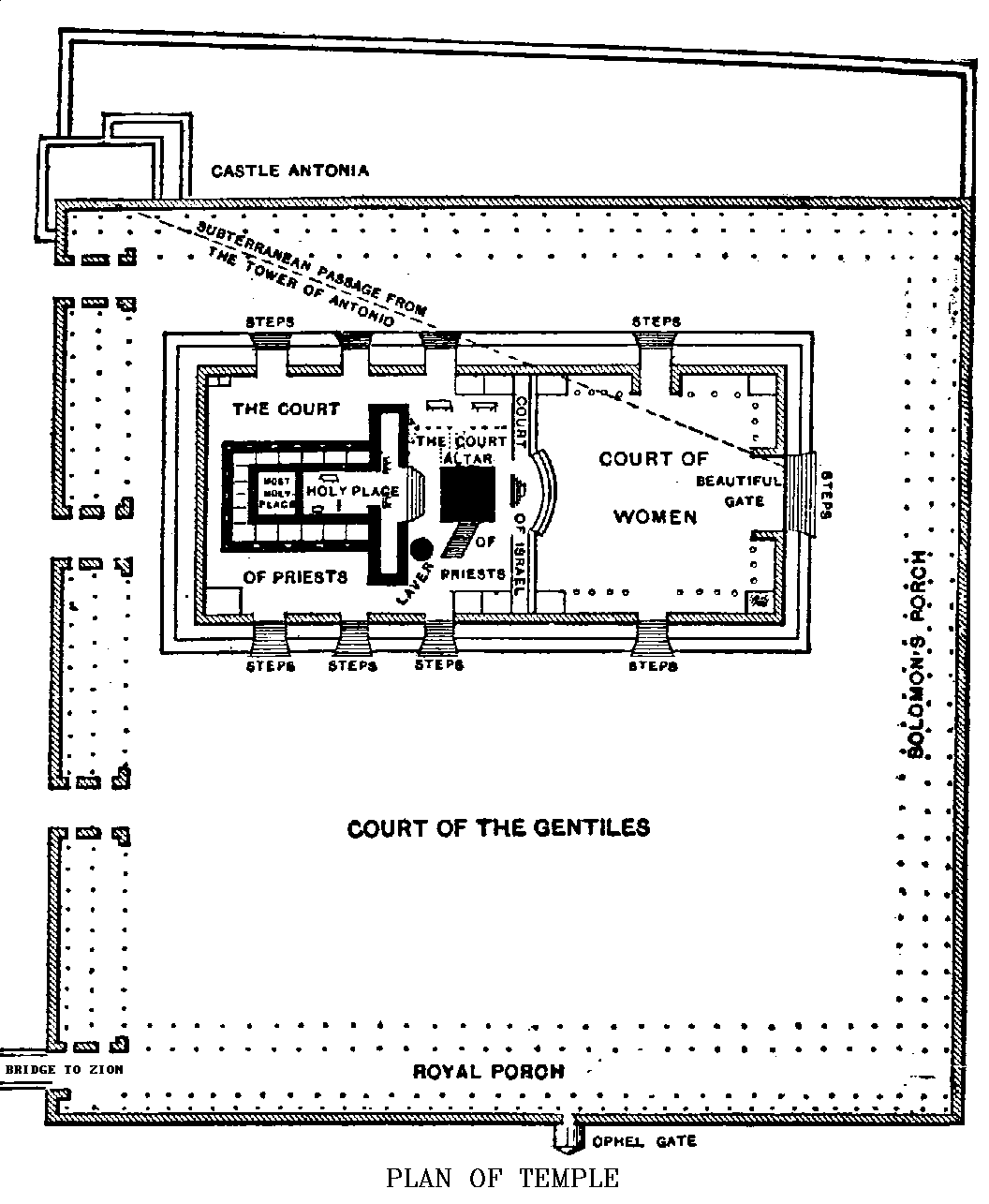
The reason that you are seeing confusion over whether or not foreigners were allowed in the Temple or not is that they were allowed into the Temple, but they weren't allowed into all areas of the Temple areas.
This is true of both the first and second Temples.

Foreigners were allowed into the Temple, but not all areas of the Temple.
When you read notations of foreigners not being allowed in the Sanctuary, this is referring to the Court of Priests, and specifically, the 'Holy of Holies' (sometimes referred to specifically as "the sanctuary").

Here's what a map of the Temple and locations which permitted different groups of peoples:
image21.gif


This is important for later when we look at what happens in Acts and how Paul is charged.


---
"Benjamin"
---​

I'm skipping over the alleged grand unification (super kingdom filled with wealth) as we lack anthropological record at this time which indicates a unified beginning as outlined in the Bible (circa 1000 BCE - see the timeline I have compiled of the Hebrew peoples as is best capable of noting in anthropological and archaeological record so far).
We have two kingdoms early on: the Northern Kingdom of Israel and the Southern Kingdom of Judah.

Now, I'm not ruling out that all tribes could have been unified in the highlands as advancing tribes.
This is what we have evidenced to us so far; that such was the case.

These groups split; north and south.
Israel had everyone except for Judah and Benjamin, but Benjamin was a leading political tribe before with good standing favor.
There was a falling out with fingers being pointed in every direction, but Benjamin ended up with a lot of the blame, and it didn't help much that they sided with Judah (power play politics is what's going on here).
So Judah and Benjamin split, and the rest kept going with Israel until Israel was wiped out and Judah was left standing (by outside forces).

Benjamin, then, becomes somewhat of a slang term in a way we say "Judas" today.

This is paraphrased somewhat decently in Wikipedia's entry (I have small issues with this summary, but the general gist of it is good enough to give you the idea).
After the death of Saul, all the tribes other than Judah remained loyal to the House of Saul, but after the death of Ish-bosheth, Saul's son and successor to the throne of Israel, the Tribe of Benjamin joined the northern Israelite tribes in making David, who was then the king of Judah, king of a re-united Kingdom of Israel. However, on the accession of Rehoboam, David's grandson, in c. 930 BCE the northern tribes split from the House of David to reform a Kingdom of Israel as the Northern Kingdom. However, this time the Tribe of Benjamin remained loyal to the House of David, and remained a part of the Kingdom of Judah, in which it remained until Judah was conquered by Babylon in c. 586 BCE and the population deported.

The important aspect to note is that almost all texts that we have left to us through history for the Torah and Tanakh were formed into their forms we are familiar with in Judah around 8th and 7th c BCE (mostly).
Keep that in mind the next time you read something ridiculing the Israelites (Kingdom of Israel).

Some names end up with social stigma attached to them due to some cultural occurrence; Benjamin was definitely one of these names even though it started out as a good name involved in primary leadership.

---
Paul and James
---​

I've ran this down before, but It's pretty clear that James set Paul up to get arrested.

Paul gets a late notice of invitation to the Jerusalem Church and so:
Acts 20:16
Paul had decided to sail past Ephesus to avoid spending time in the province of Asia, for he was in a hurry to reach Jerusalem, if possible, by the day of Pentecost.

Upon arrival, Paul is given a warning and supplied a solution to the problem he is told about by James' group.
Acts 21
Then they said to Paul: “You see, brother, how many thousands of Jews have believed, and all of them are zealous for the law. 21 They have been informed that you teach all the Jews who live among the Gentiles to turn away from Moses, telling them not to circumcise their children or live according to our customs. 22 What shall we do? They will certainly hear that you have come, 23 so do what we tell you. There are four men with us who have made a vow. 24 Take these men, join in their purification rites and pay their expenses, so that they can have their heads shaved. Then everyone will know there is no truth in these reports about you, but that you yourself are living in obedience to the law. 25 As for the Gentile believers, we have written to them our decision that they should abstain from food sacrificed to idols, from blood, from the meat of strangled animals and from sexual immorality.”
The James collective is supplying the converts to Paul and telling Paul to take them to the Temple in the ritual purification areas (not in the Court of Gentiles; this is beyond that area).
Paul thinks these are Jews like himself; Jews born in Gentile lands, but still Jews.

And then:
26 The next day Paul took the men and purified himself along with them. Then he went to the temple to give notice of the date when the days of purification would end and the offering would be made for each of them.


27 When the seven days were nearly over, some Jews from the province of Asia saw Paul at the temple. They stirred up the whole crowd and seized him, 28 shouting, “Fellow Israelites, help us! This is the man who teaches everyone everywhere against our people and our law and this place. And besides, he has brought Greeks into the temple and defiled this holy place.”

Take note that this was shouted:
“Fellow Israelites, help us!"
That would mean they were pretty far in the Temple area (refer to the above map and note the location for the Court of Israelites; that's well past the Court of Gentiles).


We are compelled to ask why this would be happening to Paul.
The short answer to that is that Paul was claiming to be the Gentilian authority for the Church of Jerusalem.
James never really gave him this approval.
Instead, when you read over the section James more or less gets tired of arguing with Paul and decides that he doesn't care what Gentiles do.
Paul appears to have taken this and decided that he could use it as a grant of authority as a sort of bishop officially; which it was not.

The reason we see Acts end so abruptly is (my guess) probably because there's really nothing nice to add after this without confirming some bad political fallout.

So the other accounts of the feuds between these two is probably sound in concept, and elaborated in style (probably didn't kick his head down the stairs, but it wouldn't strike me as surprising if he would have liked to).


---
Paul the Herodian
---​

I don't know if Paul was an Herodian or not.
What I can say is that the hypothesis doesn't really have a hard time fitting Paul.
Paul was a silver-tongued conman.

Just look at his trial after being arrested in Jerusalem.
He is able to switch locations, judges, prosecution, and witnesses multiple times until the point arrives that no one even knows what charges are actually valid, or what the charges even are.

Paul also contradicts his positions depending on who he is talking to.
He's Jewish, no, Roman, no, a Pharisee, Jews first Gentiles second, no, Gentiles second Jews first, I "only" want..., but then takes more liberty than "only" repeatedly.

So it would not be odd if he was Herodian to me, but I have to wonder if Paul was more the case that he wasn't Herodian, but wiggled his way into a technicality of being able to claim to be of that "kindship" loosely, and then (as he does in all other cases) take that small technicality and stretch it to the furthest reaches he can get away with.

For example, Paul could have converted a Herodian and considered this to make him "kin" of them in Christ and then adopt the powerplay options the "Herodian" name gives him in certain regions by dropping the name into conversation when convenient, and abstaining from it when not.
 
Last edited:
Firstly, I'd like to address the issue of foreigners in the Temple, then I'll tap on the "Benjamin" bit, and then I'll move on to Paul and James (which I've touched on in the past), and then finally I'll offer thoughts regarding Paul as an Herodian.

---
Foreigners in the Temple
---​

The reason that you are seeing confusion over whether or not foreigners were allowed in the Temple or not is that they were allowed into the Temple, but they weren't allowed into all areas of the Temple areas.
This is true of both the first and second Temples.

Foreigners were allowed into the Temple, but not all areas of the Temple.
When you read notations of foreigners not being allowed in the Sanctuary, this is referring to the Court of Priests, and specifically, the 'Holy of Holies' (sometimes referred to specifically as "the sanctuary").

Here's what a map of the Temple and locations which permitted different groups of peoples:
[qimg]http://www.templemount.org/missler/image21.gif[/qimg]


This is important for later when we look at what happens in Acts and how Paul is charged.

So, when Josephus complains about those nasty Zealots barring the Temple to foreigners in the lead up to the revolt and calling it a "new thing", he is talking about the Zealots barring foreigners from the parts of the Temple that they used to be allowed into?

Well, yeah. It would be pointless to bar access if access had never been given. I think the point was that the Zealots didn't even want "unclean" people looking at the Temple, much less wandering about in it, gawking at the men in the funny hats.


---
"Benjamin"
---​

I'm skipping over the alleged grand unification (super kingdom filled with wealth) as we lack anthropological record at this time which indicates a unified beginning as outlined in the Bible (circa 1000 BCE - see the timeline I have compiled of the Hebrew peoples as is best capable of noting in anthropological and archaeological record so far).
We have two kingdoms early on: the Northern Kingdom of Israel and the Southern Kingdom of Judah.

Now, I'm not ruling out that all tribes could have been unified in the highlands as advancing tribes.
This is what we have evidenced to us so far; that such was the case.

These groups split; north and south.
Israel had everyone except for Judah and Benjamin, but Benjamin was a leading political tribe before with good standing favor.
There was a falling out with fingers being pointed in every direction, but Benjamin ended up with a lot of the blame, and it didn't help much that they sided with Judah (power play politics is what's going on here).
So Judah and Benjamin split, and the rest kept going with Israel until Israel was wiped out and Judah was left standing (by outside forces).

Benjamin, then, becomes somewhat of a slang term in a way we say "Judas" today.

This is paraphrased somewhat decently in Wikipedia's entry (I have small issues with this summary, but the general gist of it is good enough to give you the idea).


The important aspect to note is that almost all texts that we have left to us through history for the Torah and Tanakh were formed into their forms we are familiar with in Judah around 8th and 7th c BCE (mostly).
Keep that in mind the next time you read something ridiculing the Israelites (Kingdom of Israel).

Some names end up with social stigma attached to them due to some cultural occurrence; Benjamin was definitely one of these names even though it started out as a good name involved in primary leadership.

Is it fair to say that by the time of the Second Temple, the "Tribe of Benjamin" had ceased to exist as an entity within Judaism? That it was more like a label for hostile neighbours than fellow Jews?

---
Paul and James
---​

I've ran this down before, but It's pretty clear that James set Paul up to get arrested.

Paul gets a late notice of invitation to the Jerusalem Church and so:
Acts 20:16


Upon arrival, Paul is given a warning and supplied a solution to the problem he is told about by James' group.
Acts 21

The James collective is supplying the converts to Paul and telling Paul to take them to the Temple in the ritual purification areas (not in the Court of Gentiles; this is beyond that area).
Paul thinks these are Jews like himself; Jews born in Gentile lands, but still Jews.

And then:


Take note that this was shouted:
“Fellow Israelites, help us!"
That would mean they were pretty far in the Temple area (refer to the above map and note the location for the Court of Israelites; that's well past the Court of Gentiles).


We are compelled to ask why this would be happening to Paul.
The short answer to that is that Paul was claiming to be the Gentilian authority for the Church of Jerusalem.
James never really gave him this approval.
Instead, when you read over the section James more or less gets tired of arguing with Paul and decides that he doesn't care what Gentiles do.
Paul appears to have taken this and decided that he could use it as a grant of authority as a sort of bishop officially; which it was not.

I read it as James saying to Paul: "You were only supposed to preach your nonsense to Gentiles, but you've been preaching to Jews against our orders". And Paul saying: "I never done nothing! I never preached to no Jews, honest, I swear! Look, I'll do anything you say, just don't kick me out of your gang..."

Then of course, the Jews that Paul denied preaching to show up (oh how convenient for Mr James...) and he is busted.

The reason we see Acts end so abruptly is (my guess) probably because there's really nothing nice to add after this without confirming some bad political fallout.

So the other accounts of the feuds between these two is probably sound in concept, and elaborated in style (probably didn't kick his head down the stairs, but it wouldn't strike me as surprising if he would have liked to).

If this theory is right, there is definitely a lot of "not nice" stuff left out of Acts.

---
Paul the Herodian
---​

I don't know if Paul was an Herodian or not.
What I can say is that the hypothesis doesn't really have a hard time fitting Paul.
Paul was a silver-tongued conman.

Just look at his trial after being arrested in Jerusalem.
He is able to switch locations, judges, prosecution, and witnesses multiple times until the point arrives that no one even knows what charges are actually valid, or what the charges even are.

Paul also contradicts his positions depending on who he is talking to.
He's Jewish, no, Roman, no, a Pharisee, Jews first Gentiles second, no, Gentiles second Jews first, I "only" want..., but then takes more liberty than "only" repeatedly.

So it would not be odd if he was Herodian to me, but I have to wonder if Paul was more the case that he wasn't Herodian, but wiggled his way into a technicality of being able to claim to be of that "kindship" loosely, and then (as he does in all other cases) take that small technicality and stretch it to the furthest reaches he can get away with.

For example, Paul could have converted a Herodian and considered this to make him "kin" of them in Christ and then adopt the powerplay options the "Herodian" name gives him in certain regions by dropping the name into conversation when convenient, and abstaining from it when not.

Well I'm glad to hear that my Pet Theory has survived the first hurdle: It's not impossible!

It actually means a lot to me to hear that from you JaysonR.

Do you think it's possible that Paul is the "Saulus" in Josephus? That maybe Josephus got his Saulus info from someone else (Epaphroditus maybe?) and put it in the wrong timeframe? Or is that stretching things too far?
 
So, when Josephus complains about those nasty Zealots barring the Temple to foreigners in the lead up to the revolt and calling it a "new thing", he is talking about the Zealots barring foreigners from the parts of the Temple that they used to be allowed into?

Well, yeah. It would be pointless to bar access if access had never been given. I think the point was that the Zealots didn't even want "unclean" people looking at the Temple, much less wandering about in it, gawking at the men in the funny hats.
Correct, and this has economic impacts as well.
The Court of the Gentiles wasn't only a ritual area, but it was a market trade area as well. For instance, this is the area where people would trade the high commodity item of incense.

Banning foreigners from this area would, to the non-zealot, seem utterly suicidal economically.
Zealots (as they usually do in any iteration in any culture) don't really care about ideological impacts upon the economy; they are typically more interested in the absolute adherence to whatever the group's ideological core is (we're seeing something somewhat similar to this in American Congress atm).

Is it fair to say that by the time of the Second Temple, the "Tribe of Benjamin" had ceased to exist as an entity within Judaism? That it was more like a label for hostile neighbours than fellow Jews?
This could be argued, as according to Hebrew legend, the Benjamin tribe was all but wiped out in the Battle of Gibeah, and let alive to become mixed-bloods instead of pure blood Hebrews.
By the time of the Second Temple, the Benjamin tribe is almost never mentioned; we still hear about Levi and Judah, but gone are any venerations of Benjamin.

I read it as James saying to Paul: "You were only supposed to preach your nonsense to Gentiles, but you've been preaching to Jews against our orders". And Paul saying: "I never done nothing! I never preached to no Jews, honest, I swear! Look, I'll do anything you say, just don't kick me out of your gang..."

Then of course, the Jews that Paul denied preaching to show up (oh how convenient for Mr James...) and he is busted.
I agree, I just take it further than this because James not only wanted Paul to only talk to Gentiles with Paul's bastardized form of the teachings (from James' view), but he certainly doesn't seem too tickled that Paul's walking around claiming to be a representative of the Church of Jerusalem on top of it, when all James appears to ultimately have wanted was for Paul to go away.

If this theory is right, there is definitely a lot of "not nice" stuff left out of Acts.
I'm pretty compelled to this; Acts euphimizes all of the issues and regularly leaves James out of the picture unless it's something passive or nice to say to Paul, yet it's his group of people constantly talking to Paul in the actions that lead up to Paul getting in trouble in the Temple.
It's almost like we're looking at an ancient case of plausible deniability.

Well I'm glad to hear that my Pet Theory has survived the first hurdle: It's not impossible!

It actually means a lot to me to hear that from you JaysonR.
Happy to help!

I really feel (no proof) that it fits Paul's psychology more that he wasn't Herodian properly, but that he wiggled his way into the capability of getting away with aligning himself with that group as needed.

Do you think it's possible that Paul is the "Saulus" in Josephus? That maybe Josephus got his Saulus info from someone else (Epaphroditus maybe?) and put it in the wrong timeframe? Or is that stretching things too far?
I think it's hard to play "maybe" with timeline errors and name comparisons at the same time.

I think it's possible, but I wouldn't suggest that this means it's likely or not.
I would actually need to spend some time seeing if the texts make similar errors elsewhere with timelines in general, and if so, under which context do those errors appear.
Following this, if errors were present elsewhere, I would then need to examine the citation alleged to be in timeline error and see if the context of the given citation applies to the type of contexts where the other errors occurred.

Otherwise, all I have is pattern seeking and guessing, and I don't like that approach.

If I get some time, I'll see if I can do such a comparison so that I can better offer an educated assessment of whether such a timeline error was possible.


----
By the way: you can just call me Jayson, and not JaysonR.
Jayson is my real name and I did try to sign up with just "Jayson", but it was already taken so I tossed in an extra initial from a secondary name.
 
Last edited:
Actually, I was able to come to a decision rather more quickly than I had expected.

I didn't even need timelines for this.

I think the connection is tenuous, in both accounts.
In Acts 21:37-38, we are introduced to this idea
“Do you speak Greek?” he replied. 38 “Aren’t you the Egyptian who started a revolt and led four thousand terrorists out into the wilderness some time ago?”

Which appears to be comparable to Josephus' Book 7, Chapter 10:
Accordingly, they exhorted the multitude to have a care, lest they should be brought to destruction by their means, and to make their apology to the Romans for what had been done, by delivering these men up to them; who being thus apprized of the greatness of the danger they were in, complied with what was proposed, and ran with great violence upon the Sicarii, and seized upon them; and indeed six hundred of them were caught immediately: but as to all those that fled into Egypt (18) and to the Egyptian Thebes, it was not long ere they were caught also, and brought back, whose courage, or whether we ought to call it madness, or hardiness in their opinions, every body was amazed at.

Now, firstly, I'll take Josephus' timeline over Acts on the simple matter that Acts is known for getting its times mixed up, and Josephus is known to have been involved in the Jewish Wars himself before being captured and made an interpreter for Vespasian.

We have no such credit available for the authorship of Acts.

Now here's my problem with drawing a line between these two events and considering them one such event by which Paul is responsible:
It would mean that Paul was Sicarii; which he really doesn't fit that bill at all.

Paul doesn't have a record of killing Romans (which was the primary interest of the sicarii; to fight Rome), but instead killing Christians.

Also, Paul doesn't admit to the charge in Acts at all.
He claims his birth place and moves on to describe his whereabouts.

Here's what this group is described as:
WHEN Bassus was dead in Judea, Flavius Silva succeeded him as procurator there; who, when he saw that all the rest of the country was subdued in this war, and that there was but one only strong hold that was still in rebellion, he got all his army together that lay in different places, and made an expedition against it. This fortress was called Masada. It was one Eleazar, a potent man, and the commander of these Sicarii, that had seized upon it.
...
...the Sicarii got together against those that were willing to submit to the Romans, and treated them in all respects as if they had been their enemies, both by plundering them of what they had, by driving away their cattle, and by setting fire to their houses; for they said that they differed not at all from foreigners, by betraying, in so cowardly a manner, that freedom which Jews thought worthy to be contended for to the utmost, and by owning that they preferred slavery under the Romans before such a contention.

This seems a bit of a stretch to link Paul to in my opinion.
Furthermore, the Sicarii liked killing Herodians, so it's a bit odd to link him to both at once.

I think Paul's zealot actions against deviations from traditional Judaic adherence doesn't give me enough leverage to take the leap of connecting him to Sicarii exodus to Egypt; though I can understand how it ended up being mentioned in Acts.

The author of Acts probably saw less distinction between a Zealot and the Sicarii, or could have wanted to allude that Paul was being confused for Eleazar as a way of attempting to convey a infamy of Paul's zealousness.

I can't sympathize with the view, however, that Paul is Sicarii; that seems a bit of a reach for someone born in a Roman province and who retains their Roman citizenship rather than outwardly denouncing it.


So Acts linking Paul to some Sicarii revolutionary movement; I have to toss that one out.


The other option (Eisenman doesn't give us one, but many possible ways to connect the dots) is the Idumean (from Edom, which is just due south of Judah) link in Josephus; by which route we link Paul to Herod.

Antiquities of the Jews - Book 14, Chapter 1, section 3:
But there was a certain friend of Hyrcanus, an Idumean, called Antipater, who was very rich, and in his nature an active and a seditious man; who was at enmity with Aristobulus, and had differences with him on account of his good-will to Hyrcanus. It is true that Nicolatls of Damascus says, that Antipater was of the stock of the principal Jews who came out of Babylon into Judea; but that assertion of his was to gratify Herod, who was his son, and who, by certain revolutions of fortune, came afterward to be king of the Jews, whose history we shall give you in its proper place hereafter.

This lines up with Acts 22:2-5:
Then Paul said: 3 “I am a Jew, born in Tarsus of Cilicia, but brought up in this city. I studied under Gamaliel and was thoroughly trained in the law of our ancestors. I was just as zealous for God as any of you are today. 4 I persecuted the followers of this Way to their death, arresting both men and women and throwing them into prison, 5 as the high priest and all the Council can themselves testify. I even obtained letters from them to their associates in Damascus, and went there to bring these people as prisoners to Jerusalem to be punished.

We can pop over to Wikipedia for a short-cut of chasing down the relationship:
Gamaliel's authority on questions of religious law is suggested by two Mishnaic anecdotes in which "the king and queen" ask for his advice about rituals.[8] The identity of the king and queen in question is not given, but is generally thought to either be King Herod Agrippa I and his wife Cypris, or King Herod Agrippa II and his sister Berenice.
http://en.wikipedia.org/wiki/Gamaliel


This would be a more appropriate and sympathetic link for Paul to be claiming.
Heck, with what we can see of Paul's psychology, he could think himself "kin" of Herod just because he studied under Gamaliel.


If Saulos was in Josephus (not), and not an interpretation by Eisenman of Acts 13:1, where he considers that Acts got the attributes wrong and that Saulos is Paul and that the attribute of "who had been brought up with Herod the tetrarch" was meant for Saulos and not Manaen, then I would be more compelled to go with the idea that Paul was a direct relation of some form.

But Eisenman is asking me to squint my eyes a bit too much to accept this axiom.
I don't know why Acts, only in this one spot, would screw up Paul's name and list it differently by accident, and screw up an attribute of relation to Herod when Paul is somewhat the pride of Acts' author.

Someone doesn't write a boasting propaganda for someone and screw up their title and name in just one spot and get it right ever where else.


I do think it's reasonable that Paul would have attempted an alignment as an Herodian, but I think it was through Paul's typical means of stretching the truth of the connection between reality and convenience by way of Gamaliel.
 
Last edited:
Correct, and this has economic impacts as well.
The Court of the Gentiles wasn't only a ritual area, but it was a market trade area as well. For instance, this is the area where people would trade the high commodity item of incense.

Banning foreigners from this area would, to the non-zealot, seem utterly suicidal economically.
Zealots (as they usually do in any iteration in any culture) don't really care about ideological impacts upon the economy; they are typically more interested in the absolute adherence to whatever the group's ideological core is (we're seeing something somewhat similar to this in American Congress atm).

OK. So who will call in the Legions this time, to destroy the very thing the Zealots are fighting to protect?

(sorry, I don't know anything about current US Politics, I just thought it sounded portentious...)

This could be argued, as according to Hebrew legend, the Benjamin tribe was all but wiped out in the Battle of Gibeah, and let alive to become mixed-bloods instead of pure blood Hebrews.
By the time of the Second Temple, the Benjamin tribe is almost never mentioned; we still hear about Levi and Judah, but gone are any venerations of Benjamin.

So, I'm a little confused now about Paul claiming to uphold the traditions of his fathers, and him claiming membership of that "Tribe Of Benjamin". Is this the tribe whose traditions he upholds?

Is he effectively calling himself non-Jewish? Or at the very least from a family of recent converts?

I agree, I just take it further than this because James not only wanted Paul to only talk to Gentiles with Paul's bastardized form of the teachings (from James' view), but he certainly doesn't seem too tickled that Paul's walking around claiming to be a representative of the Church of Jerusalem on top of it, when all James appears to ultimately have wanted was for Paul to go away.

OK. That makes sense. Weren't there letters of Authority from James that people were supposed to have to prove their credentials or something? Paul boasts about not needing such Authority from men.

I'm pretty compelled to this; Acts euphimizes all of the issues and regularly leaves James out of the picture unless it's something passive or nice to say to Paul, yet it's his group of people constantly talking to Paul in the actions that lead up to Paul getting in trouble in the Temple.
It's almost like we're looking at an ancient case of plausible deniability.

As I understand it, the first half of Acts is worse than the second half. That something called the "We" Document, that makes up most of the last part of the book appears to be more reliable. Can you comment on that?

Happy to help!

Well, you do seem to know a lot about this stuff.

I really feel (no proof) that it fits Paul's psychology more that he wasn't Herodian properly, but that he wiggled his way into the capability of getting away with aligning himself with that group as needed.

I see he never claims to be Herodian, but he doesn't try very hard from letting others draw that conclusion themselves. Maybe he was some Court Lickspittle with a Bright Idea to calm the Peasants in the Herodian controlled provinces...

Hmmm.

I think it's hard to play "maybe" with timeline errors and name comparisons at the same time.

I think it's possible, but I wouldn't suggest that this means it's likely or not.
I would actually need to spend some time seeing if the texts make similar errors elsewhere with timelines in general, and if so, under which context do those errors appear.
Following this, if errors were present elsewhere, I would then need to examine the citation alleged to be in timeline error and see if the context of the given citation applies to the type of contexts where the other errors occurred.

Otherwise, all I have is pattern seeking and guessing, and I don't like that approach.

If I get some time, I'll see if I can do such a comparison so that I can better offer an educated assessment of whether such a timeline error was possible.

I don't want you to go to too much effort on my account. It is only one of several questions you might be able to help me with. For instance: The end of Romans (16:11) where Paul sends greetings to "Herodion", why does Eisenman read that as "The Littlest Herod"? Is that translation plausible? Like Jimmy might mean "little James"?

----
By the way: you can just call me Jayson, and not JaysonR.
Jayson is my real name and I did try to sign up with just "Jayson", but it was already taken so I tossed in an extra initial from a secondary name.

OK, No Worries Mr R.:)
 
Actually, I was able to come to a decision rather more quickly than I had expected.

I didn't even need timelines for this.

I think the connection is tenuous, in both accounts.
In Acts 21:37-38, we are introduced to this idea


Which appears to be comparable to Josephus' Book 7, Chapter 10:


Now, firstly, I'll take Josephus' timeline over Acts on the simple matter that Acts is known for getting its times mixed up, and Josephus is known to have been involved in the Jewish Wars himself before being captured and made an interpreter for Vespasian.

We have no such credit available for the authorship of Acts.

Now here's my problem with drawing a line between these two events and considering them one such event by which Paul is responsible:
It would mean that Paul was Sicarii; which he really doesn't fit that bill at all.

Paul doesn't have a record of killing Romans (which was the primary interest of the sicarii; to fight Rome), but instead killing Christians.

Also, Paul doesn't admit to the charge in Acts at all.
He claims his birth place and moves on to describe his whereabouts.

I think we are at cross purposes here. I don't think anyone claimed Paul was a Sicarii. But that there was an attack on James in the Temple some time in the 40's instigated by Paul in which James gets thrown down the steps and injured. Based on other ancient texts -(the arguments for this are hundreds of pages long)- The Stoning of St Stephen at which Paul is present in Acts, Eisenman argues is a disguised version of this attack on James. "Stephen" being a Greek word for the funny hat the Bishop James wore (or something)...

Paul says he was given letters of Authority from the High Priest some time in the forties to go out and persecute the followers of the way. The Saulus (a relative of Aristobulus) in Josephus is given the same thing by the same guy, but Josephus says it was the 50s or 60s.

Here's what this group is described as:


This seems a bit of a stretch to link Paul to in my opinion.
Furthermore, the Sicarii liked killing Herodians, so it's a bit odd to link him to both at once.

I think Paul's zealot actions against deviations from traditional Judaic adherence doesn't give me enough leverage to take the leap of connecting him to Sicarii exodus to Egypt; though I can understand how it ended up being mentioned in Acts.

I always assumed Paul's persecutions were against Zealots. That he was acting on orders from the Roman controlled Puppet Priesthood who wanted to eradicate all of these troublemaking Fundamentalists. He never betrayed his Herodian traditions, he was always opposed to people like James...

The author of Acts probably saw less distinction between a Zealot and the Sicarii, or could have wanted to allude that Paul was being confused for Eleazar as a way of attempting to convey a infamy of Paul's zealousness.

I can't sympathize with the view, however, that Paul is Sicarii; that seems a bit of a reach for someone born in a Roman province and who retains their Roman citizenship rather than outwardly denouncing it.


So Acts linking Paul to some Sicarii revolutionary movement; I have to toss that one out.

I think we must have been talking about totally different incidents.

The other option (Eisenman doesn't give us one, but many possible ways to connect the dots) is the Idumean (from Edom, which is just due south of Judah) link in Josephus; by which route we link Paul to Herod.

Antiquities of the Jews - Book 14, Chapter 1, section 3:


This lines up with Acts 22:2-5:


We can pop over to Wikipedia for a short-cut of chasing down the relationship:

http://en.wikipedia.org/wiki/Gamaliel


This would be a more appropriate and sympathetic link for Paul to be claiming.
Heck, with what we can see of Paul's psychology, he could think himself "kin" of Herod just because he studied under Gamaliel.

He does touch on all of these things throughout the book. There is a great big pile of circumstantial evidence that points towards Paul as a Herodian.

If Saulos was in Josephus (not), and not an interpretation by Eisenman of Acts 13:1, where he considers that Acts got the attributes wrong and that Saulos is Paul and that the attribute of "who had been brought up with Herod the tetrarch" was meant for Saulos and not Manaen, then I would be more compelled to go with the idea that Paul was a direct relation of some form.

But Eisenman is asking me to squint my eyes a bit too much to accept this axiom.
I don't know why Acts, only in this one spot, would screw up Paul's name and list it differently by accident, and screw up an attribute of relation to Herod when Paul is somewhat the pride of Acts' author.

Someone doesn't write a boasting propaganda for someone and screw up their title and name in just one spot and get it right ever where else.

I'm not sure what you are talking about here. I'm talking about the Saulus in Antiquities book 18 who is given Authority by the High Priest to persecute whoever the High Priest says...

I do think it's reasonable that Paul would have attempted an alignment as an Herodian, but I think it was through Paul's typical means of stretching the truth of the connection between reality and convenience by way of Gamaliel.

And I can see how an Author of Acts, might not want to publicise Paul as a relative of Herod the Baby-killer.
 
Brainache, I have realized my error.
There is an academic reading of the section of Acts which I cited that cross references Paul to Josephus by way of the same event; assumed to be copied by the author of Acts from Josephus.

I made the error of assuming this reference from Eisenman's context (I'm reading his position from here: http://www.depts.drew.edu/jhc/eisenman.html).

I will look again at the proposition tomorrow under the right reference (as well as respond to the rest).
 

ISF - Join now!

Every member here is approved by hand. No bots, no spam, just people who care about evidence and honest debate.

Membership is free!

Create your free account

Back
Top Bottom