
icebear
Muse

- Joined
- Sep 1, 2013
- Messages
- 524
This one is not sci-rfi, in fact it's academically robust, but the authors claim to have created a century's worth of work for scifi and romance novel writers.
Consider the axis tilts of planets in our system. If our system had formed from a swirling disk of solar material as textbooks claim, all axial tilts should be approximately the same, that is, all near zero with all axes of the planets roughly perpendicular to the plane of orbit. The sun, Jupiter, and mercury do in fact show that. Uranus and Venus are odd cases out with their own explanations, but Neptune, Saturn, Mars, and Earth all have axis tilts of 23.4 - 27 degrees.
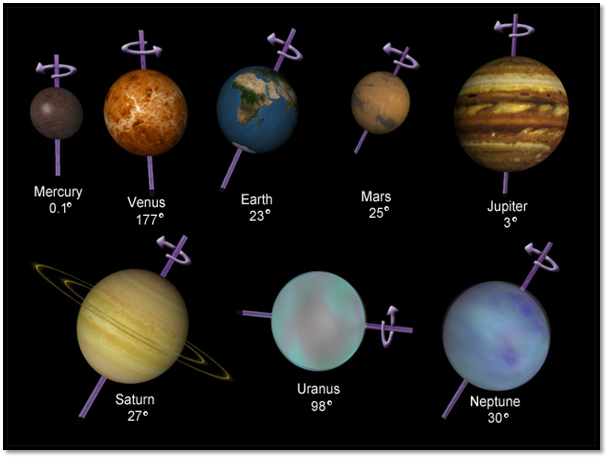
The explanation which suggests itself is as follows: Our sun, Jupiter, and Mercury, with their axes roughly perpendicular to the plane of the system, form one part of the ancient system; Uranus and Venus are odd cases with their own separate explanations; Neptune, Saturn, Mars, and Earth, with their spin axes roughly 26° to the plane of the system, comprise what once was a separate system, which must have been captured by our present sun as a group.
The normal reaction is to assume that this occurred hundreds of millions of years ago. Ancient literature says it occurred a few thousand years ago. Primitive people seeking to devise an astral religion today would end up worshiping the sun and moon, but the two chieftain gods of all antique religions were Jupiter and Saturn. Plato consistently refers to antediluvians as "Nurslings of Kronos(Saturn); the main religious festival in ancient Rome was "Saturnalia", our Sabbath is still called "Saturday". Hesiod and Ovid claim there was a golden age when Saturn/Kronos was "King of Heaven", followed by the great flood, then a brief "Silver Age" when Jupiter/Zeus was "King of Heaven", followed by the Trojan war and our present "Iron Age". In the same language, our sun is the "King of Heaven" now.
To make a long story exceedingly short, our solar system was originally in two parts: A bright part consisting of our sun, Mercury, Jupiter and its moons, and probably whatever the asteroid belt used to be; and a dark part consisting of Neptune, Saturn, Mars, and Earth. When the dark part finally flew into the Sun's orbital plane at a 26-degree angle from the South, the individual bodies peeled off and began to orbit the sun separately as they do now, but kept the ~26-d4egree angle. The How/Why of all that involves cosmic Birkeland currents and Herbig/Haro object strings.
A rocky planet (Mars, Earth) orbitting a brown dwarf star (Saturn) would do so inside the heliosphere/plasma sheath of the dark star. Life would be warm enough but the middle part of the light spectrum would be pretty much missing:
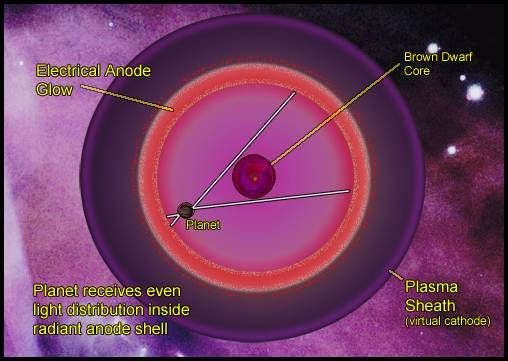
and you'd be living in a deep purple sort of a world:
http://saturndeathcult.com/the-sturn-death-cult-part-1/a-timeless-age-in-a-purple-haze/
Creatures of such a world (dinosaurs, hominids) would have huge eyes, hence the huge dinosaur and Neanderthal eye sockets:
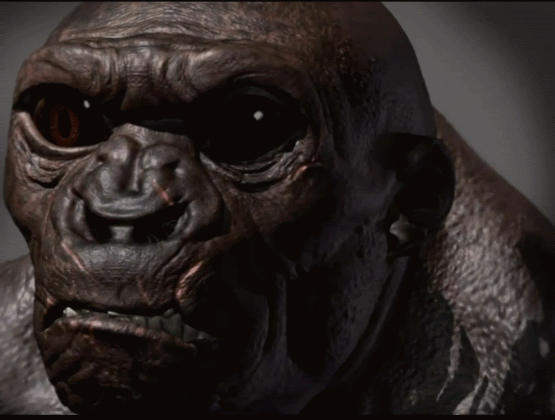
Image courtesy www.themandus.org
http://graphics8.nytimes.com/images...inosaurspan/19obdinosaurspan-articleLarge.jpg
http://www.nytimes.com/2011/04/19/science/19obdinosaurs.html?_r=0
Humans with the smallest relative eye size of higher animals could not plausibly come from such an environment. For the rest of the tale including the question of an original home for modern humans within our solar system:
http://www.cosmosincollision.com
Consider the axis tilts of planets in our system. If our system had formed from a swirling disk of solar material as textbooks claim, all axial tilts should be approximately the same, that is, all near zero with all axes of the planets roughly perpendicular to the plane of orbit. The sun, Jupiter, and mercury do in fact show that. Uranus and Venus are odd cases out with their own explanations, but Neptune, Saturn, Mars, and Earth all have axis tilts of 23.4 - 27 degrees.
The explanation which suggests itself is as follows: Our sun, Jupiter, and Mercury, with their axes roughly perpendicular to the plane of the system, form one part of the ancient system; Uranus and Venus are odd cases with their own separate explanations; Neptune, Saturn, Mars, and Earth, with their spin axes roughly 26° to the plane of the system, comprise what once was a separate system, which must have been captured by our present sun as a group.
The normal reaction is to assume that this occurred hundreds of millions of years ago. Ancient literature says it occurred a few thousand years ago. Primitive people seeking to devise an astral religion today would end up worshiping the sun and moon, but the two chieftain gods of all antique religions were Jupiter and Saturn. Plato consistently refers to antediluvians as "Nurslings of Kronos(Saturn); the main religious festival in ancient Rome was "Saturnalia", our Sabbath is still called "Saturday". Hesiod and Ovid claim there was a golden age when Saturn/Kronos was "King of Heaven", followed by the great flood, then a brief "Silver Age" when Jupiter/Zeus was "King of Heaven", followed by the Trojan war and our present "Iron Age". In the same language, our sun is the "King of Heaven" now.
To make a long story exceedingly short, our solar system was originally in two parts: A bright part consisting of our sun, Mercury, Jupiter and its moons, and probably whatever the asteroid belt used to be; and a dark part consisting of Neptune, Saturn, Mars, and Earth. When the dark part finally flew into the Sun's orbital plane at a 26-degree angle from the South, the individual bodies peeled off and began to orbit the sun separately as they do now, but kept the ~26-d4egree angle. The How/Why of all that involves cosmic Birkeland currents and Herbig/Haro object strings.
A rocky planet (Mars, Earth) orbitting a brown dwarf star (Saturn) would do so inside the heliosphere/plasma sheath of the dark star. Life would be warm enough but the middle part of the light spectrum would be pretty much missing:
and you'd be living in a deep purple sort of a world:
http://saturndeathcult.com/the-sturn-death-cult-part-1/a-timeless-age-in-a-purple-haze/
Creatures of such a world (dinosaurs, hominids) would have huge eyes, hence the huge dinosaur and Neanderthal eye sockets:
Image courtesy www.themandus.org
http://graphics8.nytimes.com/images...inosaurspan/19obdinosaurspan-articleLarge.jpg
Edited by LashL:
Changed hotlinked image to regular link. Please see Rule 5.
http://www.nytimes.com/2011/04/19/science/19obdinosaurs.html?_r=0
Humans with the smallest relative eye size of higher animals could not plausibly come from such an environment. For the rest of the tale including the question of an original home for modern humans within our solar system:
http://www.cosmosincollision.com
Last edited by a moderator:


