Curiosity: Mars Science Lab Landing and Surface Operations

So the talk was fun, nothing too much in the 'I've not yet heard that' department except for one thing, while the surface of Mars is covered with oxidized iron, the drilled rock was grey inside, thus formed under different conditions. That would be a different atmosphere if I'm not mistaking.

Since the variation in atmosphere on Earth had a lot to do with microorganisms, I'm going to have to research this more.

In the, 'no evidence of life' category, Curiosity has found no evidence of methane in the atmosphere. Lot's of evidence of past liquid water though.

Overall, I thought the mission was going tediously slow if this is all they've found in a whole year.
 
Last edited:
SAM finds abundant water is Martian soil

Future Mars explorers may be able to get all the water they need out of the red dirt beneath their boots, a new study suggests.

NASA's Mars rover Curiosity has found that surface soil on the Red Planet contains about 2 percent water by weight. That means astronaut pioneers could extract roughly 2 pints (1 liter) of water out of every cubic foot (0.03 cubic meters) of Martian dirt they dig up, said study lead author Laurie Leshin, of Rensselaer Polytechnic Institute in Troy, N.Y.

"For me, that was a big 'wow' moment," Leshin told SPACE.com. "I was really happy when we saw that there's easily accessible water here in the dirt beneath your feet. And it's probably true anywhere you go on Mars."
 
Are we talking liquid water, or ice? And how accessible is this water? Intergranular water can be tricky to extract in some cases.
 
Are we talking liquid water, or ice? And how accessible is this water? Intergranular water can be tricky to extract in some cases.

I haven't seen the paper so the finding is somewhat filtered through the reportage. When the PI says heating to " a couple hundred degrees" to release the water, that sounds closer to mineral bound than simple distillation to me at least.

ETA: I guess extrapolating a planet-wide distribution fits better with mineral-bound water, since a simple mixing of ice and water could easily be a local phenomenon. I'll have to see if the press conference has been uploaded yet.
 
Last edited:
Cylinder said:
I haven't seen the paper so the finding is somewhat filtered through the reportage. When the PI says heating to " a couple hundred degrees" to release the water, that sounds closer to mineral bound than simple distillation to me at least.
Definitely a reasonable reading of the available data.

That suggests two posibilites to my non-minerologist mind:

1) There are a higher percentage of hydrate minerals (gypsum and the like) than were previously anticipated, or
2) There is more water locked into the surface of the minerals in the form of fluid inclusions than we would expect given Earth rocks (it'd have to be at the surface in order for the pressure to break the mineral open).

Of the two, the former seems far more likely. There are many types of hydrate minerals (hydrite minerals? I always get those suffixes confused), and they can form relatively easily (evaporation of sea water, for example). The issue there is distribution, though that may not be an issue--if Mars had an active water cycle in the past it would be sufficient to distribute the material around a surprising amount of the planet, even arid areas.
 
The issue there is distribution, though that may not be an issue--if Mars had an active water cycle in the past it would be sufficient to distribute the material around a surprising amount of the planet, even arid areas.

Since the water seems to be found in the top layer of regolith, they are speculating that it should have fairly uniform distribution due to the global dust storms.

The interesting part from the reporting is that the deuterium ratio of soil-bound water seems to be identical to that of the atmosphere which could be accounted for if the water currently cycles through that atmosphere and is re-absorbed by the regolith via the pattern of dust storms.
 
Yeah....The trick with extraterrestrial stratigraphy is to remember that you're not dealing with Earth. :D I forgot how bad those dust storms can be until I read your post. That'd explain how shallow it is and global distribution, sure.
I'm tempted to make a joke about sand worms and spice, but I think I should wait until I haven't completely botched depositional modes before I do that.
 
Thanks for keeping this thread updated, Cylinder! It's appreciated. :)
 
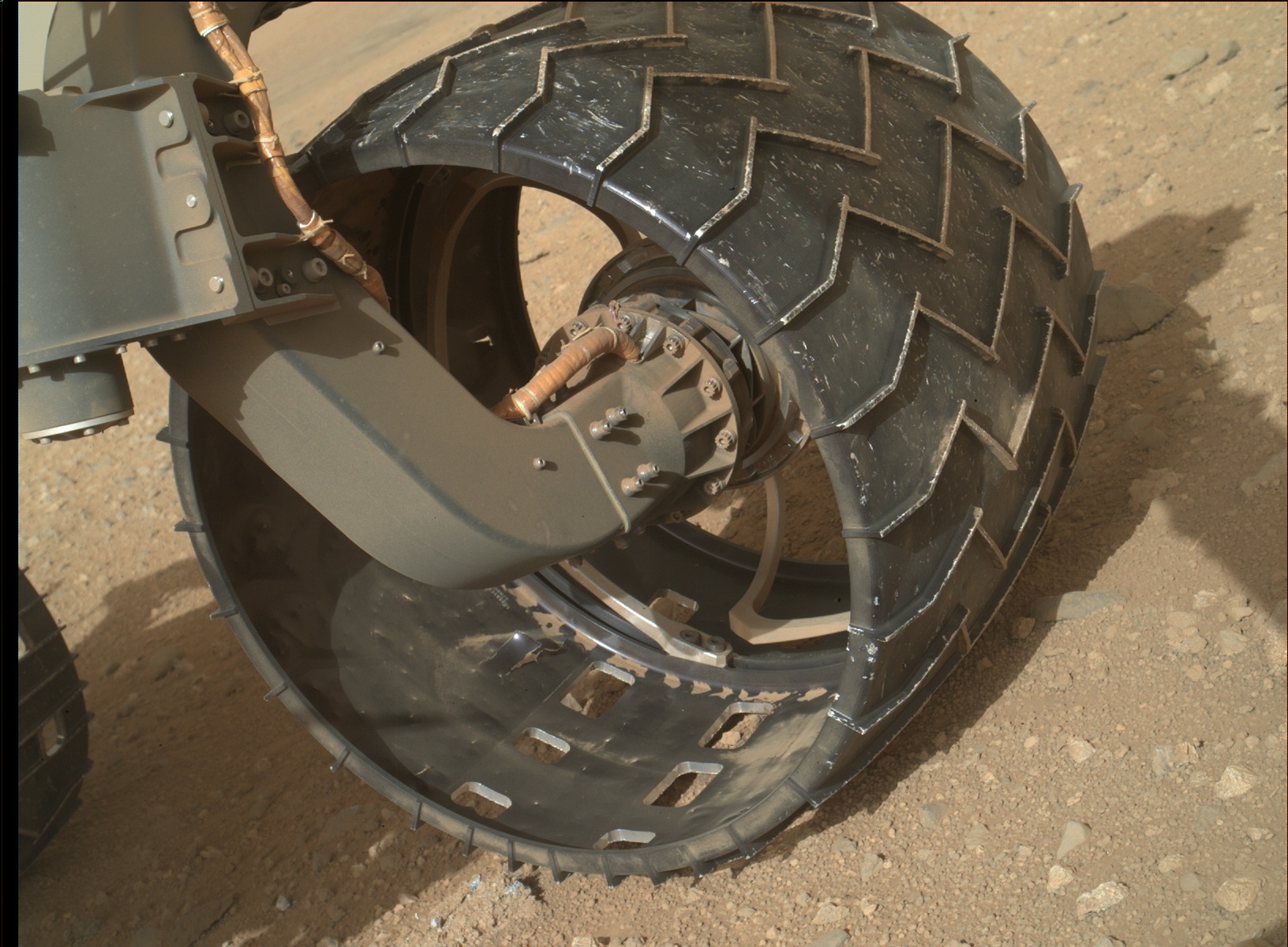
Defect imaged on Curiosity's left/front wheel


Image courtesy NASA/JPL-Caltech/MSSS

You can see the large gash just left (from the image perspective) of the dash in the Morse L. Click the image to see the larger, raw MAHLI image. This hole probably doesn't cause issues at this point.

ETA: It doesn't look like the current image set focused on the shiny metal bits on the surface just inboard of the same wheel. Interesting, though.
 
Last edited:

Back
Top Bottom
