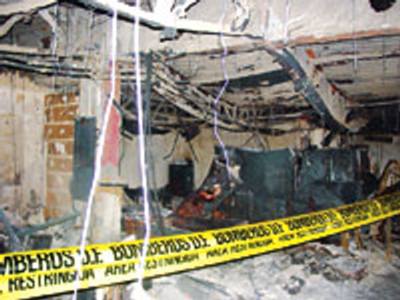
Challenge: Demonstrate Sagging floor Trusses Pulling in Perimeter Columns

It had a central core and perimeter construction. See https://failures.wikispaces.com/One+Meridian+Plaza,+Philadelphia,+PA

According to Beachnut's unfought fire theory it should have collapsed.
That statement is BS, you made it up. Meridian fire was fought, no aircraft impacts, single floor start, not multiple floors.
No, Meridian Plaza was fought. Big mistake Tony, the sprinklers put out the fire at the 30 floors.

They were pouring water on it from other buildings. Did the WTC have water on to it from other buildings? Like your fantasy of CD, you are no making up more junk.

Fire fighters were fighting the fire. You should study the report more.

The fire proofing was not dislodged, and the fires were fought. While the fire was on the 22, and 21 floors, they placed water from other buildings on to Meridian Plaza. Fires were fought.

Why is enik's model not realistic, like the photo of 3 feet of sagging floors due to ordinary office fires?

Wait, did multiple floors catch on fire at the exact same time with big holes feeding air to the fires; with KE impacts destroying the fireproofing? How is the Missing Jolt paper called Smoothness doing? Is that some new engineering term for Missing Jolt, Smoothness?>
 
Last edited:
I would love to see a video of truthers trying to assemble Ikea furniture.

clap.gif
clap.gif

It would start out as a table...one question and it then heads to being a bed...another question and is kitchen cabinets...then......


....finally a soft toy
scratch.gif
 
Enik's model doesn't say the floors can't sag.
You didn't run far Tony. BUT you got that bit right.
It says that sagging floor beams or trusses cannot generate the lateral load required to pull the perimeter columns inward.
His finding is disputed on JREF, not discussed on 911Forum and the situation unresolved on either AFAICS but it was WTC specific. Stop playing "mix-and-match" Tony.
The Meridian Plaza building fire results proves him right.
Stop laying "mix-and-match" IF he was right for WTC - which is not proven - it has no relevance to Meridian.
I have provided an explanation of why beams and trusses would not apply a truly catenary lateral tensile load. It is because they still have vertical stiffness and are still supported vertically much more than horizontally like a cable in tension.
You have made an unquantified claim which was irrelevant to the discussion where you posted it and where I made a simple statement of technical fact. MY point of fact was generic and is generically true. Your claim has not even been addressed in its original context of WTC where I could easily show the error of your claim. I simply decline to follow your derails even when the untruthfulness of your claim is a tempting target.
The WTC perimeter columns were pulled inward by removed core columns....
Prove it. IN THE PROPER THREAD.
That is the only explanation that works.
Two lies. It doesn't work and there are others. Many others.
 
Oh, so now we are on to the knocked off fireproofing all the way on the other side of the building and up a few stories from the aircraft impact for the North Tower.

What happened to the unfought fire theory?

Enik's model doesn't say the floors can't sag. It says that sagging floor beams or trusses cannot generate the lateral load required to pull the perimeter columns inward. The Meridian Plaza building fire results proves him right. I have provided an explanation of why beams and trusses would not apply a truly catenary lateral tensile load. It is because they still have vertical stiffness and are still supported vertically much more than horizontally like a cable in tension.

The inward bowing and failure of the WTC perimeter columns was due to their being pulled inward by removed core columns. That is the only explanation that works.

Meridian Plaza fires were fought, and put out by sprinklers on the 30th floor.

http://my.firefighternation.com/profiles/blogs/meridian-plaza-fire-would-your

All interior firefighting efforts were halted after almost 11 hours of uninterrupted fire in the building. Consultation with a structural engineer and structural damage observed by units operating in the building led to the belief that there was a possibility of a pancake structural collapse of the fire damaged floors.
Means exterior fire fighting was still working. See photos in article... water... Note no damage to the building from an aircraft, means no big source of air, why the fire spread so slowly for 12 plus hours.... and

Why does enik's model not sag as much as real floors? You are off on some failed analogy CD effort, must be related to your CD fantasy.
 
Right after it was struck by a fully laden jet airliner...
Watch it, 66,000 pounds of jet fuel is almost empty for 911 truth believers.

I was wanting to know why enik's model does not look like it included what steel does in fire. I don't think enik understands his model comes up short. They seem to like it at Loose Change, but they like fantasy, lies, and fiction.
 
The Meridian Plaza building burned out of control from the 22nd to the 30th floor for much of that 19 hours and there was certainly no water applied for the first couple of hours. According to your WTC logic the building should have collapsed, but it didn't, and its shell stood in downtown Philadelphia for eight years. Why didn't it collapse according to your unfought fire theory? Why weren't the perimeter columns bowed inward?


That One Meridean didn't collapse whilst the WTC on it's own isn't a grand mystery... You can argue a few similarities in circumstance with the lack of ability to fight the fires and that it had a core design but that's about where the similarities stop...

A few of the considerations that run across my mind immediately are:

- One Meridian Plaza was 38 stories... The size of the section of WTC 2 above it's impact point was about 30 stories. It was 15 stories for WTC 1. One Meridian Plaza suffered no impact damage... while the WTC had support something roughly around the equivalent size of the meridian if not not larger while seriously crippled.

- It was a much smaller building than the WTC in general both in height and floor area...

In a nutshell if you did the proper study on it, you could draw some comparisons but important differences between the cases exist that would reasonably explain the different results. You'd have to get pretty detailed if you want to use it as a model on why the WTC shouldn't have collapsed either, because the fact that it didn't collapse on it's own isn't enough, you have to know what factors made it less vulnerable, and how many of those similarities existed for the other case.

But all this is a another thread entirely... I believe enik's idea is that the perimeter trusses couldn't have been pulled in by sagging trusses... I believe he's wrong... but mostly because it sounds like he's dealing with a collapse theory that ultimately wasn't determined as the main collapse mechanism in the end. Certain aspects of the truss sagging can be drawn from One meridian as Beachnut did, but those similarities should always be taken with care that any crucial differences are kept in mind so that the similarities are discussed in proper scope. Enik can clarify if he thinks I'm misunderstanding, but it sounds to me like the "pancake collapse" initiation mechanism is where his OP arises from...
 
Last edited:
...Why does enik's model not sag as much as real floors?

...I don't think enik understands his model comes up short...
Both enik and Tony tend to lose contact with the context of whatever technical claim they are making - Tony always and enik often AFAICS.

The "Girder Walkoff" thread was a classic example for both of them. Tony made false assumptions, I called him on the false assumptions enik tried to help Tony and got the assumptions a fair bit broader but would not confirm how far he went. IIRC both of them then resorted to insulting me at that stage - which is the infallible indicator that I was right. ;)

The related problem is that they both have massive faith in calculations - enik specifically FEA. Neither of them seen to comprehend reasoning - they never post reasoned arguments of more than about one step of logic. And that step usually wrong. And they never respond to reasoned argument. It looks like a shared "blind spot" - and when they try to help each other the "blind leading blind" aspect is transparently obvious - to us but not them. :rolleyes:
 
... I believe enik's idea is that the perimeter trusses couldn't have been pulled in by sagging trusses... I believe he's wrong...
I've been researching this topic and enik's involvement. In this thread and across to some comments on 911Forum. It is hard to sort out the confused presentations which could be, almost certainly are, hiding confused thinking.

For what I can see the status is that enik has made that claim, it has been contested and the question is unresolved. It is certainly not "proven" as Tony persists in misrepresenting it - and for my purposes in recent discussions "not proven" is all I need. Sadly "not proven" does not count for many of our posting members - either side. The general preference is for "yes or no", "proven or disproved" rather than "proven or not proven". I'm far more rigorous (Pedantic?? :o).

I cannot determine either way with absolute assurance. The main contender with enik was Newtons Bit. Both of them readily accepted a far simpler scope and seemed to be totally unaware that the simplified scope was not realistic WTC 9/11. The fact that they were blithely ignoring the context shift simplification was enough to cause me reservations in trusting either of there findings.
 
I've been researching this topic and enik's involvement. In this thread and across to some comments on 911Forum. It is hard to sort out the confused presentations which could be, almost certainly are, hiding confused thinking.

For what I can see the status is that enik has made that claim, it has been contested and the question is unresolved.

Yeah... he and a couple other posters are among the people that I can't put my finger on... I guessed on the OP's premise based on previous topics where I've seen stuff like this pop up, but the responses I've seen him make seem to indicate otherwise... not outright discounting my guess but implying something else so unresolved might be appropriate for now... If my guess is on target the opinion stands, but I'm open to clarification if he offers.
 
Yeah... I guessed on the OP's premise based on previous topics where I've seen stuff like this pop up,...
enik has a strong commitment to FEA as the only solution and the complete answer to all engineering forensic issues. He has done a lot of impressive work - much of it posted on 911Forum.

BUT both he and Tony are blank in the domain of reasoned argument so they tend to try to substitute "calculations". And FEA is no more that a complicated and sophisticated calculator. It will merrily and inexorably take in wrong starting points and output wrong answers. OR worse - give near enough right answers for the wrong reasons - which can be very hard to spot.

I have responded to the fault or parodied it on multiple occasions.

e.g. If a timber frame is held together by nails the questions about nails are:
Are they sufficient?
Properly inserted?
In the right locations?
etc

In his interactions with me enik has in effect said "You cannot use a hammer so you cannot answer those questions?" So a structural engineer who cannot weld cannot specify welds or detect poor welding???? It is easy to ridicule the stupidity.

Sadly that is the sort of "thinking" we see too often...:boggled:

....but I'm open to clarification if he offers.
Watch out for goalpost shifts or loss of focus. ;)
 
Last edited:
...For what I can see the status is that enik has made that claim, it has been contested and the question is unresolved. It is certainly not "proven" as Tony persists in misrepresenting it - and for my purposes in recent discussions "not proven" is all I need. Sadly "not proven" does not count for many of our posting members - either side. The general preference is for "yes or no", "proven or disproved" rather than "proven or not proven". I'm far more rigorous (Pedantic?? :o).

But it has been proven, but not in the way you are used to. It would be best if you look through NIST NCSTAR 1-6B. It has to do with Fire Resistance Tests of Floor Truss Systems. It is a step by step procedure of how the NIST tested a 35 foot floor truss under extreme heat loads. They provide detail of every component, every dimension, material properties so that it can be easily modeled. But most important, they give their results which can be used to verify the FEA model. And to top it off, they created two additional 17 foot trusses and tested them as well. So not only can one verify the results of the 35 foot truss, but the model can be used to verify both 17 foot trusses as well.

Here is a second point to consider. The NIST performed their tests at the rated load of 100 psf. Why would you think they would do this? In engineering, it is best to overdesign a component/system rather than simply design it to a FOS of 1.0. So the NIST took the worst case scenario, or the conservative approach.

Now, this is where you (and others) do not understand the significance of FEA. Once the results are verified, the model can be used to check for scenarios that cannot be realistically tested, i.e. a 60 foot truss since the chamber they used was not big enough to contain one. Or attaching the 60 foot floor truss to a perimeter wall to see what would happen.

Some time ago,
I presented a very simple beam analysis to TFK.
How would you go about proving or disproving this simple analysis? Could you? Is there a right answer?
 
But it has been proven, but not in the way you are used to. It would be best if you look through NIST NCSTAR 1-6B. It has to do with Fire Resistance Tests of Floor Truss Systems. It is a step by step procedure of how the NIST tested a 35 foot floor truss under extreme heat loads. They provide detail of every component, every dimension, material properties so that it can be easily modeled. But most important, they give their results which can be used to verify the FEA model. And to top it off, they created two additional 17 foot trusses and tested them as well. So not only can one verify the results of the 35 foot truss, but the model can be used to verify both 17 foot trusses as well.

Here is a second point to consider. The NIST performed their tests at the rated load of 100 psf. Why would you think they would do this? In engineering, it is best to overdesign a component/system rather than simply design it to a FOS of 1.0. So the NIST took the worst case scenario, or the conservative approach.
Now, this is where you (and others) do not understand the significance of FEA. Once the results are verified, the model can be used to check for scenarios that cannot be realistically tested, i.e. a 60 foot truss since the chamber they used was not big enough to contain one. Or attaching the 60 foot floor truss to a perimeter wall to see what would happen.

Some time ago,
I presented a very simple beam analysis to TFK.
How would you go about proving or disproving this simple analysis? Could you? Is there a right answer?

NIST was trying to see how the building could collapse, not how it could not collapse.
 
I believe the photo you showed of the sagged floor beams was from the 19 hour long Meridian Bank building fire in downtown Philadelphia in 1991. There was no collapse although the building was considered unusable afterward.
Some buildings do, some don't. It depends on their structure and on the fires themselves. This pic is from Venezuela's East tower in Parque Central:

pgimeno-vigas-venezuela.jpg


And that building did suffer partial collapses. The structure was mixed, by the way: steel and concrete (and I don't mean steel-reinforced concrete, as I count that as concrete; I mean some structural elements were pure steel and some were concrete). Thus not comparable either, but an example of how some buildings *can* suffer collapses, even if partial. WTC5 is another example.


The Meridian Plaza building burned out of control from the 22nd to the 30th floor for much of that 19 hours and there was certainly no water applied for the first couple of hours. According to your WTC logic the building should have collapsed, but it didn't,
Really? What removed the Meridian Plaza's fireproofing?

It's as if you're implying that WTC7 should have collapsed within an hour if the official narrative is true.

But what you're really saying is that what happened e.g. in WTC5 and Parque Central (and in so many buildings that have collapsed) can not happen.
 
But it has been proven, but not in the way you are used to. It would be best if you look through NIST NCSTAR 1-6B. It has to do with Fire Resistance Tests of Floor Truss Systems. It is a step by step procedure of how the NIST tested a 35 foot floor truss under extreme heat loads. They provide detail of every component, every dimension, material properties so that it can be easily modeled. But most important, they give their results which can be used to verify the FEA model. And to top it off, they created two additional 17 foot trusses and tested them as well. So not only can one verify the results of the 35 foot truss, but the model can be used to verify both 17 foot trusses as well.

Here is a second point to consider. The NIST performed their tests at the rated load of 100 psf. Why would you think they would do this? In engineering, it is best to overdesign a component/system rather than simply design it to a FOS of 1.0. So the NIST took the worst case scenario, or the conservative approach.

Now, this is where you (and others) do not understand the significance of FEA. Once the results are verified, the model can be used to check for scenarios that cannot be realistically tested, i.e. a 60 foot truss since the chamber they used was not big enough to contain one. Or attaching the 60 foot floor truss to a perimeter wall to see what would happen.

Some time ago,
I presented a very simple beam analysis to TFK.
How would you go about proving or disproving this simple analysis? Could you? Is there a right answer?
NIST was trying to see if the building met code. This was not some test to see if the WTC could collapse, it was checking to see if the building was built right, a goal of NIST, unlike your silly game, goal free nonsense so you can back in CD, and the "inside job" using physics... What is your secret goal?

Are you trying to use your low fidelity FEA to prove your inside job fantasy of CD? enik?
enik - Inside Job Evidence is in the Physics of WTC #1.
What did Physics say?

1-6B is a test to see if the WTC floor assemblies could stand up to fire code. They tested asseblies with loads and full up insulation as designed, and as built. Observations...

1-6B -
The test assemblies were able to withstand stardard fire conditions for between 3/4 h and 2 h without exceeding the limits prescribed by ASTM E 119.

The purpose of 1-6B, did WTC meet specs; it did. Not some test of what happened on 911, not a test of no insulation floors, a test of insulated floors.

1-6B results are not applicable for your fantasy FEA junk. Your model is missing some physics. And thus, I doubt the physics you are using will enable you to prove your inside job, or join reality expeditiously.

Do 911 truth fantasy inside job pushers and followers read NIST for comprehension? No

NIST test does not verify an insulation compromised assembly. Why bring up NIST? Why does your inside job fantasy require NIST?
 
Last edited:
Do you understand FEA?

Yes, your FEA is not very good.

Do you understand NIST was checking to see if the WTC was built right? 1-6B
What is the problem with floor loading? What does that have to do with your inside job stuff?

Do you understand you have a fantasy?
enik - Inside Job Evidence is in the Physics of WTC #1.

Why bring up 1-6B, when it is a test of insulated floors. The floors on 911 had the insulation knocked off by KE impact of aircraft. Where did you get your model for the steel? Is it insulated, or not?

The Loose Change forum is a great place for your fantasy of an inside job. Loose Change was fiction, the inside job is fiction. Your FEA looks like it fits.
 
Last edited:
You apparently do not have a clue what FEA is or how it was used in the NIST report.
 
You apparently do not have a clue what FEA is or how it was used in the NIST report.

No wonder your FEA failed to match what is real. You waste time failing at reading minds. How many engineers in your graduating class support your inside job fantasy? Not a single engineer in my class, or in my masters class support the failed 911 truth inside job stuff.

When will you prove your inside job with physics? Your FEA failed. Guess your model doesn't work.

Time to play the "you don't have a clue what FEA is" card again; you can't prove your inside job. Reading minds has failed.

Your model failed to model material properties, you have incorrect results. You don't have clue what the limitations of FEA are, and proof is your inside job fantasy. The old FEA trap, you think you got a model of reality, and fail to understand why you failed; because you think you are right. An illusion of some sort.
 
Last edited:

Back
Top Bottom