• Quick note - the problem with Youtube videos not embedding on the forum appears to have been fixed, thanks to ZiprHead. If you do still see problems let me know.

The sad case of Niels Harrit

...
Oystein: Where did you find info that sample holder of MEK chip was made of aluminium? ...

Nowhere. I am guessing. Or more to the point: I am "predicting".

(It's possible that I read it somewhere in the past and a faint memory lingers that made me think the sample holder is Al; however, I suspect I may be mixing this up with the DSC crucible.

And now I am going to look up the word "crucible", which I never heard or used before I read the term in one these debates. ETA: Oh! I used it incorrectly in my previous post :blush:)


ETA2: Caption to Figure 2: "... The red/gray chips are mounted on an aluminum pedestal, using a carbon conductive tab, for viewing in the scanning electron microscope (SEM). ..."
 
Last edited:
Nowhere. I am guessing. Or more to the point: I am "predicting".

(It's possible that I read it somewhere in the past and a faint memory lingers that made me think the sample holder is Al; however, I suspect I may be mixing this up with the DSC crucible.

And now I am going to look up the word "crucible", which I never heard or used before I read the term in one these debates. ETA: Oh! I used it incorrectly in my previous post :blush:)

Curiouser and curiouser?

MM
 
... Oxygen ... acts far more as a measure of the flatness of your sample than as a compositional indicator. Aluminum is a bit better, but not much, since it's energy is about 1.49 keV.

... X-rays that have to travel back through the material, like those on a lower edge of the sample, will likely be absorbed. ...
...
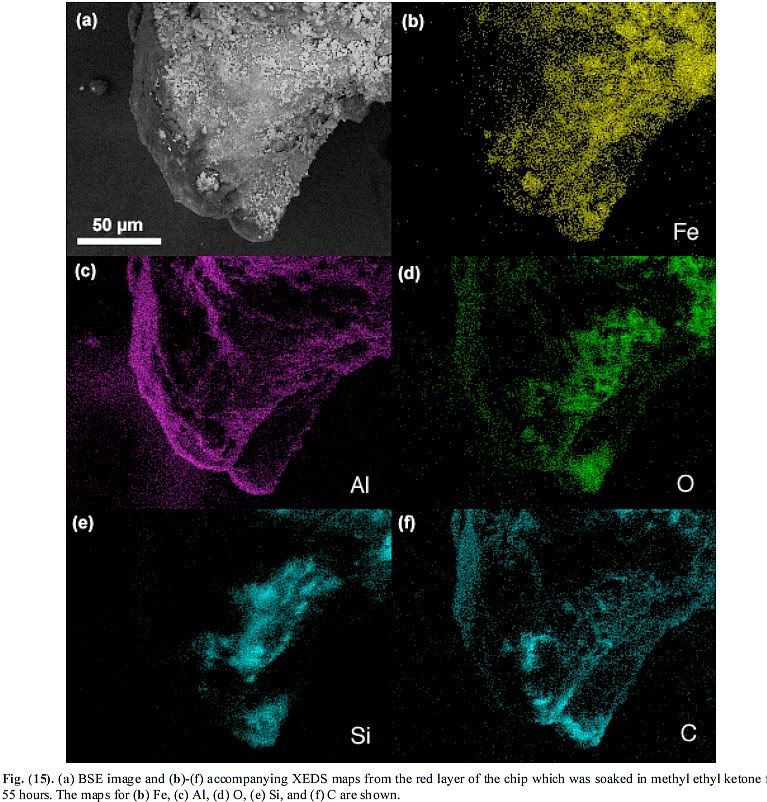
Btw, looking again at Fig. 15, I would say that areas with strong Al signals somehow coincide with several/most of places which are not perfectly perpendicular with the bombarding electron beam (we see slopes and hills, simply detailed profile, in Fig. 15a). They are basically stronger on several/many "hills" and "slopes" and so on. But they are still the strongest on the left edge, where you just noticed some Al signals even outside of chip itself...
Notably, "carbon map" seems to be somehow similar to "aluminium map": it has similarly stronger signals on some slopes, hills, etc... Perhaps the explanation is quite trivial, but I do not know it:confused:
ETA2: Caption to Figure 2: "... The red/gray chips are mounted on an aluminum pedestal, using a carbon conductive tab, for viewing in the scanning electron microscope (SEM). ..."

So we have a the strongest Al-signal on the low, steep, far-from-perpendicular-to-electron/x-ray-beam bottom left edge of the specimen, where we'd expect it to be rather attenuated due to the topography, and it coincides with C on those same steel slopes; a behaviour that is less pronounced for O and Si, and doesn't appear at all for the heavy Fe which should be least affected by topography. Hmmm.

My confidence is growing that much of the Al- and C-signals near the periphery of the chip is from the sample holder, which is an "aluminum pedestal, using a carbon conductive tab".

Figure 15 again

ActiveThermiticMaterial_Fig15.jpg
 
Bloody hell Oystein your observations and deductions are something extra-ordinary considering such a specialised field. I have a typical material engineer's experience of SEM, it's a tool, we use it, but I've never ever considered incidence (angle) in this way because it hasn't ever effected the sample. We tend to prepare them for best results where possible.

I'm damn impressed.

I was looking to reply (knowing that The Almond would anyway) and I had to think hard about this and go and dig up some notes! Thank you for getting me to consider the fundamentals that I've taken for granted.

Incidentally the aluminium "stubs" (which your specimen is placed on or attached to) that fit into the sample holder for a SEM look like this:

http://www.canemco.com/catalog/sem/Pin-type-Mounts.htm#SEM_Pin-Type_Specimen_Mounts

There are loads of different ones (as shown below) but the one above is used most of the time.

http://www.emsdiasum.com/microscopy/products/sem/holder.aspx
 
As so often, it was Ivan who spotted the interesting observation, and I who only elaborated on it ;)

Plus, I have no idea if my speculation that the stub could be picked up and show at the edges of the specimen like this. Need input on that.
 
...I'm damn impressed...
I find it a bit scary. Being a structures and hydraulics engineer it is way off my knowledge base. So I stay away most of the time.

However developing new understanding of these things is half pre-existing knowledge and half reasoning capability.

Reading your posts, Sunstealer, gives me accurate pre-digested info on metallurgical matters. Just as beachnut's material does for matters aeronautical. And several others in their fields.

But Oysteins open reporting of his personal exploring of new territory is nothing less than inspiring. Kudos to Oystein.

And the asinine comments of the "you know who's" merely reveals their lack of depth of both intellect and integrity.
 
We have several threads on red-gray chips to choose from for what I am going to post now. I chose this, because it's where Sunstealer first published his finding that the MEK-soaked chip is probably Tnemec (post 536).


On my blog, Ivan Kminek reported an observation about the data on that MEK-soaked chip that I find interesting and worthwhile pursuing:

http://oystein-debate.blogspot.de/2...howComment=1337005281901#c1942663736651428010


The problem he's discussing is the apparent observation that some unspecified region of that chip, after soaking, contains mostly Al, and too little O to have all the Al oxidized:

[qimg]http://i1088.photobucket.com/albums/i328/MikeAlfaromeo/ActiveThermiticMaterial/ActiveThermiticMaterial_Fig17.jpg[/qimg]

This finding has always had me wondering, and I admit I didn't have an explanation, and considered that measurement to be somehow erroneous, perhaps even faked. But having any fake data in the paper was not an option I could have been happy with at all.

Now Ivan asks a good question: Could it be a question of probe geometry that made the Al-count so much greater than the O-count in that XEDS measurement?

I can't give a direct, or experimental, answer to this, but there is a good indication that something of that sort is at play here, namely the distribution of oxygen as per the XEDS map, Figure 15:

[qimg]http://i1088.photobucket.com/albums/i328/MikeAlfaromeo/ActiveThermiticMaterial/ActiveThermiticMaterial_Fig15.jpg[/qimg]

You will notice that the heavy iron appears pretty ubiquitiously, but C and O do not. O supposedly is associated with Fe as iron oxide, and it is the most common element in that chip as per Fig.14, so it is a bit curious that it would not show more and more ubiquitiously. It seems like for some reason, the K-alpha level of O gets attenuated somehow in that experiment.

Another observation: While there are some scattered dots for all 5 elements outside of the confines of the chip itself, the signal for Al outside of the chips looks pretty significant. Could this come from the crucible of the XEDS device? And the concentrated Al signal on the "southwestern" edge of the chip a reflection from the Al-crucible?

I find it quite conceivabe that the geometry edges of the chip, which are far from being perpendicular to the "line of sight", precludes much of a signal from the probe to reach the detector, and that the strong Al-signal comes not from the probe, but from the crucible!


Any comments from those who know SEM equipment?

I think that you and Almond are pointing out the pitfalls of straying outside of one's field of expertise into very specialized fields of science and technology, without even advice from an appropriate specialist.

Especially when one has an axe to grind, as Harrit, Jones, & Co. do.
 
Thanks. But what's scaring you?
I lack the confidence I previously have enjoyed to explore areas of science which are strange to me. It is probably lack of motivation but I take the lazy way out and blame it on age and lack of current practice. Whatever the reason you have not seen me researching any topic which is not in my core areas of expertise to the level that you do it.

Then it may simply be laziness and boredom with 9/11 trivialsied debate >>>> leading to no motivation to expend the effort. :rolleyes: ;)

Certainly I don't lack any confidence in taking on the engineering and pseudo engineering stuff we see. I don't engage the trolls with the low level rubbish they post. Part of my preference to not feed trolls.

However there are occasions when some engineer comes along spouting false engineering and nobody other than me seems to want to take said person on. For example my recent challenge to Tony Sz where I identified his main error at one level of logic up from where he wanted to keep the discussion trivialised. In that few posts I left the detail stuff to tfk and a couple of others. Took on the first level of "bigger picture" and foreshadowed challenging Tony on at least two higher levels of logic system AND was disappointed when he ran for cover only half way through level one.
 
Thank you, Almond, for your explanation how the geometry/profile of the sample influences XEDS signals/maps. And thanks, Oystein, for your further analysis. (For those who may be interested and may wonder why MEK chip as a paint chip is not flat: one of the reasons is the fact that this chip was swollen in MEK solvent, therefore its surface is naturally more“ warped“ than before swelling).

Aside from the possibility that Al (or some other) signals can come even from the sample holder, I would say now that XEDS maps on Fig. 15 (Bentham paper) do not reflect distribution of any element (except heavier iron) in realistic way. They are more „a kind of unintentional art“, showing mostly the surface profile of the chip in „reverse shades“ created by XEDS signals from „slopes“ and „hills“, than real element maps. I think.

For now, I must correct one of my claims. I have repeated several times here that in swollen paint (or nanothermite) chip, distribution of pigment particles is different than before swelling. This is basically right.
But looking again at the Fig. 15, the depicted area is quite large (ca 200 microns). Provided that tiny pigments particles were distributed evenly in the chip before swelling (which is a very natural assumption for both paint and nanothermite), there is no reason why some pigments should be significantly concentrated in some areas by mere swelling. This seems to be valid e.g. for all inorganics containing silicon in MEK chip, therefore I don’t think that silicon map on Fig.15e shows really high concentration of silicon compounds in the blue-shining areas. I can be wrong in this respect (if, e.g., some silicon-containing pigments easily migrate in swollen polymer matrix and easily aggregate). But it seems to me that elemental maps in Fig. 15 have basically no real meaning, as for distribution of elements except iron. The less they can serve as a proof of elemental aluminium anywhere:cool:

Btw (frankly) I don’t really understand what I see in Appendix G in Jim Millette’s preliminary report (Statistical Phase X-ray Mapping). What is a “phase” here? Almond? Sunstealer? Oystein?
 
Last edited:
Guys from the Niels Harrit's "fan page" on Facebook linked this new interview with Niels Harrit. Frankly, I am lazy to listen to it. Any volunteer?

2 hours?!?! Yeegads!! Way to hide information! Why can't these people write down stuff? Harrit must be keenly aware of all the problems that have been raised with his crap paper. Why can't he address them? Why waste time on interviews of zero value?
 
2 hours?!?! Yeegads!! Way to hide information! Why can't these people write down stuff? Harrit must be keenly aware of all the problems that have been raised with his crap paper. Why can't he address them? Why waste time on interviews of zero value?
Exactly.

No one will listen and they will claim it's been refuted. Posting a link and claiming it's evidence takes no time.

I bet you can guess the logical fallacy. ;)
 
Yawn...


Harrit talks at length about his epiphany, in 2006, when he "discovered" the "free fall" of WTC7. Then he talks at great length about Galileo and how he experimented with gravity.
14.5 minutes totally wasted so far.
 
"Harrit talks at length about his epiphany, in 2006, when he "discovered" the "free fall" of WTC7.

Then he talks about Galileo and how he experimented with gravity.

14.5 minutes totally wasted so far.
"

WTC7 should be a textbook case for any structural engineering program.

If not for WTC7 there would not be such continuing interest in the truth about 9/11.

Even if you accept total internal failure with minimal perimeter wall damage, in order to have the observed 'balanced' freefall drop without major toppling in the direction of the weakest columns, all 44 perimeter columns had to be removed in-sync, for 8 floors.

The 2009 Bentham paper published research that helps explain what occurred at the WTC on 9/11.

Unfortunately, the 2012 unpublished work by Dr. Millette represents a nominal investigation into the 9/11 WTC dust substance reported by the 2009 Bentham paper.

Dr. Millette attempts a dismissal of the findings of the 2009 Bentham paper solely by claiming his 9/11 WTC chip selects match theirs and that his chips are not thermitic.

He ignored the chief findings of the 2009 Bentham paper and refused to use his own heat test in a separate test to observe possible ignition and residue results.

The results would either provide Dr. Millette with additional confirmation about his chip matching, or, results that disputed his claim that his chip selections matched those used in the 2009 Bentham paper.

Even after fully analyzing all the data from his chip selections heated to 400 C, when he could have possibly validated this data by re-heating those 'no longer needed chips' just another 30 C, Dr. Millette stops.

He read the published paper.

He knows his selected chips were only +30 C from behaving like those in the 2009 Bentham paper --- or not.

Why not toss those finished samples into the oven and see what happens at 430 C?

Because benign ash results mean his chips were not a match for those used in the 2009 Bentham paper.

And iron-rich micro-spheroids would represent an unprofitable controversy.

MM
 
WTC7 should be a textbook case for any structural engineering program.

Strangely enough it is. :rolleyes:

If not for WTC7 there would not be such continuing interest in the truth about 9/11.

MM

If only "truthers" actually took the engineering courses, then they would understand the truth. Instead of having to rely on people with an obvious agenda to tell them what to think.

:)
 
Guys from the Niels Harrit's "fan page" on Facebook linked this new interview with Niels Harrit. Frankly, I am lazy to listen to it. Any volunteer?

Ivan posted this in the Dr. Millette Dust Study thread, but the interview is not about Millette (so far at least - haven't listened to all of it yet), and not only about WTC dust, so I am taking discussion of the interview to a Harrit-thread.


Starting after 20:00, he gives a timeline of how he got into Twoofing:

  • Late 2006: He watches an SE Jones video presentation on the internet in which he "discovers" WTC7. That is his epiphany.
  • Early 2007, he writes an essay on WTC7 which gets published in a Danish newspaper - but generated no reaction at all, to his great surprise.
  • He started giving lectures in fall 2007
  • He was "independent, anonymous" "peer-reviewer" for a paper on WTC dust (sth. to do with 1,3-Diphenolpropane)which Kevin Ryan had submitted to a "scientific journal", The Environmentalist, and that's how he first got in contact with Ryan. Harrit admits he short-cut the review process by contacting Ryan directly (not through journal editors)
  • After 32:40, Harrit explains how he became refereee for that paper: 1. His Dannish newspaper essay had been translated to English by an Australian Dane 2. This came to the attention of Alan Miller, who at the time was running "Patriots for 9/11 Truth" (which Harrit thinks was a very good website) 3. Miller put Harrit on the Patriots website. That's how Harrit first became known in the TM outside of Denmark. 4. ??? (no explanation why he was then picked by The Environmentalist)
  • Harrit says that SE Jones had begun to look into WTC dust independently from Ryan. Jones started 2006 and supposely found evidence for temperatures of up to 3000 °C
  • In December 2007, Jones announced the finding of re-gray chips in The MacKinlay dust.
  • In early 2008, the Bentham team was assembled: Jones asked Harrit to join, and Harrit was honored, as he considered Jones "a great hero" and "a great man". Harrit felt he could contribute because he works somehow with nanotech at the University of Copenhagen.
  • Harrit became first author for several reasons. 1. Jones had a tense relationship with BYU 2. Four of five on the team could have served as first author, because "we have contributed equally to it" (yeah, right) 3. Jones send the paper draft for preview to his BYU faculty - and they said no one from BYU (Jones, Farrer, Farnsworth) can be first author, so that left only two or three of the rest (Harrit, Ryan and...?)

So this, in a nutshell, is Harrit's account of how he became the man whose name grace that study.
 
MM, remo (et al. ?), I and others would be happy to debate you on the fallacies of your WTC7 musings in the proper forum. Failure to carry the debate to an appropriate forum only gives the appearance that you are aware your pronouncements would not hold up, and so feel free to post them in an inappropriate arena where you are secure in the knowledge that they will be unchallenged and probably shuffled off to AAH.
 
Continuing to listen from 40:00 minutes onward, which starts with the host saying "Tell us about the [Bentham] paper" (my personal ad-hoc comments in gray):

  • "Some" red-gray chips are reactive (implying not all are), and they form elemental iron in the process "and that is the thermite reaction. That's it." (urrr no, other reactions can produce elemental iron, too - and the paper has no strict proof that any elemental iron is actually produced here)
  • Critics ignore this reactivity and focus on everything else (and Harrit focusses on nothing else)
  • Oh, and that's it.
  • The red-gray chips should be seen in the context with other observations that imply the application of thermite (abundance of iron-rich microspheres, ...)
  • Explains the thermite reaction and that it produces molten iron (but fails to mention it also produces even more, by volume, Al-oxide)
  • Old-fashioned thermite is not an explosive, it destroys things with heat only
  • Explosives produce force by creating gas that expands (he fails to mention shock waves).
  • Explains that addition of sulfur and barium nitrate can make thermate cut though steel like a hot knife through butter (and? Harrit et al found no barium, showed no nitrate, their chips a-d are free of sulfur, and they say in the paper that sulfur is only contamination on the MEK-chip. So who is he trying to confuse with this thermate talk, and why??)
  • Invokes the Barnett/Biederman/Sisson study on the "Swiss cheese" beams. Barnett found sulfur in that steel (but no barium). Harrit admits they didn't find sulfur in the chips.
  • Claims "Building 7 came down in freefall. Galileo and Newton say this was CD (haha. Harrit doesn't understand physics and the concept of closed and open systems).
  • (I am not paraphrasing more details on WTC7 - the usual crap)
  • His theory: Steel structure was weakend close to the brink of collapse, then explosives came in to knock of the rest within milliseconds.
  • Host interjects (50:00): "In a controlled demolition, do you know if thermate is usually used as well to weaken structure beforehand?". Harrit replies: "No. it's not". Then points out to the Chicago Skytowers destruction in the 30s, where one tower was demolished with "thermAte".
  • Speculates that the perps would throw in overcapacities to make sure the demolition succeeds
  • Turning to Twin Towers: Paraphrases one reporter at the scene who said the South Tower is "exploding" (yeah, sure looks like it is - but doesn't sound like it. Anyway, Explosives at CDs do NOT look like this).
  • Claims steel elements weighing several tuns were hurled up and out - by explosives (we know that Tony Szamboti finds this unconvincing). "This is not gravity. It's just simply to look, and dare to look" (Niels, you must have magic vision)
  • 55:35: "Just watch and believe what you're seeing, and the case is settled" (I think this sums up nicely why Harrit is caught deep down in this rabbit hole and can't see the light: He made up his mind immediately, in 2006, upon seeing a Jones video, became a believer before any scientific study, and never went back to examine the stuff with a critical mind. Harrit is a believer. Period.)
  • He doesn't know what kinds of explosives were used there (must be of the hush-a-boom kind, though), could be monomoleculars, could be thermitic
  • Refers to military research since the early 1990 about mixing nano-thermite with "other chemicals" to convert them into stuff that produces pressure
  • Host asks how the thermite could have been applied to the WTC towers, and Harrit refers to Chandler's "rockets" - pieces of debris that accelerate (including making turns) as towers disintegrate; and the trails of white smoke following those objects. This is not smoke from office fires, nor pulverized gypsum. Harrit guesses and believes this is nanothermite at work because Al-oxide is white (too bad they didn't identify and Al-oxide in their paper. NIST calls some of these objects that already fell before the collapse "streamers" and suggests that at least some of the trailing white smoke is "most likely polyurethane used for thermal insulation" - see NCSTAR 1-5A, Executive summary, page l (<- roman number 50) and Chapter 5.2, page 46ff. Appendix L lists ca. 120 of those for the North Tower)
  • Harrit wonders why the perps would "hurl the objects out and away" and not just "let gravity do the work" (1:00:20) (good question!). Speculates with host that it could be for terrifying visual effects (yeah right - make it obvious - smart plan)
  • Harrit doesn't run an own website, and is not on Facebook
  • http://www.nielsharrit.org is set up by somebody for him (Rick Shoddock). Harrit hasn't even seen it for a year and doesn't know what's happening there.
  • Some Danes set up a Facebook page for him, and they are doing a pretty good job.

This concludes the first hour of the program (break with Frank Zappa: "Po-Jama People" :)).

ETA: Oh - and the second hour is behind a paywall. Lost on the world then ;)

ETA2: Download the audio of hour 1 while it's still free: http://rediceradio.net/radio/2013/RIR-130528-nielsharrit-hr1.mp3
(or ask me if the link goes dead - I have downloaded)
 
Last edited:
Harrit was simply a name that Jones etc could use to front their paper because BYU wouldn't entertain them. Harrit doesn't understand the paper that uses his own name as lead author. Was Harrit present or did he perform any of the experiments? I don't think so.

He's a typical truther who cannot focus on a single issue. He doesn't realise that by invoking things like thermate and saying that some chips weren't reactive, he contradicts the very work, data and conclusions he expounds in his own paper. It's hilarious, the poor bloke is all over the place. He's just another looney-toons. He hasn't the first clue what he's talking about.
 

Back
Top Bottom