• Security incident: ISF was recently accessed by intruders. Please change your password, and change it anywhere else you used it. Read more

Miracle of the Shroud / Blood on the shroud

Status
Not open for further replies.
Akri,

- Welcome aboard.

- Try this.
1. The stains are real blood.
2. They could not have been PAINTED on the Shroud.
3. They had to be “imprinted” on from a real, dead human.
4. This human was crucified.
5. A 14th century artisan able to produce this image would have to be an absolute genius.
6. He would be able to produce an artifact that even 21st century scientists cannot.

Oh, by the way...

Has anyone ever reproduced this image by wrapping a sheet around a dead body? Or even a reasonable facsimile of a dead body? Because everything we know about wrapping sheets around bodies would not lead the image on the shroud.
 
- Sure it does.
You sure? Because I don't see anywhere in that syllogism that shows something that must be incompatible with the C14 dating. You yourself say that it would be "extremely unlikely" for the shroud to be from the 14th century, not that it would be impossible, which is what you would need to show.

- Are we 100% sure that the carbon dating was correct? I'm certainly not.
Given the current evidence? Yes, I am 100% sure the carbon dating was correct. Now I'm open to new evidence, but that evidence needs to actually A) demonstrate a flaw with the carbon dating methods used, or B) show that there is something about the shroud which is completely incompatible with a 14th century date. Your syllogism does neither.

And, if my premises are correct -- and we don't yet consider the carbon dating results -- the probability of the Shroud being of 14th century origin is extremely small. Then,
- Is the invalidity of the carbon dating results -- without yet considering my premisses -- less improbable than the Shroud being of 14th century, without considering the carbon dating results?
I'm not sure I'm understanding you here. Why would we not consider your premises when looking at the probability of the dating, and why would we not consider the dating when looking at the probability of the shroud being from the 14th century? It's all part of the same problem and should be looked at together.

- And that is just the beginning of what I consider to be evidence against the validity of the carbon dating.
Could you go ahead and share the rest of the evidence?
 
Last edited:
I'm certainly not.

And you have acknowledged that you don't have sufficient scientific background to judge the 14C data. So I must conclude that I don't care about your opinion in the absence of scientific evidence directly disputing the 14C data.

Here is your chance to provide the scientific evidence against the 14C data.

Unless you don't have any... (please don't recycle the stuff that has already been disproven, okay?)
 
- And that is just the beginning of what I consider to be evidence against the validity of the carbon dating.

--- Jabba

More than 4636 posts in this thread, and now you promise to provide "just the beginning" of the evidence against the validity of the carbon dating.

This after multiple requests (begging, pleading) from the very beginning of the thread for you to provide any scientific evidence that disputes the 14C dating!

I seem to remember these sort of promises from you before. Come on- Did you leave the evidence along with your wallet in your other pants at home? Is it in the mail? Is the evidence on your other computer, the one that needs to be repaired? Is it that you want to marry me, but only after you've arranged the divorce from your wife?
 
Slowvehicle,
- I knew that.
- But it does seem to explain the other "rivulets."
- And maybe, the same applies to what we see in the hair.
- Zugibe has spent all sorts of time studying the Shroud, and apparently doesn't find a problem with what we see in the hair.
--- Rich

Rich:
¡Bienvenido a los ceros mas lejos!

I hate to seem obdurate, and on your first day back, but Zugibe does not mention the anti-gravity rivulets in the hair. Not in the article you cited; not on his website. It is disingenuous, at the very least, to pretend that his silence indicates that he "has no problem with" what is said to be depicted in the image of hair on the cloth. Follow:

If the body was washed, then the rivulets are supposed to have flowed from an hours-dead body, a body which would have been prone or supine upon a surface. Mix a bit of corn syrup with water (about half a cup, each), and just a touch of olive oil (about a teaspoon), with a bit of red food coloring. Get a volunteer with long hair to lay prone on a sheet, preferably with their hair wet from just being washed. Sparingly pour your "blood" mixture into the volunteer's hair, and record the nature and direction of the patterns made.
For extra fun, try to preserve the patterns by wrapping the volunteer's head in a sheet...

None of which has any bearing on the fact that the cloth has been 14C -dated, and the date is absolutely consistent with the cloth being a medieval artifact. That is your elephant in the corner--the first hurdle you must overcome. Until you demonstrate how three labs, working independently, with three different routines, could all have made the same error in dating, it does not matter what is on the cloth--whatever it is, it dates from the 13th or 14th century CE. Claims of collusion, of incompetence, of dishonesty, or conspiracy are not enough.
 
Akri,

- Sure it does.

- Are we 100% sure that the carbon dating was correct? I'm certainly not.
- I would say that all we can do here is compare the probabilities. And, if my premises are correct -- and we don't yet consider the carbon dating results -- the probability of the Shroud being of 14th century origin is extremely small. Then,
- Is the invalidity of the carbon dating results -- without yet considering my premisses -- less improbable than the Shroud being of 14th century, without considering the carbon dating results?
- I don't think so.
- (Sorry about all the negatives...)

Rich, science does not deal in "100%" certainty. You would be hard pressed to find a careful thinker who would formally claim to be "100%" certain that the sun will rise in the east tomorrow morning (especially since the sun does not, actually, "rise in the east").

Your premises, even your premises about the 14C dating, are not correct. The fact that you have offered 3rd-hand character assassination, and allegations of incompetence, does not help your case.

The only way you can pretend to claim that it is unlikely that the cloth is NOT a medieval artifact is to ignore the 14C dating. Suipposing away the 14C dating does not make your case stronger; instead, it emphasizes that the only way you have a case at all is to ignore the 14C dating. You may not pretend that you have demonstrated that the cloth is less likely a medieval artifact than a 1st century artifact by assuming away the objective evidence of its medieval provenance.

- And that is just the beginning of what I consider to be evidence against the validity of the carbon dating.

Nothing you presented in this post is "evidence against the validity of the carbon dating". You cannot, I repeat, explain away the 14C dating by asking us to pretend it is not there. You have to deal with the elephant.
 
Last edited:
Jabba,

I hope you enjoyed your vacation in conspiracy-theory-land. Speaking of which, what do you think the chances are that the new Pope will stop concealing the truth, as you see it, about the shroud?

Ward
 
- I'll be taking up where I left off.
- I'll be trying to show that the "stains" were real blood.
- I focus first on blood because I see its actuality as the first premise in an extended syllogism concluding that the carbon dating has to be flawed. I see this indirect syllogism as more persuasive than the direct evidence.
- I can hear the applause from here!
--- Jabba

Welcome back, Jabba.
Let's see your evidence!
 
1. The stains are real blood.
You have not shown convincing evidence of this.
2. They could not have been PAINTED on the Shroud.
Why not?
3. They had to be “imprinted” on from a real, dead human.
Only if the human was of impossible proportions.
4. This human was crucified.
Not necessarily or even likely. Even if a human was crucified this doesn't favour any particular date; people crucify themselves in acts of devotion right up to the present day.
5. A 14th century artisan able to produce this image would have to be an absolute genius.
No, just a moderately talented painter.
6. He would be able to produce an artifact that even 21st century scientists cannot.
This is illogical. You cannot know what the shroud looked when it was first produced, so you cannot claim that such a thing cannot be replicated. The 600 years of ageing (or 2000 years in your view) means that anything produced now would not resemble the shroud until it had been subjected to the same storage, the same events such as fires, and the 600 years of time.
7. The wounds fit perfectly with those of the Biblical Jesus and modern medicine.
The maker could read the Bible, and had a living body (or a cadaver) to practice on.
8. They do not all agree with tradition.
This directly contradicts the above. The wounds cannot both agree "perfectly" with the Biblical account, and at the same time, not agree.
9. This artisan genius would also have to be sociopathic.
Why? You have not shown that it is necessary for the maker himself to murder someone. Even if you could show that there is blood on the shroud, blood is freely available in 8 pint quantities in every living human, and it even replaces itself in a few hours as long as you only take a pint or so at a time. Cadavers would be easily obtainable.
10. He would also have to be rich.
You have no evidence whatsoever to support this.
11. He should also be famous, and have produced other images of the same genre.
Again, you have absolutely no evidence to support this.
12. He probably wasn’t Leonardo.
Irrelevant. Leonardo was not the only artist of that time period, just one of the more famous ones. In passing, are you conceding here that the image on the cloth resembles the conception of Jesus in 14th/15th century European art, and is unlikely to resemble a first century man from Palestine?
- Therefore: it is EXTREMELY improbable that the Shroud is a fake from the 14th century.
Nothing in your twelve points is even close to being a support for your conclusion. Nothing in your points addresses the carbon-dating results in any way.

To help you, in order to cast doubt on the carbon-dating results, your argument needs to go something along the lines of: "the carbon-dating results of all three labs are wrong because <specific problem with the collection or processing of the samples, or with the science of carbon dating>. The evidence supporting this is <evidence goes here>."

Getting sidetracked into irrelevancies which are not time-dependent, like the presence or absence of blood, is not going to help you.

 
David,

- I suspect that this article by Frederick Zugibe (http://www.shroud.com/zugibe2.htm) explains the stains in the hair. It even describes at least some agreement from Baden. "In the December 1980 issue of Medical World News, Dr. Michael Baden, a forensic pathologist and the former Chief Medical Examiner of New York City agreed that if the Shroud is genuine, the body must have been washed. He also added that if the body was washed there might be some oozing from the wounds ( 7 )."
- I have Zugibe's 2005 book, The Crucifixion of Jesus, which repeats that article, and I'll see if I can contact him and ask about the stains on the hair. If Baden is still alive, I'll try the same with him.
- I suspect that you're better at finding addresses and phone numbers...

--- Jabba

This article was from 1980, correct? The carbon 14 tests were done afterward which negates these suppositions in light of the new evidence.
 
- Try this.
1. The stains are real blood.
2. They could not have been PAINTED on the Shroud.
3. They had to be “imprinted” on from a real, dead human.
4. This human was crucified.
5. A 14th century artisan able to produce this image would have to be an absolute genius.
6. He would be able to produce an artifact that even 21st century scientists cannot.
7. The wounds fit perfectly with those of the Biblical Jesus and modern medicine.
8. They do not all agree with tradition.
9. This artisan genius would also have to be sociopathic.
10. He would also have to be rich.
11. He should also be famous, and have produced other images of the same genre.
12. He probably wasn’t Leonardo.
- Therefore: it is EXTREMELY improbable that the Shroud is a fake from the 14th century.

--- Jabba
You unsuccessfully attempted to prove these points before your hiatus. You might do better skipping these and moving on to the next part of your proof. Describing why the 14C dating is wrong would be a good start.
 
Akri,

- Welcome aboard.

- Try this.
1. The stains are real blood.


For this to be in any way significant you need to demonstrate that it's blood from the first century.

How do you plan to do that? Carbon dating?


2. They could not have been PAINTED on the Shroud.


Unless the artist used a technique of which you have no knowledge.

How many thousands of those do you reckon there might be?


3. They had to be “imprinted” on from a real, dead human.


You have yet to establish that it's human blood.

But whatever, as in Step 1, you're still going to have to demonstrate that it couldn't be blood from one of the hundreds of thousands of real, dead humans that were lying about the place in the 14th century.


4. This human was crucified.


Again, you seem to be ignoring that crucifixion was available in the 14th century.


5. A 14th century artisan able to produce this image would have to be an absolute genius.


The ability to produce an artistic masterpiece (and I'm not saying that the shroud is any such thing) is indicative of nothing other than artistic skill.

You have no way of concluding whether the artist could tie his shoelaces or count to ten.


6. He would be able to produce an artifact that even 21st century scientists cannot.


I don't think anyone is disputing that scientists cannot produce 700-year-old artefacts so there's no real point in you spending much time on this one.


7. The wounds fit perfectly with those of the Biblical Jesus and modern medicine.


I have no idea what you mean by the 'modern medicine' bit, but the obvious explanation for the match with biblical descriptions is that the bible was as readily available to the creator(s) of the shroud as it is to you.


8. They do not all agree with tradition.


And what, pray tell, is the traditional method of painting blood stains?


9. This artisan genius would also have to be sociopathic.


What in the name of Set are you talking about?


10. He would also have to be rich.


I'm trying to think of something that would be more irrelevant than this and failing badly.


11. He should also be famous, and have produced other images of the same genre.


That is almost the exact opposite of what one would be seeking if one were hoping to perpetrate a fraud such as the ToS.


12. He probably wasn’t Leonardo.


Congratulations! You've managed to narrow the list of suspects down to about 350,000,000


- Therefore: it is EXTREMELY improbable that the Shroud is a fake from the 14th century.


Therefore it is EXTREMELY improbable that you have taken even the slightest bit of notice of the refutations contained in this very thread of the utter garbage you've posted above.
 
This article was from 1980, correct? The carbon 14 tests were done afterward which negates these suppositions in light of the new evidence.

Ouch.
Jabba, was that article the sum of your investigations?
And you didn't realise what the date implied?
 
Colman's English, of course.
Ah but which type of Colman's mustard? I've visited the mustard shop and they have many varieties......

1. The stains are real blood.
Unproven assertion. There is no proof of any blood on the shroud (as has been pointed out to you many times) and all the "evidence" cited by shroudies falls apart on inspection.
Fail.
2. They could not have been PAINTED on the Shroud.
Untrue.

3. They had to be “imprinted” on from a real, dead human.
Absolute rubbish. The use of a bas-relief is far more probably, especially given the incorrect perspective of the shroud image.

4. This human was crucified.
Unsupported assertion.

5. A 14th century artisan able to produce this image would have to be an absolute genius.
No, the shroud is a clever fake, but within the capability of artisans of the day.

6. He would be able to produce an artifact that even 21st century scientists cannot.
Outright lie. The shroud has been duplicated several times. You been given links to the processes, including video.
Stop lying.

7. The wounds fit perfectly with those of the Biblical Jesus and modern medicine.
8. They do not all agree with tradition.
Rubbish. The injuries do no match with the expected results of Roman crucifixion or xian tradition.

9. This artisan genius would also have to be sociopathic.
Unsupported assertion/

10. He would also have to be rich.
No.

11. He should also be famous, and have produced other images of the same genre.
No.

Therefore: it is EXTREMELY improbable that the Shroud is a fake from the 14th century.
Utter crap. Complete failure of login and factual evidence.


Now Jabba, remember this list?
The shroud is a medieval fake. This has been well established by scientific testing (chemical, microscopic, spectroscopic and radiocarbon), expert examination (textile, weave and artistic style) and historical research (comparison to others, culture and documentation) and is supported by other evidence:

1. Historical:
a) the lack of evidence for the shroud's existence prior to the mid fourteenth century
b) it's emergence during the 'holy relic' craze (along with about forty other such burial shrouds)
c) lack of mention of a miraculously imaged Shroud in any early Christian writings
d) the distinct changes in the shroud, fading of colour, since its first exposure

2. Physiological:
e) the lack of resemblance of the shroud image to an actual human body;
f) likewise the position of the body with hands folded across the genitals which simply isn't possible for a body lying flay (the arms aren't long enough)

3. Textile:
g) the weave pattern of the shroud does not match anything known from first century Mid East
h) the weave pattern matches medieval Europe well;
i) no example of the complex herringbone twill weave has even been shown to come from the first century Mid East

4. Testimony:
j) the d'Arcis Memo indicates the shroud was created around 1354 and was a known fake

5. Artistic:
k) the face of the image resembles medieval Byzantine style, with Gothic elements;
l) the unnaturally elongated body shape and extremities are typical of the elongated style the Late Medieval/High Gothic period

6. Reproducibility:
m) contrary to the claims of shroudies the image can and has been reproduced using medieval methods

7. Analytic:
n) microscopic examination, (including non-visible, polarised light and electron microscopy) shows the shroud is composed of common artistic pigments of the period of its origin
o) chemical testing shows the same
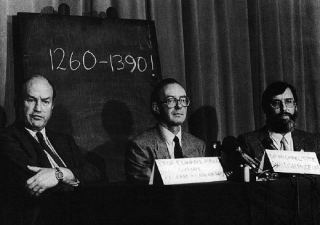
p) radiocarbon testing, carried out under highly controlled conditions by three laboratories. showed the cloth to originate between 1260 and 1390AD (>95 per cent confidence) and between 1000 and 1500AD (>99.9 per cent confidence)


8. Cultural:
q) the shroud does not match with what is documented and known of first century Jewish burial practices
r) nor does the shroud match the only extant sample of such burial cloths;
s) neither does the shroud match the biblical accounts of the burial cloths;
t) there any no demonstrated artefacts of the putative Jesus extant today
u) the supposed historical background does not suggest that such a cloth would have been preserved, certainly without publicity prior, to ~1355

9. Serological:
v) a minor point (as blood probably wouldn't survive this long anyway) but despite the best attempts of (and much lying and pseudoscience by) shroudies, there is no evidence for blood residue


Frankly the consensus of all the factors is the strongest reason to accept the medieval origin of the shroud, not any one factor.

Now that you're back how's about you stop wasting everyone's time with your nonsense and actually address these points?
:rolleyes:
 
Oh, by the way...

Has anyone ever reproduced this image by wrapping a sheet around a dead body? Or even a reasonable facsimile of a dead body? Because everything we know about wrapping sheets around bodies would not lead the image on the shroud.
The image has been recreated using a bas-relief. Some experiments were done with humans (live not dead) and they didn't match.

This article was from 1980, correct? The carbon 14 tests were done afterward which negates these suppositions in light of the new evidence.
You don't expect the shroudies to abandon their beliefs just because of mere facts do you?

- Are we 100% sure that the carbon dating was correct? I'm certainly not.
- I would say that all we can do here is compare the probabilities.
Just like all the other shroudies you have completely failed to show any reason to believe there is any doubt about the radiocarbon dating. Just the usual pathetic rubbish about contamination, magic weaves and mysterious coatings that have been dealt with here (and elsewhere) before.

 
The image has been recreated using a bas-relief. Some experiments were done with humans (live not dead) and they didn't match.

Presumably that would mean that either the top image, or the bottom image could be created, but there would be no way to get a top and bottom on the same cloth from a single object.

Come on, Jabba - you keep spouting how "no one can reproduce the shroud" using artisan methods, but you ignore the fact that the same argument rules out the possibility that was wrapped around a body.

Whoops. All this discussion for nothing.
 
The Blood

- I just sent the following to http://www.e-forensicmedicine.net/.

Hi,
Is it possible to ask Dr. Zugibe a question? If so, here it is.
In The Crucifixion of Jesus, I don't think that you mention the blood stains in the hair. Is their degree of preciseness/specificity also explained by washing?

Actually, I just encountered another issue. The results of "washing" (in your book) seems to imply that the blood flow would have been due to oozing after the washing -- but, the blood flow on the Shroud would have had to occur while the victim was still on the cross...

Just to let you know, I'm sort of "a friend of the court" (a dedicated "Shroudie") and expect you to have good answers to the above...
You can see my debate with the skeptics on the James Randi forum (http://www.internationalskeptics.com/forums/showthread.php?t=226761). I'm "Jabba."

Rich Savage
 
The Blood

- It turns out that Michael Baden still has a practice in NYC. I've tried to call his office to see how best to ask him an "academic" question, but so far, I only get a busy signal. I'll try some more, but if the busy signal keeps up, I'll send him a fax.
- His office # is 212-397-2732. His fax # is 212-397-2754. In case someone else might try to reach him...
--- Jabba
 
Status
Not open for further replies.

ISF - Join now!

Every member here is approved by hand. No bots, no spam, just people who care about evidence and honest debate.

Membership is free!

Create your free account

Back
Top Bottom