Moderated Global Warming Discussion

Status
Not open for further replies.
Alec - you make mistakes due to language and haste and you are too arrogant to admit it.
And piss off with the patronizing - if I want help from you I'll ask.
I tend to ask Gavin et al instead.
All I'm trying to do is clarify what you won't.
See the preceding post to this.
The confusion you are dishing up as over reaching knowledge isn't.

Providing temperatures as working out of a 2013 baseline is simply ludicrous.

<I stopped reading here and I won't follow these texts and links that may have value in other context or not but they are not responsive to what was being discussed>

Knock it off with such ludicrous changes of subject and your general disorderly behaviour. You asked me and you were replied: both 1 to 1.2° in 250 years and peak of 0.2°C in some 30 years for two different scenarios were provided by me departing on today levels. I never needed to add "additional" because it's quite obvious: it comes naturally from the simple notion of "warming still in the pipes".

The rest of yours is just a smoke screen: as you don't like what I say you already tried a lot of paths: acting as I said a different thing; that you don't understand my use of language -yet you do as if you understood and had answers for it-; that my inferences should have departed for the off-topics you provide, and a lot of garbage that is called in my language "to 'strew' the field with holes" that is, to hinder the opposite team with "unsportmanly" actions because your own team is a failure.

From my incidental scanning of the filler texts you posted recently I deduct you have little idea about how climate models work and how they can be initiated each day departing from a current file containing a mix of values come from a running instance of the model together and tweaked with actual instrumental data. So, what's your problem with "warming still on the pipe" that you need to make bad inferences based on outdated incomplete material while you're asking others 'sworn statements' and hard proof?

I have now to go back and reply a few messages posted before yours.
 
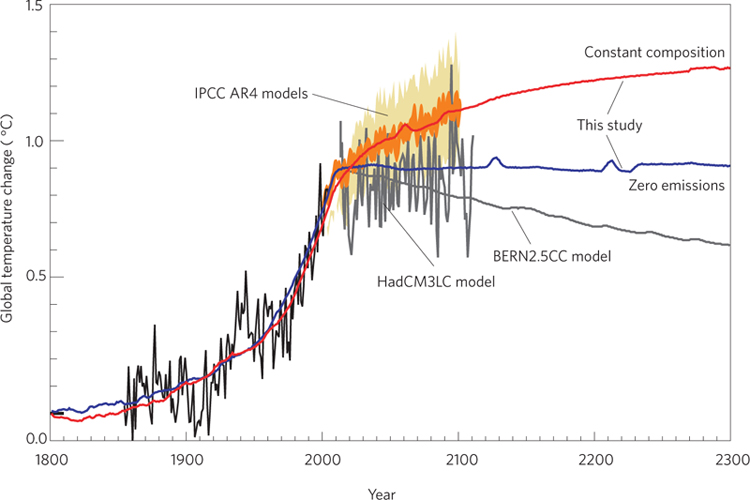
How do you square your +1 to 1.2C in 250 years with this from Real Climate


http://www.realclimate.org/index.php/archives/2006/01/can-2c-warming-be-avoided/

and

this from another realclimate article on a stop cold scenario - here is the graph

http://i106.photobucket.com/albums/m269/macdoc/junk album/cc_commitment.jpg


http://www.realclimate.org/index.php/archives/2010/03/climate-change-commitments/

unless you were implying a drop from 2.0 degrees over base period anticipated in the 400 ppm article above, to 1.0 to 1.2C over that same baseline 250 years out.

In other words the global temperature declines with no additional anthro C02.??

At all times under all scenarios with anthro C02, due to the lag, there will be a certain amount of warming to come until equilibrium is reached....when is that point?
From the graph above it's not hitting equlibrium even 300 years out. :boggled:

Indeed both links manage values in line with those I used (one, some +0.8°C in +300 years under "hypothetical stabilization", the other one constant or slow drop for the other scenario) , so look elsewhere if you want to contradict me. In most models -which not include a coupled ocean circulation model- the heat storage in deep ocean is just a tiny set of parameters that you can change in different runs. These models were pretty poor -yet, the best we had until a few years ago, and strong enough to allow us to know where science was standing-, and by modifying those parameters you had much different inertias.
 
that sounds very simplified. and this part of the science is not at all as clear as some might think. as far as i know there still is a huge lack of data especialy from coastal areas. things like the "continental shelf pump" etc and alot of uncertainties. and some simple model runs will not get you a good answer yet.
i would argue this question cannot be answered yet.

That is not simplified. That is just an analysis, a common sense one, to see if there's something behind or not. It's called reality check. Do you think that I 'believe' that analysis or that this is the extent of my knowledge on that subject?

The question is, what analysis come from common sense and involving principles of natural sciences and figures do you and others do to check the soundness of all arguments? To my astonishment I am discovering these last few weeks that nobody or almost nobody does, so I have to conclude that the fact that some are denialist and others are warmer-like is purely coincidental/accidental.

So, summarizing: you take a snippet -my analysis- and reply that it's all too much complex and who knows. It boils down to "something is possible" (oceans vomiting 'a sea' of CO2) "just because it's very complex and I don't know". That's is just a trick to keep the wished possibility even in lack of evidence, because that is what is happening in this thread. Denialist shouldn't feel alone!
 
A confusion:

When global warming is increasing, how it is too cold this year?

I am burning now with 38°C (+100 ° Usian) and we are breaking records week after week; around Xmas we experienced the record dew point high: 27.9°C: opening the door and going out was more knocking than an uppercut. It was just like we were breathing soup.

Where's the "so much" cold? Will you invite me there?
 
That is not simplified. That is just an analysis, a common sense one, to see if there's something behind or not. It's called reality check. Do you think that I 'believe' that analysis or that this is the extent of my knowledge on that subject?

The question is, what analysis come from common sense and involving principles of natural sciences and figures do you and others do to check the soundness of all arguments? To my astonishment I am discovering these last few weeks that nobody or almost nobody does, so I have to conclude that the fact that some are denialist and others are warmer-like is purely coincidental/accidental.

So, summarizing: you take a snippet -my analysis- and reply that it's all too much complex and who knows. It boils down to "something is possible" (oceans vomiting 'a sea' of CO2) "just because it's very complex and I don't know". That's is just a trick to keep the wished possibility even in lack of evidence, because that is what is happening in this thread. Denialist shouldn't feel alone!

i don't believe there is any real chance atm that Oceans overall will switch from sink to source. but your oversimplified approach did not really approach this question properly. its far more complicated, and this is actually a topic i did read about in scientific literature. but from the question, are the oceans currently a net sink or not. and for example we do not have good data from coastal areas, and parts of coastal areas are already a net CO2 source. also the different oceans are acting differently in this regard. etc etc. we simply do not know much about that particular question. and oversimplification will not deliver a proper and usefull answer at all. and it doesn't matter in which direction.

2 of the papers i did read about this have been linked to by someone else just resently here. but i did read them a few months ago.
 
Last edited:
I am burning now with 38°C (+100 ° Usian) and we are breaking records week after week; around Xmas we experienced the record dew point high: 27.9°C: opening the door and going out was more knocking than an uppercut. It was just like we were breathing soup.

Where's the "so much" cold? Will you invite me there?

China, India...
 
China, India...
Here's the global temperature report for December:

http://www.ncdc.noaa.gov/sotc/global/2012/12

If you scroll down to the section headed Temperatures you'll see a map of global temperatures showing that it was colder than usual in central Asia, and warmer than usual almost everywhere else.

The report for January will be put up in mid February. I predict that some areas will again be showing lower than usual temperatures, but many more will be showing higher.
 
Here's the global temperature report for December:

http://www.ncdc.noaa.gov/sotc/global/2012/12

If you scroll down to the section headed Temperatures you'll see a map of global temperatures showing that it was colder than usual in central Asia, and warmer than usual almost everywhere else.

The report for January will be put up in mid February. I predict that some areas will again be showing lower than usual temperatures, but many more will be showing higher.

I thought it was kind of cold in Japan too and that map confirms my anecdotal feeling about this winter. The cold air mass in central Asia seems to be affecting us even here in Japan. Perhaps it is also affecting India in January although that map for December doesn't indicate it yet.
 
Fact check #1:

How much warming would still happen if we would stop all our ghg gas emissions right now, forever?


According to Real Climate:

cc_commitment.jpg


CO2 concentrations would start to fall immediately since the ocean and terrestrial biosphere would continue to absorb more carbon than they release as long as the CO2 level in the atmosphere is higher than pre-industrial levels (approximately). And subsequent temperatures (depending slightly on the model you are using) would either be flat or slightly decreasing. With this definition then, there is no climate change commitment because of climate inertia. Instead, the reason for the likely continuation of the warming is that we can’t get to zero emissions any time soon because of societal, economic or technological inertia.


If I understand correctly, this suggests that in a zero emission scenario we would get no warming / slight cooling immediately.

My other source confirmed this to be the case (and gave different scenarios), but with a caveat that because of the overall cooling effect of some small particles (in the zero GHG emission scenario) we would get a fast warming effect of something like 0.5°c but then the climate would start to cool off.

Other scenarios were:

a) Zero CO2 emissions = pretty much no change in temperature for hundreds of years.

b) Zero CO2 and zero methane, etc. emissions = very slight cooling in the first couple of decades, because of methane's fast response.
 
According to Real Climate:

[qimg]http://www.realclimate.org/images/cc_commitment.jpg[/qimg]


If I understand correctly, this suggests that in a zero emission scenario we would get no warming / slight cooling immediately.

My other source confirmed this to be the case (and gave different scenarios), but with a caveat that because of the overall cooling effect of some small particles (in the zero GHG emission scenario) we would get a fast warming effect of something like 0.5°c but then the climate would start to cool off.

Other scenarios were:

a) Zero CO2 emissions = pretty much no change in temperature for hundreds of years.

b) Zero CO2 and zero methane, etc. emissions = very slight cooling in the first couple of decades, because of methane's fast response.

well if we go to 0 tomorow, we would still have a long time of higher temperatures compared to pre industrial levels, until we actually reach the pre industrial CO2 levels. only then we would not have any increased temperatures anymore (ignoring the long lag oceans would have to get back to normal)
 
And this of course assumes that we have not passed any major "tipping points" yet.

"tipping points" come in many flavors:

"Climate Change and Economic Growth: Evidence from the Last Half Century"

Melissa Dell, Benjamin F. Jones, Benjamin A. Olken

NBER Working Paper No. 14132
Issued in June 2008
NBER Program(s): EEE EFG

http://www.nber.org/papers/w14132.pdf

6. Conclusion

This paper presents new estimates for the effect of climatic changes on national economies. Our approach differs from standard “Integrated Assessment Models”, where authors postulate a set of climate-economy mechanisms and sum them up. In this paper, we estimate climate effects directly by examining the historical relationship between climate fluctuations and economic growth.

We find substantial effects of climatic changes, but only in poor countries. In poor countries, a 1◦C rise in temperature in a given year reduces economic growth by 1.1 percentage points on average. The estimates suggest that climate change may affect the rate of economic growth, rather than just the level of output. Moreover, estimates using the overall change in climate from 1970 to 2000 rather than annual variation produce even larger estimates, suggesting that adaptation may not undo these effects in the medium term.

While higher temperatures reduce agricultural output in poor countries, we also find that they lead to contractions in industrial output and aggregate investment and to increased political instability. These results underscore the breadth of mechanisms underlying the climate-economy relationship. The results also suggest that future climate change may substantially widen income gaps between rich and poor countries, with many poor countries driven toward greater poverty, other things equal. Further work is needed to identify precise causal mechanisms. This paper suggests such analysis is of first-order importance, as the economic effects in poor countries appear large.

Compared to the social/societal aspects, the technological/economical aspects seem like child's play.

When global markets collapse and the human population contracts and the environment becomes increasingly hostile, things get ugly quick. You really don't have to ratchet things up much higher than they've been over the last few decades to plausibly reach these points. We don't have to get to the point where the southwest deserts expand throughout much of the central plains states, and it's cheaper to grow food in factories than it is in the ever shrinking arable, open-air, land before the self-evident effects (and consequences) of a warming climate is going to put pressure on all other geopolitical considerations. There are still a lot of nasty weapons and technologies disseminated throughout the masses of our populations. At the least, we may be in a position to understand the drivers, even if we are without the strength of mind and character of social cohesion to meet these challenges,...simply one of many Fermi paradox considerations.
 
Last edited:
i don't believe there is any real chance atm that Oceans overall will switch from sink to source. but your oversimplified approach did not really approach this question properly. its far more complicated, and this is actually a topic i did read about in scientific literature. but from the question, are the oceans currently a net sink or not. and for example we do not have good data from coastal areas, and parts of coastal areas are already a net CO2 source. also the different oceans are acting differently in this regard. etc etc. we simply do not know much about that particular question. and oversimplification will not deliver a proper and usefull answer at all. and it doesn't matter in which direction.

2 of the papers i did read about this have been linked to by someone else just resently here. but i did read them a few months ago.

You are still saying the same.

"The subject is complex" is not an argument. That's why you should start with common sense and revise (or learn) the physical processes involved; then you can perceive if there's something really behind: that's exactly what I did here. When I read such kind of articles and papers, I have to be critical from the very beginning. I've probably read a dozen papers about this specific subject in the last few months. Can you provide the links to those papers so I can return a critical analysis of them? The range of problems with those papers is extremely wide.
 
You are still saying the same.

"The subject is complex" is not an argument. That's why you should start with common sense and revise (or learn) the physical processes involved; then you can perceive if there's something really behind: that's exactly what I did here. When I read such kind of articles and papers, I have to be critical from the very beginning. I've probably read a dozen papers about this specific subject in the last few months. Can you provide the links to those papers so I can return a critical analysis of them? The range of problems with those papers is extremely wide.

http://www.climate.unibe.ch/~joos/papers/gruber09gbc.pdf

http://www.up.ethz.ch/education/term_paper/termpaper_hs07/MAJOREK_rev_termpaper_hs07.pdf
 
Most people who study global warming agree that it's reached a critical threashold and cannot be stopped.

would you agree with that statement?
 
No - that's a ridiculous statement to make. There are any number of ways of stopping agw - none too pleasant and perhaps whoever is making it should attempt to back it up.
It may well have halted for the moment if the Asian brown cloud is overwhelming the warming.
 
No - that's a ridiculous statement to make. There are any number of ways of stopping agw - none too pleasant and perhaps whoever is making it should attempt to back it up.
It may well have halted for the moment if the Asian brown cloud is overwhelming the warming.

You make some good points.
There may be ways to "stop" climate change, but the issue is more whether or not we have reached the point that even if we took humanity and its future additional contributions completely out of the picture, have we already engaged enough natural feedbacks that the warming would continue to accelerate (albeit at a reduced rate)? As to the Asian emissions, there is a difference between a masking of some symptoms and a complete halting or removal of the underlying processes.
 
No - that's a ridiculous statement to make. There are any number of ways of stopping agw - none too pleasant and perhaps whoever is making it should attempt to back it up.
It may well have halted for the moment if the Asian brown cloud is overwhelming the warming.

a shame the guy that made the claim dares not debate it here. most propably because he knows his claims are wrong and he knows he is not able to backup his claims with evidence.
 
Status
Not open for further replies.

Back
Top Bottom