NIST’s purpose was to find the timing of collapse initiation and progression.
More specifically, and all that can be directly extraced from 12.5.3, the purpose..."
A more detailed analysis examined the vertical displacement, velocity, and acceleration through different stages of the collapse process.". The "more detailed analysis" was prompted by the Chandler claims, and so the "purpose" is tightly linked.
The "Stage 1" conclusions consist of a small number of quantities, namely...T
0 (start time), End time, distance descended and description of acceleration behaviour. They got the start time, the end time and distance wrong. The acceleration behaviour was a no-brainer. 75% wrong. Poor.
femr2’s purpose was to be able to graph what happens to the acceleration of the NW corner over time as accurately as possible.
My data and methods have almost
nothing to do with the failings of 12.5.3. This simple misunderstanding on your part renders the majority of your post utterly irrelevant to this topic.
Wrong (1)
For the analysis of the fall initiation and progression of the north wall, NIST used the Camera 3 location (~2200 feet from the north face of the building). This video is of substantially higher resolution by being ~ 10 times closer and subject to less atmospheric refraction* than the Dan Rather video.
The resolution of both videos is exactly the same. Both NTSC.
Wrong (2)
The field of view of the building is wider
Narrower.
Wrong (3)
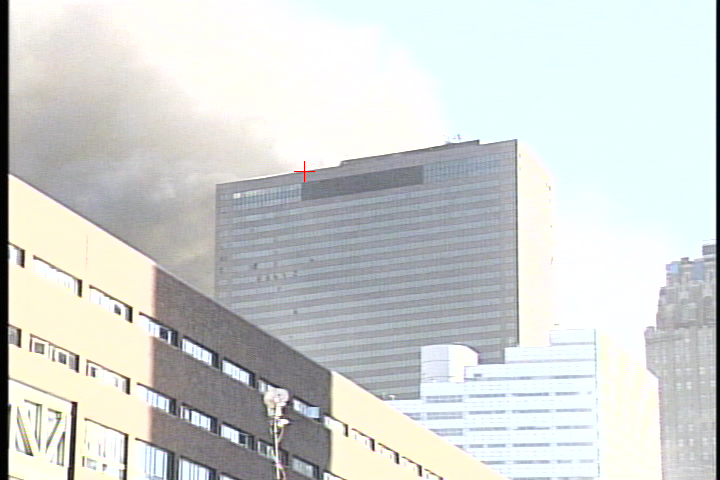
If you enlarge this frame (ctrl +) to maximum, the pixels cannot be seen.
http://femr2.ucoz.com/_ph/7/2/516330913.png.
If you enlarge the following frame (ctrl +) to maximum, the pixels can be seen and the point selected for SynthEyes as the NW corner of the building.
http://femr2.ucoz.com/_ph/3/822594143.png
ROFL. You failed to notice that the second image is
already significantly enlarged. Deary me.
Wrong (4)
Can one tell where the exact NW corner of the building is?
Data has been shown time and time again confirming ~+/-0.2 pixel variance on positional tracking. Raw data provided also includes the FOM data (figure of merit) which indicates the quality of pattern match per sample.
Of course, the Cam#3 footage is higher quality, as has been discussed many times. Trace data exists for BOTH. Accuracy of my raw Dan Rather data has been clarified many times, including "praise" from your hero WDC.
For the analysis of the fall initiation and the acceleration of the NW corner, femr2 used the Camera 2, aka Dan Rather view (~21,000 feet from the north face of the building).
I use BOTH.
Wrong (5)
This video is of substantially lower resolution
Same resolution. Standard NTSC.
Wrong (6)
The field of view of the building is narrower
Wider.
Wrong (7)
B) Data tracking method:
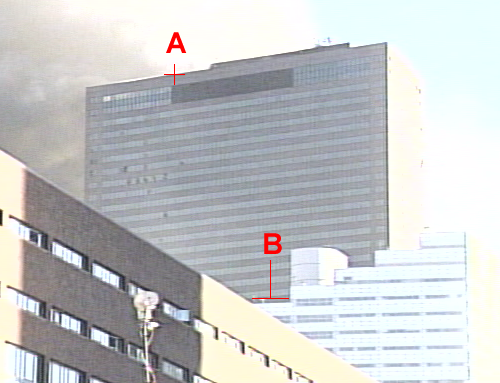
NIST- For determining the beginning of the north wall global collapse, NIST used a point atop the parapet above the eastern louvers edge, near the collapse of the East pent house,
They used this pixel column...
This information exists. Use it.
Adobe software to determine gray pixel gradients in 250 steps within each pixel.
You are getting confused between 12.5.3 and the Appendix C moire method.
NIST do not state what software they used, though it is likely that they used Photoshop.
8bit greyscale provides 256 levels, not 250. If you had even the most primitive understanding you would know this.
Wrong (8)
Within each pixel ? A statement borne from lack of understanding. An 8bit greyscale palette has 256 levels, sure. They only looked at ONE pixel. Each ?
Few data points, appears to be manual, but not stated.
No automation method used. Manual. No automated method will latch to either of their trace locations, as horizontal motion cannot be bounded.
Wrong (9)
For determining the overall progression, from the start of the north wall collapse until obscured by buildings in front, NIST used a second point at the top of the wall near the center of the north wall above a window 18 stories below. Fewer displacement data points at about 4 per second, could be manual, but not stated.
No automation method uses variable frame-skip. Manual. No horizontal latch features. Manual.
Wrong (10)
WDC said:
Yet it is an objective fact that, during the interval from 11 to 13 seconds on your time scale, using your own measurements of the NW corner, using the objective criterion of least squares, NIST's model as described in section 12.5.3 is more accurate than your Poly(10) model.
http://www.internationalskeptics.com/forums/showthread.php?postid=7154921#post7154921

WDC
deliberately used data outside the ROI in order to present a false picture. He was told many times about his "error" and failed to correct it. Almost 1s of data before the ROI was included, skewing WDC's "results".
How does one test the accuracy of femr2’s data?
Irrelevant to this thread. Quoting WDC's failed "hit-piece" does you no favours, at all.
Dan Rather video+ SynthEyes data plot, displacement to velocity data thanks to W.D.Clinger.
LOL. Trusting your "peers" is not always a good idea, as I shall explain to you.
For V1=5 ft/sec ; V2=50 ft/sec ; deltaT= .017 sec;
Acceleration = 2647 ft/sec2!
ROFL. The issue, which you fail to recognise due to your incompetence, is that WDC chose to use very narrow symmetric differencing to generate the velocity data, a method he knew was misleading. In order to be equivalent to NIST data spacing a 15 sample window would be required. With a more appropriate window width, you get the following...
Note also that you have ALSO made the same error as WDC, though in your case I suspect due to lack of understanding, by using near-ajdacent samples to perform your differentiation. That is plain WRONG. It is stupid to do such when treating high frequency data containing noise. Plain dumb.
Accuracy is relative, impossible is wrong. This acceleration is impossible and wrong.
NIST’s any 2 adjacent data points don’t exhibit this instability.
An inappropriate method of generating the derivative was used. Your "conclusion" is nonsense.
Wrong (11)
NISTs datapoints are much further apart so,
of course, amplification of noise is lower than by the inappropriate method used by WDC. They do however exhibit the same relative (if not more) "instability" (measurement error), just with less amplification.
Wrong (12)
Manual tracking of a few points must be less accurate than automated tracking: False
Absolute nonsense. Sub-pixel tracing methods have been shown to resolve motion under 100th of a pixel, a task IMPOSSIBLE to do by eye.
Wrong (13)
Dan Rather less resolution video + femr2 model +automated SynthEyes subpixel data tracking is more accurate than NIST’s Camera 3 higher resolution video + single pixel displacement tracking. False.
Ansolute nonsense. Even your revered WDC has stated that my raw data is significantly more accurate than NIST's, a fact demonstrated time and time again.
Wrong (14)
That you attempt to use an inappropriate graph produced with the wrong methods simply shows your intent. It's backfired upon you. Shame.
NIST To = 0 Start of EPhouse collapse
Nonsense. T
0 is the start point of "Phase 1". The point where vertical descent "started". The NIST "Stage 1" would have started earlier otherwise.
Wrong (15)
NIST 6.9s. start of top of wall collapse
Which is the T
0.
NIST 7.9s. femr2 claims fall of NW corner indicates start of north wall collapse, that NIST is 1 second late.
LOL. Not late, early. If you meant "early", then correct, for the reasons presented, via detailed comparisons between Cam#3 and Dan Rather traces, along with careful analysis of motion direction. I'll let you off that one. LOL.
femr2 mistakes this as the start of the north wall collapse.
ROFL. No, I don't. I base my view of motion upon many factors, which includes analysis of early motion traces from multiple points on both Cam#3 and Dan Rather viewpoints. You've already conceded that NIST messed up with their initial pixel choice, as they 100% included non-vertical motion as vertical, therefore skewing their results.
Wrong (16)
Conclusion: North wall falls, kink moves in line away from femr2’s Dan Rather view and cannot be seen. North wall fell vertically and kinked in simultaneously. NIST start of global collapse at +6.9s. is right. True.
Including primarily non-vertical motion within a vertical data trace is 100% wrong. T
0 is always slightly subjective, but motion direction can be determined. It has. Early data from the NIST T
0 is almost all non-vertical in the real world. Big mistake.
Wrong (17)
Measurement error would explain why NIST chose ~4 frames per second instead of ~60 frames per second, and for timing the collapse
Simply speculation. I suggest they simply couldn't be bothered, and replicated the sample interval of Chandler, with their bizarre varying inter-sample spacing.
3 physical parameters instead of femr2’s 11 or 51 imaginary ones.
LOL. As I've already told you, the poly fits are not models, but simply a means to smooth the data. A compression method if you will. There are no meaningful "parameters" at all. You listen to WDC far too much. Suggest you use your own, er, noodle. He can at least "try" and talk his way out of his mistakes (deliberate distortions). You can't.
NIST didn’t state whether they used interlaced or deinterlaced video. femr2 doesn’t prove what NIST used.
There is more than enough information within 12.5.3 to conclude with 100% certainty that NIST did not deinterlace the video.
Wrong (18)
NIST could have used the odd numbered or even numbered fields only, in the frames they selected. femr2 doesn’t prove what NIST used.
Inter-sample spacing confirms your assertion to be incorrect.
Wrong (19)
NIST did not deinterlace their video: Don’t know.
See above.
Wrong (20)
They were interested in the general trend by sampling ~4 frames per second. This reduces noise and derivation of velocity and acceleration profile data.
Incorrect. It doesn't reduce the noise within the data in the slightest. Their sampling method, manual, contains MORE "error" than that extracted by automated methods. As I have explained to you above, it was WDC's CHOICE to use narrow symmetric differencing to derive the velocity data which amplified inherent noise. That's the wrong way to treat the data, as WDC knew well.
Wrong (21)
There’s no evidence the data points NIST selected were less noisy than the ones femr2 selected at the same locations, perhaps more.
Increased accuracy of my data has been shown time and time again.
Wrong (22)
There’s no evidence that sampling ~ 60 frames per second decreases available data redundancy considerably for the purposes of noise reduction and derivation of velocity and acceleration profile data.
You got yourself confused, as you don't really understand what you're talking about. Increasing sample rate INCREASES available data redundancy, the simplest proof of which is simply the ability to decimate the data.
Wrong (23)
Due to measurement error, there are diminishing returns in increasing the frame sampling rate.
There are diminishing returns in all measurement techniques, the point being to get the best data you can.
NIST may have determined 4 frames per second is optimal.
LOL. Believe what you will, but you KNOW that is nonsense.
Increasing the sampling rate to 60 frames per second is optimal: False
Incorrect. Sampling every frame is as optimal as you can get, as there are no additional frames to sample. You can always throw out overy other, or every 4 out of five afterwards, if you choose to. Sampling every frame has significant and distinct advantages when employing automated relative motion pattern matching tracing techniques.
Wrong (24)
Increasing the sampling rate to 60 frames per second is optimal: False
Again, No.
Wrong (25)
NIST top of parapet pixel is an actual feature, an actual point of the building, no different than femr2’s top of parapet point at the NW corner. Claim False.
Stupidly incorrect. It's been explained to you many times, yet you still fail to understand. The problem with NIST's tracing pixel column is that it is a fixed horizontal position within the image frame. As the building descends the horizontal position of the building (and so what WAS the original horizontal position of the initial point) moves left and right. The NIST tracing method does not track this motion, and so ends up tracking the position of bits of the roofline to the left and right of their original location, as the building moves left and right. If you are confised on this item, I'll go into further detail.
Wrong (26)
NIST’s tracked pixel column is a rather meaningless point. False
See above.
Wrong (27)
NIST’s moire technique, and Photoshop subpixel gray scale used in their pre collapse E-W motion, might have been used to track this E-W motion during wall fall. Don’t know, neither does femr2.
Highly unlikely, clearly. Scraping the barrel
And wouldn't have improved anything in their poxy 12.5.3 either.
femr2 solved this E-W, N-S drift problem in his own data tracking. False.
Incorrect. Use of Dan Rather footage, use of NW corner (allowing separate tracking of motion both horizontall and vertically) and static motion removal.
Wrong (28)
They would have noticed notable vertical motion. Section C.1.3 on. True.
The moire method only detects HORIZONTAL motion.
Wrong (29)
NIST had no way of gathering early motion data, or quantifying long term noise levels. False.
Another invented claim. Tsk. NIST had oodles of early motion data. Their moire method was far superior to the poxy methods used within 12.5.3
NIST selected a second point near the center of the north wall, above the top of the windows 18 floors below, otherwise they would not have selected this second point.
Doesn't even make sense
NIST chose a trace endpoint which could not be traced from their selected T0 time. NIST chose a second point above their end point. Claim that NIST calculated fall time from East screen point location. False
Exact details of how NIST spliced the two datasets together has been provided, namely using their incorrect T0 in conjunction with trace data above region B. No other possibilities exist.
Wrong (30)
NIST merged data from two separate traces together. False.
Incorrect. Just ask yourself where T0 is determined
Wrong (31)
NIST did not perform perspective correction upon the resultant trace data. Don’t know, neither does femr2.
I do. They didn't.
NIST did not recognise that the initial movement at their chosen pixel column was primarily north-south movement resulting from twisting of the building before the release point of the north facade. False.
Laughably incorrect.
Wrong (32)
NIST did not perform static point extraction (H, V). Even when the camera appears static, there is still (at least) fine movement. Subtraction of static point movement from trace data significantly reduces camera shake noise, and so reduces track data noise. - I don’t understand how these graphs prove femr2’s point.
ROFL. You don't understand how removing motion of the camera from the data improves the quality of the data ?

NIST didn’t perform static point extraction. Claim: Don’t know.
I do. They state it was not removed for the moire method, and certainly did not remove it for 12.5.3
Wrong (33)
NIST did not choose a track point which could actually be identified from the beginning to the end of the trace, and so they needed to splice together information from separate points. Without perspective correction the scaling metrics for these two points resulted in data skewing, especially of the early motion. - Yes they did. See 7) and 9) above. Claim False.
Laughably incorrect.
Wrong (34)
NISTs displacement function, if derived to obtain acceleration/time contains a ~1s period of over-g acceleration. Whilst that in itself is fine, it's at the wrong time, and in their conclusions they ignore it. - It’s at the wrong time. See 8). False.
One area where comparison to my data is valid. You have only my data to make any comparison. Your "false" is specious.
Wrong (35)
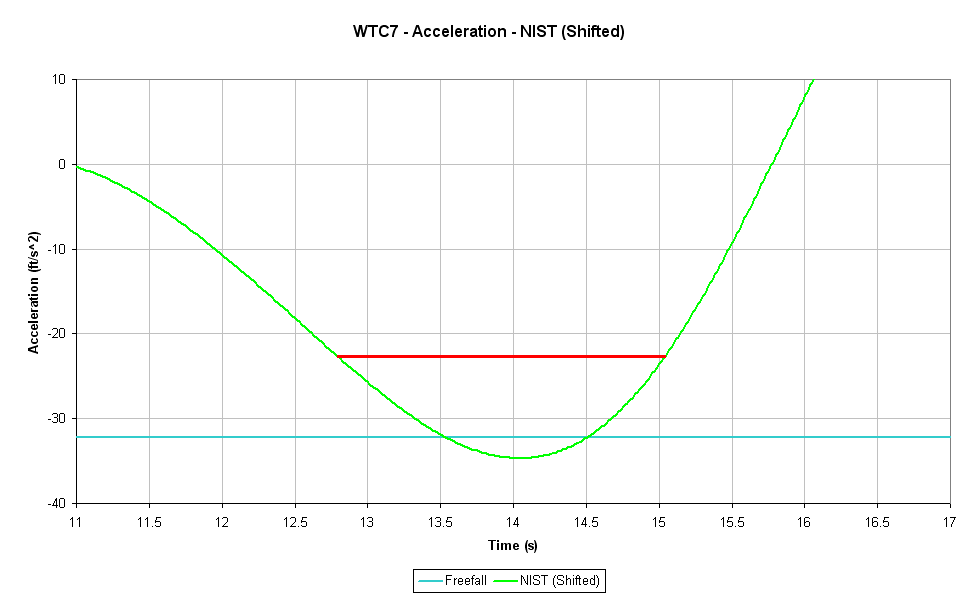
NISTs displacement function, if derived to obtain acceleration/time does not suggest a 2.25s period of roughly gravitational acceleration. - Dan Rather less resolution video + SynthEyes inaccurate subpixel acceleration + NIST velocity and acceleration functions = Don’t know if NIST suggests 2.25 s period of roughly gravitational acceleration.
Gibberish. The function for velocity, differentiated for acceleration, looks like this...
The red line indicates a 2.25s period. No 2.25s of ~g.
Wrong (36)
The displacement data appears to have been extracted initially from the T0 pixel column, but using the scaling factor determined for a point above Region B, further skewing the displacement data. - See 7) . False.
LOL. Nope. Definitely as I suggest.
Wrong (37)
If this were a contest between NIST’s experienced Ph.D.s and femr2 as to who can achieve the greater accuracy, I would bet on NIST.
It's not a contest. NIST didn't bother to extract high quality data for 12.5.3. They could have extracted much better data if they had applied their moire technique. They didn't bother. My NW corner trace data is far superior to that within 12.5.3.
1. NIST extracted data from the Camera 3 video with higher resolution than femr2’s Dan Rather camera view.
The videos are the same resolution.
Wrong (38)
2. NIST’s model for Stage 1 is superior to femr2’s.
I have no "Stage 1" model.
Wrong (39)
3. A determination of the optimal frame sampled per second needs to consider displacement measurement error, which femr2 didn't do.
Wrong on both elements of your statement.
Wrong (40)
4. NIST’s model analyses physical factors, femr2’s calculates arbitrary parameters.
I utilised poly fits simply as a means of compression/smoothig....all of which was supersceded by the Savitzky-Golay based derivations.
Wrong (41)
5. femr2 is wrong to claim that the kink developed without vertical falling motion.
I don't make that claim. I say primarily N-S not vertical. There's a very small vertical component, but that's not the issue. The issue is that NIST included motion which was NOT vertical as vertical motion.
Wrong (42)
6. femr2’s SynthEyes produces impossible, wildly inaccurate velocity and acceleration data of the north wall.
ROFL. Laughably incorrect. See notes on use of narrow window symmetric differencing. The problem there was the person, not the data
Wrong (43)
By NIST’s standards - to find the timing of collapse initiation and progression - NIST did not “ blew WTC7 Stage 1 analysis”.
You've barely touched ANY of the issues with NIST Stage 1 Analysis. All you've managed to do is show that you have no understanding of this topic, by attempting, and failing, to identify issues with MY data, which has almost NOTHING to do with critique of NIST Stage 1. ROFL.

Wrong (44)
For a long time femr2 has promoted the myth that femr2’s analysis is the most accurate possible, it is not.
It's the most accurate available, by far.
Wrong (45)
Again, you've really not touched on "NIST Stage 1 Analysis" at all, as you made the fatal misunderstanding that my data has anything to do with the issues with Stage 1 at all
Where you DO veer into addressing Stage 1 issues...you've gotten it WRONG
45 instances of you being wrong in one single post. A record I think.
Pathetic.