In what way is it "obvious"? Which pieces of evidence are you referring to? I'm not saying it couldn't have happened, because Thurman was there from the earliest days and that has to be a red flag, but I don't know of any definite evidence that this happened.
You're right. I wasn't there in decembre 1988. However, there are indications that the chain of custody was broken from the very start of the investigation.
That's the first I've heard of that interpretation.
Claiden seems pretty clear that he's talking about ten inches above the floor of AVE4041. That's the way the measurement is presented in the diagram in the AAIB report.
A Inside the container.
Perhaps -- I would like to point out that there is a slight diagrammatic error in this report.
Q Yes. What's that?
A It refers back to figure F 10, and a dimension in that figure of ten inches.
Q Yes.
A The ten-inch dimension is actually from [1537] the top of that container base to the point
in the hole, as indicated. And that figure was drawn incorrectly there, but it got transposed
onto figure F 13. So the ten-inch dimension in figure F 13 should actually have been nearer 13 inches.
…..
Q And if you could look again at figure F 13 in your report, 137.
A Yes.
Q And on this we can see the measurements of ten inches which you took up from the base of the container. [1615]
A As I've explained, that on this diagram was an error, and that should be nearer 13 or 13 and a half.
….
Q May we see figure F 10, image FF 10 in the present production, please.
491
Now, is this the diagram to which you drew attention just a moment ago, Mr. Claiden?
A Yes, it is.
Q Now, we see a depiction in the upper part of the photograph of the fibreglass container,
do we?
A Yes, indeed. It's another sketch.
Q And do we see it drawn sitting on its base?
A Yes, you do.
Q And there is a measurement of ten inches present within the diagram?
A Yes, there is. And it is as drawn from the wrong datum. The ten inches refers to the height of that cross, which is -- I wouldn't say an arbitrary position, but it's just a reference position for the [1548] hole. And that is meant to be ten inches from the top surface of the base, not the lower surface.
Q I see.
A And that's the error I managed to allow into the report.
Q So if we ignored the base of the container, what would the effect be on the ten inches?
A Well, the ten inches would be from the floor, as it sits in the court, to a position indicated by that cross.
Q Yes. But, of course, if we understand that in the aircraft the container would sit on its base, then we should take account of that?
A Yes, we should.
Q What would the height then be from the base of the container to the cross?
A Well, the base of the container, I think is three and a half inches thick. And so we add that to the ten, so it would be 13 and a half inches.
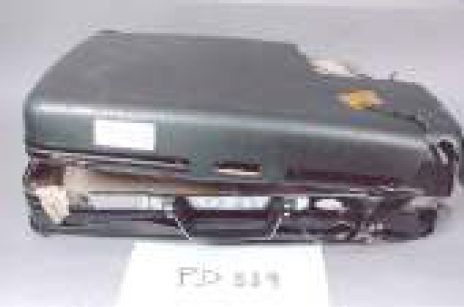
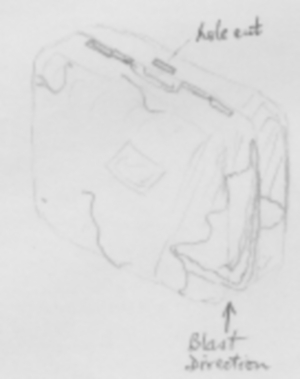
Bear with me here. Can we regard this as the second-last chapter in an Agatha Christie? I'm Poirot, and I'm telling you that my little grey cells have deduced that the bomb suitcase was definitely the one on the bottom of the left-hand stack. That is, it was the Bedford suitcase, which was not moved by any of the baggage handlers (though it might have shifted to the left and partly into the overhang section during the flight).
Can you definitely prove it wasn't?
Ehhh.... no.

I go for the "third possible position" in John Ashtons book (Appendix 2) with the blue tourister on top of the bomb suitcase.
.... Another point to consider is the pretty complete disintegration of both the bomb suitcase and the Coyle case. ....
There is no correlation between the number of fragments found and the degree of desintegration. It is possible that for example 70-90% of both suitcases survived the explosion, but that only 10-20% was found.



 )
)