• Quick note - the problem with Youtube videos not embedding on the forum appears to have been fixed, thanks to ZiprHead. If you do still see problems let me know.

WTC Dust Study Feb 29, 2012 by Dr. James Millette

"Dr. Millette does not address those DSC findings which argue against the credibility of his own findings.

He shows his ignorance of the DSC work performed by the research scientists, when he states that only the "thermal properties" of a substance are revealed.

Dr. Millette ignores the importance of the findings from the DSC post ignition red chip residue.

And sadly, he shows little curiosity."
"...At the very least, it is unnecessary to burn chips specifically in a DSC:..."
"The red chips of interest, were not 'burned' in the DSC.

They were ignited in the DSC.

As you also know, the authors acknowledge and discuss in their report, the exceptional energy release when the red chips were ignited.

It would not suffice to "burn the chips" at the 400C Dr. Millette chose and then dig through the residue.

From my reading of the Bentham Paper, iron-rich spheres were always found in the residue produced by ignited red chips.

If Dr. Millette had heated the chips to at least 500C, the 430C threshold issue would at least be dealt with.

It would be expected that upon microscopic examination of the residue at least some of his [Dr. Millette] red chips would have ignited and produced iron-rich spheres, where previously none existed."
"MM, you completely and utterly dodged my question. What will a DSC of Millette's chips show besides "thermal properties"?"
"The DSC produces valuable residue.

The residue supports a thermitic reaction."
"Putting aside the "burned" vs "ignited" question. a mor4e impprrtant point here is that MM and for that matter Steven Jones claim that iron-rich spheres were created in the burning of the chips in the Bentham paper where none were found before. The Bentham authors have admitted that the energy release is too high for thermite alone. The valuable residue does NOT include large amounts of aluminum oxide. So the value of the residue is now down to the existence of iron-rich spheres after the burning/igniting of the chips that Jones et al did. Am I right MM? I am asking you because I am not sure that in recent posts here at least the issue of the iron-rich spheres emerging FROM THIS EXPERIMENT has really been addressed. So let's address it now. MM and Steven Jones seem to be saying that these iron-rich spheres are evidence of thermite (due to 2700-degree temps allegedly required to create them), which Millette is ignoring this by not doing a DSC test. What are other explanations of why burning paint chips can also create iron-rich microspheres IN THIS EXPERIMENT?"

RE: "The Bentham authors have admitted that the energy release is too high for thermite alone."

And they provide a possible explanation and a research path to further explore the dramatic behaviour of the chips.

RE: "The valuable residue does NOT include large amounts of aluminum oxide."

The valuable residue DOES show iron-rich spheres which are formed as a result of the iron-melting temperature created by the aluminum oxide consuming thermitic reaction.

RE: "What are other explanations of why burning paint chips can also create iron-rich microspheres IN THIS EXPERIMENT?"

Paint in a flame test;

Harrit et al said:
"Several paint samples were also tested and in each case, the paint sample was immediately reduced to fragile ashes by the hot flame. This was not the case, however, with any of the red/gray chips from the World Trade Center dust."

If heating the suspect red chips to approximately 430C triggers their ignition, DSC should not be required to produce a residue containing iron-rich spheres.

I suggested 500C maximum to generously allow for any temperature measurement error.

Even Dr. Millette should be able to handle that.

MM
 
MM, if you burnt a small chip of paint with rust on it, would it produce iron rich micro spheres ?

A straight yes or no will do.
 
Last edited:
It would not suffice to "burn the chips" at the 400C Dr. Millette chose and then dig through the residue.

From my reading of the Bentham Paper, iron-rich spheres were always found in the residue produced by ignited red chips.

If Dr. Millette had heated the chips to at least 500C, the 430C threshold issue would at least be dealt with.

It would be expected that upon microscopic examination of the residue at least some of his [Dr. Millette] red chips would have ignited and produced iron-rich spheres, where previously none existed.

MM
You have been told numerous times why Dr Millette chose 400°C yet every time you refuse to acknowledge the reason even when that reason is specifically written by Dr Millette himself.

Low-temperature ashing (LTA) is an alternative to using solvents to extract inorganic constituents from an organic film or coating.6 LTA of the chips of interest was done using an SPI Plasma Prep II plasma asher. LTA was performed for time periods of
30 minutes to 1 hour depending on the size of the chip. The gray layer remained intact and the red layer residue was collected in clean water and drops of the suspension were placed on carbon-film TEM grids. After drying, the particulate was analyzed using a Philips CM120 TEM capable of SAED and equipped with an Oxford EDS system.

Chips of interest were ashed in a muffle furnace using a NEY Temperature Programmable furnace operated at 400oC for 1 hour. The gray layer remained intact and the red layer residue was prepared as described above and analyzed using a Philips CM120 TEM-SAED-EDS.
And there it is again for you to conveniently ignore.

Why do you ignore the reason for low temperature ashing?

Why do you want the temperature for LTA to tally with temperatures for DSC?

You talk about the 430°C as a threshold.

Do you understand why you wouldn't want to raise a sample to that "threshold" if you wanted to look at the non-organic particles in the matrix?

Heating to or above that temperature is likely to destroy the very thing you want to preserve.

There is absolutely no point in heating samples to satisfy your need for microspheres when you totally ignore the FTIR and TEM-SAED results.

If Millette had performed DSC to 700°C and no microspheres were found, you'd claim he didn't have the same material or he was falsifying data. If he did observe microspheres you would say ,"Look! Look! Proof of thermite!" even though the material had been shown to be paint adhered to oxidised steel.

If you ignite paint as the Harrit et al authors claim then you are unlikely to see microspheres because the microspheres come from the gray layer which is oxidised steel.

Remember that the DSC test went up to 700°C. That's very close to the A1 temperature of 723°C in the Fe-C phase diagram. We know that spheroidisation of pearlite occurs below this temperature and we also know that Mn segregation to cementite also occurs below this temp. We also know that Fe2O3--> Fe occurs below this temperature via reduction using H2 or CO.

There are far too many factors occurring in these samples to simply state that microspheres are a product of Fe melting due to a thermite reaction.

So lets actually analyse the SEM photos of post DSC residue. Here's one I had earlier that is labelled. Fig 21:

picture.php


Remember that this sample has experienced 700°C. What can you see in the photo?

Truthers are concentrating on the sphere but they are blind to the other particles present. I have labelled these particles. They are exactly the same particles as observed pre-DSC testing.

Look at the SEM image below and compare the hexagonal platelets and the rhomboid shaped particles.

picture.php


Identical!

So what does this tell us? What it tells us is 2 things.

1. Remember the authors claims that elemental Al is in the hexagonal platelet particles? Remember that these particles experienced temperatures of 700°C.

What is the melting point of elemental Aluminium?
660°C


If these hexagonal platelet particles contained elemental aluminium then that aluminium would have melted, destroying the hexagonal shape. If elemental Al was in these platelets then we would not observe any platelets after subjecting them to 700°C.

Ergo - the residue proves no elemental Al was present in the hexagonal platelets. This is confirmed by Millette's TEM analysis.

2. The authors claime that the hexagonal platelets contain elemental Al and the rhombohedral particles are Fe2O3 and are intimately mixed.

The thermite equation is

Fe2O3 +2Al --> 2Fe +Al2O3

Therefore they are saying that the hexagonal platelets are reacting with the rhombohedral particles in the above thermite equation.

Now look at that SEM photo again. What do you see?

Yep, that's right, you still see hexagonal platelets and rhomboids. This is supposed to be nano-thermite that ignites and reacts at 430°C, but there is no reaction between the intimately mixed particles otherwise we wouldn't be able to see them because their structures, their shapes would be destroyed. Even at 700°C these intimately mixed particles haven't reacted.

The residue shows that there is little reaction occurring between the particles. Therefore no thermite reaction.


It is self evident that the material that is forming these microspheres is predominantly coming from the gray layer. The red "thermite" layer is mostly remaining whilst the gray oxidised steel layer is missing. See below.

picture.php
If the red layer was thermite then we wouldn't see any red material at all. All of the iron oxide would have reacted. If there were reactions between the particles in the red layer then the red layer wouldn't exist. Instead we see the loss of the iron oxide layer. It's obvious that this forms the basis of the iron spheres.

Post DSC residue shows that no thermite reaction occurred.

There is no point in performing DSC on Millette's samples when the DSC testing already performed disproves the thermite hypothesis.
 
The "thermite hypothesis" was disproved by the lack of blinding white flashes, the complete lack of evidence, the lack of plausibility, the lack of a cohesive narrative of how it would happen, etc. No need to get all technical. :)
 
...
If heating the suspect red chips...

Ok. Which chips are "suspect"? How do you select them from the dust?

You have previously agreed with Frank Legge that "it is all set out" in the "Active Thermitic Materials paper" - meaning an actionable, definitive method for separating thermitic ("suspect") red-gray chips from non-thermitic chips such as paint (uhm yes, Legge also answered the question "some [red-gray chips] may perhaps represent paint, and some may perhaps represent other mundane or not so mundane things?" with the short affirmative words: "Of course!")


Assuming you still agree with Frank Legge that some red-gray chips are not "suspect", and that the method for separating those away from the "suspect" chips "is all set out" in the Bentham paper, please answer this then:

Is it necessary for a relevantly qualified expert to contact the authors of the Bentham paper if s/he wants to know the method? Yes or no, MM? Or don't you know?
 
"The red chips of interest, were not 'burned' in the DSC.

They were ignited in the DSC.

As you also know, the authors acknowledge and discuss in their report, the exceptional energy release when the red chips were ignited.

It would not suffice to "burn the chips" at the 400C Dr. Millette chose and then dig through the residue.

From my reading of the Bentham Paper, iron-rich spheres were always found in the residue produced by ignited red chips.

If Dr. Millette had heated the chips to at least 500C, the 430C threshold issue would at least be dealt with.

It would be expected that upon microscopic examination of the residue at least some of his [Dr. Millette] red chips would have ignited and produced iron-rich spheres, where previously none existed."
"…There is absolutely no point in heating samples to satisfy your need for microspheres when you totally ignore the FTIR and TEM-SAED results…"

And there will never be any discussion until the occurrence of iron-rich microspheres is explained.

The existence of other microsphere mixes is not in question.

But evidence that shows ignited red chips produced iron-melting temperatures cannot be ignored.

MM
 
And there will never be any discussion until the occurrence of iron-rich microspheres is explained.

The existence of other microsphere mixes is not in question.

But evidence that shows ignited red chips produced iron-melting temperatures cannot be ignored.

MM

Ok, let's not ignore the iron-rich microspheres (which are a common byproduct of combustion of mixed mineral/organic materials and perfectly ordinary in many types of ashes) and study thermitic red-gray chips.

Not non-thermitic red-gray chips.

Thermitic red-gray chips.


YOU said you agree with Frank Legge that the "how-to" for selecting such chips is all in the Bentham paper.

Do you think it is still necessary to contact the authors about it?
 
Ok, let's not ignore the iron-rich microspheres (which are a common byproduct of combustion of mixed mineral/organic materials and perfectly ordinary in many types of ashes) and study thermitic red-gray chips.

Not non-thermitic red-gray chips.

Thermitic red-gray chips.


YOU said you agree with Frank Legge that the "how-to" for selecting such chips is all in the Bentham paper.

Do you think it is still necessary to contact the authors about it?
Hey gang,

On behalf of Jim Millette, I DID contact Kevin Ryan and asked him for samples of the red-0grey chips they found and reported on in the Bentham paper. Jim Millette wanted the chips but was denied them. As Jim reported in his preliminary paper, when he was unable to obtain samples from Ryan/Jones/Harrit et al he followed their protocol and found the same kind of chips in the WTC dust himself. MM it is unfair for you to blame Millette for Ryan's refusal to cooperate. You can justify Ryan's refusal but at least dona't accuse Millette of going forth with his own samples when that's all he could get his hands on. And BTW I believe the protocol for finding those chips was clearly explained in the Bentham paper and Millette was successful in finding the same kind of samples... and many 9/11 Truth people agree that Millette did indeed find the same red-grey chips.
 
"And there will never be any discussion until the occurrence of iron-rich microspheres is explained.

The existence of other microsphere mixes is not in question.

But evidence that shows ignited red chips produced iron-melting temperatures cannot be ignored."
"Ok, let's not ignore the iron-rich microspheres (which are a common byproduct of combustion of mixed mineral/organic materials and perfectly ordinary in many types of ashes) and study thermitic red-gray chips...."

Please provide some examples of materials you believe should have commonly existed in the dust of the WTC, that would be expected to ignite around 430C.

Materials, which upon ignition, rapidly generate temperatures in excess of the 1535C producing molten iron, which cools into iron-rich microspheres.

MM
 
Please provide some examples of materials you believe should have commonly existed in the dust of the WTC, that would be expected to ignite around 430C.

Materials, which upon ignition, rapidly generate temperatures in excess of the 1535C producing molten iron, which cools into iron-rich microspheres.

MM

You have absolutely zero evidence suggesting that the chips produced temperatures in excess of 1535 degrees C. Your "iron-rich microspheres" are perfectly capable of being artifacts of temperatures much lower than that.
 
Please...

After you, pal:

YOU said you agree with Frank Legge that the "how-to" for selecting such chips is all in the Bentham paper.

Do you think it is still necessary to contact the authors about it? Or would an expert with the relevant expertise be able to determine the correct method from reading the paper alone?
 
You have absolutely zero evidence suggesting that the chips produced temperatures in excess of 1535 degrees C. Your "iron-rich micro spheres" are perfectly capable of being artifacts of temperatures much lower than that.

Yes correct, i posted earlier in this thread, iron(III)oxide(rust)+carbon monoxide+heat (~500C) will directly reduce iron from the rust. The iron is such a fine dust it is pyrophoric (ignites on contact with air). As we know burning is an oxidation reaction, so the iron burns (at high temp) and re-oxidizes into iron II oxide forming your iron rich micro spheres. Youtube pyrophoric iron for some cool demos with ferric oxcilate.

So simply put rust + carbon monoxide + heat = pyrophoric iron
when O2 hits this iron it rapidly oxidizes (burns) and creates iron rich microspheres.
 
Please provide some examples of materials you believe should have commonly existed in the WTC dust, that would be expected to ignite around 430C.

MM

Hehe:D Incredible;):D:D

MM: clear, perfect, typical, "archetypal", undisputable, absolutely ideal examples of materials commonly existed in the WTC dust, that would be expected to ignite around 430C, are.......(surprise):
Paints
To all, but mainly to Chris:
I think that we have basically no chance to explain in detail how these microspheres are formed from the gray rust attached to red paint layers below or at 700 degrees C. It would require very thorough research not only on genuine and closely analyzed/sorted WTC red-gray chips, but also on some model systems, like other paints/composites, other oxidized steel, single layers instead of bilayers, etc.
Although the system under discussion (heated red paint layers on rust flakes) looks simple at first glance, it is pretty complex in fact and detailed metallurgical, as well as polymer research, sophisticated instrumentation, cooperation of experts etc. would be necessary.
Here, we can only bring some/many partial hypotheses, "hints" and examples of low-temperature microspheres formation from the available literature. (And, btw, we have already brought several/many such examples, including iron-rich microspheres formation at room temperature in the past...)

We can (well, Jim Millette can) only prove that from some pre-sorted red-gray chips with basically known structure/composition, microspheres depicted in Bentham paper are really created below or at 700 degrees under air in some oven, DSC device or other heating apparatus.
Such finding could at least make silent those (well, some) truthers who are trying to stupidly claim that Jim has studied different red-gray chips than Harrit et al. But, the microsphere formation from red-gray paint chips wouldn't be scientifically explained in this way, would be only proven.
 
Last edited:
We should not forget that the "microspheres, therefore thermite" argument is older than the faux "finding" of "active thermitic material". To recap history (and yeah, the following is a bit on the sarcastical side:)
2005: The TMTM "discovers" the "explosive CD" of WTC7 as the "smoking gun"
2006: Everybody even within the TMTM realizes there were no explosions at WTC7 (it was eerily silent)
2007: Steven Jones invents "thermite" theory so the TMTM has some silent fantasy explanation. He bases this on nothing but "microspheres" found in the dust
2008: Magically, they find ATM in red-gray chips! Magically, it produces "microspheres"!
2009: A pay-to-pubish pariah journal accepts $800 and publishes the "paper"

We know there is no thermite in the red-gray chips:
- Farrer's work on chips a-d disproves thermite
- Jones' work on the MEK-chip disproves thermite
- Farrer's work on the DSC disproves thermite
- Harrit's letter in May 2009 corroborates chips a-d are LaClede paint (Sr-Chromate!)
- Farrer's work on the TEM corroborates LaClede paint
- The fact that FTIR, XRD and TEM results are held back speaks against thermite
- Jones' presentation in Australia corroborates MEK-chip is Tnemec
- HenryCo's tests disprove thermite
- Basile's "confirmation" tests disprove thermite
- Millette's preliminary report rules out thermite 100%

So there is a very large body of evidence that the chips are not thermitic.

And still, these guys wonder about microspheres.

Bottom line is: Microspheres don't prove thermite. Microspheres form from a number of different processes, most of them well below the melting temperature of iron.


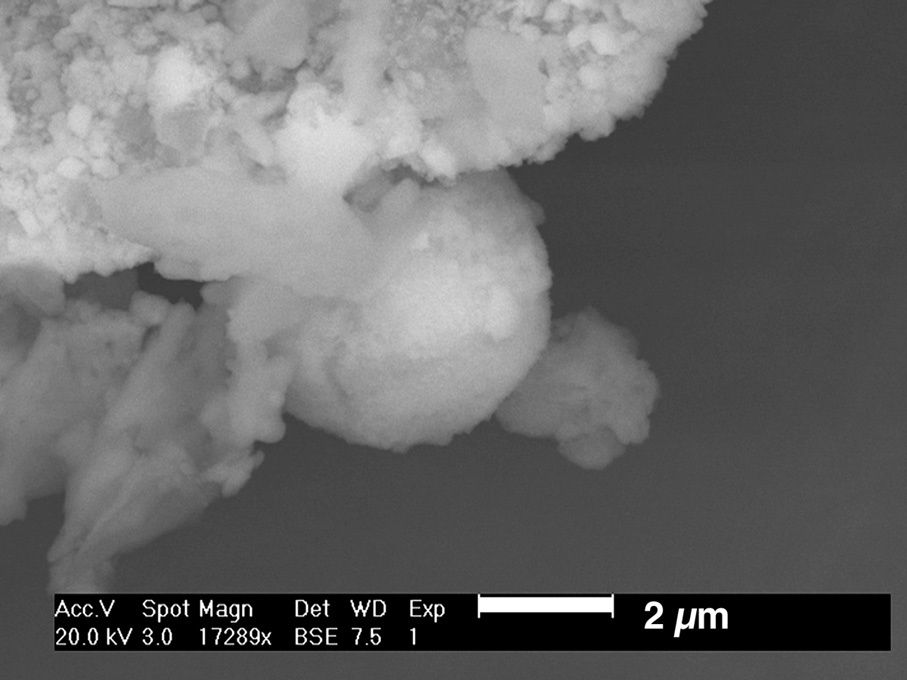
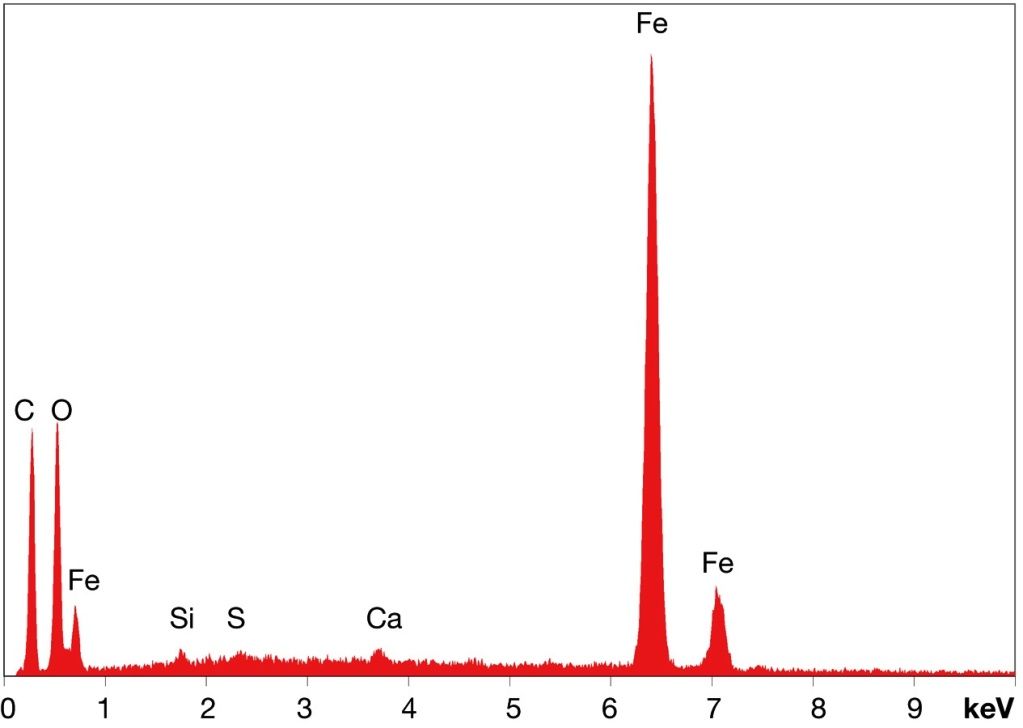
And actually, the evidence that any actual elemental iron microspheres were found in their residue is rather thin, and they don't relate any quantities! The only bit of data that speaks for elemental iron is Figure 21:

ActiveThermiticMaterial_Fig21a_orig.jpg

ActiveThermiticMaterial_Fig21b_orig.jpg

"Fig. (21) Spheroid found in post-DSC residue showing iron-rich sphere and the corresponding XEDS spectrum. The carbon peak must be
considered indeterminate here since this sample was flashed with a thin carbon layer in order to preclude charging under the electron beam.
"

We are lead to believe that the XEDS spectrum is from the round thing in the center of the image, a ball ca. 4.5-5 microns across.

While the spectrum, supposedly done with a 20 keV beam, indeed seems to indicate too little O to oxidize all the Fe, I find that data questionable. Here's why: In the mass in the top left of the image, you can see many of the 100 nm faceted grains of iron oxide pigments present in the paint already before burning. They appear much more densely packed than in the unburned paint - so they must have agglomerated after much of the organic matrix decomposed and burned. You also see some of the hexagonal platelets of kaolin, that evidently experienced no melting at temperatures up to 700 degrees, proving they did not contain any free Al. So that mass of "thermite" evidently did not react chemically in any way, shape or form, except for the organics that vanished.
So how come there's an "iron" ball attached to that "thermite"? If that "iron" ball had been liquid and near the melting point of bulk iron at the time it solidified (froze), why did the heat not ignite the rest of the "thermite" it immediately touched?

My main problem however is the shade of gray: This is a BSE image. In BSE images, the brightness of a "pixel" is determined by the average atomic weight of the atoms. It would be near white for heavy atoms, and near black for very light atoms. As we can see, it is some light gray for the kaolin plates (Si-Al-O), which have an average atomic weight of 15 (including hydrogen; 19 excluding hydrogen), and somewhat brighter for the hematite grains - average atomic weight is 32. If the ball in the middle truly were mostly iron, its average atomic weight would be well above 40, and it should appear even brighter. But it doesn't. Why? Well, in that image, it appears to be behind the plane of focus. It may simply be a case of sloppy work on the SEM machine! And that is perhaps also the reason why that ball appears smoother and more uniform than the other mass - although it really isn't smooth! I tend to think that if the electron microscope had been properly focused on that ball, we'd see it consists of another agglomeration of hematite pigments, pulled together in a shape approaching a sphere by cooling remains of organic char. And the XEDS spectrum might look different, too.


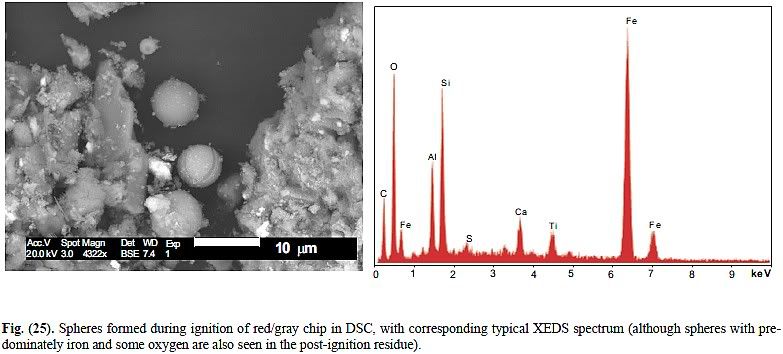
Another Figure has the caption:
"Fig. (25). Spheres formed during ignition of red/gray chip in DSC, with corresponding typical XEDS spectrum (although spheres with predominately iron and some oxygen are also seen in the post-ignition residue)."
Link:
ActiveThermiticMaterial_Fig25.jpg


Now that spectrum clearly shows an archetypical Si-Al-Fe glass sphere that is even more typical for ashed from mixed mineral/organic combustions than iron-rich spheres, and does not show an iron-rich sphere at all!
I strongly wonder: If "spheres [plural!!] with predominately iron and some oxygen are also seen", why don't they just show them in the paper? Or is Fig 21, that dubious and sloppy piece of worl, really the only vague hint?


I think before we try to bend over backwards to explain iron spheres, we should ask for better proof there actually were any iron spheres at all - and ask for proof they made up a significant portion (say, >5% by weight) of the residue. And while we are at it: Find as much Al2O3 in the resdiue, too!


Oh and by the way: Steven Jones has declared:
ProfJones said:
I (Dr. Jones) have searched Millette's plots and see no indication of strontium (Sr) or lead (Pb) in his samples, but he does report titanium (Ti) which we do not see. Thus, his samples do not appear to be the same material as what we reported on.
Well, in the DSC residue shown in Fig 25 I "see no indication of strontium (Sr) or lead (Pb) in his samples, but he does report titanium (Ti)". Thus, this sample does not appear to be the same material as what they reported on elsewhere in the paper. :p
 
Oystein: Thanks:cool:

You posted the same Fig. 21 as Sunstealer yesterday. Sunstealer thinks the he sees quite clearly kaolinite hexagonal platelet (and rhomboidal hematite crystals), but is it really that conclusive? I mean... could be this hypothesis (this platelet is kaolinite) used as a kind of evidence in some scientific debate, or in the serious debate with educated truthers? I still have some doubts. Other pigments (e.g. in Tnemec primer ) could have basically the same appearance here. (It is really pitty that we have no detailed micrographs of Tnemec primer available, but this is one of the things which can be corrected comparatively easily (it should not be really great problem to scratch some paint from some monument made of WTC perimeter columns and look at this sample with an electron microscope)).

But, if Sunstealer is right (and I tend to trust him because of his long practical experience), this chip (its remains) should be "Laclede paint" chip, as well as all other burned chips in Fig. 20:cool: They look all the same, with all those similar shiny globules, they should be the same material.

Also: whereas we have very little direct evidence from Harrit et al that microspheres in Fig. 20 are really iron-rich (the less purely "iron"), they should originate from the gray layers, as Sunstealer pointed out again yesterday. From that point of view, they really should contain mostly iron stuffs, indeed in some mixture with Si, Al and other stuffs present originally in red layers, or even on them (as accidental surface contaminants).
 
Last edited:
"Hey gang,

On behalf of Jim Millette, I DID contact Kevin Ryan and asked him for samples of the red-0grey chips they found and reported on in the Bentham paper. Jim Millette wanted the chips but was denied them. As Jim reported in his preliminary paper, when he was unable to obtain samples from Ryan/Jones/Harrit et al he followed their protocol and found the same kind of chips in the WTC dust himself. MM it is unfair for you to blame Millette for Ryan's refusal to cooperate. You can justify Ryan's refusal but at least dona't accuse Millette of going forth with his own samples when that's all he could get his hands on. And BTW I believe the protocol for finding those chips was clearly explained in the Bentham paper and Millette was successful in finding the same kind of samples... and many 9/11 Truth people agree that Millette did indeed find the same red-grey chips.
"

As you know Chris, Kevin Ryan has trust issues with Dr. Millette.

Having observed and financially contributed to the Millette research, I can quite understand Kevin Ryan's reluctance to participate.

The problem is not so much Kevin Ryan's refusal to provide relevant red chip samples, but Dr. Millette's refusal to test them in the same manner followed by Dr. Harrit.

Dr. Millette happily accepted $1,000 for work on a paper he had already started and was under obligation to produce anyway.

Dr. Millette used his own WTC dust samples, his own equipment, and his own time.

He also followed a methodology which appeared to duplicate the original study by Dr. Harrit et al only so far as the red chip separation and some preliminary microscopic analysis. Up until that point, his observations were pretty much in agreement with the original study.

But Dr. Millette's company does not own a DSC and he had no interest in sub-contracting one for comparison purposes.

Such a definitive approach would go to the heart of the Bentham Paper, but it would also expand the number of people familiar with those test results (re: DSC technician).

Assuming Dr. Millette actually read through the original Bentham Paper, he would have been well aware of the sensational nature of the DSC red chip residue.

Clearly, even without a DSC, if Dr. Millette had heated his collection of red chips to 430C or higher, he should have ignited some of those red chips and produced a similar residue containing iron-rich microspheres as those observed by Dr. Harrit et al.

But then, he would have a serious quandary.

MM
 
...
He also followed a methodology which appeared to duplicate the original study by Dr. Harrit et al only so far as the red chip separation and some preliminary microscopic analysis. ...

Well, did he do that part right?
Did he use the method that was "all set out" in the Benthan paper, as Frank Legge said, and you agreed?
Or would he have to contact the authors to know exactly how to do the the red chip separation correctly? Cuz ya know, Professor Jones thinks that "his samples do not appear to be the same material as what we reported on"!
 
I admire the dedication of many of you, but this thread should perhaps be renamed "A study into MM's evasion techniques".
 
"Please provide some examples of materials you believe should have commonly existed in the dust of the WTC, that would be expected to ignite around 430C.

Materials, which upon ignition, rapidly generate temperatures in excess of the 1535C producing molten iron, which cools into iron-rich microspheres.

MM"
"Hehe:D Incredible;):D:D

MM: clear, perfect, typical, "archetypal", undisputable, absolutely ideal examples of materials commonly existed in the WTC dust, that would be expected to ignite around 430C, are.......(surprise):
Paints
"

And Paints as you put it, upon ignition, rapidly generate temperatures in excess of 1535C, producing molten iron, which cools into iron-rich microspheres.?

MM
 

Back
Top Bottom