Merged Thread to Discuss The Excellent Analysis of Jones latest paper

There is a pic on there website

http://www.clarkson.edu/news/2012/news-release_2012-09-07-2.html

Not the best quality but better than nothing.

Thanks:o) If I lived in New York, I would definitely visit this monument and measure the dimensions of these steel elements:cool: But I'm/we are still reliant just on such "detective work on distance". Anyway, it's still a kind of a weird fun for me:blush:

And If I visited this monument, I would also definitely scratch some sample of paint from it and try its behavior in MEK (whether it is gradually dissolved or only swollen in this solvent after some tens of hours):cool:
 
Nice and useful find, Ivan! You are the greatest finder of things here :)

I don't see a date when Jones held this lecture, but it was before the upload date 01/21/2011, and after the AE911T petition reached 1,000 signatures, which was in january 2010. By january 2011 they had over 1,400, so I would intuit that this was closer to the earlier date, in the first half of 2010.


The first useful information in the video is that Professor Jones personally argues that the chips are not paint because their spectra don't resemble that sample from the Clarkson memorial. This implies an answer to what he asked me recently at 911Blogger:

The answer is: ProfJones, you logically implied such a claim in a lecture you gave in 2010, recorded in this video: http://www.youtube.com/watch?v=fucU3yq5KWE

And here is why:

At 1:44 in the video:
"Perhaps it [the red-gray chips] is just paint, an in particular primer paint, which was applied to the WTC steel, which has a red-orange color, similar to the color that we see here. So, we finally found a sample of the primer paint."
"A" sample of "the" primer paint, both singular, logically implies one paint only.

Jones goes on and describes how someone scratched this sample from the steel at Clarkson University, and presents its chemical signature. He then explains, starting at 2:55, showing the image that Ivan produced above:
"What we have is the analysis of the paint on the bottom plot, and, for comparison, the ... elemental signature for the red chip material on the top plot."
(Note that this singular "the material" implies only one material which red-gray chips are made of - another false assumption on his part. He continues:)
"You can see that they are distinctly different. The paint shows a very strong signal of Zinc. There is no zinc in the red chip material."
(We all know why: Because he compared with only one of the several red chip matrerials. Another, represented by the MEK-soaked chip, has a clear Zinc-signal)
"There are other differences that you can see: The Calcium peak is enormous in the paint, for example."
(Yes, and it is also enormous in Fig. 14, the MEK-soaked chip!)
Jones concludes: (3:31)
"Now, when we look at the red material, this anomalous - now we can call it anomalous because it doesn't behave like paint, certainly very distinct from the primer paint actually used in the WTC."

ProfJones should now admit that he drew that conclusion based on the assumption that all the primer paint actually used in the WTC had the characteristics of that sample from the Clarkson memorial, such as Zinc and Calcium content.

ProfJones should now concede that he was unaware of the existence of at least one other primer paint actually used in the WTC that does not contain Zinc and Calcium, namely the LaClede primer paint on the floor joists. Clearly, the Clarkson memorial is made of steel from the core columns, not the floor joists, so he can't validly conclude that "the" red material is "very distinct from the primer paint actually used in the WTC" - he didn't compare with any other primer paint actually used in the WTC.

Here is a comparison of Jones's red material, from chip b, with a primer paint actually used in the WTC, the LaClede composition (according to the published composition; note that I scaled Fig 7b, bottom, such that its Si-peak has the same hight as the Si-peak in the LaClede simulation, top):

[qimg]http://i1088.photobucket.com/albums/i328/MikeAlfaromeo/LaClede/Sim_vs_Fig_7b.jpg[/qimg]

These signatures are virtually identical. ProfJones, please acknowledge!

Oystein,
Please let me know when you and/or Ivan or whoever finds something Jim Millette should know about. If we have known spectra for LaClede that Millette doesn't have, Millette needs this. He has been unable to find any LaClede samples to test but a good LaClede spectrum might be great to pass on to him. I want to keep nudging him with new info to see if we can get the momentum going again on his study of the red-gray chips.
 
Oystein,
Please let me know when you and/or Ivan or whoever finds something Jim Millette should know about. If we have known spectra for LaClede that Millette doesn't have, Millette needs this. He has been unable to find any LaClede samples to test but a good LaClede spectrum might be great to pass on to him. I want to keep nudging him with new info to see if we can get the momentum going again on his study of the red-gray chips.

I certainly keep my eyes open for such stuff, but have little hope that anybody would have consciously looked at floor truss steel and its paint.

The most interesting source that I know of but can't tap is Jeff Farrer, far and away. I want to see his TEM-data! I want to see where and how he saw Strontium and Chromium!

The Jones lecture on YT that Ivan linked to has Jones showing actual TEM results by Farrer, from an iron oxide grain. Since all sides agree on the presence of iron oxide grains in pretty much all red chips, that data is not interesting in and of itself, but it shows that Jones had access to Farrer's TEM data at the time! I try to keep open a line to Jones, in spite of the total effective censorship at 911Blogger and Jones's obvious aversion to addressing the hard issues we are facing him with. But I don't have any line to Farrer.
 
REMO: You are right that the steel of Clarkson memorial can basically originate from other buildings than WTC1 and 2. But it is expilicitly written on the web arstore.org: "Two of the structural steel beams came from the fifty-fifth floor of the South Tower of the World Trade Center"." And, among others, WTC7 had only 47 floors.

Vertical elements of the memorial are anyway hardly structural beams, they should be structural (core) columns, so the info on the web arstore.org is probably not correct in everything.
On the right column, the numbers 70-80 are readable, and the number 70 is readable also on the horizontal element (upside down). This could be a key for the identificaton of the steel (and also some inquiry to the architect of this monument can help:cool:).

(It's perhaps also noteworthy how clearly you truthers see the evidence of 9/11 inside job in this memorial, as well as in NYPD museum or tens/hundreds of other public places/databases, which again raises the very basic question: WTF, was this inside job secret, or was it intentionally planned to be recognizable by anyone with the access to the net/public places? But this is of course off-topic here:cool:)
 
Last edited:
Oystein,
Please let me know when you and/or Ivan or whoever finds something Jim Millette should know about. If we have known spectra for LaClede that Millette doesn't have, Millette needs this. He has been unable to find any LaClede samples to test but a good LaClede spectrum might be great to pass on to him. I want to keep nudging him with new info to see if we can get the momentum going again on his study of the red-gray chips.

Chris,
simulated XEDS spectra of Laclede paint were presented in our (Oystein's and mine) white-paper, which was sent to Jim Millette months ago. But it is possible that Jim was not "patient" enough to read this long and complex text and he could even overlook this important detail (yes, we still consider this simulation as important and very telling:cool:)
 
It's interesting to see that in the enhanced picture provided by Ivan, there is hardly any paint left on the structure. At a guess I would say 98% is rust ?

This comes as no surprise due to being subjected to fire, collapse impact and being left open to all weather conditions.

Was the sample collector aware that red areas on the monument are infact primer paint ? Or did they suspect the red area to be the explosive compound they were looking for ?

Perhaps a truther could point out on the picture where they think the thermite was ?
 
It's interesting to see that in the enhanced picture provided by Ivan, there is hardly any paint left on the structure. At a guess I would say 98% is rust ?

This comes as no surprise due to being subjected to fire, collapse impact and being left open to all weather conditions.

Was the sample collector aware that red areas on the monument are infact primer paint ? Or did they suspect the red area to be the explosive compound they were looking for ?

Perhaps a truther could point out on the picture where they think the thermite was ?

Here is the image:

picture.php


I would say (but I'm not sure) that some red primer is still apparent namely on the right vertical piece, especially on its lower part:cool:

I have of course no idea what were the thoughts of samples collectors, but S. Jones and his fellows (justly) considered those samples as "WTC primer paint", not nanothermite.
Which is perhaps rather strange, since according to truthers, core columns (if these are core columns) were by far the best "targets" to be "undermined" with "devastating" layer of red nanothermite (almost 100 micrometers thick, this is more than/equal to the crossection of human hair! How mighty weapon!):cool:
 
Last edited:
Spanx: I read in the old article on 911Myths that Jones obtained not only primer paint samples from Clarkson 911 memorial, but also samples which should prove "molten metals":cool: A quote:

"A monument constructed primarily from structural steel from the WTC Towers located at Clarkson University in Potsdam, New York, is the source of previously-molten metal samples...

The samples were sent directly to Prof. Jones at BYU, and inspected by him and Dr. Jeffrey Farrer together, and analyzed by the BYU group."


So the same memorial was a source of some molten metal for Jones (personally I do not see any), as well as of (unburned) red primer paint, but not of nanothermite, which should create this molten metal by extreme temperature (?!). I stay confused:rolleyes:

Anyway, also web 911Myths is/was not sure, as for the exact source of steel in Clarkson memorial. Perhaps (a quote) "N.Y. Clarkson alumnus Michael Bielawa, who supervised cleanup efforts at ground zero and donated three pieces of structural steel to the school" would know more...
 
Last edited:
Chris,
simulated XEDS spectra of Laclede paint were presented in our (Oystein's and mine) white-paper, which was sent to Jim Millette months ago. But it is possible that Jim was not "patient" enough to read this long and complex text and he could even overlook this important detail (yes, we still consider this simulation as important and very telling:cool:)
OK now I am confused. Can you send me a link to your white paper? Have I already read this? Very importantly, can you also cite a page number I can point to for Jim Millette and show him what you have re spectra of LaClede paint? And what do you mean by "simulated spectra?"
 
OK now I am confused. Can you send me a link to your white paper? Have I already read this? Very importantly, can you also cite a page number I can point to for Jim Millette and show him what you have re spectra of LaClede paint? And what do you mean by "simulated spectra?"

Chris,
I (or Oystein) can send you a copy of this "white paper", since it was not published on the net, therefore no link is avaiable.
Instead of publishing it, Oystein decided basically to split up this "paper" into several contributions on his blog, which is perhaps "more flexible" and "more readable" solution.

As for XEDS spectra of Laclede paint for WTC floor trusses: we have no access to this paint, as well as Jim Millette.

But we know its elemental composition from the specification presented in NIST NCSTAR 1-6b report (except the exact elemental composition of epoxy binder, in which there is some uncertainity in the content of oxygen and nitrogen).
At such circumstances, expected (real) XEDS spectra of the material can be calculated/simulated, as was first shown by The Almond here, but repeated later also by Oystein using the same program.
You can see this simulated spectrum and its comparison with the real spectra of the Bentham red-gray chips (a) to (d) again here in the Oystein's post No 1184.

Indeed, the match of the simulated XEDS spectrum of Laclede paint and the real spectra of these four chips is simply stunning and very convincing and can easily be used even as an evidence e.g. "at bar". I think:cool:

Just look here again (the first spectrum is simulated Laclede paint, the second is the real spectrum of one of Bentham chips (a) to (d)):

picture.php
 
Last edited:
and the number 70 is readable also on the horizontal element (upside down). This could be a key for the identificaton of the steel (and also some inquiry to the architect of this monument can help:cool:).

Ivan,

It looks like that horizontal member is from WTC7. I am looking through the WTC7 blueprints and steel fab drawings to see if I can find a match. I count 5 bolts on the left side for a connection and 6 bolts in the middle of the member for a connection that came off from one side. Shear studs on the bottom are similar to what was used for the concrete floor in WTC7.

I'll see of I can dig up something more.
 
Ivan,

It looks like that horizontal member is from WTC7. I am looking through the WTC7 blueprints and steel fab drawings to see if I can find a match. I count 5 bolts on the left side for a connection and 6 bolts in the middle of the member for a connection that came off from one side. Shear studs on the bottom are similar to what was used for the concrete floor in WTC7.

I'll see of I can dig up something more.
It could just as easily be from the basement levels of the towers (remember they were more traditionally framed). The configuration is not really all that unique. I suspect you will have a very hard time actually identifying it.
 
Ivan,

It looks like that horizontal member is from WTC7. I am looking through the WTC7 blueprints and steel fab drawings to see if I can find a match. I count 5 bolts on the left side for a connection and 6 bolts in the middle of the member for a connection that came off from one side. Shear studs on the bottom are similar to what was used for the concrete floor in WTC7.

I'll see of I can dig up something more.

In the video of SE Jones's 2010 presentation at a AE911Truth press conference (I believe on the occasion of their reaching 1000 A&E signatures in januars 2010)...
http://www.youtube.com/watch?v=fucU3yq5KWE
... he explains how that paint sample from the Clarkson Memorial was retrieved (starting ca. 2:30):
ProfJones said:
The fellow that put the monument together for the university was kind enough to go to the monument and extract some of the paint off the surface.
This sounds as if this was done after the memorial was erected, and would make it seem most probable that this paint sample was scratched from one of the three upright members and not the horizontal girder on top, as that would ne the most difficult to reach. I guess we'd need to figure out then the location within the WTC complex of all of these major elements to make an educated guess. We can rule out however twin tower floor trusses and perimeter, based on eye-balling dimensions. Since it is said elsewhere that some members are from the 55th floor, that leaves core columns as the only option - and perhaps core girders/beams?


What are the dimensions of typical WTC7 girders, such as the famous one between columns 79 and 44 that did, or didn't, walk off its seat?
 
OK now I am confused. Can you send me a link to your white paper? Have I already read this? Very importantly, can you also cite a page number I can point to for Jim Millette and show him what you have re spectra of LaClede paint? And what do you mean by "simulated spectra?"

I am confused that you are confused. I have always been under the impression that I must have mailed you a draft of our paper that I never finished, and that you had forwarded it to Millette?

I am not happy with it anymore, based on criticism I got from a couple of draft readers - too long-winded.

My blog post Another primer at the WTC: LaClede Standard Primer (http://oystein-debate.blogspot.de/2012/03/another-primer-at-wtc-laclede-standard.html) is probably the best description for Millette. It has the pertinent References to the LaClede paint composition, my derivation of elemental composition, and my simulated XEDS graph for that composition as well as a copy of the chips a-d red layer XEDS. Millette will see instantly that the match is brilliant, and of course he understands that his and Farrer's images of the pigments, hematite and kaolin, are wonderful matches.

What's missing there is my speculation that Fig. 10 of the Harrit paper may show one or two pigmente of Strontium Chromate. I'll post the images here:
First, the original Fig. 10:
ActiveThermiticMaterial_Fig10.jpg


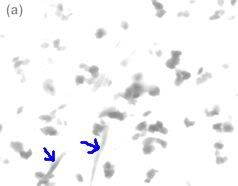
it shows in (a) a BSE-image of a region on chip a. We see kaolin plates and hematite grains. Some of the kaolin plates are shown edge-on. The most interesting property to look for here is that, in BSE-images, brightness is determined by the atomic weight of the atoms: Regions with heavier atoms such as Fe, Sr or Cr would appear the brightest, regions with no or hardly any heavy atoms, but rich enough in medium weight atoms such as Al and S appear in some medium gray, and regions where there are only light atoms such as O, C and H appear dark. Thus, the hematite grains are white, the kaolin plates are grey (even if edge-on), and the matrix-only areas appear dark.

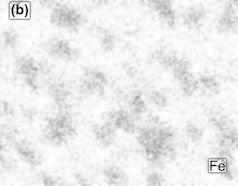
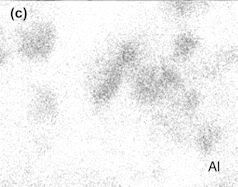
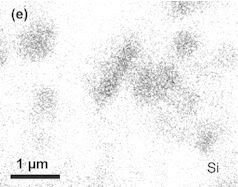
Fig 10 (c) and (e) shows the distribution of Al and Si, and as we have all already noticed, these distributions match each other nicely, and they also match the distribution of the kaolin plates in (a). This indicates that pretty much all the Al and Si is found in these plates, and that's part of the reason we are so sure this is in fact kaolin and no elemental Al.

Fig 10 (b) shows the distribution of Fe. It seems to coincide fairly well with the white grains in (a), but the picture is a little fuzzy here. So, in order to help vision, I did some image editing on (a), (b), (c) and (e): Converted them all to grayscale, inverted them (negative image), increased contrast and adjusted gamma (brightness) such that the main features of the distribution stand out better. Then compare:

ActiveThermiticMaterial_Fig10a_inverted.jpg
ActiveThermiticMaterial_Fig10b_inverted.jpg

ActiveThermiticMaterial_Fig10c_inverted.jpg
ActiveThermiticMaterial_Fig10e_inverted.jpg


The two blue arrows point at thing, long particles ("acicular" = needle-shaped) that have no corresponding signal in the Fe-map, and also no corresponding signal in the Al- and Si-maps! So I say: These two pigments are neither iron oxide nor kaolin-plates edge-on. So what are they? In my opinion, these are candidates for Strontium Chromate pigments. Such pigments look like this (under a photomicroscope):

SrCr_7_Image.jpg


We have a match for shape, we have a match for size (the two particles I point to in (a) are about 1 micrometer long; SrCr=4 pigments are typically 1-4 micrometers long), and we have a match for the general atomic weight as per BSE image intensity.


So this is what Millette could have been looking for (and I admit I see no obvious candidate of this kind in Millette's data).
 
In the houses of shadow everybody lies.

Mr Kminek's question,"WTF, was this inside job secret, or was it intentionally planned to be recognizable by anyone with the access to the net/public places?. Intentionally planned? You cannot mean that. The intentional planning was the demolition. There were ALWAYS going to be indicators. YES. To be recognizable by anyone with access to net/public places! YES. You just have to read more widely to see it. The girder in photo length appears too short to be that between 44 and 79 which would be same basic size, just longer by memory 54'?.[W33x130. 30 Studs].
Those shear studs are however, within the context of computer construct verses physical reality, which is what we are talking of here, 'of the same' as those in collapse initiation hypothesis. It is material of exactly that same nature the NIST report had to manufacture the breaking of before their hypothesis even began. By inventing, and i say this plainly, inventing the differential stresses to allow it. NCSTAR 1 -9:352

"As for XEDS spectra of Laclede paint for WTC floor trusses: we have no access to this paint, as well as Jim Millette. But we know its elemental composition from the specification presented in NIST NCSTAR 1-6b report (except the exact elemental composition of epoxy binder, in which there is some uncertainity in the content of oxygen and nitrogen)."
 
Mr Kminek's question,"WTF, was this inside job secret, or was it intentionally planned to be recognizable by anyone with the access to the net/public places?. Intentionally planned? You cannot mean that. The intentional planning was the demolition. There were ALWAYS going to be indicators. YES. To be recognizable by anyone with access to net/public places! YES. You just have to read more widely to see it. The girder in photo length appears too short to be that between 44 and 79 which would be same basic size, just longer by memory 54'?.[W33x130. 30 Studs].
Those shear studs are however, within the context of computer construct verses physical reality, which is what we are talking of here, 'of the same' as those in collapse initiation hypothesis. It is material of exactly that same nature the NIST report had to manufacture the breaking of before their hypothesis even began. By inventing, and i say this plainly, inventing the differential stresses to allow it. NCSTAR 1 -9:352

"As for XEDS spectra of Laclede paint for WTC floor trusses: we have no access to this paint, as well as Jim Millette. But we know its elemental composition from the specification presented in NIST NCSTAR 1-6b report (except the exact elemental composition of epoxy binder, in which there is some uncertainity in the content of oxygen and nitrogen)."

? :confused:
 
Mr Kminek's question,"WTF, was this inside job secret, or was it intentionally planned to be recognizable by anyone with the access to the net/public places?. Intentionally planned? You cannot mean that. The intentional planning was the demolition. There were ALWAYS going to be indicators. YES. To be recognizable by anyone with access to net/public places! YES. You just have to read more widely to see it. The girder in photo length appears too short to be that between 44 and 79 which would be same basic size, just longer by memory 54'?.[W33x130. 30 Studs]. ...

Wow, you have Pulitzer Prize winning information, but you are unable to take action to team with a newspaper to earn the biggest Pulitzer since Watergate. What is stopping you?

The fact is Jones made up thermite as the cause of the WTC demise based on nothing; now you support, may I say, blindly support the lie that it was an inside job based on the delusions of a failed physicist, who best work it Christ walking with native Americans. His work with Christ is much more real, than his claims he found active thermite in WTC dust.

How many newspapers has turned you down with your massive piles of evidence to support the inside job fantasy? What action will you take now?
 
Oystein: Personally I would omit this speculation on possible strontium chromate needles in any info for Jim Millette, we have enough of much, much better stuff, which is definitely not speculation, e.g. those simulated Laclede primer XEDS spectra, thicknesses corresponding to "Laclede", expected main pigments found, epoxy binder found... you know:cool:

Chris: Can you inform us what Jim Millette actually knows about Laclede primer and its existence "discovered" here in JREF?
Once again: Jim Millette considered only one old WTC primer (Tnemec brand) as a material of red layers in his preliminary report, because he found its specification in NIST reports. But the specification of "Laclede primer" is presented in NIST reports as well and in a great detail! And many of XEDS spectra measured by Jim Millette (those which were taken on freshly cut chips) correspond to Laclede primer quite well, I think. Therefore, Jim Millette should really consider Laclede primer paint at least as a possible material of some of his chips, which is quite crucial in this falsification of Bentham paper.

Beachnut: "Jones work with Christ is much more real, than his claims he found active thermite in WTC dust."
Exactly:rolleyes: More generally: whereas it is still possible that Jesus Christ visited America (why not? his "curriculum vitae" is not well known, good ships were available, no problem) , the probability that anyone bothered with the "auxiliary" controlled demolition of WTC is very apparently a plain zero . People who are able to seriously claim such an utter, imbecile, desperate jackassry should loose their right to vote and their legal capacity. At least:rolleyes:

Remo, you quoted me: "As for XEDS spectra of Laclede paint for WTC floor trusses: we have no access to this paint, as well as Jim Millette. But we know its elemental composition from the specification presented in NIST NCSTAR 1-6b report (except the exact elemental composition of epoxy binder, in which there is some uncertainity in the content of oxygen and nitrogen)."
You probably think that this uncertainity is some problem for us. But it is not so. Whereas we have been unlucky in some respects, e.g. it would be very difficult to find any samples of authentic Laclede primer, we are lucky in this case. Uncertainty in oxygen content in the binder is anyway just slight and not imporant (common epoxy resin is always based on Bisphenol A/epichlorhydrin precursors with basically given oxygen content). And nitrogen is supposed to have a very weak XEDS signal in such a material, as explained by Almond (and proven by many published XEDS spectra of epoxy resins cured with amines). And the content of other elements is given in the paint specification. This is why XEDS spectrum of Laclede primer can be calculated/simulated with a quite high "precision". Do you understand? (very probably not, but who cares:rolleyes:).
Otherwise, I basically appreciate your attempts to help us with the identification of the steel in Clarkson memorial:rolleyes:
 
Last edited:
Ok, I'm not getting the steel beam thing.

What does it matter which of the buildings the beams came from ?

Is it a case of implying that Wtc7 had thermite and 1&2 didn't ?

As far as molten metal on the beams, they have all been cut so what's the surprise ?
 

Back
Top Bottom