• Quick note - the problem with Youtube videos not embedding on the forum appears to have been fixed, thanks to ZiprHead. If you do still see problems let me know.

WTC Dust Study Feb 29, 2012 by Dr. James Millette

Two pages up,m I linked to Fig 9 which I uploaded to my Photobucket account. I just noticed that Photobucked scaled it down, from 1291x968 pixels and 247 KB to 1023x767 pixels and 64 KB.
I've uploaded the original (extracted from the paper in raw form) here:

http://www.formauri.es/personal/pgimeno/xfiles/cache/atm-007.jpg

The resolution is indeed 1291x968. File size is 310 Kb. I don't know how you got a 247 Kb file, probably the extraction method you used recompressed it. I guarantee that file to be extracted verbatim from the PDF. It starts at offset 493851 hexadecimal (4,798,545 decimal) and spans for exactly 318,054 bytes.

For those using Linux, it can be easily done with the standard system utility dd, which can be used to extract raw fragments of a file:

Code:
dd if=7TOCPJ.pdf of=Figure9.jpg bs=1 count=318054 skip=4798545

For those using Windows, no idea. There are hex editors that I've heard can extract portions of files. Googling I've found [nfurl]www.softpedia.com/get/System/File-Management/File-Parter.shtml[/nfurl] which claims to do that, but I can't give any guarantees.
 
Alright, I am not that techie ... I simply highlighted the image, right-clicked, copied, then pasted into my favorite image editor, IrfanView (that preserved pixelresolution) - and then saved as jpeg, which compressed file size (I probably saved at a setting of "95%". At 100%, file size is 502 KB).

Anyway, there isn't really a visible difference between these versions.
 
Anyway, there isn't really a visible difference between these versions.
That was actually my point, since MM seemed to make a big deal of the "low resolution 68 KB JPEG image" (defining "low resolution" as "79% the original size"). I was actually just proving that 1291x968 is the exact resolution available in the paper, and providing means for those who want to check.
 
Last edited:
"That was actually my point, since MM seemed to make a big deal of the "low resolution 68 KB JPEG image" (defining "low resolution" as "79% the original size"). I was actually just proving that 1291x968 is the exact resolution available in the paper, and providing means for those who want to check."
bolding is mine

On what basis do you assume that the embedded images in the Bentham Paper pdf are the same resolution as the originals.

The JPEG format is a lossy format.

Your 79% the original size, is 79% of a lossy copy of a lossy embedded pdf image.

The pdf image, is a cropped and compressed for publication copy of the original high resolution recorded image.

A typical professional digital back would be at least an 18 MP, producing RAW files upwards of 31 MB, a lot of data.

Where is the quality in an explanation that relies on a ruler measurement applied to a multiple generation, lossy, 68,000 byte image copy of an original, lossless, RAW image of 31,000,000 bytes or higher?

MM
 
MM,

1. Did you notice that pgimeno linked to an image with 100% of the resolution available from the Bentham paper, not 79%?
2. Did you notice that my original assessment (3.5 nm per pixel) was also derived from the 100% resolution, not 79%? I only linked to the lower resolution on my Photobucket account, being unaware that Photobucket had resized it. pgimeno fixed that problem. Does it hurt you physically to recognize and acknowledge that we readily corrected an honest and irrelevant mistake?
3. Did you notice my post 875 which supercedes the argument from pixel resolution with regard to the maximum capabilities of the particular SEM device that the Bentham authors used?
4. Did you notice that, according to Chris Mohr's paraphrasing of the convesation with Gage, Richard Gage determined from the Bentham paper that there are spheres 100 that are only atoms across - a claim that simply does not stand up to scrutiny, and is easily refuted by just looking at the Bentham paper?

I fully expect you to give me four separate answers to these four separate questions from which I can clearly determine whether or not you noticed 1.-4.!
 
"Nanothermite in the WTC has been disproven because:

1) ____________________________

2) ____________________________

3) ____________________________ "

1) No trace of thermite, nano or otherwise was found. No evidence, no residual.
2) Thermite, nano or otherwise, would not cause the demolition.
3) No trace of ANYTHING outside of the known and provable established causes, to wit the impact and fires caused by the observed aircraft, have ever been found. No evidence what so ever, of anything that might over come the null hypothosis.

You know what the null hypothosis is right?
 
Yes, I've noticed this. How many opportunities have you guys had to present your case now? What is the difficulty?

"Nanothermite in the WTC has been disproven because:


"Nanothermite in the WTC has been disproven because:

Many reasons, not least which the chips don't have enough thermitic compounds to react...

True or false, Ergo: a thermitic reaction requires both a fuel and an oxidizer
True or false, Ergo: the Harrit/Jones chips are mainly composed of Carbon
True or false, Ergo: thermite does not use Carbon as an oxidizer (unless you can find an example of one that does!)
True or false, Ergo: Thermite is composed MAINLY of a fuel and an oxidizer, not something else.

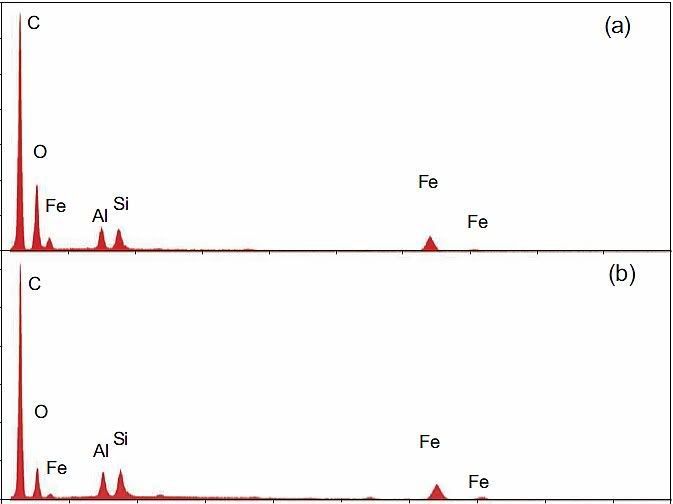
So how can this be thermite or nanothermite, Ergo? Please explain chemically how this could be so. It is Harrit's own XEDS data from the chips.

ActiveThermiticMaterial_Fig07_ab.jpg
 
A mystery of missing strontium chromate solved?

To Oystein, Chris Mohr and others who may be still interested:cool:

Well, if some/many of chips investigated by Jim Millette are Laclede primer chips (as is indicated by their XEDS spectra and/or kaolinite pigment and/or epoxy resin, not speaking to iron oxide), they should contain ca 1.5 % of strontium chromate. This anticorrosive stuff should have a form of yellow crystalline needles with the lenghts of some micrometers or so. But, Jim has not found any strontium chromate, at least using his methods (XEDS, various microscopy).
(On the other hand, N. Harrit was so very kind and showed us a detailed XEDS spectrum of „Bentham chip a“, in which some strontium and chromium signals are detected – in his white paper WHY THE RED/GRAY CHIPS ARE NOT PRIMER PAINT.)

OK, it could not be easy to find pigment in such a low concentration in the paint, but is here any other explanation? Could strontium chromate crystals somehow „dissapear“ from the Laclede paint?
Yes, I think so (after some short study):cool: The matter is that up to now, I hadn' t any closer idea how this pigment could behave during electrocoating/curing/usage of Laclede primer paint, especially I have mostly overlooked passivation processes as important parts of anticorrosive action. In my head, there was only info that strontium chromate is very sparingly soluble in water.

Here is a short excerpt from the lengthy article COATINGS FOR CORROSION CONTROL:

„The utility of chromate pigments for passivation is well established. Various mechanisms have been proposed to explain their effectiveness (38). All the proposed mechanisms require that the chromate ions be in aqueous solution. Like all passivators, chromate ions accelerate corrosion at low concentrations… Sodium dichromate is an effective passivating*agent, but would be a poor passivating pigment; its solubility in water is too high. It would be rapidly leached out of a film and would probably cause massive blistering. At the other extreme, lead chromate is so insoluble that it has no electrochemical action...
Strontium chromate (SrCrO4) has an appropriate solubility in water (5x10⁻³ mol CrO4/l) and is sometimes used in primers, especially latex paint primers…etc.“


This should mean that strontium chromate needles in the freshly electrocoated paint are gradually dissolved in the aqeous environment of the swollen paint, and they are probably further dissolved during curing and perhaps even later. Therefore, they could be basically missing in the paint, or they at least could change substantially their original form during this dissolution.

It seems that the fate of strontium and chromate ions („dissolved“ in water) in such wet paints is not really clear (I will add some good reference tomorrow), but chromate ions should travel to the painted steel and react with it forming very thin passivation layer. Therefore, at least chromium should not be easy to detect by XEDS, since it is "hidden" under the paint layer.

Btw, similar kind of passivation (migration of chromate ions to the protected steel and subsequent chemical reaction) is observed for zinc chromate (pigment in Tnemec primer), therefore even this stuff should be gradually dissolved in the wet paint to be effective „passivator“. The situation is more complex here, e.g. since various „zinc chromates“ are known, but any zinc chromate should be somehow chemically/physically transformed and this could shed a new light on the behavior of this pigment e.g. during the long term extraction of MEK chip with MEK.


Generally, the behavior of such passivating (and other) pigments in the electrocoated paint (a kind of colloid layer) can be quite complex and I have to admire researchers and engineers who have developed such sophisticated anticorrosive paints:o)
 
Last edited:
On what basis do you assume that the embedded images in the Bentham Paper pdf are the same resolution as the originals.
I don't. You've lost focus.

Oystein,
Last Friday Richard Gage told me personally that some of the iron-rich spheres found in the Bentham paper were only about 100 atoms across. Is this true? That would be ultra-nano if it were! He thinks Millette may not have looked at this closely enough.
If Gage was talking about spheres found in an image with a better resolution than one in the Bentham paper, then that statement is false because then what he was talking about and what he said he was talking about are not the same thing.
 
To Oystein, Chris Mohr and others who may be still interested:cool:

Well, if some/many of chips investigated by Jim Millette are Laclede primer chips (as is indicated by their XEDS spectra and/or kaolinite pigment and/or epoxy resin, not speaking to iron oxide), they should contain ca 1.5 % of strontium chromate. This anticorrosive stuff should have a form of yellow crystalline needles with the lenghts of some micrometers or so. But, Jim has not found any strontium chromate, at least using his methods (XEDS, various microscopy).
(On the other hand, N. Harrit was so very kind and showed us a detailed XEDS spectrum of „Bentham chip a“, in which some strontium and chromium signals are detected – in his white paper WHY THE RED/GRAY CHIPS ARE NOT PRIMER PAINT.)

OK, it could not be easy to find pigment in such a low concentration in the paint, but is here any other explanation? Could strontium chromate crystals somehow „dissapear“ from the Laclede paint?
Yes, I think so (after some short study):cool: The matter is that up to now, I hadn' t any closer idea how this pigment could behave during electrocoating/curing/usage of Laclede primer paint, especially I have mostly overlooked passivation processes as important parts of anticorrosive action. In my head, there was only info that strontium chromate is very sparingly soluble in water.

Here is a short excerpt from the lengthy article COATINGS FOR CORROSION CONTROL:

„The utility of chromate pigments for passivation is well established. Various mechanisms have been proposed to explain their effectiveness (38). All the proposed mechanisms require that the chromate ions be in aqueous solution. Like all passivators, chromate ions accelerate corrosion at low concentrations… Sodium dichromate is an effective passivating*agent, but would be a poor passivating pigment; its solubility in water is too high. It would be rapidly leached out of a film and would probably cause massive blistering. At the other extreme, lead chromate is so insoluble that it has no electrochemical action...
Strontium chromate (SrCrO4) has an appropriate solubility in water (5x10⁻³ mol CrO4/l) and is sometimes used in primers, especially latex paint primers…etc.“


This should mean that strontium chromate needles in the freshly electrocoated paint are gradually dissolved in the aqeous environment of the swollen paint, and they are probably further dissolved during curing and perhaps even later. Therefore, they could be basically missing in the paint, or they at least could change substantially their original form during this dissolution.

It seems that the fate of strontium and chromate ions („dissolved“ in water) in such wet paints is not really clear (I will add some good reference tomorrow), but chromate ions should travel to the painted steel and react with it forming very thin passivation layer. Therefore, at least chromium should not be easy to detect by XEDS, since it is "hidden" under the paint layer.

Btw, similar kind of passivation (migration of chromate ions to the protected steel and subsequent chemical reaction) is observed for zinc chromate (pigment in Tnemec primer), therefore even this stuff should be gradually dissolved in the wet paint to be effective „passivator“. The situation is more complex here, e.g. since various „zinc chromates“ are known, but any zinc chromate should be somehow chemically/physically transformed and this could shed a new light on the behavior of this pigment e.g. during the long term extraction of MEK chip with MEK.


Generally, the behavior of such passivating (and other) pigments in the electrocoated paint (a kind of colloid layer) can be quite complex and I have to admire researchers and engineers who have developed such sophisticated anticorrosive paints:o)

From this, I would assume that the chromium would be more likely to be found in the "gray layer" of the chips, in the +3 oxidation state. Correct?
 
From this, I would assume that the chromium would be more likely to be found in the "gray layer" of the chips, in the +3 oxidation state. Correct?

I'm not sure about the state of chromium in gray layers, it only seems that passivation layers are only some nanometers or tens of nanometers "thick", therefore negligible in comparison with the thicknesses of gray layers of oxidized steel in WTC red-gray chips.

Another quote from this article:

The failure to find an adequate alternative to chromate inhibitors during the last 25 years is, at least partly, due to a lack of understanding of the mechanism of inhibition. Numerous studies (2-5) have been devoted to clarification of the mechanism by which chromate ions inhibit the corrosion of metals and alloys. Thus, at high concentrations, chromate may act as the classical anodic passivating inhibitor, while at lower concentrations it may be reduced at cathode sites to chromium oxide, essentially functioning as a cathodic inhibitor.

Some schemes how such passivation can work eletrochemically in paints are here.

It could be easily a "full time job" for at least several days to know all essentials about chromate passivation of steel, but suitable chromate pigments in anticorrosive primers must be simply "very slightly soluble" in water, which leads to the formation of chromate and strontium ions migrating/diffusing (at least) in the still wet paint layer.

I have always wondered how strontium chromate crystals, quite rare in Laclede primer and firmly "trapped" in the crosslinked epoxy resin binder, can inhibit steel corrosion, since it looks like a classical "action at the distance"; and at least this point is clearer now:cool:

For me, it is another "point for Laclede paint" (here is some explanation of perhaps missing strontium chromate needles, as for Jim Millette's effort to find them), although I cannot be really conclusive in this regard:cool:
 
Last edited:
Some more thinking about the dissolution of strontium chromate crystals in wet Laclede primer paint...

The solubility of this stuff in cold water is ca 1 g/l. Its weight concentration in dry paint is ca 1.5 % (it corresponds ca to 15 g/kg). But, in the wet paint after electrocoating (basically colloid layer which is highly swollen with water), its concentration can be much lower and can approach 1 g/l. Therefore, crystals can be dissolved substantially. Here, my reasoning is not well-based (I do not know e.g. the content of water in fresh coating), but it is at least some very rough guess:o)

Interestingly, dissolution of chromates can be important process also in dried/cured anticorrosive primers. Here is an explanation for zinc chromate:

“In dry, low humidity weather the zinc chromate does not do anything other than remain in the coating. On the other hand, when the humidity in the air increases, or on a rainy day moisture from the air penetrates the primer coating and slightly dissolves the zinc chromate. The dissolved zinc chromate solution now does react with the underlying metal surface and forms a passive layer (like a blanket) that prevents corrosion. As soon as the weather becomes dry again the zinc chromate no longer plays a role ... at least until the next time it rains, when the process is repeated. If there are frequent cycles of high and low humidity the zinc chromate will eventually be depleted and soon after you might start to see corrosion of the metal.”


And another quote from the article cited yesterday:

For the pigment to be effective, the binder must permit diffusion of water to dissolve the pigment. Therefore, the use of passivating pigments may lead to blistering after exposure to humid conditions. Such pigments are most useful in applications in which the need to protect the steel substrate after film rupture has occurred outweighs the desirability of minimizing the probability of blistering.

Well, Laclede paint has been exposed to quite stable and low humidity both on WTC floor trusses and in the bags for storage of WTC dust samples, but after 40 years... some strontium chromate crystals can be "dissolved" even in this way. Perhaps:o)
 
Last edited:
Wow - chromate may actually get depleted over time... I wouldn't have thought that.

I don't think that all the depletion action already occurs from the electrocoating and before the paint layer is fully dry. It is my understanding that the purpose of chromate as a rust inhibitor is to "repair" the passivation layer when it gets disrupted during the lifetime of the coating. If you think that the pigments merely dissolve and the solution is distributed in the wet vehicle, then I'd think the chromate would re-crystallize, perhaps to smaller particles.


If the chromate gets depleted, where do the three elements go? O goes to steel surface and bonds with Fe. What happens to Cr and Sr? They don't vanish, or do they?
 
Oystein: I also do not think that all strontium chromate is dissolved during painting - just some small portion of it.

Chromate ions go to steel and react with it somehow. As for strontium ions... no idea so far.

Perhaps this quote from here indicates that strontium reacts/interacts with the steel as well:

In protective (primer) coatings containing strontium chromate as the inhibitive pigment, both chromate and strontium species are present and may leach and react at the metal/coating interface. It is possible that the additional presence of strontium (associated with the chromate) would affect the local electrochemistry at this location.
 
Last edited:
"Oystein: I also do not think that all strontium chromate is dissolved during painting - just some small portion of it.

Chromate ions go to steel and react with it somehow. As for strontium ions... no idea so far.

Perhaps this quote from here indicates that strontium reacts/interacts with the steel as well:

"In protective (primer) coatings containing strontium chromate as the inhibitive pigment, both chromate and strontium species are present and may leach and react at the metal/coating interface. It is possible that the additional presence of strontium (associated with the chromate) would affect the local electrochemistry at this location."
"
Is this a PM or a Post?

MM
 
MM: ? This was just normal post, I think:cool:

Oystein: For the record, here is a document Polymer Flammability

E.g., in Appendix A, there are these values tabulated for epoxy resin:

Td (onset of decomposition) 427 degrees C
Tp (peak mass loss rate) 462 degrees C
Tign (autoignition temperature) 427 degrees C

Btw, I have heard about some red chips from WTC dust, which perhaps autoignited at ca 430 degrees C.... But indeed, we should not take these data as something ultimate or valid for all epoxies...
 
Last edited:
Epoxy physical data

Oystein: For the record, here is a document Polymer Flammability

E.g., in Appendix A, there are these values tabulated for epoxy resin:

Td (onset of decomposition) 427 degrees C
Tp (peak mass loss rate) 462 degrees C
Tign (autoignition temperature) 427 degrees C

Btw, I have heard about some red chips from WTC dust, which perhaps autoignited at ca 430 degrees C.... But indeed, we should not take these data as something ultimate or valid for all epoxies...

Cool! -> # oysteinbookmark

I might add, for epoxy (EP):

Table A2:
LATENT HEAT OF GASIFICATION: 1.6 kJ/g
ENTHALPY OF GASIFICATION OF POLYMERS: 1.5 kJ/g
CHAR YIELD: 4%

Table A3:
THERMAL CONDUCTIVITY: 0.19 W/(m*K)
DENSITY: 1.2 g/ml
HEAT CAPACITY: 1.7 J/(g*K)

Table A5:
EFFECTIVE HEAT OF COMBUSTION: 20.4 kJ/g
HEAT OF COMPLETE COMBUSTION OF FUEL GASES: 27.1 kJ/g
Efficiency: 75%


Might come in handy at some point ;)
 
Little Fe in post-DSC spheres

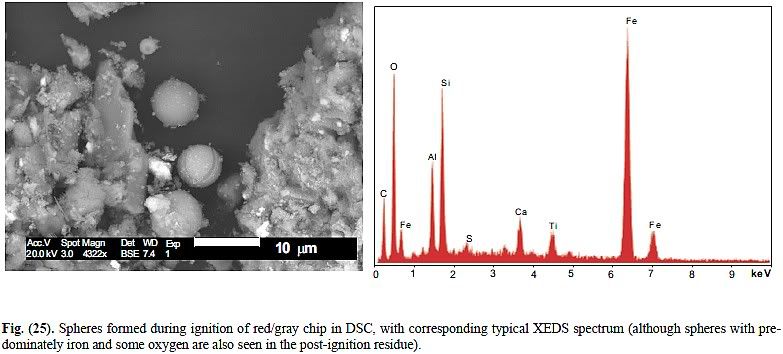
Today I looked very closely at Fig. 25 of the Bentham paper, which shows post-DSC residue of some red-gray chip. It shows grainy and coarse particles as well as a few microspheres that are several µm across. This is accompanied by an XEDS chart that is supposedly taken from one of the spheres, with a dominant Fe-peak, and also much Si and a lower Al peak. Of course O and C, too:

ActiveThermiticMaterial_Fig25.jpg


This is a link to a greater magnification of the SEM image:

http://i1088.photobucket.com/albums...erial/ActiveThermiticMaterial_Fig25a_orig.jpg


What is interesting here?
-> The spheres are only medium gray!

Why is that intersting?
-> Because it's a BSE image! The brightness of spots in BSE images scales with the atomic number or mass of the predominating elements in thar spot. As we know e.g. from Fig. 4, 5, 8, particles or regions rich in iron (Fe, atomic number 26) appear bright, almost white, while regions dominated by Si and Al (atomic numbers 14 and 13) appear medium gray, and where there is only organic matrix (C, O; atomic numbers 6 and 8) we have a dark background.

Now this Fig 25 shows several small whitish, non-spherical particles that may be between 200 nm and perhaps 3-4 µm across, but the spheres, several µm in diameter, are of the same medium gray as large platy particle to the left of the spheres in the center. So the spheres have to be dominated by Al and / or Si, and contain little, if any, Fe, while it seems that the Fe-rich particles of hematite are preserved in shape, and probably also in size.

There is one sphere that has lines like meridians, below center. Its surface appears sprinkled with very small whitish particles, which are near the resolution of this image in size. In the larger version, one pixel is ca. 56 nm, so these sprinkles, often around 2px across, may well be just the hematite pigment size of 100-150 nm.


The large Fe-peak in the corresponding XEDS then comes from where?
-> We don't know, but not from a clean surface of a sphere! Perhaps this XEDS catches a sphere contaminated on its surface with lots of Fe2O3 pigmnents, or it captures a much larger area than just a sphere.


Conclusion: These post-DSC spheres don't contain any significant amount of iron, whether elemental or oxidized. They probably consist mainly of Si and Al (with O, no doubt, and quite possibly C).


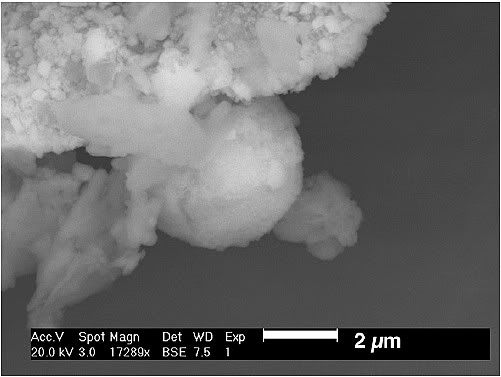
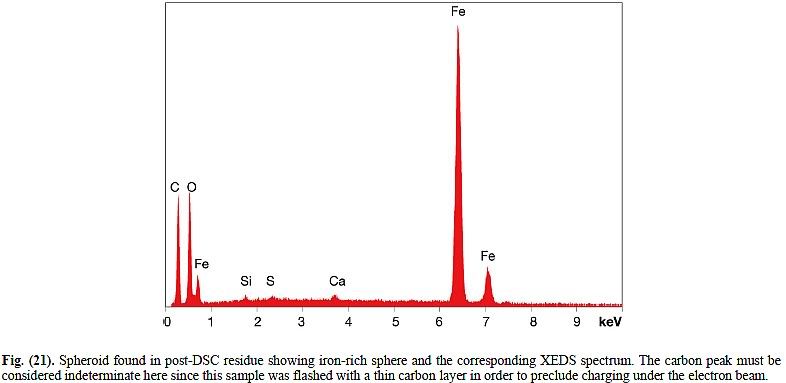
On the other hand, Fig. 21, where the sphere also doesn't look bright enough to be dominated by Fe, has a corresponding XEDS without any Al and very little Si. Here, I believe that the XEDS scan is not from the sphere, but from the coarse, brighter region in the top left quarter:

ActiveThermiticMaterial_Fig21_1.jpg

ActiveThermiticMaterial_Fig21_2.jpg


Perhaps Jim Millette has similar findings? I heard he wanted to look into this microsphere issue :D
 

Back
Top Bottom