• Security incident: ISF was recently accessed by intruders. Please change your password, and change it anywhere else you used it. Read more

Acceleration of the falling top blocks.

This falls into the "weak building" category of bandaids that hijack conspiracy theorists have to add to their story to make it work. Those buildings were strong! They weren't weak.

Very true. A point ergo will never except is, the towers were incapable of standing without the floors.
 
This is a silly concept. The mass of the upper floors did not increase at any point.

Ah, I assume you never covered "dynamics" at pharm school......

A little exercise you could try.......place a can of Diet coke on your toes......apart from having cold toes (assuming the can can out of your fridge) your toes are none the worse.

Now drop that can from above your head onto your toes..........

Notice any difference :) The mass is of course the same but the loading on your toes is much much greater for a short time.
 
What you call the "normal" view doesn't account for the beginning moments of the final destruction of those buildings.

Let me bring it back to my original premise. The normal way of viewing the collapses is that the tops of the buildings did a pratfall on the lower, causing instant catastrophic destruction of joints at the point of impact, thus initiating a cascade of destruction. This concept may actually confuse some people because itis hard to understand how even a dynamic load would crush down the core columns.

What I see happening, rather, is that the top parts sort of sagged, putting strain on the core columns in ways that they were not designed to bear weight, forcing them apart. This same process, of course, also separates the top core columns from one another. This releases a lot of floor slabs to overload those below to cause a steady progressive collapse down the inside of the office areas and to force the perimeter columns outward.

That the crushing and wedging apart of the core columns would arrest is not really controversial. What is controversial, and it is a point on which we diverge from the twoofers, is that there are other forces at play. The lateral connections between many of the core columns at the top have now been deswtroyed and are standing there, shaking in the tumultuous upward stream of air and being pounds by collapsing floor slabs (which I think we can colclude spararted first fromm their outer connections. This has to have set up some serious vibrations or various sorts of resonnances to further stress the welds and joints.

The ability of a steel grid tower (as championed by ergo) depends on every part's moving and rebounding in unison. If there are columns of uneven lengths standing free at the top of that tower, this will not happen. Thus joints are strained even more, and the stress becomes greater as more joints at the top fail, allowing more chaotic and wider-ranging oscillations of the standing colmuns. We can see this in the final shot of the spires, as one column moves back and forth at least three times before falling. This is obviously inconsistant with CD, which requires simultaneous failure of all columns at any given level.
 
This falls into the "weak building" category of bandaids that hijack conspiracy theorists have to add to their story to make it work. Those buildings were strong! They weren't weak.

And what in Pharm school would lead you to think you have the ability to "know" that?

The buildings were strong but they depended on the floor trusses as part of that strength. Each Floor was capable of carrying about 3X its maximum possible static load. However even one floor falling on the one below would apply a dynamic loading in excess of that strength. That floor would then too fail and the two floors would then hit the one below with a force that would instantly cause it too to fail and so on down all 80 plus floors below the impact point.
The floors were the building Achilles heel. The piledriver that destroyed it.
 
So what destroyed the steel columns, under this theory of yours?

And what in Pharm school would lead you to think you have the ability to "know" that?

The buildings were strong but they depended on the floor trusses as part of that strength. Each Floor was capable of carrying about 3X its maximum possible static load. However even one floor falling on the one below would apply a dynamic loading in excess of that strength. That floor would then too fail and the two floors would then hit the one below with a force that would instantly cause it too to fail and so on down all 80 plus floors below the impact point.
The floors were the building Achilles heel. The piledriver that destroyed it.
 
I include the columns on the first floor to be a part of the first floor. Not just the "floor" itself, but the entire construction of the first floor. It was strong enough to hold the top 109 floors without a problem for 30+ years.

See, there's your problem. ONLY the columns are strong enough to hold up the building above, the rest is not. Looking down at a cross section of the building, those columns make up about 1% of the area of the building. Once the load above shifts off the columns, there's nothing to stop it from falling.
 
I'd like to know what you think broke apart all the steel columns. Not the floors. It's not like the floors went wackety wackety all the way down and the steel columns remained. They were broken apart.

The columns were built in 3 storey tall sections, bolted and/or welded together. They were designed to support vertical load, not horizontal. When the floors and beams attached to them were being broken apart and torn off the columns, they were exerting horizontal load that the columns weren't designed to handle, breaking the connections between the segments.
 
This is a silly concept. The mass of the upper floors did not increase at any point.

Poorly phrased, but not silly. Just replace mass with weight. For a demonstration of the effect, gently place a brick on one foot, then drop a brick on the other foot from 12 feet, and compare.

ETA: Lol, posted this before I saw sheeplesnshills coke can example.
 
Last edited:
So what destroyed the steel columns, under this theory of yours?
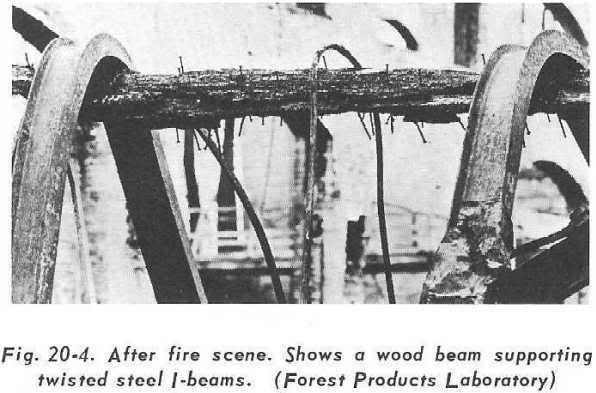
Fire destroyed the strength of the steel. Steel columns did not turn to dust or foam as you claim with your idiotic fantasy.
woodsteelfire.jpg

Fire destroyed the strength of steel. You could try science instead of fantasy, but ...


I said this "At the relatively low speeds that gravity alone would produce". I never said gravity was a speed, rather, that it would produce a speed. Get it right.
You got it wrong; why can't you get it right?
This statement, along with your inability to grasp a momentum model is an indication you and physics are not on talking terms.

"low speeds". Oh? ZERO to 65.83 mph in three seconds is SLOW????!!!!!

Gravity will produce 60 mph in 2.735 seconds, making Gravity one of the top 8 fastest Cars in the world.

Name a car that does 0-60 in 3 seconds. There are 7 cars close or better than Gravity, a 2011 Ferrari 458 Italia gets close. These cars are not called the world's low speed cars, these are called the World's Fastest Cars. Most cars are "slower" than gravity, to put it in the language of woo.

The people who jumped on 911 were hitting the ground at 100-120 mph; you call this low speed. Good for you.

You don't understand physics.
 
Last edited:
Honestly, someone who can't use the quote function properly doesn't deserve a response, it's rude, annoying and makes the forum hard to follow.
 
Last edited:
Don't even try to school me on biomedical science. A fetus (pronounced /ˈfiːtəs/; also spelled foetus, fœtus, faetus, or fætus, see below) is a developing mammal or other viviparous vertebrate after the embryonic stage and before birth.


You sure you know anything about biology? Two pounds is WAY past fetus.
 
I love it when detractors prove my points for me. See how the steel sagged? That's what steel does when exposed to extreme heat for a significant duration. It sags. It doesn't shatter.

Fire destroyed the strength of the steel. Steel columns did not turn to dust or foam as you claim with your idiotic fantasy.
[qimg]http://i286.photobucket.com/albums/ll116/tjkb/woodsteelfire.jpg[/qimg]
Fire destroyed the strength of steel. You could try science instead of fantasy, but ...


You got it wrong; why can't you get it right?
This statement, along with your inability to grasp a momentum model is an indication you and physics are not on talking terms.

"low speeds". Oh? ZERO to 65.83 mph in three seconds is SLOW????!!!!!

Gravity will produce 60 mph in 2.735 seconds, making Gravity one of the top 8 fastest Cars in the world.

Name a car that does 0-60 in 3 seconds. There are 7 cars close or better than Gravity, a 2011 Ferrari 458 Italia gets close. These cars are not called the world's low speed cars, these are called the World's Fastest Cars. Most cars are "slower" than gravity, to put it in the language of woo.

The people who jumped on 911 were hitting the ground at 100-120 mph; you call this low speed. Good for you.

You don't understand physics.
 
Don't even try to school me on biomedical science. A fetus (pronounced /ˈfiːtəs/; also spelled foetus, fœtus, faetus, or fætus, see below) is a developing mammal or other viviparous vertebrate after the embryonic stage and before birth.

Poor choice of words maybe, but I was replying to you saying "2 pound babies", and in the context, disgusting as it was, they were clearly out of the womb.
 
Don't even try to school me on biomedical science. A fetus (pronounced /ˈfiːtəs/; also spelled foetus, fœtus, faetus, or fætus, see below) is a developing mammal or other viviparous vertebrate after the embryonic stage and before birth.

Pick your science. Pick your topic.

A dumbass like me can school you on ANY of them.
 
Pick your science. Pick your topic.

A dumbass like me can school you on ANY of them.

I think the fact that Dr. Dusty had to copy-paste that definition directly from wiki speaks volumes about her competence in her alleged field of expertise.
 
Last edited:
I have been thinking a great deal over the last couple of days about the rate of acceleration when the top blocks of the twin towers began collapsing.

Everybody seems to assume that the core columns all broke more or less at the same time, to allow the top block to fall more or less at free-fall acceleration. Has that actually been measured?

Only in the context of free-fall does Tony's "missing jolt" make the least bit of sense.

But the seems to me to be an alternate mode of failure that would not produce any jolt.

Think for a moment of the huge "horseshoe" column, smoothly bent with not much cracking. This can, of course, only occur in very hot steel. Is it possible that the columns just sagged enough to let the top blocks come to rest catawampus on the perimeter columns and start to break up, thus wedging the perimeter columns open?

Over at the911forum, I revived an older thread, which started out with someone's misbegotten hypothesis on something, which in turn caused OneWhiteEye to revisit some other thread where he (?) had derived from theoretical considerations of conversation of momentum (and, implicitly, energy) what the collapse acceleration will be if all collisions are inelastic, and asuming that no energy is dissipated beyond the work done in those inelastic collisions.

The result is, analytically, that acceleration will in the long run converge on 1/3 of g. It will start out faster if the initial mass ("top block") is larger, and then take somewhat longer to get near 1/3 g, but the difference is not large. It turns out that it doesn't matter how high the floors are or what their individual mass is.

I get approximately the same result through discrete iteration with a spreadsheet in which I compute each individual collision of "top block" with next floor below from the 95th (or 80th) down to the ground: Acceleration starts somewhat below 1g and above 2/3 g, and drops to not much above 1/3 g towards the end.


Acceleration of 1/3 of g means directly that only 1/3 of the potential energy is turned and sustained as kinetic energy, and the rest is dissipated in the inelastic collisions, mostly as deformation and fracture, and to a small extent as heat.


We are currently thinking hard about whether these close to 2/3 of available energy that gets converted into "destruction" already takes care of / includes all, most, some or none of the destruction of the structural supports that necessarily must be destroyed for collapse to continue*). My intuition says that most of the energy required to break structural connections is already accounted for in the loss of kinetic energy due to inelastic collision, OWE seems to think otherwise, but I don't know how to model this, and he isn't there yet.

Any energy expended on top of (or temporally after) the inelastic collision to break connections would decrease the collapse acceleration. Again, my hunch is that this is not very significant.

The same is true for all energy (and momentum) that's transferred down the columns and into the ground and thus lost to planet earth. Here, too, my hunch is that this is not very significant.


Now this model that we are talking about seems too simple and unrealistic, but I think it does get us pretty close to true values. The reason is that I think that in the chaos of the collapse front, even though everything is not going smoot and uniform and all collisions have elastic components, it eventually all adds up to being insignificantly different from a total inelastic scenario: As some have said, the perimeter mesh helps to keep most of the material confined to the footprint so there isn't a lot of mass shedding; components that get kicked down elastically undergo further collisions with other floors to give them more chances to dissipate energy and get caught up with the bulk of the collapse front.


Anyway, expect any top-down collapse starting with a sufficient top mass to start above 2/3 g, drop quickly (after a few floors) below 1/2 g and soon converge near 1/3 g.


*) We don't show it in that thread, but we both know (from Bazant's limiting cases) that this amount of energy easily suffices to break enough connections (say: all long truss to column connections). Iirc, Bazant has shown that if the top 15 floors reach a velocity that is equivalent to a free-fall drop of 0.5 meters, then their kinetic energy will overwhelm the next floor worth of connections, and from then on the structure is doomed. (Notice that this scenario does not need to assume any actual free fall at collapse initiation!)

 
Last edited:
...

The result is, analytically, that acceleration will in the long run converge on 1/3 of g. It will start out faster if the initial mass ("top block") is larger, and then take somewhat longer to get near 1/3 g, but the difference is not large. It turns out that it doesn't matter how high the floors are or what their individual mass is.

I get approximately the same result through discrete iteration with a spreadsheet in which I compute each individual collision of "top block" with next floor below from the 95th (or 80th) down to the ground: Acceleration starts somewhat below 1g and above 2/3 g, and drops to not much above 1/3 g towards the end.


Acceleration of 1/3 of g means directly that only 1/3 of the potential energy is turned and sustained as kinetic energy, and the rest is dissipated in the inelastic collisions, mostly as deformation and fracture, and to a small extent as heat.

...

Anyway, expect any top-down collapse starting with a sufficient top mass to start above 2/3 g, drop quickly (after a few floors) below 1/2 g and soon converge near 1/3 g.
...

Interesting! As I wrote in Skeptical Inquirer last year (July/August 2011),
Second, Chandler argues that being a Newtonian action/reaction pair, the impact force of the upper section on the lower section was only a third of the upper part’s weight. However, I’ve found that his estimate of the downward impact force was too low by a factor of one hundred. In addition, I found that the actual process—a series of twelve-foot free falls punctuated by violent and brief collisions with each floor—would have resulted in an average acceleration of precisely what Chandler measured for the start of the collapse of WTC 1, namely 2/3 g. (By the end of the collapse, my calculations indicate an average acceleration of only 1/3 g, but this can’t be measured in dust-obscured videos.)

Cheers, Dave
 
Dave, the interesting result is that this limit of 1/3 g is independent of the local spacial distribution of the mass, and of the absolute mass. It's the same if you multiply the mass of each floor slab by 100 or divide it by 100; it's the same if you have 110 floors or 1100 of 1/10 the actual height*, and I dare say it is independent of the physical arrangement if the material into slabs, trusses, girders, columns, dead weight etc.

Now the answer to this question that we are still debating, whether an additional and significant amount of energy (and thus momentum) is dissipated to fracture support or not, will bear on the question if the "factor of safety" has a significant effect on collapse acceleration. My intuition is that as long as the energy needed to snap connections is very much less than the potential energy available, then the FoS makes hardly any difference, as I presume that that energy is mostly included in the inelastic-collision-only dissipation.


* In fact, OWE takes this idea to its infinitesimal limit where the building mass is continual - uniform density - as it is distributed over infinitely many floors of zero height.
 

ISF - Join now!

Every member here is approved by hand. No bots, no spam, just people who care about evidence and honest debate.

Membership is free!

Create your free account

Back
Top Bottom