• Quick note - the problem with Youtube videos not embedding on the forum appears to have been fixed, thanks to ZiprHead. If you do still see problems let me know.

WTC7 and the girder walk-off between column 79 and 44

Status
Not open for further replies.
No, I'm agreeing with you that twoofers don't understand how "structural elements" can fail in fire.


Gosh, I don't know. Could you perhaps explain how you went from "hyperstatic" to "no redundancy"? Thanks!!


Nobody said that. I'm completely agreeing with you that only 4 - 5 seconds of additional descent time is needed to explain the momentum losses through successive collisions through 80 - 90 storeys, and concomitant total pulverization of all contents and floor structures. Natch.

Which part of "When structural elements fail there's a reduction of this redundancy" you didn't understand?

How much additional time do you think would be necessary? Why?
 
LMFAO.

And this is what ergo thinks constitutes for engineers a competent "numerical analysis" for WTC7.

"... hey did any of you guys notice that there are numbers other than 79?"

Hmm.. maybe this is all too engineery for me.

So is column 79TM some kind of "Achilles" column, as LSSBB was suggesting?
 
Which part of "When structural elements fail there's a reduction of this redundancy" you didn't understand?

Well, if 'a' is the engineered hyperstatic state, and say, 'k' is the "complete loss of redundancy" state, then just parts b, c, d, e, f, g, h, i, and j!

Thanks so much! :)
 
Hmm.. maybe this is all too engineery for me.

So is column 79TM some kind of "Achilles" column, as LSSBB was suggesting?
Why not get out NIST, and look it up; see what you think instead of failing to make sense? Do you do research? As good as you do physics? Which is your stronger area? Have you read NIST?
 
Last edited:
Well, if 'a' is the engineered hyperstatic state, and say, 'k' is the "complete loss of redundancy" state, then just parts b, c, d, e, f, g, h, i, and j!

Thanks so much! :)

Let's consider a hypotetical structure.

Let's say its "degree of hyperestaticity" or "degree of redundancy" (i don't know do you say this technical term in english) is equal to 20. (remember, it's just a hypotetical structure)

After a serie of structural failures, this number become to 19, 18, 17, 15, 13, 10, 8, 5, 3, 2, 0.

So, what can you say about the building structural redundancy now?
 
Let's consider a hypotetical structure.

Let's say its "degree of hyperestaticity" or "degree of redundancy" (i don't know do you say this technical term in english) is equal to 20. (remember, it's just a hypotetical structure)

After a serie of structural failures, this number become to 19, 18, 17, 15, 13, 10, 8, 5, 3, 2, 0.

So, what can you say about the building structural redundancy now?


OMG, I never thought of this! It's all so clear now! Just pick a number and count down from it arbitrarily to determine what the series of structural failures were that brought a 47-storey steel-framed highrise from a state of hyperstaticity to zero redundancy! Wow!

Why has no one come up with this solution before?! Have you submitted this to NIST ???
 
Here is ergo's response to tfk's post where he was forced to answer his own questions since Tony was not capable...

Yes, this does look impressively engineery.

The fact that it looks impressive to you or Chris is no surprise.....neither of you are Engineers. What is disturbing is that is also looks impressive to Tony who is an Engineer and should know better....but he doesn't. Engineering incompetence is excusable for folks who are not Engineers, but it is INEXCUSABLE for people who are Engineers.

This is why the truth movement is either ignored or mocked by the vast majority of Engineers.


This question shows that you don't understand what Tom wrote.


This question shows that you don't understand what Tom wrote.


This question shows that you don't understand what Tom wrote.

I'm so sure this is true. Bedunkers have a such a deep understanding of Newton's Third Law, after all... ;)

This comment shows that you don't understand what Tom wrote.

But again.....it's okay.........it's not your fault ergo. You simply are not educated enough or experienced enough to understand basic engineering principles, physics, or mathematics. It's okay....we know you don't understand and just pat you on the head and say "there there".
 
Hmm.. maybe this is all too engineery for me.

So is column 79TM some kind of "Achilles" column, as LSSBB was suggesting?

What part of "hump somebody else's leg" is too difficult for you to understand?
 
What part of "hump somebody else's leg" is too difficult for you to understand?

Try writing it in crayon Tom..........truthers understand it much better when you do that..........
 
Oooo... Hey everyone, Carlos here can tell us how structural redundancy engineered throughout a 47-storey steel-framed highrise became an "unstable mechanism". Finally! Oh boy! I'm looking forward to hearing this explanation!
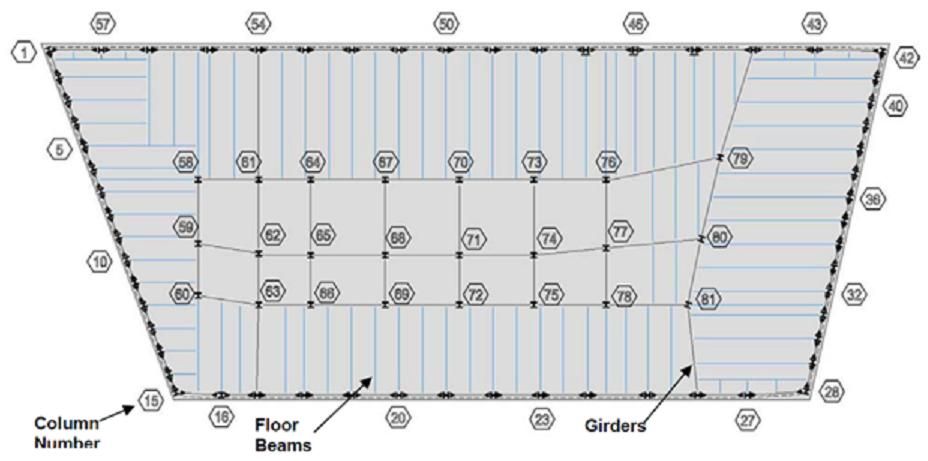
her ya go champ, Point out your "structural redundancy" around column 79, Do you see a column 79-B? or a column 79-C?

WTC_7_Plan.jpg
 
OMG, I never thought of this! It's all so clear now! Just pick a number and count down from it arbitrarily to determine what the series of structural failures were that brought a 47-storey steel-framed highrise from a state of hyperstaticity to zero redundancy! Wow!

Why has no one come up with this solution before?! Have you submitted this to NIST ???

OMFG!

It was just an example of a hypothetical structure
an example of a hypothetical structure
Twoofers...
 
Last edited:
So is column 79TM some kind of "Achilles" column, as LSSBB was suggesting?

More or less, yes. What, does that somehow seem inherently impossible to you? I don't see why. You certainly aren't explaining yourself.

Hypothetically, you could bring facts and arguments to dispute the analysis. But you don't seem to have much beyond 'C'mon, it was a really big building!!' Gee, ya think?
 
Tony,

When I asked you about the assumptions built into your "solutions", you facilely & unimpressively answered "the same assumptions that NIST used."

I can assure you that you are wrong about even this vapid non-response.


Here they are.

[qimg]http://www.internationalskeptics.com/forums/picture.php?albumid=638&pictureid=5901[/qimg]

Note well that the equation that you used assumes that the correct stress strain curve is the dashed lines on the left of the graph.

The fact that, when materials creep yield due to temperature, they are no longer operating in the linear mode. You'd need to calculate the stress conditions at each point in the beam to figure out if the material could actually support that stress level at that particular temperature.

To the extent that any particular element was shown to not be able to support the stress assumed by the linear analysis, your results will be wrong.


[qimg]http://www.internationalskeptics.com/forums/picture.php?albumid=638&pictureid=5902[/qimg]

Yes, at low temps, the bolts haven't broken. They are therefore holding the ends of the beam such that the slopes of the beams (∂y/∂x) are zero. This results in a completely different curve shape than the simply supported beams, which allows there to be a non-zero slope at the ends. This changes the solution of the "boundary condition differential equation", because the boundary conditions are not met.

The proper solution is to use a "fixed support / fixed support" at 20°C (before the bolts break), a "fixed support / simple support" for when one bolt breaks, and a "simple support / simple support" after both bolts break.


This is highly significant, because with the construction loads considered, you'll START your thermal deflections from an outer fiber stress state in your beams that is (for a factor of safety of 2) somewhere between 50% & 100% of yield strength in the beams, depending on the engineers' design criteria.

As you can see from the stress-strain curves above, even a conservative design loading will cause the outer fiber stress to drop considerably when heated, and cause the outer fibers to elongate dramatically.

Even in a rectangular cross-section beam (like the concrete), the loss of stress carrying capability in the outer fibers cause the fibers towards the neutral axis to assume stresses that are much, much higher than they would have to if you were still in the linear stress/strain range, because the outer fibers (with their high "moment arm" from the neutral axis) are the most efficient at counteracting the externally applied moments.

As the heat soaks into the beam, the inner fibers can also no longer support the necessary stresses, and the whole situation cascades in a positive feedback loop.


[qimg]http://www.internationalskeptics.com/forums/picture.php?albumid=638&pictureid=5900[/qimg]

Note that the tensile strength of the concrete is much lower than the compressive strength, and this causes the neutral axis to shift towards the upper surface.

But the situation in an I-beam is far, far worse than described, because of the cross-section. The load carrying capability of the web is insignificant compared to the load carrying capability of the upper & lower flange, simply due to the webs thin width. Once the outer fiber start yielding, then there is way too little material in the web to take up the load shed by the outer fibers.

[qimg]http://www.internationalskeptics.com/forums/picture.php?albumid=638&pictureid=5899[/qimg]


The important assumptions of this solution are the following:

a. You are staying within the linear stress-strain region.
This is wildly violated for your analysis.

b. Plane sections stay planar.
This is violated for your solution.

c. Boundary conditions are as stated above.
y0 = yL = ∂x/∂y0 = ∂x/∂yL = 0

One or both of your slope boundary conditions are violated, depending on how many bolts are fractured.

d. The beams are carrying all of the load.
This is significantly violated.

As soon as the beams START to yield from heat (i.e., without any physical deflections), they are going to shed their load back into the concrete, because 1. the concrete is also a solid beam, but a much, much wider one and 2. the concrete heats up much much slower than the steel.

This changes your load condition on the beams HUGELY. Their load fairly quickly will drop to self-weight, if the concrete can support itself over those spans.


Cripes, Tony. This one was a bone that I threw you, and you still couldn't get it.

It's "Newton's 3rd law".

You guys are so fond of saying this in vapid meaningless contexts, yet the one time that it was appropriate, you drop the ball...?

One might come to the conclusion that you don't understand the flexure of beams at any deep level.

Not very good, Tony.

Why don't you gather back a couple of shards of engineering dignity & explain to everyone exactly how this equation is based on Newton's 3rd? Or would you rather that I did that for you, too?
___

The ultimate conclusion from all of the above is that, for the highly complex, high strain, & highly non-linear conditions that occur in beam sagging due to heating, the simple beam equations that are applicable to low stress & low strain are WILDLY inappropriate.

And that a competent FEA is the only way to get accurate results.

And this, right here, is my main message when looking at your spreadsheet, based on equations used, & assumptions made, that are wholly inappropriate for the analysis intended.

Is that "engineer-y" enough for ya, Tony?
Or does it still sound like "sales" to you?

Tom

:o 4 U


:deadhorse :notm :notm :notm


Global failure emanating from one location WTC7 and the girder walk-off between column 79 and 44.


:deadhorse :notm :notm :notm


FTFY with the following.


http://www.youtube.com/watch?v=8wHMaJ6AtNs
 
What we do know is that the building collapses were not due to natural causes. Beyond that I can tell you what I believe and have to qualify it as speculation, as only an investigation would verify it.

There is a lot of talk about paper intensive Enron files and the like being in the SEC offices on the 12th and 13th floor. In other words, it was a garbage can for incriminating case files of elite people that could be taken down with the excuse that damage from the twin towers caused it.

I believe the charges were set when the work was done for Rudy Giuliani's bunker, and that is why he was insistent on the bunker being in WTC 7 over the objections of many. The project cost was 13 million dollars and had access to the entire building for emergency power and life systems integration.

Rudy was a key man here, because he also had control over the cleanup and it seems he cleaned it all up, because NIST got none of the steel from WTC 7 for their investigation and people like Jonathan Barnett weren't given access to it. We know this is true because it is stated in the NIST report and Barnett is on tape saying they were unable to do the type of investigation they normally do with the steel from WTC 7. That is simply shocking given that WTC 7 would have been the first high rise building to completely collapse due to fire.

It isn't hard to see that 911 and the ensuing wars had something to do with oil, and guess who Rudy works for now. He was made a full partner in the Bracewell and Patterson law firm in Houston and the majority of their clients are oil and gas companies. The firm is now called Bracewell and Giuliani.

This is not to say that every person in the oil industry was involved in 911. However, Rudy Giuliani would be on the short list of those who need to be investigated and deposed in any re-investigation of what occurred.

I am not going to argue the above. I only posted it because you asked.

I would have used a shredder.

But I suppose Rudy had a moment and thought that 4 aircraft and tons of therm*te or PE would be better.

Are you currently in employment Tony?
 
Tony,

When I asked you about the assumptions built into your "solutions", you facilely & unimpressively answered "the same assumptions that NIST used."

I can assure you that you are wrong about even this vapid non-response.


Here they are.

[qimg]http://www.internationalskeptics.com/forums/picture.php?albumid=638&pictureid=5901[/qimg]

Note well that the equation that you used assumes that the correct stress strain curve is the dashed lines on the left of the graph.

The fact that, when materials creep yield due to temperature, they are no longer operating in the linear mode. You'd need to calculate the stress conditions at each point in the beam to figure out if the material could actually support that stress level at that particular temperature.

To the extent that any particular element was shown to not be able to support the stress assumed by the linear analysis, your results will be wrong.


[qimg]http://www.internationalskeptics.com/forums/picture.php?albumid=638&pictureid=5902[/qimg]

Yes, at low temps, the bolts haven't broken. They are therefore holding the ends of the beam such that the slopes of the beams (∂y/∂x) are zero. This results in a completely different curve shape than the simply supported beams, which allows there to be a non-zero slope at the ends. This changes the solution of the "boundary condition differential equation", because the boundary conditions are not met.

The proper solution is to use a "fixed support / fixed support" at 20°C (before the bolts break), a "fixed support / simple support" for when one bolt breaks, and a "simple support / simple support" after both bolts break.


This is highly significant, because with the construction loads considered, you'll START your thermal deflections from an outer fiber stress state in your beams that is (for a factor of safety of 2) somewhere between 50% & 100% of yield strength in the beams, depending on the engineers' design criteria.

As you can see from the stress-strain curves above, even a conservative design loading will cause the outer fiber stress to drop considerably when heated, and cause the outer fibers to elongate dramatically.

Even in a rectangular cross-section beam (like the concrete), the loss of stress carrying capability in the outer fibers cause the fibers towards the neutral axis to assume stresses that are much, much higher than they would have to if you were still in the linear stress/strain range, because the outer fibers (with their high "moment arm" from the neutral axis) are the most efficient at counteracting the externally applied moments.

As the heat soaks into the beam, the inner fibers can also no longer support the necessary stresses, and the whole situation cascades in a positive feedback loop.


[qimg]http://www.internationalskeptics.com/forums/picture.php?albumid=638&pictureid=5900[/qimg]

Note that the tensile strength of the concrete is much lower than the compressive strength, and this causes the neutral axis to shift towards the upper surface.

But the situation in an I-beam is far, far worse than described, because of the cross-section. The load carrying capability of the web is insignificant compared to the load carrying capability of the upper & lower flange, simply due to the webs thin width. Once the outer fiber start yielding, then there is way too little material in the web to take up the load shed by the outer fibers.

[qimg]http://www.internationalskeptics.com/forums/picture.php?albumid=638&pictureid=5899[/qimg]


The important assumptions of this solution are the following:

a. You are staying within the linear stress-strain region.
This is wildly violated for your analysis.

b. Plane sections stay planar.
This is violated for your solution.

c. Boundary conditions are as stated above.
y0 = yL = ∂x/∂y0 = ∂x/∂yL = 0

One or both of your slope boundary conditions are violated, depending on how many bolts are fractured.

d. The beams are carrying all of the load.
This is significantly violated.

As soon as the beams START to yield from heat (i.e., without any physical deflections), they are going to shed their load back into the concrete, because 1. the concrete is also a solid beam, but a much, much wider one and 2. the concrete heats up much much slower than the steel.

This changes your load condition on the beams HUGELY. Their load fairly quickly will drop to self-weight, if the concrete can support itself over those spans.


Cripes, Tony. This one was a bone that I threw you, and you still couldn't get it.

It's "Newton's 3rd law".

You guys are so fond of saying this in vapid meaningless contexts, yet the one time that it was appropriate, you drop the ball...?

One might come to the conclusion that you don't understand the flexure of beams at any deep level.

Not very good, Tony.

Why don't you gather back a couple of shards of engineering dignity & explain to everyone exactly how this equation is based on Newton's 3rd? Or would you rather that I did that for you, too?
___

The ultimate conclusion from all of the above is that, for the highly complex, high strain, & highly non-linear conditions that occur in beam sagging due to heating, the simple beam equations that are applicable to low stress & low strain are WILDLY inappropriate.

And that a competent FEA is the only way to get accurate results.

And this, right here, is my main message when looking at your spreadsheet, based on equations used, & assumptions made, that are wholly inappropriate for the analysis intended.

Is that "engineer-y" enough for ya, Tony?
Or does it still sound like "sales" to you?

Tom

This is nothing more than If You Can't Dazzle Them With Brilliance Baffle Them With BS and something seems to be missing in all this. It is called an answer. I think the problem is that your answer won't be much different than mine and you are full of it by saying the only way you can get an answer is with FEA.

I believe I did say the deflections were only those due to heating and not the original load at room temperature.

The simply supported beam deflection equation is commonly used for long beams with fixed ends, as the end conditions don't change the answer in any significant way, and that is why you don't show us.

The rest of what you say has even less of an effect. If you maintain any of these points are applicable in any significant way then show it in a result.

We are all waiting to see how your points prove your claim that they would make a difference comparable to the USS Nimitz vs. a row boat. C'mon Tom show us results.

People should also remember this is from a guy (tfk) who claimed the girder between columns 76 and 79 could push column 79 to the east by 4.5 inches but when challenged with an analysis showing the girder would buckle long before that couldn't back up his statement and is probably hoping everybody here will forget about that.
 
Last edited:
Why not? Do you believe fire cannot cause structural elements to fail?


Do you understand that when a hyperstatic structure becomes an unstable mechanism (after successive elements failures) there's no significant resistance anymore?

Continuous acceleration of the North Tower? Really? So, why was the collapse time greater than FFA time?

What do you mean by hyperstatic and how do you think it applies?
 
Last edited:
:o 4 U


:deadhorse :notm :notm :notm


Global failure emanating from one location WTC7 and the girder walk-off between column 79 and 44.


:deadhorse :notm :notm :notm


FTFY with the following.


http://www.youtube.com/watch?v=8wHMaJ6AtNs
Is this the same kind of response you plan to give NIST is they present questions?


Really Tony. Put him in his place with engineering, not stupid smiles and youtube videos.


BTW, You really need to read your "theory" (the Enron one) to some non CT friends. I think then you will see how bad it really is.
 
Last edited:
Status
Not open for further replies.

Back
Top Bottom