• Quick note - the problem with Youtube videos not embedding on the forum appears to have been fixed, thanks to ZiprHead. If you do still see problems let me know.

WTC Dust Study Feb 29, 2012 by Dr. James Millette

Actually, XEDS is more than capable of resolving this overlap. One simply requires suitable standards (SiO2 and SrF2, for example). A multiple linear least squares fitting algorithm will readily deconvolve minor Sr L family lines from major Si lines.

Aha, this is completely new for me. Could you explain it on some more understandable manner? And can it work even at this high Si/Sr ratio in samples? Could we expect some real, unambigous proof of strontium in this way in Laclede paint?
Thanks in advance for the answers, Almond:cool:
 
Last edited:
One thing is for sure. If you remove material from WTC dust using a magnet you separate chips of paint adhered to steel not thermite.

Unless, of course, it's thermite.

If it isn't, how do steel (as opposed to iron oxide) particles get separated from bulk steel?
 
Aha, this is completely new for me. Could you explain it on some more understandable manner? And can it work even at this high Si/Sr ratio in samples? Could we expect some real, unambigous proof of strontium in this way in Laclede paint?
Thanks in advance for the answers, Almond:cool:

Ok, the extremely short answer is as follows:

Let's say you have two curves, F(x) and G(x), of which x is the independent variable. Now let's introduce a 3rd curve that is an equally weighted linear combination of F and G such that H(x) = F(x) + G(x). Let's say you can measure H(x) and G(x), but not F(x). Using very simple algebra, we can recover the function F(x) as long as we know G(x) and H(x).

Now let's make it more complicated. H(x) is now a weighted combination of F and G such that H(x) = a*F(x) + b*G(x). If we can only measure H(x) and G(x), we're sunk in the water. But, if we precisely know what F(x) and G(x) are ahead of time, and if we measure H(x), we can use linear algebra to determine the scaling factors a and b. The way we do that is to guess at the scaling factors for a and b, and then derive a new function H'(x). Obviously, our goal is to get H'(x) as close to H(x) as we possibly can. The way we test this closeness is to take the sum of the squares of the differences between H(x) and H'(x). When it's as low as we can go, we're done.

In x-ray microanalysis, we have lots of peak overlaps. Sr and Si are pretty common. The convolved peak of Sr and Si is H(x). We measure a Sr standard and an Si standard to make F(x) and G(x). After that, we iterate through to determine the scaling factors.

Research has shown this method to be incredibly effective in finding even very small peaks hidden under very large peaks. The one problem is that one requires a lot of count data. Generally speaking, you need at least one million counts in the peak of interest to do this correctly. So the likelihood of doing this well given the data presented is very small.
 
Well, as you know, we expect some 1.2 wt% of strontium chromate in Laclede primer. XEDS is definitely not able to prove it, since strontium peak is inevitably in overlap with silicon peak and, moreover, the concentration of this compound is too low.
We perhaps hoped that Jim may find some needle-shape crystals of this compound by microscopy (namely microscopy using polarized light), but Jim has not confirmed such crystals.
Therefore, I am willling to pay some more money for the proof of strontium, using suitable method, like atomic absorption spectrometry. For such measurements, only red chips corresponding quite well or very well to Laclede paint (owing to their XEDS spectra) should be selected:cool:
OK but Jim Millette specifically said to me, unequivocally, NO STRONTIUM CHROMATE. It was clear to me that he looked and he did not find it. I wouldn't bet my nuts on it being LaClede.

In the meantime, your frustration with this matter is good evidence that we are not influencing the course of Jim Millette's research. He's already said to the 9/11 truth side through me, if you want to do DSC testing here are some good people, I'm not interested. I got the same vibe about the strontium question. If you really want to pursue this we might be able to arrange a red-gray chip for you to play with, I don't know. We may be able to do the same for the DSC test. In the meantime, I am thrilled that both sides are getting nowhere trying to direct his research. In the long run, that's what we need!
 
Last edited:
OK but Jim Millette specifically said to me, unequivocally, NO STRONTIUM CHROMATE. It was clear to me that he looked and he did not find it. I wouldn't bet my nuts on it being LaClede...

So you are in agreement Chris, that Dr. Millette's current WTC Dust Study findings confirm that none of the red chips he tested contained LaClede primer paint?

MM
 
So you are in agreement Chris, that Dr. Millette's current WTC Dust Study findings confirm that none of the red chips he tested contained LaClede primer paint?

MM
Not at all. He has neither confirmed nor disproven that yet. In his preliminary report he said he couldn't ID the chips precisely. Now he is saying, "I have no opinion until I do the tests myself." He will look at promising possibilities, obtain samples, and do direct tests. Ivan is chomping at the bit but he'll just have to chomp a bit longer because Millette will say nothing until he does the experiments himself. He's not hiding anything, he's just not saying anything until he knows what he is saying. Jim's research will be carried out ndependently of Ivan or his left nut, which is now on the chopping block.

Also, if there is a version of LaClede that doesn't have strontium chromate, or if there is another test that shows strontium chromate, there is always the possibility Jim will look at that.
 
Last edited:
Almond: Thanks. So, if I understand, a proof of strontium using available XEDS data is not really possible. Pity...

Chris: Considering that Jim Millette used only methods not well suitable for detection of strontium (or strontium chromate), I do not wonder that he did not detect this element (or strontium chromate). I was rather skeptical in advance (contrary to Oystein).
Now, it is a time to try better methods:cool:
I do not really understand your attitude here, Chris: you were even able to admit that red chips may by thermite (what is an apparent nonsense), but, on the other hand, you are still not able to admit that Laclede paint is indeed an excellent candidate as the material of the many/most chips (despite the current absence of proof of strontium chromate). There is simply no other red paint (except Tnemec for perimeter columns) which can be present in WTC dust in such abundance. And, results of analyses of Jim Millette are basically consistent with some red paints. Would you agree?
(Well, some red primer from WTC7 can not be ruled out, but then, it should have a composition close to Laclede paint; that is still possible)

Ergo: As for your "Unless, of course, it's thermite. If it isn't, how do steel (as opposed to iron oxide) particles get separated from bulk steel?"

Here I will make one single exception and I will respond to you.
Conclusion of Jim Millette is: "The red/gray chips... are consistent with a carbon steel coated with... etc." Although this is basically correct, I think that Jim Millette should change his wording in this way: "The red/gray chips... are consistent with an oxidized layer of carbon steel coated with... etc." It is absolutely clear from XEDS spectra that gray layer is a form of iron oxide and I believe that even you are able to understand this fact.
Otherwise, how the separation of steel together with red layers can be any evidence of thermite???:D
 
Last edited:
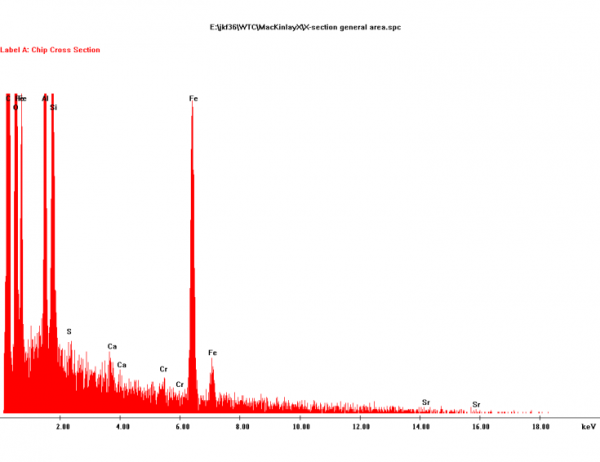
Of course, as the scale of the spectra stops at 10 keV, the Strontium CANNOT be detected on this spectra (peaks around 14 and 16 kev)!

BUT, Strontium is BOUNDED with Chroma...


AND Chroma is several times detected in the chips candidates for Laclede primer paint (p26 p27 and p42)

Almond, tell me if I'm wrong....
 
Of course, as the scale of the spectra stops at 10 keV, the Strontium CANNOT be detected on this spectra (peaks around 14 and 16 kev)!

BUT, Strontium is BOUNDED with Chroma...


AND Chroma is several times detected in the chips candidates for Laclede primer paint (p26 p27 and p42)

Almond, tell me if I'm wrong....

Problem is that chromium was present (as zinc chromate) also in Tnemec primer paint (and perhaps even in some other minor primers, unknown to us). So, clearly only strontium detection can be good enough as the "final" proof of Laclede paint.
 
Yes, but the peaks should be over 10 keV
http://csrri.iit.edu/cgi-bin/period-form?ener=&name=Sr
and the scale stops at 10 keV

Those are the K peaks of Sr. At 1.8 you have the L peaks of Sr, which may be masked by Si K peak. But as Oystein showed, there would be a visible broadening of Si peak.

A good fit could show the Sr L alpha peak presence.
- get the raw data
- correct the background signal
- Fit tghe Si peak to a gaussian
- If the right side tail is not fitted, then add the contribution of Sr L peaks, and check wheter the fit is right then.

Just cualitative. It's not a cuantitative fit, but would show the Sr L peak is there.
 
Since I feel this focussing on conclusions about paint that are NOT yet there in Millette's study is better discussed in my "Origin of the paint" thread, I posted a reply there
 
Hi Ivan and Oystein,

Since Jim Millette is looking for the source of the red-gray chips right now, I think this is a good place to keep the discussion, but if you want to move it back to Oystein's "Origin" thread, I'll follow there too.

Ivan, I haven't ruled out anything except thermitic material in the dust. I refused to completely rule out thermites in the dust until I got my own independent verification that it's not there. Jim Millette has done that, in spades. Now I can say with confidence: no thermitic material in the dust. And as you can see from Jim Millette's report, he's independent all right. He isn't taking your or anyone's word on the LaClede hypothesis and will make no statement until he gets his own sample and tests it himself.

In no way does that imply that I reject the LaClede hypothesis. But there is a problem with the strontium chromate issue. Interestingly though, Oystein's read on the Bentham paper is that those guys DID find trace amounts of strontium chromate, and Jim did not. Why is this?
 
Chris, my case for strontium chromatre pigment specifically in Chip (a) is this (and it is all included in the paper draft that Millette already has):

A) Harrit's letter from May 2009, where he proved that chips (a)-(d) are not Tnemec (he made the mistake there first, equivocating "Tnemec" and "WTC primer").
Find it here: http://ae911truth.org/downloads/documents/primer_paint_Niels_Harrit.pdf

This letter contains the following XEDS spectrum of chip (a):

Harrit_figure-5b.png


Again, this is Harrit's original data on chip (a). His software marked Sr and Cr.


B) My analysis of Fig. 10 in the Bentham paper:
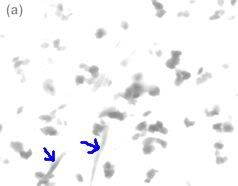
ActiveThermiticMaterial_Fig10a_inverted.jpg
ActiveThermiticMaterial_Fig10e_inverted.jpg

ActiveThermiticMaterial_Fig10b_inverted.jpg
ActiveThermiticMaterial_Fig10c_inverted.jpg


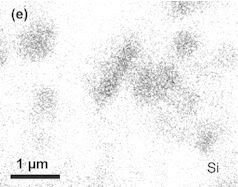
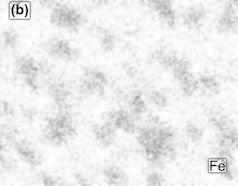
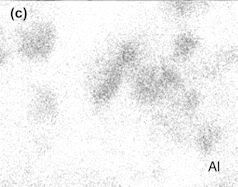
Fig 10 shows both the SEM image and XEDS-maps for the 5 most abundant elements. Using a common photo editing program, I first converted the sub-Figures to grayscale and made a negative image (such that features of interest are dark dots on brighter background). I adjusted contrast and brightness of the SEM image such that the organic matrix and the greyish kaulin plates "white out" and only the iron oxide grains remain visible (a). SEM shows heavier elements such Fe, Sr or Cr very bright, light elements such as C or O rather dark, and intermediate elements auch as Al and Si in shades of medium grey. In negative image, it's the other way round: Fe, Cr and Sr would appear dark, and the others lighter gray. So again, I increased brightness such that all the light and medium grays of areas where there are no pigments, or plate-like pigments, become white, and increased contrast such that the remaining dark areas with Fe2O3 pigments appear solidly dark.

The XEDS maps for Si, Al and Fe I adjusted such that the areas with little signal whiteout, and the areas with significant signal stand out nicely in a way that oout eyes and brains can discern more easily.

As you can see,
Al and Si signals match each other almost perfectly.
Fe-signal is more fuzzy than the visible grains in the SEM, but matches the grains nicely, too.
But the two needles that the blue arrows point to match neither the Al+Si maps, nor the Fe map. So there seems to be something with heavier elements that is not iron oxide.

Strontium Chromate is a candidate because
  • The XEDS spectrum of chip (a) matches the expected LaClede spectrum most perfectly
  • Strontium chromate pigments have this needle shape and size
  • I see no other candidate elements heavier than Si (ok, actually, there is calcium, but the needle isn't gypsum; could be Ca-chromate instead)


For disclosure's sake, here is the orginal Fig 10:

ActiveThermiticMaterial_Fig10.jpg
 
In light of the knowledge that Si and Sr are very close in the main XEDS peak, let me point out that indeed, the needles seem to show some Si which could be Sr instead. There is no correspondence between the needles and Al. It's a weak confirmation though, but it matches the interpretation that the needles are strontium chromate.
 
Unless, of course, it's thermite.

If it isn't, how do steel (as opposed to iron oxide) particles get separated from bulk steel?

Even more interesting a question (I think) on this line of thought is: how and why is un-reacted thermite bonded to steel? Can't be from heat, cause it would have reacted.

The chips are probably from collisions and grinding in the collapses. A paint's bond to steel makes sense when you think of it that way.
 
if its 300$ i could do that to clear this up!! if he accepts ill send 300$ STAT! same criteria millette used to seperate what he thought were particles of interest.....SEM, EDX.

hear that oystein. if he does it then im in.
Senenmut,

Do you want to go ahead and put $300 into a DSC test of a single chip? We may be able to get such a test in that price range, by a lab recommended by Millette.
 
Here is Jim Millette's latest reply to the new 9/11 Truth chant that "he didn't do DSC so his testing is invalid":

Chris,

My assessment of the situation is that researchers performed DSC on some WTC chips and found what they thought was an exothermic reaction. They then formed a hypothesis that this might be caused by thermite materials in the dust. As is required in scientific inquires their hypothesis was testable. They set out to confirm their hypothesis by testing the chips. Their microscopical analysis showed some results that they concluded were consistent with thermite or nano-thermite. I was asked to analyze the materials to see if I could confirm or not confirm their conclusion. My initial tests showed similar findings in terms of the characteristics of the chips. However, additional testing following analytical forensic methods showed that the chips were not thermite or nano-thermite. We repeated the tests on 4 different samples from different locations and found the same result – not thermite. It seems to me that the ball is now in their court. The DSC testing can suggest a type of material based on thermal properties but cannot be used to prove the existence of thermite. If they believe that the DSC results clearly show an exothermic reaction they need to come up with another testable hypothesis as to what the chips are as they are not thermite.

Jim
 
Senenmut,

Do you want to go ahead and put $300 into a DSC test of a single chip? We may be able to get such a test in that price range, by a lab recommended by Millette.
Hi all,
Many will disagree (including possibly Jim Millette himself) but I want to take Senenmut up on his offer. The standard 9/11 Truth line is now, "Jim Millette didn't heat up the chips to 430 degrees C and do a DSC analysis like Harritt et al did, therefore the test is invalid." Millette's answer seems scientifically valid to me but will not satisfy the 9/11 Truth people who will say the Bentham paper's tests were never fully replicated.

So for starters I am going to get a quote from one of Millette's recommended labs. Then I will ask Millette if he can provide a single sample for a single DSC test that replicates what the Bentham people did. I predict we will get similar results and data. Millette, Sunstealer and others who know their stuff will say we now know what we always knew. The next step would be to analyze that data, and Jim Millette has been unable to find an expert willing to do this. If we can't find an expert willing to give an objective analysis, I think Senenmut will have wasted his money.

Senenmut, I'm starting the research here but will we come up with anything of value? Another option would be to try to find someone independent to analyze the tests already done in the Bentham paper. Might that be a better use of the $300? As you will see as I undertake this exercise, getting the right people to do this is a difficult and time consuming process.

There is also the issue of iron-rich microspheres which allegedly were a byproduct of the bentham people cooking the chips. I believe Millette is indeed studying this and will include his results in the final paper.
 
Last edited:

Back
Top Bottom