• Quick note - the problem with Youtube videos not embedding on the forum appears to have been fixed, thanks to ZiprHead. If you do still see problems let me know.

WTC Dust Study Feb 29, 2012 by Dr. James Millette

I think I found a candidate LaClede primer chip:

It's the one identified as 9119-5230M3451B-crosssec2
Images in Appendix D

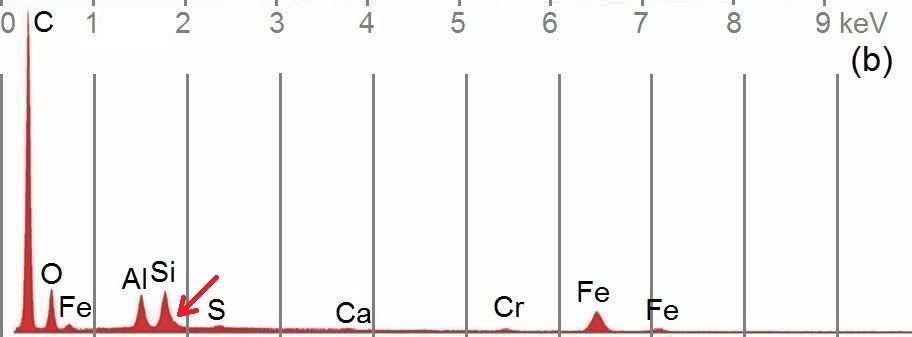
First, compare the red layer XEDS of this chips with Harrit's chip (b):
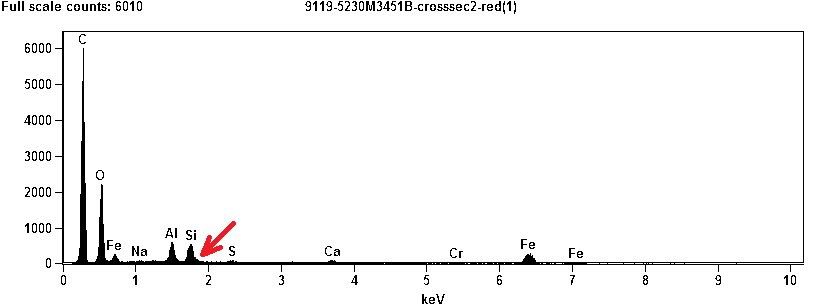
9119-5230M3451B-crosssec2-red1_Xeds20kV.jpg

Harrit_7b.jpg


I notice in both:
  • C dominates far and away
  • O is second highest (in Millette's spectrum, lighter elements are relatively stronger and heavier relatively weaker than in Harrit's. Such effects can come from geometry of the sample, attenuating factors, or would happen if Millette used a lower beam energy))
  • Al and Si come next and are almost equal
  • Si is "pregnant" on the right shoulder, at the 1.81 keV where Sr likes to hide!
  • Traces of S, Ca and Cr
  • And of course iron in fifth place
Only difference: Millette has a trace of Na. Oh well, I guess well never find anything totally without impurity.


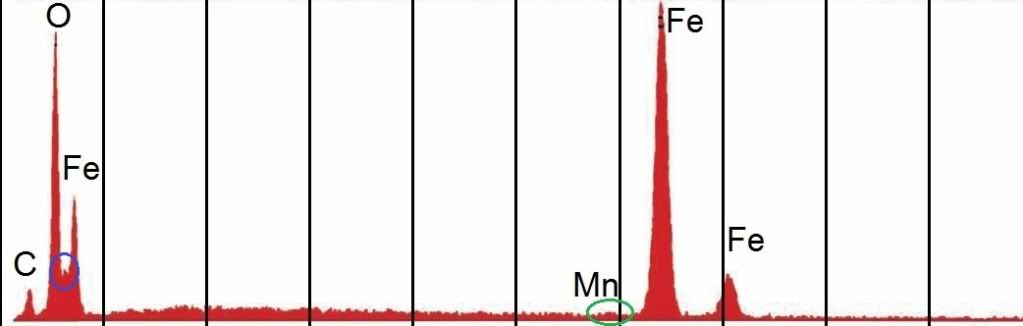
Now the gray layer XEDS:
9119-5230M3451B-crosssec2-gray1_Xeds20kV.jpg

Harrit_6b.jpg


I notice in both:
  • Fe just a little higher than O
  • There is this weird little peak between O and Fe L-alpha that doesn't correspond with any element's Edge energy as far as I can find, yet it's still there (also in chip c)
  • I think there is a tiny signal for Mn near 5.9 keV, although neither Millette nir Harrit labeled it (I did)
  • Little bit of C

So both red and gray spectra are really nice matches.

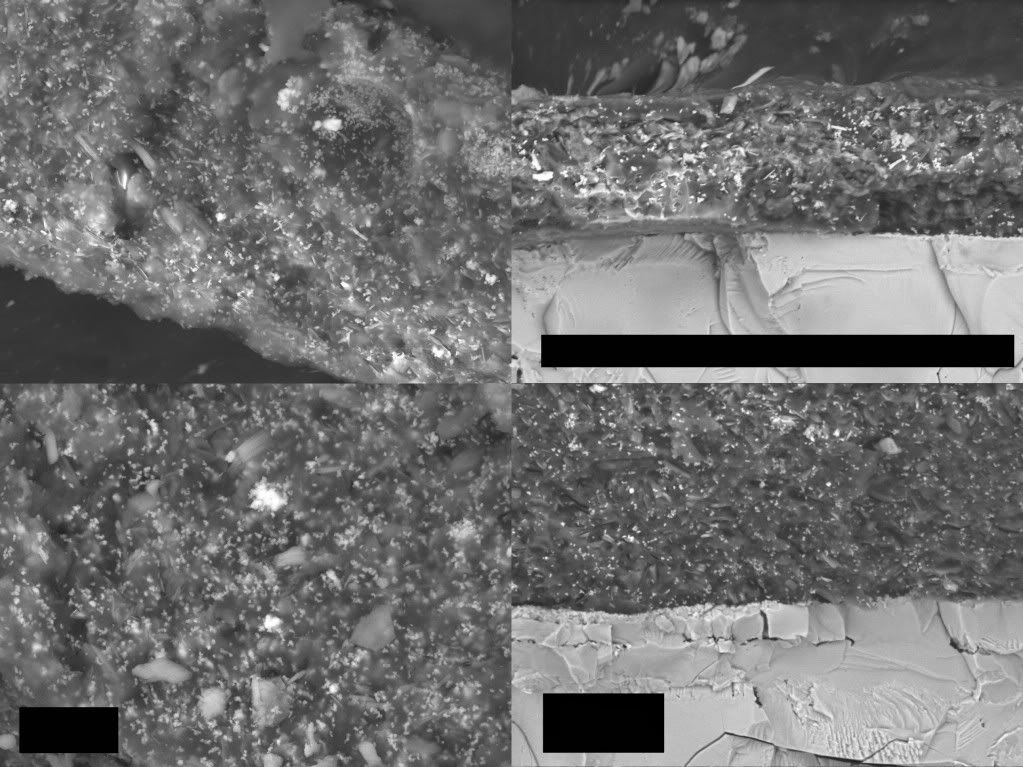
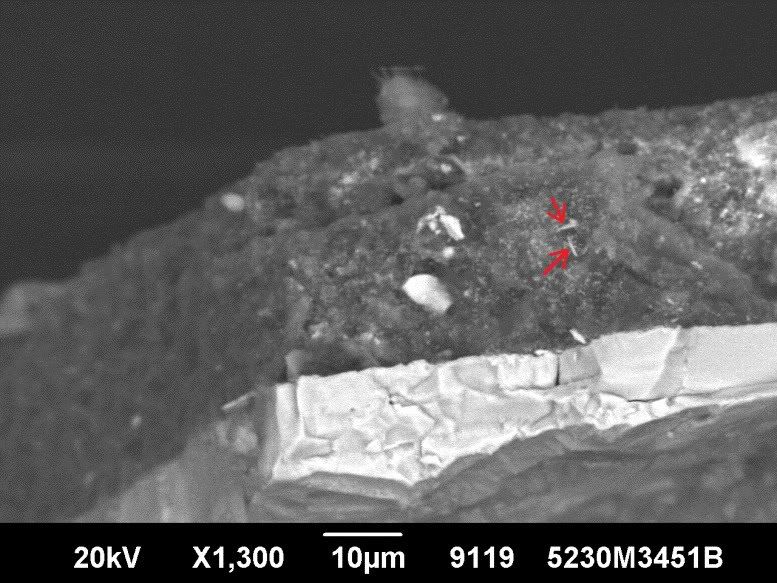
And on to the image:
9119-5230M3451B-crosssec2-SemImage_1300x.jpg

ActiveThermiticMaterial_Fig05_orig.jpg


Is that BSE? Red layer is dark, gray layer bright. The gray layer is as homogeneous, brittle and edgy as the gray layers of Harrit. The red layer seems to be sprinkled with the 100nm hematite grains. Kaolin platelets are less than sharp, but the red arrows point at two acicular, whitish particles ca. 3µm long and perhaps 500nm thin. Candidates for Strontium Chromate?


What do you think, guys?
 
Oystein: Thanks for your analyses:cool:

Those two light needles can be strontium chromate crystals, interesting discovery, it is perhaps more convincing that the finding of such needles in our white paper. But still, it can be perhaps some accidental impurity, e.g. some tiny fibers (??). It would be great if Jim Millette can have a look on this:o)

Well, according to your analysis, this one Jim's chip must be Laclede paint because of a very good match of XDES with theory... not many chips, but at least one. Anyway, success:cool:
It would be great (and conclusive!) if Jim Millette can assign some FTIR spectrum confirming epoxy binder and kaolinite to this chip or to any other chips in which XEDS spectra were taken on cross-section of the red chips.
I still think that most of the spectra in Appendix D (XEDS on chips cross-sections) basically correspond to the expected Laclede paint spectra, considering that ratio between Si/Al peaks and Fe peak naturally fluctuates, e.g. since XEDS probe was mostly intentionally focused to very tiny areas. Impurities are practically negligible there. In the case of red paint chips from WTC, which were surrounded by fine dust e.g. from calcium sulfate, only XEDS spectrum on freshly cut surfaces perhaps can be good enough.

As for the "third peak" between Fe and O, I think that it could be some noise, which can be jugded from the overal noise in this graph. I think:cool:
 
Last edited:
Last night I copied all the graphs in all of the Appendices to proper image files, they are clearer that way.

One thing that strikes me as odd is that almost all (33 of 34) XEDS graphs in Appendix B have some Mg. The lone exception is 9119-5230M3451B-red-gray(2) which is also a LaClede candidate. The cross-sections in Appendix D on the other hand are all Mg-free, with again one exception (9119-5230M3451B-crosssec1-red(1), which is not a LaClede candidate). Why would that be so? Mg, at 1.25 keV, is a nice distance away from its nearest plausible neighbors, Na (1.04) and Al (1.49), so it is certainly not a matter of mistaking it for some other element. Would that indicate that Mg is a very common surface contamination that's hard to wash off with just water?
I would have to accept some Mg an perhaps other traces when selecting chips for closer examination - not a happy prospect.


(By the way: Comparing Millette's and Farrer's/Jones's images and graphs, I think that the Harrit team did some pretty nice hands-on work, they don't pale against the pro)
 
Last night I copied all the graphs in all of the Appendices to proper image files, they are clearer that way.

One thing that strikes me as odd is that almost all (33 of 34) XEDS graphs in Appendix B have some Mg. The lone exception is 9119-5230M3451B-red-gray(2) which is also a LaClede candidate. The cross-sections in Appendix D on the other hand are all Mg-free, with again one exception (9119-5230M3451B-crosssec1-red(1), which is not a LaClede candidate). Why would that be so? Mg, at 1.25 keV, is a nice distance away from its nearest plausible neighbors, Na (1.04) and Al (1.49), so it is certainly not a matter of mistaking it for some other element. Would that indicate that Mg is a very common surface contamination that's hard to wash off with just water?
I would have to accept some Mg an perhaps other traces when selecting chips for closer examination - not a happy prospect.


(By the way: Comparing Millette's and Farrer's/Jones's images and graphs, I think that the Harrit team did some pretty nice hands-on work, they don't pale against the pro)

My self-quote from post 341:
"(As for XEDS spectra of surfaces, Appendix B)
Main problems I see as a layman (without proper experience):
- There is invariably some little peak of Mg, which should not be in Laclede paint; could it be contaminant?
- There is always little to medium peak of Ca, which does not belong to Laclede. Could it be contaminant?"
(On the other hand XEDS spectra on cross-sections show no Mg)


So, I agree, it is rather strange. I think that it is highly improbable that just accidentally, all "surface samples", just owing to Mg peak, are different paint that all "cut samples", since both sets of samples are comparatively big.
This prompts me that Mg peak should be somehow connected with the surface contamination of all (almost) chips in Appendix B, no matter what paint they are made of.

But I will enjoy now the first really spring day and evening in Prague (20 degrees C, sunny, a lot of people outside:rolleyes:)
 
Last edited:
As for the "third peak" between Fe and O, I think that it could be some noise, which can be jugded from the overal noise in this graph. I think:cool:

Suggestion: since Oysten identified a bump that might be Mn K line near 6 Kev, then it might be Mn L line at 0.63 Kev, just in between O K and Fe L.
 
Suggestion: since Oysten identified a bump that might be Mn K line near 6 Kev, then it might be Mn L line at 0.63 Kev, just in between O K and Fe L.

The peak in question is actually part of the Fe L series. The Fe L family contains about 10 transition edges, of which at least 2 are visible at the resolution presented in the paper. The fluorescence yield of Mn L lines is usually about 1/10th of the Mn K-L2,3 (K alpha) lines.
 
Why would that be so? Mg, at 1.25 keV, is a nice distance away from its nearest plausible neighbors, Na (1.04) and Al (1.49), so it is certainly not a matter of mistaking it for some other element. Would that indicate that Mg is a very common surface contamination that's hard to wash off with just water?
I would have to accept some Mg an perhaps other traces when selecting chips for closer examination - not a happy prospect.

Mg is an incredibly common Earth element. I can't think of a dust/dirt/ash sample that had no Mg in it. That being said, remember that we are dealing with heterogeneous materials, most of which are flakes and pieces. Those sneaky little X-rays have lots of opportunity to fluoresce nearby grains and contaminants.
 
And also from that thread:

SnowCrash said:
Look at them claiming a DSC is meaningless. Tillotson did one. Is it meaningless? Of course not.
I recall having seen someone say recently that either Tillotson or Gash said later that that test was unnecessary. Could someone confirm this? I've been searching the threads but can't find the quote.
Found it.

Later they admitted (in private conversation) to some faulty thinking and that the DSC result isn't really very interesting.
 
And also from that thread:

SnowCrash said:
Look at them claiming a DSC is meaningless. Tillotson did one. Is it meaningless? Of course not.
I recall having seen someone say recently that either Tillotson or Gash said later that that test was unnecessary. Could someone confirm this? I've been searching the threads but can't find the quote.

Found it.

Later they admitted (in private conversation) to some faulty thinking and that the DSC result isn't really very interesting.

Not unnecessary. Just, with hindsight and several years of learning later, not the smartest thing they could have done. Over the years, they have come to rely less and less on the enthalpy from DSC for irreversible reactions as an absolutely accurate value. In irreversible high energy processes the solid experiences too many changes that may lead to inefficient heat transfer to he DSC sensor and thus an inaccurate heat flow measurement. It's still an excellent tool for reversible processes such as melting/solidfying ot crystal phase transitions. Also for thermal decomposition. For full-fledged chemical reactions (redox), combustion calorimetry (http://en.wikipedia.org/wiki/Reaction_calorimeters ?) is a far more accurate way to determine reaction enthalpy.
 
Thanks for the clarification. I got a different impression from the "not very interesting" part.
 
Mg is an incredibly common Earth element. I can't think of a dust/dirt/ash sample that had no Mg in it. That being said, remember that we are dealing with heterogeneous materials, most of which are flakes and pieces. Those sneaky little X-rays have lots of opportunity to fluoresce nearby grains and contaminants.

Thanks, Almond
According to the USGS table published here, the percentage of magnesium in the dust was in the range from ca 1.7 to 3.2 %. And magnesium was found in all samples.

Si prevailed together with Ca and Mg is everywhere in levels quite "compatible" with this little peak found in the XEDS spectra on red layer surfaces:cool: I think.
 
Last edited:
Btw, let me consider those average concentrations of elements in the dust according to that table (not really calculated, just rough estimates):
Ca 17%
Si 18 %
Mg 3 %
S 4 %
Fe 2 %
Al 3 %

Now again for Appendix B, where little Mg peaks are almost always visible.
Considering that red chips are contaminated with the dust with this average composition, we can expect that Ca and Si contaminants quite substantially contribute to the heights of XEDS peaks of those elements originating from the red layers themselves.

On the other hand, such contribution should be negligible in the case of Fe and Al peaks.
Sulfur can in principle come only as contaminant, since there is no sulfur compound in the specification of both Laclede and Tnemec primer paint.

E.g., silicon peaks in Appendix B are in some cases substantially higher than aluminum peaks, which is not consistent with Laclede paint. But, if some part of Si peaks belongs to contaminants, the picture is immediately closer to Laclede. And Ca peaks can come only from contaminants. (I have not considered here few XEDS spectra which are more consistent with Tnemec, because of Zn peak etc.)

Perhaps it could deserve some closer look/correlation.
But perhaps not:o
 
Last edited:
Jim Millette and DSC Particle Testing

Hi all,

Jim Millette dug up a couple labs for DSC tests but is not interested in adding this to his experimental protocol. Here is what he wrote this morning:


"Chris, I got your Email concerning the DSC opinion. I had tracked down 2 laboratories who could do the work: Micromeritics in Atlanta and Particle Technology Labs in Downers Grove, IL. ... I am not interested of directing this part of the project. I will see who I might find in the Forensics area for an opinion. Jim"


I also have the contact data Jim gave me if anyone wants to organize a DSC test. But as Jim told me twice on the phone, once he determined with certainty that the chips he tested had no thermitic materials, he would have just been testing the properties of some kind of paint chip.

The last sentence of his email above is of more interest to me and most of us: he liked my idea of getting an independent analysis of the DSC tests already done and reported on in the Bentham study.

So if anyone really wants to shell out the $250-$400 to DSC test a single chip, let me know.
 
Hi, Chris,

OK, such an independent look of some expert on the Bentham DSC curves would be definitely useful for us, even if this expert is not able to identify the paint binder:cool:
 
Regarding the "need" felt by truthers to do DSC test, I would like to point out that they are, as far as can be determined thus far, NOT interested in the curves (no truther has EVER set out to explain the curves, beyond the fallacious "they are narrow, so reaction speed must have been high") but only in the residue. As Frank Legge writes at 911Blogger:
Frank Legge said:
The important criterion regarding the DSC test is that the product is globular iron, hence previously molten. There is no way that the combustion of organic material in air can produce a temperature high enough to produce molten iron.

For those promoting "thermitic paint", the responsibility is theirs to find a sample of such material and to show that it had been applied in large scale in the towers. A theory without evidence is just a distraction.
The truthers did not record when during the DSC testing the melting supposedly happened, and indeed it can't be deducted with any degree of certainty from the graphs. Melting is an endotherm process. If it happens alone, without parallel combustion, the curve would dip below zero. Interestingly, two of their four curves DO dip below zero - after the exotherm reactions have ended of course: between ca. 550°C and 680°C (and the other two curves do not). This might indicate that the heat of the DSC plate itself is sufficient to melt something.

So again, truthers aren't interested in DSC results und discussion thereof (100% of them lack the required education), they only want to heat chips (slowly?) to 700°C, see them burn, and look if any microspheres have formed. To do that, you don't need a DSC. Perhaps Millette can do that with his muffler? Perhaps he is already doing that?
 
Last edited:
In 2009, a few weeks after the paper came out, I successfully characterised the material that was in the Harrit et al paper as primer paint adhered to oxidised steel. I showed conclusively that the red layer contained kaolin. Read the following if you don't believe me.

http://www.internationalskeptics.com/forums/showthread.php?t=139293&highlight=kaolin+thermite
http://www.internationalskeptics.com/forums/showthread.php?t=140017&highlight=kaolin+thermite

I did this without using the DSC data. DSC is not required to work out what this material is. DSC is a red herring. DSC is worthless. DSC tells you nothing you don't already know. The fact that DSC is in Harrit et al tells you they didn't know what they were doing.

In 2012 Millette successfully characterises the material as primer paint adhered to oxidised steel and conclusively shows the presence of kaolin. He does this, just like me, without the use of Differential Scanning Calorimetry data.

Tell me why anyone should need to use DSC in order to characterise this material. Why did Harrit et al do it when they didn't need to?

Que single line "answer" from truthers in 3..2..1 rather than a 1000 word scientifically literate, logical and coherent response.
 
In 2009, a few weeks after the paper came out, I successfully characterised the material that was in the Harrit et al paper as primer paint adhered to oxidised steel. I showed conclusively that the red layer contained kaolin. Read the following if you don't believe me.

http://www.internationalskeptics.com/forums/showthread.php?t=139293&highlight=kaolin+thermite
http://www.internationalskeptics.com/forums/showthread.php?t=140017&highlight=kaolin+thermite

I did this without using the DSC data. DSC is not required to work out what this material is. DSC is a red herring. DSC is worthless. DSC tells you nothing you don't already know. The fact that DSC is in Harrit et al tells you they didn't know what they were doing.

In 2012 Millette successfully characterises the material as primer paint adhered to oxidised steel and conclusively shows the presence of kaolin. He does this, just like me, without the use of Differential Scanning Calorimetry data.

Tell me why anyone should need to use DSC in order to characterise this material. Why did Harrit et al do it when they didn't need to?

Que single line "answer" from truthers in 3..2..1 rather than a 1000 word scientifically literate, logical and coherent response.

like i said before it helps to rule out what material you have. you guys can NOT say that what millette tested is the same material that jones tested before you do a dsc. will it react at 430 or will it be like henryco's chips and NOT react to produce iron and silicon rich microspheres even at 900C. henryco did not do a dsc but when he heated up his chips they did not react.
 
like i said before it helps to rule out what material you have. you guys can NOT say that what millette tested is the same material that jones tested before you do a dsc. will it react at 430 or will it be like henryco's chips and NOT react to produce iron and silicon rich microspheres even at 900C. henryco did not do a dsc but when he heated up his chips they did not react.
Why do truthers have such poor reading comprehension?

Once again - Tell me why anyone should need to use DSC in order to characterise this material. (characterise means find out what it is)

You answered
like i said before it helps to rule out what material you have.
How? How exactly does it help to rule out other materials? Go into detail. Why would you use DSC in a materials characterisation exercise?

A single line answer with nothing to back it up. You made a statement now back it up.

If I give you a random sample of something, why would you put it in a DSC to find out what it's not rather than use dozens of other techniques that actually tell you what it is?
 

Back
Top Bottom