• Quick note - the problem with Youtube videos not embedding on the forum appears to have been fixed, thanks to ZiprHead. If you do still see problems let me know.

Black holes

No I haven't.

It's the Shapiro delay. Even a child can work out that the light is delayed because it goes slower when it skims the sun. Ah, I see some bright spark has removed the Einstein quote from the wiki article.

It's a "delay" in the sense that light takes longer to travel the path than it would if the star were not there.

And, that delay is only evident in a non-local measurement (propagation of light between distant points).

No it doesn't. We know it doesn't because an optical clock in that falling laboratory ticks slower and slower the lower it gets. Our parallel-mirror light clock will tick slower and slower too. All electromagnetic phenomena will be similarly affected, included that within the bodies of the observers within that laboratory.

Be careful to note what what I'm actually referring to here. I'm talking about a measurement made by a physicist in a freely falling laboratory. A local measurement, in contrast to the the non-local measurement I mentioned earlier in my post. Such physicists will always measure 299792458 m/s, and that is the value we denote by "c". It is that value which appears in Maxwell's equations (in vacuo) and the formulae for Z0 and c in terms of μ0 and ε0.

It obviously isn't constant, and this is even more obvious when one understands the unification of electric and magnetic fields into the electromagnetic field.

Electromagetism, at the classical level, is described by Maxwell's equations. And in that context, c and μ0 are just constants resulting from the particular choice of units. So, whatever you're talking about here is not classical electromagnetism.

But that's one for another day. Meanwhile: I don't need to specify how it changes from place to place, all I need to do is demonstrate that it does.

If you assume that c and μ0 are varying through space, then it is quite clearly possible that they could vary in such a way that Z0 remains constant. It is also possible that c and Z0 vary while μ0 remains constant, and so on.

So, you do need to specify how it changes from place to place, otherwise there is no way to know whether your claim was true.

You mean like in gravitational lensing? You might like to read up on that, ct. Here, try this little article.

I'm familiar enough with gravitational lensing for present purposes. As it is perfectly well accomodated by the standard, modern understanding of GR in which c, Z0 and μ0 are a constants, you cannot appeal to the existence of lensing to prove the superiority of your model.

Or take a look at Inhomogeneous Vacuum: An Alternative Interpretation of Curved Spacetime. Here's the abstract:

"The strong similarities between the light propagation in a curved spacetime and that in a medium with graded refractive index are found. It is pointed out that a curved spacetime is equivalent to an inhomogeneous vacuum for light propagation. The corresponding graded refractive index of the vacuum in a static spherically symmetrical gravitational field is derived. This result provides a simple and convenient way to analyse the gravitational lensing in astrophysics".

They do not demonstrate equivalence, merely close similarity in certain limited circumstances (though they reproduce some correct results for a static gravitational field). You are claiming complete equivalence.

You should read this short page for more information on that general "refractive index" approach (and why it falls down): http://mathpages.com/rr/s8-04/8-04.htm

Again, a model in which only a single (ETA: scalar) quantity (in their case, a refractive index they denote by "n") is varying from point to point cannot logically be equivalent to GR in all its gory detail.

Hasn't anybody else here rumbled this blind-em-with-maths rewriting of history? This is what Einstein actually said:

(...snip...)

What Einstein believed from 1911-1915 doesn't matter for this discussion. What we have in front of us is (a) the modern understanding of GR, and (b) your claim that GR's predictions can be reproduced by assuming that c and/or Z0 vary from point to point.

Noted. He's mentioned in the Inhomogeneous Vacuum paper above. Which doubtless some here will say has not been peer-reviewed, or will decry in some other fashion.

It's worth noting that Puthoff's model is not a reinterpretation of GR. It is a different model with different predictions. What we're discussing here is, purportedly at least, classical GR.


I'm familar with annihilation and pair production. They are well understood within the framework of the Standard Model. You do not need any understanding of particle physics in order to understand GR (i.e. standard GR).

So, if FGR (as I see it has been christened) depends on the nature of particles to ensure that all clocks are affected exactly equally by gravity, then it cannot be the same thing as standard GR.
 
Last edited:
Would you be so kind, dear reader of this post (and JREF member), as to tell us all (by writing a post) if I am boring you to death? Thank you.

ETA: also, if you wouldn't mind, do you understand what Farsight has written (Impedance is an electrical property of say a cable, but it applies to space too, which electromagnetic waves propagate through. It applies to alternating current rather than direct current, these both being associated with conduction current, which is the motion of charged particles. You can create such charged particles via pair production, and get the electromagnetic waves back again via annihilation. Those electromagnetic waves are displacement current rather than conduction current, and they wave. They're alternating.)?

I think I've already answered the first question in my previous post - I'm certainly not bored.

As for the second: not really, no. Parts of it make sense, but the whole doesn't.
 
When I read posts like this, I am reminded of "conversations" I've had with young-earth creationists. ....
That still does not address what I wrote:
Originally Posted by Reality Check
You have not cited any "hard scientific evidence" other than the references to the effects predicted by GR .
this post of yours is a list of quotes from Einstein before the publication of GR in 1917. No surprising physics in what he states.
The hard scientific evidence you have posted so just states that GR is correct, e.g. that the coordinate speed of light varies according to the coordinates used.
That is trivial.

You though deny this by asserting that the speed of light at an event horizon is zero. This is wrong because the speed of light (no "coordinate") is always c. If you mean the coordinate speed of light then you have to specifiy the coordinate system that you are using. For example
  • In Schwarzschild coordinates the coordinate speed of light is zero at the event horizon (there is a coordinate singularity there).
  • In Kruskal–Szekeres coordinates the coordinate speed of light is the same everywhere (there is no coordinate singularity at the event horizon).
 
Would you be so kind, dear reader of this post (and JREF member), as to tell us all (by writing a post) if I am boring you to death? Thank you.

ETA: also, if you wouldn't mind, do you understand what Farsight has written (Impedance is an electrical property of say a cable, but it applies to space too, which electromagnetic waves propagate through. It applies to alternating current rather than direct current, these both being associated with conduction current, which is the motion of charged particles. You can create such charged particles via pair production, and get the electromagnetic waves back again via annihilation. Those electromagnetic waves are displacement current rather than conduction current, and they wave. They're alternating.)?


For what it's worth you can add me to the list of lurkers who:
  1. Isn't at all bored by your posts
  2. Doesn't understand the sentence in italics above.
I admire your gentle persistence but I don't think you will succeed in walking Farsight through this until one of you perceives their error. I think he's aware at some level that he can't work logically through to his conclusion, but is still absolutely sure it's correct.
 
As mathematical arguments go, that isn't one.

You quoted Hassani's definition on page 764 as your authority. That definition says the coordinates are real.

I'm sorry that Hassani (and every other reference I've checked) offends your personal sense of the racial characteristics you have chosen to attach to mathematical objects, but your racist language is not a mathematical argument.

It's a matter of using accepted definitions. When you ignore accepted definitions while pretending to champion the proper mathematical definitions, it's a little churlish of you to blame us for your miscommunication.

So, pedantic it is. Hope I am not being too churlish pointing that out. Since I am considered a lout, let's try Wikipedia as to what they think a coordinate system is supposed to be. I know it is not the best authority all of the time, but, lets see what it says all the same. We might as well drag out my loutish sensibilities for all to bear.

What is a coordinate system great Wiki Wiki.

In geometry, a coordinate system is a system which uses one or more numbers, or coordinates, to uniquely determine the position of a point or other geometric element.

Wiki Wiki, What is a number?

A number is a mathematical object used to count and measure. In mathematics, the definition of number has been extended over the years to include such numbers as zero, negative numbers, rational numbers, irrational numbers, and complex numbers.

So, I guess complex numbers are numbers, and coordinate systems use numbers, and the thing I gave used numbers, and... is there something I am missing here? I am just wondering because I have used complex valued coordinates in a class before. I guess they weren't "real" numbers, but they sure did act like coordinates in a coordinate system in all the ways that I could tell of.
 
Pedantic

So, I guess complex numbers are numbers, and coordinate systems use numbers, and the thing I gave used numbers, and... is there something I am missing here?


Yes. Riemannian manifolds are locally Euclidean (and pseudo-Riemannian manifolds are locally pseudo-Euclidean). Charts have two purposes: to define coordinates, and to establish a homeomorphism between an open subset of the manifold and an open subset of n-dimensional Euclidean (or pseudo-Euclidean) space.

If you allow coordinates to be complex instead of real numbers, you're doubling the number of dimensions of that space. If you're not careful (and, at this point, we don't have reason to think you're careful), your doubling of the dimension will prevent your alleged chart from being a homeomorphism.

Cue sound of trap snapping shut.
 
Last edited:
I'm going to skip a couple of posts, because this one is important:

No, you've got it backwards. If we find waves oscillating at 9,192,631,770 Hertz we already know what the second is. That's because Hertz is cycles per second.

Are you being deliberately obtuse? We don't know what the frequency of this signal is until after we see how caesium reacts to it.

It's long been established that caesium reacts specifically to frequencies of 9,192,631,770 cycles per "1/31,556,925.9747 of the tropical year for 1900 January 0" (former definition of the second).

Whenever we find a frequency that reacts with caesium in this way, we know that this frequency is always exactly 9,192,631,770 Hertz even if we don't know the exact length of the second.

So when we want to measure the length of the second:

FIRST we determine that a microwave signal has a frequency of 9,192,631,770 cycles per second by observing it's interaction with caesium.

THEN we measure the length of the second by observing how long it takes for this signal to cycle 9,192,631,770 times.​


It isn't an issue. Where light goes slower the second is bigger, then you use the slower light and the bigger second to define the metre, so that metre is the same metre regardless of how fast the light is going.

Assuming that the speed of light in a vacuum is variable, why should the second be bigger when light is slower? We don't define time based on the speed of light.

No it wouldn't, because your definition of the second relies upon the speed of light.

You're wrong. Our definition of light does not rely upon the speed of light. It relies on a specific frequency of light.

Take two caesium atomic clocks. Fill one clock with one bar of hydrogen, and one clock with one bar of sulfur hexafluoride.

The microwaves will be traveling more slowly in the sulfur hexafluoride clock (because it's a much denser gas), but the two clocks should remain in perfect synchronization.

The actual speed the light is traveling is irrelevant.

You can't say this because it assumes that the electromagnetic hyperfine transition is unaffected by whatever it was that caused the light to slow down.

What's wrong with this assumption?

But right or wrong, it's a testable assumption. We could compare the time from an atomic clock to the time from a Surface Acoustic Wave based clock in different gravities.

Would you expect the SAW clock to gain/lose time at a different rate in comparison to the atomic clock at different locations?

So, you measure the speed of electromagnetic wave propagation using an atomic clock... which employs microwaves? Or a quartz time that employs the piezoelectric effect?

Anybody spot a problem with that?

I don't see a problem with using the atomic clock due to it's using microwaves. It's not like the speed of the microwaves affect the timekeeping.

But if you don't like the quartz timepiece, we can use a Surface Acoustic Wave (SAW) filter as the basis of the timepiece. This uses the piezoelectric effect to produce and and detect the acoustic (sound) wave, but it's the purely mechanical properties of the device which determines the frequency of the acoustic wave that passes through it.
 
Last edited:
Stop wasting everybody's time Dopa. We all know about carbon dating.

He made no mention of carbon dating, which would be useless for day-to-day timekeeping.

A radioisotope clock could be built by using a Geiger-counter or scintilloscope to detect particles emitted by a radioactive substance with a long half-life. The passage of time would be measured by keeping count of the number of particles detected.

And I think you completely missed his point, which I assume was intended to address your assertions about the nature of clocks. A radio-isotope clock would not be covered by your concept of all clocks being based on regular motion.

How does one measure the impedance of space? And is the impedance of space the same as vacuum impedance?

You measure the speed of light then apply c = √(1/ε0μ0) and Z0 = √(μ00).

Why not just use Z00C0 or Z0 = 1/ε0C0 instead of making it complicated?

:confused:

ETA: And since you could use these formulae to calculate the speed of light by measuring the impedance of space, this brings us back to DeiRenDopa's question. How do you measure the impedance of space?

If you're trying to find the speed of light by measuring the impedance of space, the response "measure the speed of light" is less than helpful.

It's dark in visible wavelengths, maybe dusty. You can't see any nearby stars, but you can detect the 21cm hydrogen line. This electromagnetic radiation "is at the precise frequency of 1420.40575177 MHz". You detect it, and find it to be isotropic.

Fair enough.

You know that it's coming at you at the speed of light, and that there is a direct relationship between wavelength and frequency.

Why would this be relevant for measuring the second? If you were trying to directly determine the length of the metre, sure, but not for measuring time.

You know that this tells you how many wavelengths pass you by in a second.

A wavelength is the distance a photon travels per cycle. We don't care about distance, only how many cycles.

To determine the duration of the second, we ignore the length of the cycles that are passing us, and simply count the number of cycles.

So if your master clock suffers some breakdown, you know that you can recalibrate it by counting the hydrogen-line microwaves passing you by. When you get to 1,420,405,751.77, that's a second. It's very simple.

Yes, it is.

You defined your second using the motion of light.

No, we defined our second using the frequency of light. The exact motion or velocity of the beam of light that passed us was irrelevant...

... unless you're suggesting that the frequency of the 21cm hydrogen line varies with the speed of light?

But since this line is the result of photons with a specific energy level interacting with hydrogen, slower light would need a smaller wavelength to get the same level of energy.

I assume that if you halved the speed of light, the 21cm line would probably become a 10.5cm line, and there'd be no difference in the time it takes to count the same number of cycles. Can anyone else (except Farsight) tell me if this is correct?
 
Last edited:
I can't stop long today I'm afraid guys. I'll look through the posts and respond selectively before going back through the rest in turn.

Don't take this the wrong way, but the boring part is your repeated assertions without anything additional in the way of evidence or even explanation. You seem to take any request for aditional information as some sort of insult or as set up for a trap. People here are trying to understand what you're saying, but you haven't really made it clear at all. You keep saying the same things repeatedly without ever clarifying questions. I believe it would improve all sides of the coversation if you could slow down, put aside the animosity for a bit, and try to answer the questions...not with generalities but with specifics. Science isn't a shotgun, it's a sniper rifle. Precision counts.
Noted, Hellbound. I'll try to remain factual and responsive whilst keeping emotion out of it. If it helps at all, I imagine that with your electronics training you're aware of the lossless line where Z0 = √(L/C). There is a relationship with Z0 = √(μ00). And you might find this Taming Light at the nanoscale interesting, it concerns displacement-current circuitry. Displacement current is a "time varying electric field". If an electromagnetic wave passes you by, you will detect a time-varying electric field.

Regarding the main point I'm trying to convey, if I showed you two parallel cables with a different impedance, you'd expect to see some variation in the A/C signal propagation time, which we might depict like this:

|-----------------|
|-----------------|

If I replace the cables with light beams in say a smoke-filled chamber, and gave you a gedanken high-speed camera, you should be able to play back the film and see the light beams propagating in a similar fashion:

|-----------------|
|-----------------|

I would hope that you would attribute this difference to vacuum impedance rather than "time flowing slower", and conclude that c = √(1/ε0μ0) is not an absolute constant.
 
Lurking in this thread, I have learned that "hard scientific evidence" means "Farsight's iconoclastic intuitions and just-so qualitative narratives".

I've also learned that Farsight is the only one who has managed to "think it through". Shame on all of you actual scientists for labouring away in ignorance, relying on regurgitation, quantification and rote learning.
I'm afraid D'rok, that that description is almost totally accurate. The only thing I think it's worth pointing out is that some of the people here are mathematicians rather than physicists. There's nothing wrong with mathematics, and it's a vital tool for physics, but IMHO some people involved in physics sometimes attach more importance to mathematics than patent scientific evidence. What I'm trying to get across here re black holes concerns "non-real" solutions. For example if you need to carpet a square room which has a floor area of 16m², you can employ mathematics and work out that you need a carpet measuring 4m by 4m. However there is another solution to √16, namely -4. Mathematics does not tell you that a carpet measuring -4m by -4m is a non-real solution. It doesn't tell you that such a "negative carpet" does not actually exist. Whilst there's no problem with a negative displacement, distance is a scalar, and there is no such thing as a negative distance.
 
Last edited:
Are you being deliberately obtuse? We don't know what the frequency of this signal is until after we see how caesium reacts to it.
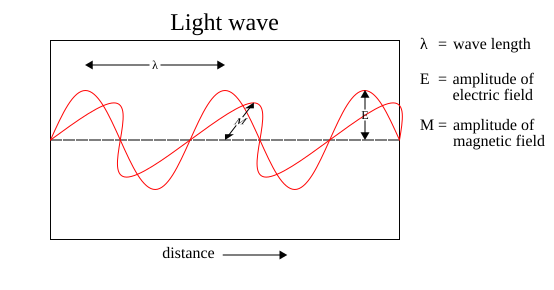
I'm not being deliberately obtuse, I'm trying to get this crucial point across. Suppose I show you a light wave, like this snapshot but propagating from left to right:

554px-Light-wave.svg.png

(GNUFDL image by Heron, see http://en.wikipedia.org/wiki/File:Light-wave.svg)

If I then say to you Your second is not defined you cannot say what the freqency of this light wave is. However what you can do is count 9,192,631,770 peaks passing you by, and then say I define the duration of my counting to be one second. Then you can assert that the frequency of this signal is 9,192,631,770 Hz. If we then repeat the scenario but with the signal passing you by at a slower rate, the second that you define will be a greater duration than previously. We can repeat the whole exercise with a different signal, associated with hydrogen rather than caesium, whereupon you would count to 1,420,405,751.77 . But again you can't assign a frequency until after you've defined the second.

It's long been established that caesium reacts specifically to frequencies of 9,192,631,770 cycles per "1/31,556,925.9747 of the tropical year for 1900 January 0" (former definition of the second).
Whenever we find a frequency that reacts with caesium in this way, we know that this frequency is always exactly 9,192,631,770 Hertz even if we don't know the exact length of the second.
That definition doesn't account for relativity, wherein the second varies with gravitational potential.

So when we want to measure the length of the second:

FIRST we determine that a microwave signal has a frequency of 9,192,631,770 cycles per second by observing it's interaction with caesium.

THEN we measure the length of the second by observing how long it takes for this signal to cycle 9,192,631,770 times.​
I'm sorry Brian, but that's circular reasoning. Yes we can say this is the signal that interacts with caesium but we can't give it a frequency until after we've counted to 9,192,631,770 and defined the second.

Assuming that the speed of light in a vacuum is variable, why should the second be bigger when light is slower? We don't define time based on the speed of light.
See above. If I had a magic button that made that signal pass you by more slowly, you still count to 9,192,631,770 but now your second is bigger than it was previously. And I do have a magic button. It's the button in the lift you're doing your experiment in. I send you down to the ground floor.

You're wrong. Our definition of light does not rely upon the speed of light. It relies on a specific frequency of light.
I'm sorry Brian, but until you've defined the second, you haven't got a frequency.

Take two caesium atomic clocks. Fill one clock with one bar of hydrogen, and one clock with one bar of sulfur hexafluoride.

The microwaves will be traveling more slowly in the sulfur hexafluoride clock (because it's a much denser gas), but the two clocks should remain in perfect synchronization.

The actual speed the light is traveling is irrelevant.
It isn't. The NIST fountain clock lofts the caesium atoms in a vacuum, the metre is "the length of the path travelled by light in vacuum in 1 ⁄ 299,792,458 of a second". The speed of electromagnetic propagation between the molecules of a gas isn't different to what it is in a vacuum, however interaction with their electromagnetic fields results in dipole oscillations that reduces the overall phase velocity. Sorry, I'm pushed for time and can't give a good reference for that. Even if you discount it and say c is reduced as per this webpage, when you use a gas for your definitions you get a smaller metre. That won't do.

What's wrong with this assumption?
An electron is an electromagnetic thing, we can make it along with a positron from light via pair production. On that basis you can't assert that something that affects light will have no effect on the electron spinflip.

But right or wrong, it's a testable assumption. We could compare the time from an atomic clock to the time from a Surface Acoustic Wave based clock in different gravities. Would you expect the SAW clock to gain/lose time at a different rate in comparison to the atomic clock at different locations?
I'd expect it to stay in synch with an atomic clock that's next to it. The SAW uses a piezoelectric substrate. Electromagnetism again.

I don't see a problem with using the atomic clock due to it's using microwaves. It's not like the speed of the microwaves affect the timekeeping.
That clock runs slower when it's lower.

But if you don't like the quartz timepiece, we can use a Surface Acoustic Wave (SAW) filter as the basis of the timepiece. This uses the piezoelectric effect to produce and and detect the acoustic (sound) wave, but it's the purely mechanical properties of the device which determines the frequency of the acoustic wave that passes through it.
The mechanical properties depend on electromagnetic bonds. Look at low-energy proton-antiproton annihilation to gamma photons, and probably even a nuclear clock won't do.

Sorry, I have to go.
 
But again you can't assign a frequency until after you've defined the second.
I'm sorry Brian, but that's circular reasoning. Yes we can say this is the signal that interacts with caesium but we can't give it a frequency until after we've counted to 9,192,631,770 and defined the second.
I'm sorry Brian, but until you've defined the second, you haven't got a frequency.

You're oddly fixated on the idea of having to arbitrarily define the second first.

Why can't you accept that we can arbitrarily define a uniquely identifiable signal as having a specific frequency, and calculate the duration of the second from that?

Your entire argument about this amounts to little more than asserting "but you just can't do it that way", and accusing us of circular reasoning solely because you insist it must be done the other way around.

That definition doesn't account for relativity, wherein the second varies with gravitational potential.

It doesn't really matter. At some altitude, it was exactly 9,192,631,770 counts. As we're now using the caesium clock to determine the second, we're automatically measuring time by that definition as applied to that unknown (and irrelevant) altitude.

See above. If I had a magic button that made that signal pass you by more slowly, you still count to 9,192,631,770 but now your second is bigger than it was previously. And I do have a magic button. It's the button in the lift you're doing your experiment in. I send you down to the ground floor.

Bigger by what metric? Slower by what measure?

If it's only the speed of light that's affected, then we'd need a smaller wavelength to excite the caesium, and the slower light with smaller wavelength would take exactly the same amount of time for 9,192,631,770 cycles to pass. The length of the second remains unchanged.

But if it's everything that's slower, then to you it might appear that my second is longer, but to me my second is exactly the same. Locally, the length of the second remains unchanged.

So in what circumstances would this change the local length of the second?
If you're going to claim that the local length of the second is different, please explain how we would demonstrate this locally (without relying on non-local references).

I'd expect it to stay in synch with an atomic clock that's next to it. The SAW uses a piezoelectric substrate. Electromagnetism again.


"A surface acoustic wave (SAW) is an acoustic wave traveling along the surface of a material exhibiting elasticity, with an amplitude that typically decays exponentially with depth into the substrate."

A SAW doesn't need to propagate on a piezoelectric substrate, as it doesn't use the piezoelectric effect to filter the wave. Piezoelectric transducers are used to generate and detect the wave (which makes building the whole thing on a piezoelectric substrate convenient), but the frequency of oscillation depends on mechanical properties of the device, not the piezoelectric effect.

If I'd suggested using a tuning fork with a inductive transducer to detect the rate of vibration and trigger a counter at the same rate, would you say that this would also be subject to variations of the speed of light on the grounds that the inducer was using electromagnetism (photons) to detect the vibration of the tuning fork?

An electron is an electromagnetic thing, we can make it along with a positron from light via pair production. On that basis you can't assert that something that affects light will have no effect on the electron spinflip.

You could make the same argument about the quarks from which protons and neutrons are made.

The mechanical properties depend on electromagnetic bonds. Look at low-energy proton-antiproton annihilation to gamma photons, and probably even a nuclear clock won't do.

The mechanical properties of all material depends on electromagnetic bonds. Are you suggesting that no matter how low the local value of C becomes, that the physical properties of everything will change so that so the value of C appears unchanged?

And if so, exactly how is this different from time slowing down?
 
Last edited:
ben m said:
Amazing! Not only "all local clocks" but all local physics experiments whatsoever. Why, it's almost as there were some "law of relativity", in which the laws of physics do not care what time-coordinates the observer has chosen to use!
You talk as if the laws of physics constitute some deity, ben. They aren't. Space is the way that it is, and other things too, such as light. We describe how these things behave, we note the underlying symmetries, and we draw inferences that we label as "the laws of physics". That's all.
(I added an 's': "the laws of physic" -> "the laws of physics")

I'm pretty sure most readers have concluded - at some level - that one of the aims of the Gedankenexperiments I've proposed (and which Farsight is on-board with, so far) is the exploration of the relationship between "the laws of physics" and 'local vs remote viewing' (I'll explain this further later).

Of course, the "the laws of physics" I propose to explore are a small subset of all such; however, it's the principle that counts. Specifically, I'd like to see if it's possible to say, as a general conclusion, something like this: "the laws of physics are universal, to all local observers", or "locally, the laws of physics are the same, throughout the universe".

About 'local vs remote viewing': a concrete example of what this is about is in this post by Farsight:
DeiRenDopa said:
Oh, one more thing we need to agree on: how to measure the speed of light. Can you please describe how we can do this, using devices/equipment/techniques/etc which incorporate - at whatever critical point necessary - the definitions of the second and the meter?
We measure the speed of light with light and mirrors, like Fizeau did. We already know something about relativity, so we constrain our measurements to horizontal measurements to avoid radial length contraction and keep our experiment simple. However we are not so stupid as to use our parallel-mirror light clock to time the back-and-forth travel time. Or our atomic clock, because that employs the electromagnetic hyperfine transition and microwaves. Or the optical clock which employs UV light. Or the quartz wristwatch, because that's electromagnetic like light. Or the mechanical clock, because that's made of electrons and protons etc, which have an electromagnetic nature. We time it using the distant pulsar.

Here Farsight seems to be proposing that the outcome of a local experiment - in this case the measurement of the (local) speed of light, using a local ruler and a local clock - will be different if we use a non-local clock.

More generally, what can we say about the (local) "laws of physics" if we view them from afar? In my next post I'll present a revised version of the proposed Gedankenexperiments to incorporate this.
 
Last edited:
For now, just this, which will begin to get at Farsight's apparent misunderstanding of GR (well, one of them):

Farsight said:
DeiRenDopa said:
I think you need to go read a good textbook on relativity, Farsight. The only way you can tell if a 'clock runs slower' is by comparing it with another clock in the same reference frame!
Let's see now. I can see my clock, and I can see my other clock. One's lower than the other, and it's running slower, just like Einstein said. Then I can open up my clocks and see them in action. I can see the cogs whirring, or the crystals oscillating, or using my gedeanken microscope I can the electrons flipping or the electromagnetic waves propagating. And in the lower clock I can see all those things moving slower than the upper. But then you lean over my shoulder and say No Farsight, they're moving at the same speed, they're just in different reference frames. What reference frames? Two little rectangles, one around each clock? And then you say you need to read the good book, Farsight. The last time I heard stuff like that was when I was having a dingdong with the YECs.

Let's start, Farsight, by going diving. We will carry with us a pressure gauge, and the water we will dive in has a nice, vertical ruler, marked in meters, with zero being the water's surface.

We will also carry with us a nice, miniature, (physical) chemistry lab. As we descend, we keep a record of the pressure gauge readings, the depth (per the ruler), and the results of experiments we do with our lab, concerning pressure-sensitive reactions (including phase changes); our lab is a pretty snazzy one in that it does an excellent job of holding other physical conditions (such as temperature) constant. We take with us a team of observers, equipped with appropriate recording devices, so there is an objective, independently verifiable, record of our experimental results.

What we find is not all that surprising, and may be summarized by saying that depth correlates with pressure, and the various parameters of our chemistry experiments do too.

As we live in the far future, we are able to repeat this set of experiments in many bodies of water, at different locations on Earth, and on other bodies in our solar system.

With me so far? Any questions or comments?

For our next series of experiments, we travel the world with a gravitometer, an altimeter, and our usual cast of observers. We keep a very careful record of the output of the gravitometer. In one set of experiments, we climb, with our instruments, up a tall, strong, low-mass tower.

Again, this being the far future, we are able to repeat our experiments on, and above, the surfaces of many solar system bodies.

What we find is also not very surprising, and may be summarized by saying that the local g correlates with altitude (or, as you like to say, elevation) on any particular solar system body, and with the estimated mass of that body.

With me so far? Any questions or comments?

For the next set of experiments we carry with us a standard clock, a standard ruler (i.e. devices which measure time and length, per the SI definitions), and a parallel-mirror light clock. We also have pressure gauges, temperature gauges, gravitometers, ... This time we have some friends along, each of whom has their own clock, and each clock is of a different kind; one has a grandfather clock, another a quartz crystal clock, a third an optical clock, a ... Oh, and our usual retinue of observers.

We visit all the places we went to on our 'gravitometer tour'.

This time we find something strange and wonderful (or not): at each location, all the clocks tell the same time (within their error bars/uncertainties)!

With me so far? Any questions or comments?

This being the very far future, we repeat all our experiments, in environments considerably more extreme than any we'd visited previously, like near the photosphere of the Sun, in deep space, just above the surface of a white dwarf star, ditto of a neutron star.

Do any of our findings (experimental results) change?

That is the first post in which I proposed some Gedankenexperiments.

Here's an updated proposal.

A small team of JREF members is going diving. Into a carefully constructed tank. Actually, a whole lot of identical tanks.

Each tank has a ruler on the inside of one of its vertical sides, with the surface marked as zero. Each tank is filled with pure water, held at a constant temperature.

Each diving team carries a suite of pressure gauges, each of which operates via physical processes that differ in at least one respect from all the other gauges. For example, one such gauge works by detecting phase changes in chemically pure substances, another by the deflection of a membrane (vacuum one side, water the other). Each team also has a chem lab and a thermometer, to check the composition and temperature of the medium (water).

Accompanying each JREF team is two teams of observers. One - the Observer A team (OAT, for short) - is equipped with appropriate recording devices, so there is an objective, independently verifiable, record of the experimental results. OAT also broadcasts their records, in real time, to the whole universe; their broadcast is a 'multi-messenger' one: the signal is encoded onto streams of photons (of several different wavelengths), also onto streams of neutrinos, OAT sends out little USB-key-like packets, etc.

The B Observer team (BOT, for short) is also equipped with appropriate recording devices and 'multi-messenger telescopes'. You see, BOT observes all the other JREF diving teams! I.e. they look, very closely, at how the experiments are carried out, sorta like taking a video of what's happening, from afar. BOT also detects the outputs from the OATs (other than their own team's OAT). The purpose is, as you might guess, to be able to compare and contrast the records of the experiments - their conduct and their outputs - as perceived by the locals (the OATs) and the remotes (the BOTs).

The diving teams set up their tanks in many locations: at various places on the solid surface of the Earth, deep in mines dug into that solid surface, on tall towers built above it; ditto on the surfaces of other solar system bodies, etc. (We are all living in the far future! :p )

For the next series of experiments, the teams travel the world each with a gravimeter, an altimeter, and our usual cast of observer teams. Again, this being the far future, we are able to conduct our experiments on, and above, the surfaces of many solar system bodies.

At the end of the experiments, everyone gathers together in a nice, comfortable resort. We all pitch in to analyze the data (which includes all the OATs' and BOTs' records). Our aim is to produce a succinct set of rules, which we call "laws" (and which all members of all teams agree on), which compactly summarize all the experimental results. These laws might, for example, include a formula relating depth to pressure, temperature, altitude, and g. The laws will also, explicitly, contain statements concerning any differences in laws derived by analyzing data obtained locally with those derived by analyzing data obtained by observing remotely.

With me so far? Any questions or comments?

For the next set of experiments each JREF team carries with it a standard clock, a standard ruler (i.e. devices which measure time and length, per the SI definitions), and a parallel-mirror light clock. They also have pressure gauges, thermometers, gravimeters, ... This time each team has some friends along, each of whom has their own clock, and each clock is of a different kind; one has a grandfather clock, another a quartz crystal clock, a third an optical clock, a fourth a radioisotope clock, a fifth a SAW (Surface Acoustic Wave) clock, a sixth a tuning fork clock, a ... Oh, and our usual retinue of OATs and BOTs.

A critically important set of members of each experimental team are friends of Farsight (FoF). They are thoroughly conversant with the Farsight method of measuring the (local) speed of light using distant pulsars, and with the Farsight method of measuring the (local) impedance of space*. Of course, the OATs record the work of the FoF, and the BOTs record that work too, remotely, as well as recording what they receive from the OATs.

The teams visit all the places previously visited in 'gravimeter experiments'. This being the very far future, there are teams which go to environments considerably more extreme than any visited previously, like near the photosphere of the Sun, in deep space, just above the surface of a white dwarf star, ditto of a neutron star.

As before, everyone gets together afterwards, at a (different) comfortable resort, analyzes the data, and agrees on a set of laws which succinctly describe/account for all that data.

With me so far? Any questions or comments?

* Note: we do not - yet - know what these methods are
 
Farsight said:
Or take a look at Inhomogeneous Vacuum: An Alternative Interpretation of Curved Spacetime. Here's the abstract:

"The strong similarities between the light propagation in a curved spacetime and that in a medium with graded refractive index are found. It is pointed out that a curved spacetime is equivalent to an inhomogeneous vacuum for light propagation. The corresponding graded refractive index of the vacuum in a static spherically symmetrical gravitational field is derived. This result provides a simple and convenient way to analyse the gravitational lensing in astrophysics".
They do not demonstrate equivalence, merely close similarity in certain limited circumstances (though they reproduce some correct results for a static gravitational field). You are claiming complete equivalence.

You should read this short page for more information on that general "refractive index" approach (and why it falls down): http://mathpages.com/rr/s8-04/8-04.htm

Again, a model in which only a single (ETA: scalar) quantity (in their case, a refractive index they denote by "n") is varying from point to point cannot logically be equivalent to GR in all its gory detail.
That's pretty cool (the "short page")! :)

It's also worth pointing out that the Ye and Lin paper (cited by Farsight) suggests simplified methods of analyzing astronomical gravitational lensing observations (so it may have considerable practical utility), could lead to testable hypotheses concerning the nature of the observed gravitational lensing signals, explicitly states that the "inhomogeneous vacuum" is not exactly equivalent to GR (pace Farsight), and concludes with this sentence: "We anticipate our work to be a stimulus to the quantum vacuum based investigation of the gravitational force."

Oh, and thanks for taking the time and trouble to answer my questions.
 
Would you be so kind, dear reader of this post (and JREF member), as to tell us all (by writing a post) if I am boring you to death? Thank you.

ETA: also, if you wouldn't mind, do you understand what Farsight has written?

I came for the sol and zig, stayed for the drd.

To be honest, I don't understand half of what goes on in these threads, but I learn more every time they're updated.
 
DeiRenDopa said:
Stop wasting everybody's time Dopa. We all know about carbon dating.
He made no mention of carbon dating, which would be useless for day-to-day timekeeping.

A radioisotope clock could be built by using a Geiger-counter or scintilloscope to detect particles emitted by a radioactive substance with a long half-life. The passage of time would be measured by keeping count of the number of particles detected.

And I think you completely missed his point, which I assume was intended to address your assertions about the nature of clocks. A radio-isotope clock would not be covered by your concept of all clocks being based on regular motion.
Yep.

And I got to thinking, how many different kinds of no-moving-parts clocks could you build, in principle?

So I started a thread, Radioisotope clocks, to see what others think (at least about a radioisotope clock). :D

There's also this interesting aspect: why should the universe care about human-scale stuff? A clock based on C-14 would indeed be useless for day-to-day timekeeping. So would one based on Cn-284 (an isotope of copernicium, half-life 97 msWP). But, from the point of view of physics, clocks, and timekeeping, that's irrelevant, right?
 

Back
Top Bottom